
There are different ways to perform. IP based DoS Attacks.The most common IP based DoS attack is that an attacker sends an extensive amount of connection establishment (1)(e.g.TCP SYN requests) to establish hanging connections with the controller or a DPS
题目
There are different ways to perform. IP based DoS Attacks.The most common IP based DoS attack is that an attacker sends an extensive amount of connection establishment (1)(e.g.TCP SYN requests) to establish hanging connections with the controller or a DPS. Such a way, the attacker can consume the network resources which should be available for legitimate users. In other (2), the attacker inserts a large amount of (3)packets to the data plane by spoofing all or part of the header fields with random values. These incoming packets will trigger table-misses and send lots of packet-in flow request messages to the network controller to saturate the controller resources. In some cases, an (4)who gains access to DPS can artificially generate lots of random packet-in flow request messages to saturate the control channel and the controller resources. Moreover, the lack of diversity among DPSs fuels fuels the fast propagation of such attacks.Legacy mobile backhaul devices are inherently protected against the propagation of attacks due to complex and vendor specific equipment. Moreover, legacy backhaul devices do not require frequent communication with core control devices in a manner similar to DPSs communicating with the centralized controller. These features minimize both the impact and propagation of DoS attacks. Moreover, the legacy backhaul devices are controlled as a joint effort of multiple network element. For instance, a single Long Term Evilution(LTE) eNodeB is connected up to 32 MMEs. Therefore, DoS/DDoS attack on a single core element will not terminate the entire operation of a backhaul device(5)the net work.
A.message B.information C.request D.date
A.methods B.cases C.hands D.sections
A.bad B.cases C.fake D.new
A.or B.administrator C.editor D.attacker
A.or B.of C.in D.to
相似考题
参考答案和解析
更多“There are different ways to perform. IP based DoS Attacks.The most common IP based Do ”相关问题
-
第1题:
According to the last paragraph, the fourth way is "of a different kind" because( )
[A] the first three ways can increase the water supply, while the fourth one can't
[B] the first three ways can make a better use of water, while the fourth one can't
[C] the first three ways is technology-based, while the fourth one is market-based
[D] the first three ways can't balance the supply and demand of water, while the fourth one can
正确答案:C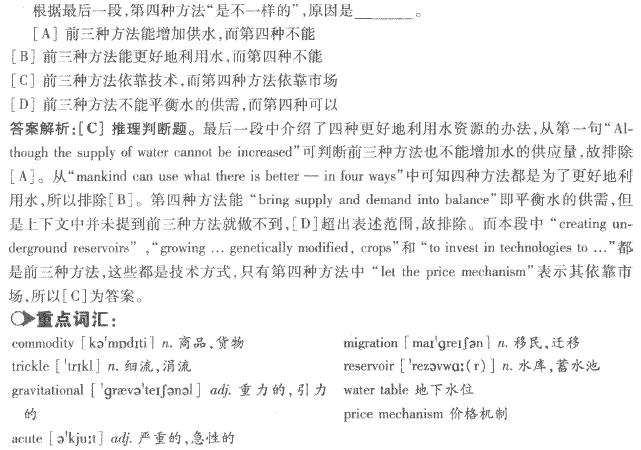

-
第2题:
2、Q-learning属于哪种算法
A.On-policy算法
B.Off-policy 算法
C.Model-based 算法
D.Value-based 算法
B -
第3题:
不需要建模环境,等待真实反馈再进行接下来的动作,这是哪种强化学习算法
A.Model-free方法
B.Model-based 方法
C.Policy-based 方法
D.Value-based 方法
错误 -
第4题:
3、Q-learning属于哪种算法
A.On-policy算法
B.Off-policy 算法
C.Model-based 算法
D.Value-based 算法
B -
第5题:
在实际的工作计划制定过程中,主要采用三种方法:“基于项目(Project-based)”,“基于流程(Process-based)”和基于时间(Time-based)。
以上都是 -
第6题:
17、不需要建模环境,等待真实反馈再进行接下来的动作,这是哪种强化学习算法
A.Model-free方法
B.Model-based 方法
C.Policy-based 方法
D.Value-based 方法
D