
● We can use the word processor to (74) your documents.(74)A. editB. computeC. translateD. unload
题目
● We can use the word processor to (74) your documents.
(74)
A. edit
B. compute
C. translate
D. unload
相似考题
更多“● We can use the word processor to (74) your documents. (74)A. edit B. compute C. transla ”相关问题
-
第1题:
试题(71)~(75)Object-oriented analysis (OOA) is a semiformal specification technique for the object-oriented paradigm. Object-oriented analysis consists of three steps. The first step is (71). It determines how the various results are computed by the product and presents this information in the form. of a (72) and associated scenarios. The second is (73) , which determines the classes and their attributes. Then determine the interrelationships and interaction among the classes. The last step is (74) , which determines the actions performed by or to each class or subclass and presents this information in the form. of (75) .
(71)
A. use-case modeling
B. class modeling
C. dynamic modeling
D. behavioral modeling
(72)
A. collaboration diagram
B. sequence diagram
C. use-case diagram
D. activity diagram
(73)
A. use-case modeling
B. class modeling
C. dynamic modeling
D. behavioral modeling
(74)
A. use-case modeling
B. class modeling
C. dynamic modeling
D. behavioral modeling(75)
A. activity diagram
B. component diagram
C. sequence diagram
D. state diagram
正确答案:A,C,B,C,D
参考译文
面向对象的分析(OOA)是一种面向对象范型的半形式化描述技术。面向对象的分析包括3个步骤:第1步是用例建模,它决定了如何由产品得到各项计算结果,并以用例图和相关场景的方式展现出来;第2步是类建模,它决定了类及其属性,然后确定类之间的关系和交互;第3步是动态建模,它决定了类或每个子类的行为,并以状态图的形式进行表示。
-
第2题:
()Word2003提供了9大类共74种域。A.错误
B.正确
参考答案:B
-
第3题:
● Object-oriented analysis (OOA) is a semiformal specification technique for the object-oriented paradigm. Object-oriented analysis consists of three steps. The first step is (71). It determines how the various results are computed by the product and presents this information in the form. of a (72) and associated scenarios. The second is (73) , which determines the classes and their attributes. Then determine the interrelationships and interaction among the classes. The last step is (74) , which determines the actions performed by or to each class or subclass and presents this information in the form. of (75) .
(71)
A.use-case modeling
B. class modeling
C. dynamic modeling
D. behavioral modeling
(72)
A. collaboration diagram
B. sequence diagram
C. use-case diagram
D. activity diagram
(73)
A. use-case modeling
B. class modeling
C. dynamic modeling
D. behavioral modeling
(74)
A.use-case modeling
B. class modeling
C. dynamic modeling
D. behavioral modeling
(75)
A. activity diagram
B. component diagram
C. sequence diagram
D. state diagram
正确答案:A,C,B,C,D
-
第4题:
●Object-oriented analysis (OOA) is a semiformal specification technique for the object-oriented paradigm. Object-oriented analysis consists of three steps. The first step is (71). It determines how the various results are computed by the product and presents this information in the form. of a (72) and associated scenarios. The second is (73) , which determines the classes and their attributes, then determines the interrelationships and interaction among the classes. The last step is (74) , which determines the actions performed by or to each class or subclass and presents this information in the form. of (75) .
(71)
A.use-case modeling
B. class modeling
C. dynamic modeling
D. behavioral modeling
(72)
A. collaboration diagram
B. sequence diagram
C. use-case diagram
D. activity diagram
(73)
A. use-case modeling
B. class modeling
C. dynamic modeling
D. behavioral modeling
(74)
A.use-case modeling
B. class modeling
C. dynamic modeling
D. behavioral modeling
(75)
A. activity diagram
B. component diagram
C. sequence diagram
D. state diagram
正确答案:A,C,B,C,D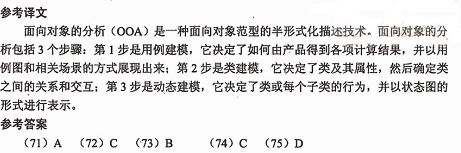
-
第5题:
27.If we travel by car ,we_________.
A. can't travel fifty or one hundred miles a day
B. can-t stop at a hotel to spend the night
C. can make our own timetable '
D. can travel to a very far place in several minutes
正确答案:C
27.C【解析】从文章最后一段第一、二句可知. -
第6题:
如下程序的运行结果是__________ lst=[12,63,74,51] lst.sort(key= lambda temp:temp%10,reverse=True) print(lst)
A.[74,63,12,51]
B.[12,51,63,74]
C.[51,12,63,74]
D.[74,63,51,12]
B