
下面程序的输出结果是 public class Test{ public static void main(String[] args){ int[]array={2,4,6,8,10}; int size=6; int result=-1: try{ for(int i=0;i<size&&result==-1;i++) if(array[i]==20)result=i; }catch(ArithmeticException e){ System.out.println("Catch---1"); }c
题目
下面程序的输出结果是 public class Test{ public static void main(String[] args){ int[]array={2,4,6,8,10}; int size=6; int result=-1: try{ for(int i=0;i<size&&result==-1;i++) if(array[i]==20)result=i; }catch(ArithmeticException e){ System.out.println("Catch---1"); }catch(ArrayIndexOutOfBoundsException e){ System.out.println("Catch---2"); }catch(Exception e){ System.out.println("Catch---3"); } } }
A.Catch---1
B.Catch一--2
C.Catch---3
D.以下都不对
相似考题
更多“下面程序的输出结果是public class Test{ public static void main(String[] args){ int[]array ”相关问题
-
第1题:
下面程序的输出结果是【】。includeusing namespace std; class base { protected: int 下面程序的输出结果是【 】。
include <iostream>
using namespace std;
class base
{
protected:
int a;
public:
base(){cout<<"0":}
};
class basel: virtual public base
{
public:
base1(){ cout<<"1";}
};
class base2 : virtual public base
{
public:
base2(){cout<<"2";}
};
class derived : public base1,public base2
{
public:
derived () {cout<<"3"; }
}
int main ()
{
derived obj;
cout<<end1;
return 0;
}
正确答案:0123
0123 解析:本题考核含有虚基类的继承中构造函数的调用顺序,应该先调用基类的构造函数,接着是按照派生类继承列表的顺序依次调用虚基类的构造函数,最有调用派生类自己的构造函数.题中先调用base的构造函数,然后调用base1、base2的构造函数,最后调用derived的构造函数。 -
第2题:
下面程序的输出结果是()。includeusing namespace std;class A {public:A( ) {cout<< 下面程序的输出结果是( )。 #include <iostream> using namespace std; class A { public: A( ) {cout<<"A";} } class B { public: B() {coat<<"B" ;} } class C: public A { public: B b; C() {cout<<"C";} } void mian(){ C c; }
A.CBA
B.ABC
C.ACB
D.BCA
正确答案:B
解析:先执行基类A构造函数输出A,调用类B的构造函数输出B,调用本身构造函数输出C。 -
第3题:
阅读以下说明和Java程序,填写程序中的空(1)~(6),将解答写入答题纸的对应栏内。
【说明】
以下Java代码实现一个简单绘图工具,绘制不同形状以及不同颜色的图形。部分接口、类及其关系如图5-1所示。


【Java代码】
interface?DrawCircle?{? //绘制圆形 public(1) ;}class?RedCircle?implements?DrawCircle?{? ?//绘制红色圆形???????public?void?drawCircle(int?radius,intx,?int?y)??{????????????System.out.println("Drawing?Circle[red,radius:"?+?radius?+",x:"?+?x?+?",y:"?+y+?"]");???????}}class?GreenCircle?implements?DrawCircle?{????//绘制绿色圆形??????public?void?drawCircle(int?radius,?int?x,int?y)?{???????????System.out.println("Drawing?Circle[green,radius:"?+radius+",x:?"?+x+?",y:?"?+y+?"]");??????}}abstract?class?Shape?{????//形状? protected? ? (2)???;? ? public?Shape(DrawCircle?drawCircle)?{? ?this.drawCircle=?drawCircle;? ? ? public?abstract?void?draw();}class?Circle?extends?Shape?{? //圆形? ?private?int?x,y,radius;? public?Circle(int?x,int?y,intradius,DrawCircle?drawCircle)?{? ?(3)???;? this.x?=?x;? ? ? this.y?=?y;? ?this.radius?=radius;? }? ? ?public?void?draw()?{? ? drawCircle.? ?(4)? ?;? ? ? }}public?class?DrawCircleMain?{? public?static?void?main(String[]?args)?{? Shape?redCircle=new?Circle(?100,100,10,? (5) );//绘制红色圆形? Shape?greenCircle=new?Circle(200,200,10,(6) );//绘制绿色圆形? ?redCircle.draw(); greenCircle.draw();? ?}}答案:解析:(1)void drawCircle (int radius,int x,int y)
(2)DrawCircle drawCircle
(3)super.drawcircle=drawcircle
(4)drawCircle(radius,x,y)
(5)new RedCircle()
(6)new GreenCircle()【解析】
第一空是填接口里面的方法,在接口的实现里面找,可以发现应该填void drawCircle (int radius,int x,int y)。
第二空可以根据后面this drawCircle=drawCircle判断,这里应该有一个drawCircle属性,因此应该填)DrawCircle drawCircle。
第三空这里用super,用super. drawcircle来引用父类的成员。
第四空调用drawCircle(radius,x,y)方法。
第五、六空分别创建一个红色圆形对象和一个绿色圆形对象作为Circle里面的实参。 -
第4题:
对于下面程序,对p进行赋值正确的是( )。 class A{ public:fun(int i){cout<<i<<endl;} }; main(){ void(A::*p)(int); }
A.p=fun;
B.p=fun();
C.p=A::fun;
D.p=A::fun()
正确答案:C
解析:给类函数指针赋值的格式是:指针名>=类名::函数名> -
第5题:
下面程序的结果是 includeclass test{private: int num; publi 下面程序的结果是 #include<iostream.h> class test{ private: int num; public: test( ); int getint( ) {return num;} ~test( );}; test::test( ) { num=0;} test::~test( ) { cout<<"Destructor is active"<<endl;} void
A.Exiting main Destructor is active Destructor is active Destructor is active
B.Exiting main Destructor is active Destructoris active
C.Exiting main Destructoris active
D.Exiting main
正确答案:A
解析:C++语言中析构函数是在程序退出不用该类的对象时进行调用。 -
第6题:
阅读下列说明和C++代码,填写程序中的空(1)~(6),将解答写入答题纸的对应栏内。
【说明】
以下C++代码实现一个简单绘图工具,绘制不同形状以及不同颜色的图形。部分类及其关系如图6-1所示。
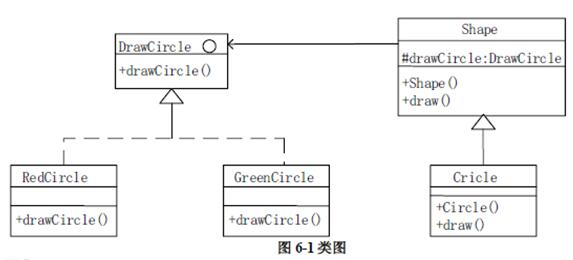
【C++代码】
#include?#include?using?namespace?std;class?DrawCircle?{??????//绘制圆形,抽象类? ? ? public: (1);//定义参数为?int?radius,?int?x,?inty? ?virtual~DrawCircle()?{?}};class?RedCircle:public?DrawCircle?{????//绘制红色圆形? ? ? ? public: void?drawCircle(intradius,?int?x,?int?y)?{cout?<?drawCircle?=?drawCircle;? }? ?virtual~shape()?{?}? public:? ?virtual?void?draw()?=?0;};class?Circle:public?Shape?{????//圆形? ? private:? ? ?int?x,y,radius;? ? public:? Circle(int?x,inty,int?radius,DrawCircle?*drawCircle)? (3)? {? this->x?=?x;? ?this->y?=?y;? ? this->radius?=?radius; }? ? ? public:? void?draw(){? drawCircle?-> (4); }};int?main(){Shape?*redCirclenew?Circle(100,100,10,????(5)????);//绘制红色圆形? Shape?*greenCircle=new?Circle(100,100,10, (6)??);//绘制绿色圆形redCircle >draw();? ?greenCircle?->draw();? ?return?0;}答案:解析:(6)(1)void drawCircle (int radius,int x,int y)
(2)DrawCircle*drawCircle
(3)drawcircle
(4)drawCircle(radius,x,y)
(5)new RedCircle()
(6)new GreenCircle()【解析】
第一空是填接口里面的方法,在接口的实现里面找,可以发现应该填void drawCircle (int radius,int x,int y)。
第二空可以根据后面this drawCircle=drawCircle判断,这里应该有一个drawCircle属性,因此应该填)DrawCircle drawCircle。
第三空这里填drawcircle,用-> drawcircle来引用父类的成员。
第四空调用drawCircle(radius,x,y)方法。
第五、六空分别创建一个红色圆形对象和一个绿色圆形对象作为Circle里面的实参。