
有如下程序: include using namespace std; class base { public:virtual void f1(){有如下程序: #include<iostream> using namespace std; class base { public: virtual void f1() { cout<<"F1Base"; } virtual void f2() { cout<<"F2Base "; } }; class derive : public base { void
题目
有如下程序: #include<iostream> using namespace std; class base { public: virtual void f1() { cout<<"F1Base"; } virtual void f2() { cout<<"F2Base "; } }; class derive : public base { void f1 ( ) { cout<<"F1Derive"; } void f2( int x ) { cout<<"F2 Derive"; } }; int main () { base objl, * p; derive obj2; p = & obj2; p -> f1(); p -> f2(); return 0; } 执行后的输出结果是( )。
A.F1Derive F2Base
B.F1Derive F2Derive
C.F1Base F2Base
D.F1Base F2Derive
相似考题
参考答案和解析
解析:本题主要考察C++中虚函数机制及其继承过程中的要点。虚函数在基类中加关键词virtual声明,在派生类中重新定义。如果派生类没有覆盖虚函数,则程序执行中将会执行基类的虚函数版本。本题程序中,建立了基类base,其内函数voidf1()和voidf2()均被声明为虚函数,并在调用时会显式地发出声明。派生类derive利用public方式继承基类base,并覆盖其基类base中的虚函数f1()。对于base中的虚函数f2(),由于派生类derive中的同名函数f2()中带有参数intx,因此被编译器认为是函数重载,而不作虚函数覆盖处理,所以实际上派生类derive中包含两个f2()函数,一个不带参数,调用时执行基类base中的f2()函数版本,一个带参数intx,调用时执行重载后的版本。本题主函数中,定义了基类对象。obj1和基类指针*p,同时定义了派生类对象。obj2。p指向obj2时,“p->n()”函数调用执行派生类覆盖后的版本,输出F1Derive;“p->f2()”由于不带参数,因此执行未经派生类覆盖的函数版本,即基类base中的f1()函数版本。
更多“有如下程序: #include<iostream> using namespace std; class base { public:virtual void f1(){ ”相关问题
-
第1题:
有如下程序:includeinclude using namespace std;class BASE{char c;public 有如下程序: #include<iostream>#include<iosream> using namespace std; class BASE{ char c; public; BASE(char n):c(n){} virtual ~ BASE(){cout<<c;} }; class DERIVED; public BASE{ char c; public: DERIVED (char n): BASE (n+1)
A.XY
B.YX
C.X
D.Y
正确答案:A
-
第2题:
有以下程序:includeusing namespace std;class BASE{private: char c;public: BASE(c 有以下程序: #include <iostream> using namespace std; class BASE { private: char c; public: BASE(char n):c(n);{} virtual~BASE() { cout<<c; } }; class DERIVED:public BASE { char c; p
A.XY
B.YX
C.X
D.Y
正确答案:A
解析:在C++中,由于析构函数不能被继承,因此在执行派生类的析构函数时,基类的析构函数也将被调用。执行顺序是先执行派生类的析构函数,再执行基类的析构函数,其顺序与执行构造函数的顺序正好相反。在此题的程序中,在主函数结束时,派生类DERIVED对象obj将被删除,所以就会调用对象的析构函数。先调用派生类的析构函数,输出X,然后调用基类的析构函数,输出Y。 -
第3题:
有如下程序:includeusing namespace std;class BASE{public:~BASE(){cout<<"BASE";}} 有如下程序: #include<iostream> using namespace std; class BASE{ public: ~BASE(){cout<<"BASE";} }; class DERIVED:public BASE{ public: ~DERIVED(){cout<<"DERIVED";} }; int main(){DERIVED x;return 0;} 执行后的输出结果是( )。
A.BASE
B.DERIVED
C.BASEDERIVED
D.DERIVEDBASE
正确答案:D
解析:此题考查的是派生类的定义和使用。当对象被删除时,派生类的析构函数就被执行。由于析构函数不能被继承,因此在执行派生类的析构函数时,基类的析构函数也将被调用。执行顺序是先执行派生类的析构函数,再执行基类的析构函数,其顺序与执行构造函数的顺序正好相反。 -
第4题:
有如下程序:includeusing namespace std;class BASE{public:~BASE() {cout<<"BASE"; 有如下程序: #include <iostream> using namespace std; class BASE{ public: ~BASE() {cout<<"BASE"; } }; class DERIVED: public BASE { public: ~DERIVED() {cout<;"DERIVED"; } }; int main(){DERIVED x; return 0;} 执行后的输出结果是______ 。
A.BASE
B.DERIVED
C.BASEDERIVED
D.DERIVEDBASE
正确答案:D
解析:析构函数的调用顺序是,先调用派生类的析构函数,再调用基类的析构函数。 -
第5题:
若有以下程序:includeusing namespace Std;Class Base{public:Base(){x=0;}int x;};c 若有以下程序: #include<iostream> using namespace Std; Class Base {public: Base() {x=0;} int x;}; class Derivedl:virtua1 public Base {public: Derived1() {x=10;}}; class Derived2:virtual1 public Base {public: Derived2()
A.20
B.30
C.10
D.0
正确答案:A
解析: 本题考查虚基类的应用。虽然Derived1和Derived2都是由共同的基类x派生而来的,但由于引入了虚基类,使得它们分别对应基类的不同副本,这时数据成员x只存在一份拷贝,不论在类Derivedl中修改,还是在De- rived2中修改,都是直接对这惟一拷贝进行操作。本题程序执行语句“Derivedob“”时,就会先调用虚基类Base的构造函数,使得x=0,然后执行类Derived1的构造函数使得x=10,再执行类Derived2的构造函数,使得x=20。最后输出x的值为20。 -
第6题:
阅读下列说明和C++代码,填写程序中的空(1)~(6),将解答写入答题纸的对应栏内。
【说明】
以下C++代码实现一个简单绘图工具,绘制不同形状以及不同颜色的图形。部分类及其关系如图6-1所示。
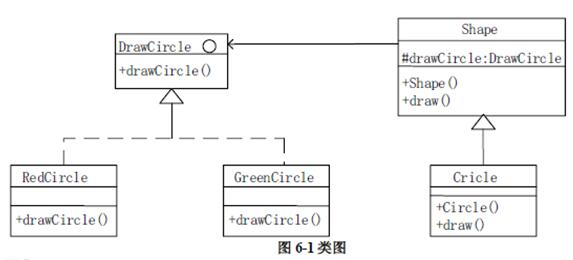
【C++代码】
#include?#include?using?namespace?std;class?DrawCircle?{??????//绘制圆形,抽象类? ? ? public: (1);//定义参数为?int?radius,?int?x,?inty? ?virtual~DrawCircle()?{?}};class?RedCircle:public?DrawCircle?{????//绘制红色圆形? ? ? ? public: void?drawCircle(intradius,?int?x,?int?y)?{cout?<?drawCircle?=?drawCircle;? }? ?virtual~shape()?{?}? public:? ?virtual?void?draw()?=?0;};class?Circle:public?Shape?{????//圆形? ? private:? ? ?int?x,y,radius;? ? public:? Circle(int?x,inty,int?radius,DrawCircle?*drawCircle)? (3)? {? this->x?=?x;? ?this->y?=?y;? ? this->radius?=?radius; }? ? ? public:? void?draw(){? drawCircle?-> (4); }};int?main(){Shape?*redCirclenew?Circle(100,100,10,????(5)????);//绘制红色圆形? Shape?*greenCircle=new?Circle(100,100,10, (6)??);//绘制绿色圆形redCircle >draw();? ?greenCircle?->draw();? ?return?0;}答案:解析:(6)(1)void drawCircle (int radius,int x,int y)
(2)DrawCircle*drawCircle
(3)drawcircle
(4)drawCircle(radius,x,y)
(5)new RedCircle()
(6)new GreenCircle()【解析】
第一空是填接口里面的方法,在接口的实现里面找,可以发现应该填void drawCircle (int radius,int x,int y)。
第二空可以根据后面this drawCircle=drawCircle判断,这里应该有一个drawCircle属性,因此应该填)DrawCircle drawCircle。
第三空这里填drawcircle,用-> drawcircle来引用父类的成员。
第四空调用drawCircle(radius,x,y)方法。
第五、六空分别创建一个红色圆形对象和一个绿色圆形对象作为Circle里面的实参。