
若有以下程序:include using namespaces std;class A{public: A (){} A (int i) {x1=若有以下程序: #include <iostream> using namespaces std; class A { public: A (){} A (int i) { x1=i; } void dispa() { cout<<"xl="<<xl<<" , "; } private: int x1; }; class B : public A { publi
题目
若有以下程序: #include <iostream> using namespaces std; class A { public: A (){} A (int i) { x1=i; } void dispa() { cout<<"xl="<<xl<<" , "; } private: int x1; }; class B : public A { public: B (){} B (int i):A(i+10) { x2=i; } void dispb() { dispa (); cout <<"x2="<<x2<<end1; } private: int x2; }; int main () { B b(2); b.dispb (): return 0; } 程序运行后的输出结果是( )。
A.x1=10,x2=2
B.x1=12,x2=10
C.x1=12,x2=2
D.x1=2,x2=2
相似考题
更多“若有以下程序:#include <iostream>using namespaces std;class A{public: A (){} A (int i) {x1= ”相关问题
-
第1题:
若有以下程序:includeusing namespaces std;class A{public:A(){}A(int i){x1=i; } v 若有以下程序: #include<iOStream> using namespaces std; class A { public: A(){} A(int i) { x1=i; } void dispa() { cout<<"X1="<<x1<<",": } private; int x1; }; class B:public A { public: B(){} B(int i):A(i+10) { x2=i; } void dispb() { dispa(); cout<<"x2="<<x2<<end1; } private: int x2; }; . int main() { B b(2); b.dispb() return 0; } 程序运行后的输出结果是( )。
A.x1=10,x2=2
B.x1=12,x2=10
C.x1=12,x2=2
D.x1=2,x2=2
正确答案:C
解析:本题考核派生类的构造函数。在C++中,构造函数不能被继承,因此,派生类的构造函数必须通过调用基类的构造函数来初始化基类子对象。所以,在定义派生类的构造函数时,除了对自己的数据成员进行初始化外,还必须负责调用基类构造函数使基类的数据成员得以初始化。如果派生类中还有子对象,还应包含对于对象初始化的构造函数。 -
第2题:
若有以下程序:includeusing namespace std;class point{private: int x, y;public: 若有以下程序: #include <iostream> using namespace std; class point { private: int x, y; public: point ( ) { x=0; y=0; } void setpoint(int x1,int y1) { x=x1; y=y1;
A.12,12
B.5,5
C.12,5
D.5,12
正确答案:D
解析:本题考核对象指针的定义与使用。分析程序:程序首先定义一个类point。类point中有两个私有成员,整型变量x和y,还有两个公有成员函数setpoint(intx1,inty1)和dispoint()。函数setpoint()用来设置私有成员x和y的值,而函数dispoint()用来显示私有成员x和y的值。主函数中,首先定义了类point的指针对象p,并申请了内存空间,然后调用对象p中公有成员setpoint给对象p中的私有成员x和y赋值,然后调用成员函数dispoint显示x和y的值。由此可知,最后输出的值应该是5,12。 -
第3题:
若有以下程序:includeusing namespace std;class A{private: int a;public: A(int 若有以下程序: #include <iost ream> using namespace std; class A { private: int a; public: A(int i) { a=i; } void disp () { cout<<a<<", "; } }; class B { private:
A.10,10,10
B.10,12,14
C.8,10,12
D.8,12,10
正确答案:D
解析:本题考核派生类构造函数的使用。本题中,派生C具有多重继承关系,所以在派生类C的构造函数中应该包含基类A和B的成员初始化列表。而且派生类C中的成员函数disp分别调用了基类A、B的公有成员函数disp()用于输出基类中私有数据变量初始化后的值。所以由类C构造函数的初始化形式可知,程序最后输出为8,12,10,即D选项。 -
第4题:
若有以下程序:includeusing namespaces std;class A {public: A(){} A(int i) {x1=i 若有以下程序: #include <iostream> using namespaces std; class A { public: A(){} A(int i) { x1=i; } void dispa() { cout<<'x1="<<x1<<","; } private: int x1; }; class B: public A { public: B(){} B(int i):A(i+10) { x2=i; } void dispb() { dispa(); cout<<"x2="<<x2<<end1; } private: int x2; }; int main() { B b(2); b.dispb(): return 0; } 程序运行后的输出结果是
A.x1=10,x2=2
B.x1=12,x2=10
C.x1=12,x2=2
D.x1=2,x2=2
正确答案:C
解析:本题考核派生类的构造函数。在C++中,构造函数不能被继承,因此,派生类的构造函数必须通过调用基类的构造函数来初始化基类子对象。所以,在定义派生类的构造函数时,除了对自己的数据成员进行初始化外,还必须负责调用基类构造函数使基类的数据成员得以初始化。如果派生类中还有子对象,还应包含对子对象初始化的构造函数。 -
第5题:
若有以下程序:includeusing namespace std;class A{public:A() { }A(int i){x1=i;}v 若有以下程序: #include <iostream> using namespace std; class A { public: A() { } A(int i) { x1=i; } void dispa0 { cout<<"x1="<<x1<<","; } private: int x1; }; class B: public A { public: B() { } B(int i):A(i+10) { x2=i; } void dispb() { dispa(); cout<<"x2="<<x2<<endl; } private: int x2; }; int main() { B b(2); b.dispb(); return 0; } 程序运行后的输出结果是( )。
A.x1=10,x2=2
B.x1=12,x2=10
C.x1=12,x2=2
D.x1=2,x2=2
正确答案:C
-
第6题:
阅读下列说明和C++代码,填写程序中的空(1)~(6),将解答写入答题纸的对应栏内。
【说明】
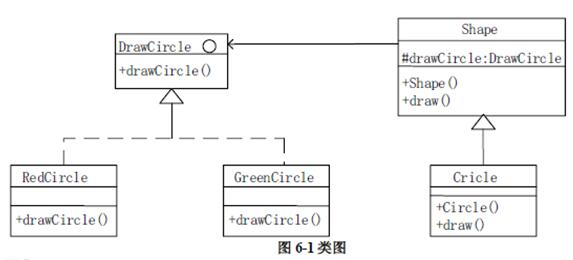
以下C++代码实现一个简单绘图工具,绘制不同形状以及不同颜色的图形。部分类及其关系如图6-1所示。
【C++代码】
#include?#include?using?namespace?std;class?DrawCircle?{??????//绘制圆形,抽象类? ? ? public: (1);//定义参数为?int?radius,?int?x,?inty? ?virtual~DrawCircle()?{?}};class?RedCircle:public?DrawCircle?{????//绘制红色圆形? ? ? ? public: void?drawCircle(intradius,?int?x,?int?y)?{cout?<?drawCircle?=?drawCircle;? }? ?virtual~shape()?{?}? public:? ?virtual?void?draw()?=?0;};class?Circle:public?Shape?{????//圆形? ? private:? ? ?int?x,y,radius;? ? public:? Circle(int?x,inty,int?radius,DrawCircle?*drawCircle)? (3)? {? this->x?=?x;? ?this->y?=?y;? ? this->radius?=?radius; }? ? ? public:? void?draw(){? drawCircle?-> (4); }};int?main(){Shape?*redCirclenew?Circle(100,100,10,????(5)????);//绘制红色圆形? Shape?*greenCircle=new?Circle(100,100,10, (6)??);//绘制绿色圆形redCircle >draw();? ?greenCircle?->draw();? ?return?0;}答案:解析:(6)(1)void drawCircle (int radius,int x,int y)
(2)DrawCircle*drawCircle
(3)drawcircle
(4)drawCircle(radius,x,y)
(5)new RedCircle()
(6)new GreenCircle()【解析】
第一空是填接口里面的方法,在接口的实现里面找,可以发现应该填void drawCircle (int radius,int x,int y)。
第二空可以根据后面this drawCircle=drawCircle判断,这里应该有一个drawCircle属性,因此应该填)DrawCircle drawCircle。
第三空这里填drawcircle,用-> drawcircle来引用父类的成员。
第四空调用drawCircle(radius,x,y)方法。
第五、六空分别创建一个红色圆形对象和一个绿色圆形对象作为Circle里面的实参。