
Many new ____ will be opened up at sea in the future for those with a university education.A.opportunitiesB.realitiesC.necessitiesD.Probabilities
题目
Many new ____ will be opened up at sea in the future for those with a university education.
A.opportunities
B.realities
C.necessities
D.Probabilities
相似考题
更多“Many new ____ will be opened up at sea in the future for those with a university education ”相关问题
-
第1题:
A new coil of nylon line should be opened by ______.
A.pulling the end up through the eye of the coil
B.taking a strain on both ends
C.uncoiling from the outside with the coil standing on end
D.unreeling from a spool
正确答案:D
一卷心的尼龙绳通过线轴回卷才能解开。 -
第2题:
Passage 2
Teacher education provided by U.S. colleges and universities has been routinely criticized sinceits inception in the early nineteenth century, sometimes deservedly. These programs, likenon-university programs, are uneven in quality and can be improved. What makes today′ s criticismsdifferent is an aggressive effort by advocacy groups, and self-proclaimed educational entrepreneursto deregulate the preparation of teachers, and to expand independent, alternative routes intoteaching.
This effort to "disrupt" the field of teacher preparation in the United States has gainedconsiderable momentum and legitimacy, with venture capitalists, philanthropy, and the U.S.
Department of Education all providing sponsorship and substantial funding.
The strength of this effort is that the United States may quickly seek to dismantle its universitysystem and replace much of it with independent, private programs. The resulting system of teacherpreparation may differ dramatically in its government, structure, content, and processes movingaway from its current location alongside legal, medical, and other professional preparation that pairsacademic degrees with professional training.
Throughout the nation, states are reporting teacher shortages in particular subject areas andgeographical locations, and several states have either passed legislation to lower the standards forbecoming a teacher or, like the state of Washington, have looked toward expanding the number ofteacher education providers to try to fill teaching vacancies. The federal government has contributedto the push to lower standards for becoming a teacher with the Teacher Preparation Academy
provision in the new K-12 education law, the Every Student Succeeds Act, which encourages statesto expand the number of independent programs not associated with colleges and universities.
Because of the increasing tuition rates, a consequence in part, of cuts in funding to publicuniversities that continue to educate most U.S. teachers, enrollments in college and universityteacher education programs have declined in many parts of the country. Independent teachereducation programs are being viewed by some as an important part of the solution in staffing thenation′s classrooms and addressing our serious and enduring problems in education inequities.
Additionally, advocacy groups, philanthropists, and so-called education entrepreneurs are workingaggressively to expand these independent alternative routes into teaching.
Given the seriousness of the teacher shortage problem in the United States and the substantialmedia attention that has been given to independent teacher education programs as the solution toteacher shortages and education inequities, policy makers should very carefully examine theevidence that exists about the nature and impact of these relatively new programs that are rapidlyexpanding while university teacher education enrollments decline.
What can be inferred from Paragraph 3
A.The university system of the United States will completely collapse.
B.The university system of the United States will be totally restructured.
C.The new teacher education programs may not grant students academic degrees in the future.
D.The new teacher education programs will follow the usual practice of other professionalpreparation.答案:D解析:推断题。根据第三段末尾“The resulting system ofteacher preparation may differdramatically in…moving away from its current location alongside legal,medical,and other professional preparation”可推断出,新的师范教育项目会遵照其他职业教育的惯例,D项正确。A项“美国的高等教育系统会完全瓦解”,该说法过于绝对。B项“美国高等教育系统将会被完全调整”,根据第三段第一句中“theUnited Statesmayquickly seek to dismantle its university system and replace much of it with independent,private programs”可知,只是大部分会被调整,而不是完全调整。C项“未来私立师范项目将不会为师范学生颁发学位证书”,文中未提及。故选D。 -
第3题:
The University in Transformation,edited by Australian futurists Sohail Inayatullah and Jennifer Gidley,presents some 20 highly varied outlooks on tomorrow’s universities by writers representing both Western and non-Western perspectives.Their
essays raise a broad range of issues,questioning nearly every key assumption we have about higher education today.
The most widely discussed alternative to the traditional campus is the Internet University—a voluntary community to
scholars/teachers physically scattered throughout a country or around the world but all linked in cyberspace.A computerized
university could have many advantages,such as easy scheduling,efficient delivery of lectures to thousands or even millions of students at once,and ready access for students everywhere to the resources of all the world’s great libraries.
Yet the Internet University poses dangers,too.For example,a line of franchised courseware,produced by a few superstar
teachers,marketed under the brand name of a famous institution,and heavily advertised,might eventually come to dominate
the global education market,warns sociology professor Peter Manicas of the University of Hawaii at Manoa.Besides enforcing a rigidly standardized curriculum,such a“college education in a box”could undersell the offerings of many traditional brick and mortar institutions,effectively driving them out of business and throwing thousands of career academics out of work,note
Australian communications professors David Rooney and Greg Hearn.
On the other hand,while global connectivity seems highly likely to play some significant role in future higher education,
that does not mean greater uniformity in course content—or other dangers—will necessarily follow.Counter-movements are
also at work.
Many in academia,including scholars contributing to this volume,are questioning the fundamental mission of university
education.What if,for instance,instead of receiving primarily technical training and building their individual careers,university students and professors could focus their learning and research efforts on existing problems in their local communities and the world?Feminist scholar Ivana Milojevic dares to dream what a university might become“if we believed that child care workers and teachers in early childhood education should be one of the highest(rather than lowest)paid professionals?”
Co-editor Jennifer Gidley shows how tomorrow’s university faculty,instead of giving lectures and conducting independent
research,may take on three new roles.Some would act as brokers,assembling customized degree-credit programmes for
individual students by mixing and matching the best course offerings available from institutions all around the world.A second group,mentors,would function much like today’s faculty advisers,but are likely to be working with many more students
outside their own academic specialty.This would require them to constantly be learning from their students as well as
instructing them.
A third new role for faculty,and in Gidley’s view the most challenging and rewarding of all,would be as meaning-makers:
charismatic sages and practitioners leading groups of students/colleagues in collaborative efforts to find spiritual as well as
rational and technological solutions to specific real-world problems.
Moreover,there seems little reason to suppose that any one form of university must necessarily drive out all other options.Students may be“enrolled”in courses offered at virtual campuses on the Internet,between—or even during—sessions at A.real world problem focused institution.
As co-editor Sohail Inayatullah points out in his introduction,no future is inevitable,and the very act of imagining and
thinking through alternative possibilities can directly affect how thoughtfully,creatively and urgently even a dominant
technology is adapted and applied.Even in academia,the future belongs to those who care enough to work their visions into
practical,sustainable realities.
When the book reviewer discusses the Internet University?A.he is in favour of it.
B.his view is balanced.
C.he is slightly critical of it.
D.he is strongly critical of it.答案:B解析:本题考查作者的观点态度。
针对“Internet University”,本文第二段提出了许多的“advantages”,随后的第三段则指出其存在的“dangers”,可见文中对网络大学的利弊均进行了客观的陈述,观点上不存在倾向性,综上,B选项正确。
故正确答案为B项。 -
第4题:
The University in Transformation,edited by Australian futurists Sohail Inayatullah and Jennifer Gidley,presents some 20 highly varied outlooks on tomorrow’s universities by writers representing both Western and non-Western perspectives.Their
essays raise a broad range of issues,questioning nearly every key assumption we have about higher education today.
The most widely discussed alternative to the traditional campus is the Internet University—a voluntary community to
scholars/teachers physically scattered throughout a country or around the world but all linked in cyberspace.A computerized
university could have many advantages,such as easy scheduling,efficient delivery of lectures to thousands or even millions of students at once,and ready access for students everywhere to the resources of all the world’s great libraries.
Yet the Internet University poses dangers,too.For example,a line of franchised courseware,produced by a few superstar
teachers,marketed under the brand name of a famous institution,and heavily advertised,might eventually come to dominate
the global education market,warns sociology professor Peter Manicas of the University of Hawaii at Manoa.Besides enforcing a rigidly standardized curriculum,such a“college education in a box”could undersell the offerings of many traditional brick and mortar institutions,effectively driving them out of business and throwing thousands of career academics out of work,note
Australian communications professors David Rooney and Greg Hearn.
On the other hand,while global connectivity seems highly likely to play some significant role in future higher education,
that does not mean greater uniformity in course content—or other dangers—will necessarily follow.Counter-movements are
also at work.
Many in academia,including scholars contributing to this volume,are questioning the fundamental mission of university
education.What if,for instance,instead of receiving primarily technical training and building their individual careers,university students and professors could focus their learning and research efforts on existing problems in their local communities and the world?Feminist scholar Ivana Milojevic dares to dream what a university might become“if we believed that child care workers and teachers in early childhood education should be one of the highest(rather than lowest)paid professionals?”
Co-editor Jennifer Gidley shows how tomorrow’s university faculty,instead of giving lectures and conducting independent
research,may take on three new roles.Some would act as brokers,assembling customized degree-credit programmes for
individual students by mixing and matching the best course offerings available from institutions all around the world.A second group,mentors,would function much like today’s faculty advisers,but are likely to be working with many more students
outside their own academic specialty.This would require them to constantly be learning from their students as well as
instructing them.
A third new role for faculty,and in Gidley’s view the most challenging and rewarding of all,would be as meaning-makers:
charismatic sages and practitioners leading groups of students/colleagues in collaborative efforts to find spiritual as well as
rational and technological solutions to specific real-world problems.
Moreover,there seems little reason to suppose that any one form of university must necessarily drive out all other options.Students may be“enrolled”in courses offered at virtual campuses on the Internet,between—or even during—sessions at A.real world problem focused institution.
As co-editor Sohail Inayatullah points out in his introduction,no future is inevitable,and the very act of imagining and
thinking through alternative possibilities can directly affect how thoughtfully,creatively and urgently even a dominant
technology is adapted and applied.Even in academia,the future belongs to those who care enough to work their visions into
practical,sustainable realities.
Which category of writing does the review belong to?A.Narration.
B.Description.
C.Persuasion.
D.Exposition.答案:D解析:本题考查推断。
全文主要是对一本书的主要内容进行说明介绍,很显然应该归为exposition(说明文)之列。综上,D选项正确。
故正确答案为D项。 -
第5题:
Recently,Xiangning started to communicate with Mike,the contact person of Monsell.
One day.Mike received an e-mail from Sophia Jones.She wrote an e-mail to Mike who is the contact person of Monsell.Sophia Jones asked some information about Registered Education Savings Plan of Monsell.
Read the e-mails.A word or phrase is missing in some of the sentences.Four answer choices are given below each of the sentences.Select the best answer to complete the text.Then select the right answer.
Dear Mike,
I am one of those concerned mothers who believe that education is the key[1]our children’s future.
But as far as I know,it’s costly-currently as much as$60,000 for a four year degree at a Canadian university.My daughter Alisa has just got[2]to the University of Toronto.
On one hand,I am thrilled at this great news,while on the other hand,I am a little bit worried[3]our moderate financial status.
As a result,I write this to ask for suggestions on ways to maximize our education savings.How many options do I have and how do they work I really appreciate and look forward to your early reply.
Yours sincerely,
Sophia Jones
Recently,Xiangning started to communicate with Mike,the contact person of Monsell.
One day.Mike received an e-mail from Sophia Jones.She wrote an e-mail to Mike who is the contact person of Monsell.Sophia Jones asked some information about Registered Education Savings Plan of Monsell.
Read the e-mails.A word or phrase is missing in some of the sentences.Four answer choices are given below each of the sentences.Select the best answer to complete the text.Then select the right answer.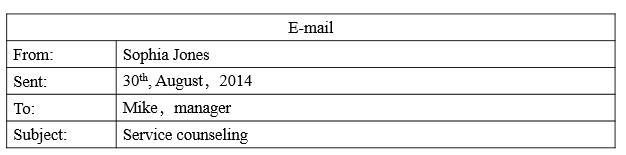
Dear Mike,
I am one of those concerned mothers who believe that education is the key[1]our children’s future.
But as far as I know,it’s costly-currently as much as$60,000 for a four year degree at a Canadian university.My daughter Alisa has just got[2]to the University of Toronto.
On one hand,I am thrilled at this great news,while on the other hand,I am a little bit worried[3]our moderate financial status.
As a result,I write this to ask for suggestions on ways to maximize our education savings.How many options do I have and how do they work I really appreciate and look forward to your early reply.
Yours sincerely,
Sophia Jones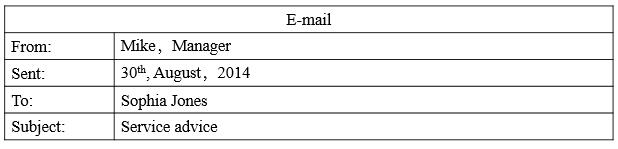
Mrs.Jones,
Firstly,please send my sincere congratulations to Alisa for getting into the University of Toronto.As far as I can see,our Registered Education Savings Plan(RESP)is the[4]way to help you maximize your education savings.Tax-sheltered investment growth and eligibility for government grants can make a big contribution to your child’s future.This plan consists of the[5]plan and the family plan.The former is to open an RESP for an individual child,while with a family plan you can name one or more children as beneficiaries.
Attached is a brochure on RESP.Please feel free to write to me if any further information is needed.
[4]A.perfect
B.more perfect
C.most perfect
D.perfectest答案:A解析:本题考查的是细节理解。
【关键词】the ______ way to
【主题句】AS far as I can see, our Registered Education Savings Plan(RESP) is
the ______ way to help you maximize your education savings.在我看来,我们的注册教育储蓄计划(简称RESP),是帮助您最大化教育储蓄的完美方案。
【解析】本题的问题是“我看来,我们的注册教育储蓄计划(简称RESP),是帮助您最大化教育储蓄的完美方案。”本题考查的是perfect,“完美”,这个词是极端形容词,没有比较级和最高级。 -
第6题:
共用题干
A New Educational Feature
1.There is a distinctive and comparatively new feature of the Taiwanese Education. In recent years,more students from Taiwan are seeking education in the mainland.
2.The number of Taiwanese students admitted into college and postgraduate programs in the mainland,according to official Chinese figures,totaled 1,264 in 2000,2,470 in 2002 and approximately 3,700 in 2004.The latest official numbers indicated that by 2013,7,349 Taiwanese received high education on the mainland.Chinaedu.com said this number had risen between 40 to 50 percent annually in the last decade with well over 1,500 entering mainland campuses last year.
3.Based in the Chinese city of Guangzhou,the Internet site provides education service and information on Chinese mainland colleges and universities."Many Taiwanese believe a Chinese mainland education helping them to learn more about the people and culture in the mainland,and it will increase their chances in Chinese job market,"Chinaedu.com president Mark Ling said."I believe it will give me hands-on experience in the media of the Chinese mainland and a better understanding of the Chinese mainland people,"said Maria Wang,an 18-year-old student majoring in communications at Nanjing University. Wang has a plan to continue her education and get a master's degree in mass media in Beijing,where she believes provides the best environment for such studies and opportunities for future development.
4.Li,a postgraduate student at Taiwan Furen University said he was inclined to study business administration in the Chinese mainland,because there will be better prospects for careers now that more Taiwanese companies are going there.
5.A large number of business executives would like to send their children to study in the Chinese mainland too."They hope the children could build up connections which could later become useful in their business operations."said Yuqin Ma,professor of the Chinese mainland studies.Receiving an education in the mainland could help Taiwanese students in the business field because they can get_______.
A:practical experience
B:business operations
C:good quality education
D:culture and people there
E:a good chance
F: the favorable circumstance答案:A解析:依第一段第一句“more students from Taiwan are seeking education on the mainland”可知,选项D正确。
文章的第二段给出了一系列的数据,说明赴大陆读书的台湾同胞的数量快速增加,所以选E。
第三段谈到台湾同胞认为大陆的教育“will increase their chances in Chinese job market",还谈到了可以为学习和未来发展提供很好的环境。所以C正确。
第四段谈到“there will be better prospects for careers now that more Taiwanese companies are going there",即随着越来越多的台湾公司入驻大陆,给在大陆上学的台湾同胞提供了很好的事业前景,所以选A。
依第三段第二句“Many Taiwanese believe a Chinese mainland education helping them to learn more about the people and culture in the mainland",可知答案为D。
第三段的第三句提到在大陆接受教育可以得到“hands-on experience in the media" , hand-on experience指“实践经验”,意思和practical experience一样,由此可以得知 A正确。
第三段最后一句提到在北京学大众传媒可以“provides the best environment",所以选F,选项中的favorable意思为“有利的”,与原文中的句意相符。
第五段第二句提到企业高管希望他们的孩子在大陆接受教育以此建立关系,而这些关系“could later become useful in their business operations",因此选B。 -
第7题:
The goals for secondary education are()from those for higher education.
different
略 -
第8题:
A new()will be set up in this area so we will have enough electricity in the future.
Apower station
Belectricity station
Cpower factory
Delectrical station
A
略 -
第9题:
A new()will be set up in this area so we will have enough electricity in the future.
- A、power station
- B、electricity station
- C、power factory
- D、electrical station
正确答案:A -
第10题:
单选题What do Americans think the relationship between their children and the future of the America is?ATheir future rests on how their children become.
BTheir children can’t shape their future because they can’t affect their children’s development through education.
CIf the children turn out to be useless, they won’t have any better future than the Soviet Union.
DThe changes in education aim to make the American children better prepared for the new world order.
正确答案: C解析:
最后一段:对美国孩子来说,教育上的所有这些改变意味着什么?一方面,他们表明了美国人的根本信念:我们的希望就在孩子们的身上,孩子们将塑造着我们的未来;另一方面,是通过教育这种根本的方法来影响孩子的发展。因此A项“美国的未来在孩子的身上”符合文章大意。故选A。B意为“因为美国人没有办法通过教育来影响孩子们,所以这些孩子们无法塑造国家的未来”。C意为“如果美国孩子们长大了一无是处,美国的未来赶不上苏联”,文章在此处没有写美苏的对比。D意为“教育上的所有改变都是为了使美国孩子们为世界新秩序做更好的准备”,文章没有提到这一点。 -
第11题:
单选题What can be inferred from Paragraph 3?AThe university system of the United States will completely collapse.
BThe university system of the United States will be totally restructured.
CThe new teacher education programs may not grant students academic degrees in the future.
DThe new teacher education programs will follow the usual practice of other professional preparation.
正确答案: D解析: -
第12题:
单选题The main idea of this passage is _____.Athe effects of TV in developing countries
Bpeople begin to receive more information
CTV has opened up new horizons
Dthe changes of TV language
正确答案: D解析:
由第四段“To illustrate its effects, Kenny cites the case of Brazil”可知作者借用巴西为例解释电视对于发展中国家的影响。接下来作者从电视对于巴西出生率、青少年吸毒现象、健康水平的影响进行分述,可知全文主旨就是电视对于发展中国家的影响。A项正确。B项“人们开始接收更多信息”,和C项“电视打开了人们的视野”,都属于电视对人们的影响,不全面。D项没有提及。 -
第13题:
The University in Transformation,edited by Australian futurists Sohail Inayatullah and Jennifer Gidley,presents some 20 highly varied outlooks on tomorrow’s universities by writers representing both Western and non-Western perspectives.Their
essays raise a broad range of issues,questioning nearly every key assumption we have about higher education today.
The most widely discussed alternative to the traditional campus is the Internet University—a voluntary community to
scholars/teachers physically scattered throughout a country or around the world but all linked in cyberspace.A computerized
university could have many advantages,such as easy scheduling,efficient delivery of lectures to thousands or even millions of students at once,and ready access for students everywhere to the resources of all the world’s great libraries.
Yet the Internet University poses dangers,too.For example,a line of franchised courseware,produced by a few superstar
teachers,marketed under the brand name of a famous institution,and heavily advertised,might eventually come to dominate
the global education market,warns sociology professor Peter Manicas of the University of Hawaii at Manoa.Besides enforcing a rigidly standardized curriculum,such a“college education in a box”could undersell the offerings of many traditional brick and mortar institutions,effectively driving them out of business and throwing thousands of career academics out of work,note
Australian communications professors David Rooney and Greg Hearn.
On the other hand,while global connectivity seems highly likely to play some significant role in future higher education,
that does not mean greater uniformity in course content—or other dangers—will necessarily follow.Counter-movements are
also at work.
Many in academia,including scholars contributing to this volume,are questioning the fundamental mission of university
education.What if,for instance,instead of receiving primarily technical training and building their individual careers,university students and professors could focus their learning and research efforts on existing problems in their local communities and the world?Feminist scholar Ivana Milojevic dares to dream what a university might become“if we believed that child care workers and teachers in early childhood education should be one of the highest(rather than lowest)paid professionals?”
Co-editor Jennifer Gidley shows how tomorrow’s university faculty,instead of giving lectures and conducting independent
research,may take on three new roles.Some would act as brokers,assembling customized degree-credit programmes for
individual students by mixing and matching the best course offerings available from institutions all around the world.A second group,mentors,would function much like today’s faculty advisers,but are likely to be working with many more students
outside their own academic specialty.This would require them to constantly be learning from their students as well as
instructing them.
A third new role for faculty,and in Gidley’s view the most challenging and rewarding of all,would be as meaning-makers:
charismatic sages and practitioners leading groups of students/colleagues in collaborative efforts to find spiritual as well as
rational and technological solutions to specific real-world problems.
Moreover,there seems little reason to suppose that any one form of university must necessarily drive out all other options.Students may be“enrolled”in courses offered at virtual campuses on the Internet,between—or even during—sessions at A.real world problem focused institution.
As co-editor Sohail Inayatullah points out in his introduction,no future is inevitable,and the very act of imagining and
thinking through alternative possibilities can directly affect how thoughtfully,creatively and urgently even a dominant
technology is adapted and applied.Even in academia,the future belongs to those who care enough to work their visions into
practical,sustainable realities.
According to the review, what is the fundamental mission of traditional university education?A.Knowledge learning and career building.
B.Learning how to solve existing social problems.
C.Researching into solutions to current world problems.
D.Combining research efforts of teachers and students in learning.答案:A解析:本题考查细节。
第五段首句提到大学教育的根本任务,第二句进一步提到“instead of receiving primarily technical training and building their
黑钻押题,瑞牛题库软件考前更新,下载链接 www.niutk.com
individual careers”,即“不是接受基本的技术训练和构建学生个人的职业生涯”,可知传统大学的基本功能是“knowledge
learning and career building”。综上,A选项正确。
故正确答案为A项。 -
第14题:
The University in Transformation,edited by Australian futurists Sohail Inayatullah and Jennifer Gidley,presents some 20 highly varied outlooks on tomorrow’s universities by writers representing both Western and non-Western perspectives.Their
essays raise a broad range of issues,questioning nearly every key assumption we have about higher education today.
The most widely discussed alternative to the traditional campus is the Internet University—a voluntary community to
scholars/teachers physically scattered throughout a country or around the world but all linked in cyberspace.A computerized
university could have many advantages,such as easy scheduling,efficient delivery of lectures to thousands or even millions of students at once,and ready access for students everywhere to the resources of all the world’s great libraries.
Yet the Internet University poses dangers,too.For example,a line of franchised courseware,produced by a few superstar
teachers,marketed under the brand name of a famous institution,and heavily advertised,might eventually come to dominate
the global education market,warns sociology professor Peter Manicas of the University of Hawaii at Manoa.Besides enforcing a rigidly standardized curriculum,such a“college education in a box”could undersell the offerings of many traditional brick and mortar institutions,effectively driving them out of business and throwing thousands of career academics out of work,note
Australian communications professors David Rooney and Greg Hearn.
On the other hand,while global connectivity seems highly likely to play some significant role in future higher education,
that does not mean greater uniformity in course content—or other dangers—will necessarily follow.Counter-movements are
also at work.
Many in academia,including scholars contributing to this volume,are questioning the fundamental mission of university
education.What if,for instance,instead of receiving primarily technical training and building their individual careers,university students and professors could focus their learning and research efforts on existing problems in their local communities and the world?Feminist scholar Ivana Milojevic dares to dream what a university might become“if we believed that child care workers and teachers in early childhood education should be one of the highest(rather than lowest)paid professionals?”
Co-editor Jennifer Gidley shows how tomorrow’s university faculty,instead of giving lectures and conducting independent
research,may take on three new roles.Some would act as brokers,assembling customized degree-credit programmes for
individual students by mixing and matching the best course offerings available from institutions all around the world.A second group,mentors,would function much like today’s faculty advisers,but are likely to be working with many more students
outside their own academic specialty.This would require them to constantly be learning from their students as well as
instructing them.
A third new role for faculty,and in Gidley’s view the most challenging and rewarding of all,would be as meaning-makers:
charismatic sages and practitioners leading groups of students/colleagues in collaborative efforts to find spiritual as well as
rational and technological solutions to specific real-world problems.
Moreover,there seems little reason to suppose that any one form of university must necessarily drive out all other options.Students may be“enrolled”in courses offered at virtual campuses on the Internet,between—or even during—sessions at A.real world problem focused institution.
As co-editor Sohail Inayatullah points out in his introduction,no future is inevitable,and the very act of imagining and
thinking through alternative possibilities can directly affect how thoughtfully,creatively and urgently even a dominant
technology is adapted and applied.Even in academia,the future belongs to those who care enough to work their visions into
practical,sustainable realities.
Judging from the three new roles envisioned for tomorrow’s university faculty, university teachersA.are required to conduct more independent research.
B.are required to offer more courses to their students.
C.are supposed to assume more demanding duties.
D.are supposed to supervise more students in their specialty.答案:C解析:本题考查推断。
第二句指出:“assembling customized degree credit programmes for individual students by mixing and matching the best
course offerings available from institutions all around the world”可以看出将来对大学教员的要求越来越高,要将世界各地大学的优秀课程进行整合之后再传授给学生,综上, C选项正确。
第六段首句指出:“instead of giving lectures and conducting independent research”,即“而不是授课和进行独立的研究”,故排除A。
末句指出:“...are likely to be working with many more students outside their own academic specialty”,可知大学教员将来不是“管理更多的自己专业的学生”,而是要“和更多其他专业的学生接触”,故排除D。
故正确答案为C项。 -
第15题:
The University in Transformation,edited by Australian futurists Sohail Inayatullah and Jennifer Gidley,presents some 20 highly varied outlooks on tomorrow’s universities by writers representing both Western and non-Western perspectives.Their
essays raise a broad range of issues,questioning nearly every key assumption we have about higher education today.
The most widely discussed alternative to the traditional campus is the Internet University—a voluntary community to
scholars/teachers physically scattered throughout a country or around the world but all linked in cyberspace.A computerized
university could have many advantages,such as easy scheduling,efficient delivery of lectures to thousands or even millions of students at once,and ready access for students everywhere to the resources of all the world’s great libraries.
Yet the Internet University poses dangers,too.For example,a line of franchised courseware,produced by a few superstar
teachers,marketed under the brand name of a famous institution,and heavily advertised,might eventually come to dominate
the global education market,warns sociology professor Peter Manicas of the University of Hawaii at Manoa.Besides enforcing a rigidly standardized curriculum,such a“college education in a box”could undersell the offerings of many traditional brick and mortar institutions,effectively driving them out of business and throwing thousands of career academics out of work,note
Australian communications professors David Rooney and Greg Hearn.
On the other hand,while global connectivity seems highly likely to play some significant role in future higher education,
that does not mean greater uniformity in course content—or other dangers—will necessarily follow.Counter-movements are
also at work.
Many in academia,including scholars contributing to this volume,are questioning the fundamental mission of university
education.What if,for instance,instead of receiving primarily technical training and building their individual careers,university students and professors could focus their learning and research efforts on existing problems in their local communities and the world?Feminist scholar Ivana Milojevic dares to dream what a university might become“if we believed that child care workers and teachers in early childhood education should be one of the highest(rather than lowest)paid professionals?”
Co-editor Jennifer Gidley shows how tomorrow’s university faculty,instead of giving lectures and conducting independent
research,may take on three new roles.Some would act as brokers,assembling customized degree-credit programmes for
individual students by mixing and matching the best course offerings available from institutions all around the world.A second group,mentors,would function much like today’s faculty advisers,but are likely to be working with many more students
outside their own academic specialty.This would require them to constantly be learning from their students as well as
instructing them.
A third new role for faculty,and in Gidley’s view the most challenging and rewarding of all,would be as meaning-makers:
charismatic sages and practitioners leading groups of students/colleagues in collaborative efforts to find spiritual as well as
rational and technological solutions to specific real-world problems.
Moreover,there seems little reason to suppose that any one form of university must necessarily drive out all other options.Students may be“enrolled”in courses offered at virtual campuses on the Internet,between—or even during—sessions at A.real world problem focused institution.
As co-editor Sohail Inayatullah points out in his introduction,no future is inevitable,and the very act of imagining and
thinking through alternative possibilities can directly affect how thoughtfully,creatively and urgently even a dominant
technology is adapted and applied.Even in academia,the future belongs to those who care enough to work their visions into
practical,sustainable realities.
Which of the following is NOT seen as a potential danger of the Internet University?A.Internet based courses may be less costly than traditional ones.
B.Teachers in traditional institutions may lose their jobs.
C.Internet based courseware may lack variety in course content.
D.The Internet University may produce teachers with a lot of publicity.答案:A解析:本题考查细节。
A项谈到“网络课程比传统课程节省费用”,这是件好事,不是其潜在的危险,综上,应选A。
文中关于网络大学潜在弊端的介绍主要在第三段中。通过 “throwing thousands of career academics out of work”可知B 项符合文意。故排除B。
C 项可由“enforcing a rigidly standardized curriculum”得出。故排除。
D项也可以从“a few superstar teachers”得出,故排除。
故正确答案为A项。 -
第16题:
This model embodies many new features.A:consists of
B:includes
C:makes up
D:marks答案:B解析:本句意思:这种型号具有许多新特点。embody包括,包含,收录。consist of由……组成(或构成); include包含,包括;make up组成;mark标志,做标记。 -
第17题:
Directions: Some people think that all university students should study whatever they like. Others believe that they should only be allowed to study subjects that will be useful in the future, such as those related to science and technology. What′s your view about what subject university students should study? You are required to write a composition within 180 words, but no less than 150 words.答案:解析:People have different views about what subject university students should study, whether the one they like or only the one that will be useful in the future. People who believe students should only study subjects that will be useful in the future list several reasons. First, university courses like medicine, engineering and information technology can provide more job opportunities, career progression, better salaries, and therefore an improved quality of life for students who take them. Second, those subjects play the major role in new inventions, economic growth, and the society' s greater future prosperity. As far as I am concerned, university students should be free to choose their preferred subjects. In my opinion, students can study well if the learning content caters to their interest. Besides, the creative thinking patterns behind some theoretical subjects have potential value. In this sense, more students of art, history and philosophy are needed. In conclusion, although it might seem sensible for students to focus only on the most useful subjects, I personally assert that they have the right to study whatever they like. -
第18题:
To many Americans,education is important because()
Ait contributes to the success of individuals
Bit contributes to the strengthening of national strength
Cit prepares the young people for future development
DBoth A and B
D
略 -
第19题:
In the fifties last century many new cities()in the desert
Abring up
Bmake up
Cgrew up
Dbuild up
C
略 -
第20题:
In the fifties last century many new cities()in the desert
- A、bring up
- B、make up
- C、grew up
- D、build up
正确答案:C -
第21题:
单选题A new coil of nylon line should be opened by().Apulling the end up through the eye of the coil
Btaking a strain on both ends
Cuncoiling from the outside with the coil standing on end
Dunreeling from a spool
正确答案: C解析: 暂无解析 -
第22题:
单选题To many Americans,education is important because()Ait contributes to the success of individuals
Bit contributes to the strengthening of national strength
Cit prepares the young people for future development
DBoth A and B
正确答案: D解析: 暂无解析 -
第23题:
单选题In the fifties last century many new cities()in the desertAbring up
Bmake up
Cgrew up
Dbuild up
正确答案: B解析: 暂无解析