
翻译句子We can make music ourselves if we play an instrument or sing.
题目
翻译句子We can make music ourselves if we play an instrument or sing.
相似考题
更多“翻译句子We can make music ourselves if we play an instrument or sing. ”相关问题
-
第1题:
We ______ booked. Look, this restaurant is almost empty.A. must have
B. can’t have
C. should have
D. needn’t have
答案:D
解析:根据题意选D。
本句意思:我们应该已经预订过了。看,这家餐厅几乎空无一人。
must have意思为:“必须已经”;can’t have“不能”;should have意思为:“应该已经”;needn’t have意思为:“不必”,
-
第2题:
阅读下列说明、C++代码和运行结果,填补代码中的空缺(1)~(5),将解答填入答题纸的对应栏内。 【说明】 对部分乐器进行建模,其类图如图5-1所示,包括:乐器(Instrument)、管乐器(Wind)、打击乐器(Percussion)、弦乐器(Stringed)、木管乐器(Woodwind)、铜管乐器(Brass)。
 图5-1 类图 下面是实现上述设计的C++代码,其中音乐类(Music)使用各类乐器(Instrument)进行演奏和调音等操作。
【C++代码】 include<iostream> using namespace std; enum Note { /* 枚举各种音调 */ MIDDLE_C, C_SHARP, B_FLAT }; class Instrument{ /* 抽象基类,乐器 */ public: (1) ; //play函数接口 virtual void adjust()=0; //adjust函数接口 }; class Wind (2) { public: void play(Note n) { cout<<"Wind.play()"<<n<<end1; } void adjust() { cout<<"Wind.adjust()"<<end1; } }; /* 类Percussion和Stringed实现代码略 */ class Brass (3) { public: void play(Note n) { cout<<"Brass.play()"<<n<<end1; } void adjust() { cout<<"Brass.adjust ()"<<end1; } }; class Woodwind : public Wind { public: void play(Note n) { cout<<"Woodwind.play()"<<n<<end1; } }; class Music { public: void tune(Instrument* i) { i->play(MIDDLE_C); } void adjust(Instrument* i) { i->adjust(); } void tuneAll( (4) e[], int numIns) { /* 为每个乐器定调 */ for( int i=O; i<numlns; i++) { this->tune(e[i]); this->adjust(e[i]); } } }; /* 使用模板定义一个函数size,该函数将返回数组array的元素个数,实现代码略 */ int main() { Music* music= (5) Music(); Instrument* orchestra[]={ new Wind(), new Woodwind() }; music->tuneAll(orchestra, size(orchestra)); /* size数组orchestra的元素个数 */ for (int i=0; i<size (orchestra), i++) delete orchestra[i]; delete music; } 本程序运行后的输出结果为: Wind.play() 0 Wind.adjust() Woodwind.play() 0 Wind.adjust()
正确答案:(1)virtual void play(Note n)=0(2):public Instrument(3):public Wind(4)Instrument*(5)new
-
第3题:
阅读下列说明、C++代码和运行结果,填补代码中的空缺,将解答填入答题纸的对应栏内。
[说明]
对部分乐器进行建模,其类图如下图所示,包括:乐器(Instrument)、管乐器(Wind)、打击乐器(Percussion)、弦乐器(Stringed)、木管乐器(Woodwind)、铜管乐器(Brass)。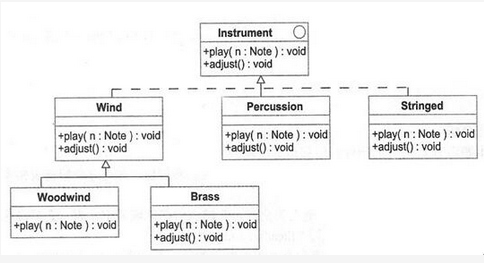
类图
下面是实现上述设计的C++代码,其中音乐类(Music)使用各类乐器(Instrument)进行演奏和调音等操作。
using namespace std; enum Note(/*枚举各种音调*/ MIDDLE_C,C_SHARP,B_FLAT }; classInstrument{/*抽象基类,乐器*/ public: ______; //play函数接口 virtual voidadjust()=0; //adjust函数接口 }; class Wind ______{ public: void play(Note n) { cout<<"Wind.play() "<<n<<endl; } void adjust(){cout<<"Wind.adjust()"<<endl; } ); /*类Percussion和Stringed实现代码略*/ class Brass ______{ public: void play(Note n) {cout<<"Brass.play() "<<n<<endl; } void adjUSt(){cout<<"Brass.adjust()"<<endl;) }; classWoodwind:public Wind{ public: void play(Note n) { cout<<"Woodwind.play()"<<n<<endl; } }; class MusiC { public: voidtune(Instrument*i) { i->play(MIDDLE_C.; } voidadjust(Instrument*i){ i->adjust(); } void tuneAll(______ e[],int numIns){ /*为每个乐器定调*/ for(int i=0; i<numIns; i++){ this->tune(e[i]); this->adjust(e[i]); } } }; /*使用模板定义一个函数size,该函数将返回数组array的元素个数,实现代码略*/ int main(){ Music*music=______ Music(); Instrument*orchestra[]={new Wind(),new Woodwind() }; music->tuneAll(orchestra,size(orchestra));/*size返回数组orchestra的元素个数*/ for(int i=0;i<size(orchestra);i++) deleteorchestra[i]; delete music; }
本程序运行后的输出结果为:
Wind.play()0 Wind.adjust() Woodwind.play()0 Wind.adjust()答案:解析:virtual void play(Noten)=0
:public Instrument
:public Wind
Instrument*
new -
第4题:
We’ve got a full house, so if you really want to keep your room this afternoon, we’ll have to charge you 50% of the price. (翻译)
参考答案:我们的客房很满,如果您确实需要再住一个下午,恐怕我们要向您收取50% 的房费
-
第5题:
27.If we travel by car ,we_________.
A. can't travel fifty or one hundred miles a day
B. can-t stop at a hotel to spend the night
C. can make our own timetable '
D. can travel to a very far place in several minutes
正确答案:C
27.C【解析】从文章最后一段第一、二句可知. -
第6题:
阅读以下说明和Java程序,填补代码中的空缺,将解答填入答题纸的对应栏内。
[说明]
对部分乐器进行建模,其类图如下图所示,包括:乐器(Instrument)、管乐器(Wind)、打击乐器(Percussion)、弦乐器(Stringed)、木管乐器(Woodwind)、铜管乐器(Brass)。
类图
下面是实现上述设计的Java代码,其中音乐类(Music)使用各类乐器(Instrument)进行演奏和调音等操作。
[Java代码] enum Note{/*枚举各种音调*/ MIDDLE_C,C_SHARP,B_FLAT; //其他略 } interfaceInstrument {/*接口,乐器*/ ______; //play方法接口 void adjust(); //adjust方法接口 } class Wind ______{ public voidplay(Note n) { System.out.println("Wind.play()"+n); } public void adjust(){System.out.println("Wind.adjust()");} } /*类Percussion和Stringed实现代码略*/ class Brass ______{ public voidplay(Note n) {System.out.println("Brass.play()"+n); } public voidadjust(){System.out.println("BrasS.adjust()");) } Class Woodwindextends Wind{ publicvoidplay(Note n){System.out.println("Woodwind.play()"+n); } } public classMusic{ voidtune(Instrument_i){i.play(Note.MIDDLE_C.; } voidadjust(Instrument i){i.adjust(); } voidtuneAll(______ e){ for(Instrumenti:e){ adjust(i); tune(i); } } public Static voidmain(String[] args){ Music music=______ Music(); Instrument[]orchestra={new Wind(), new Woodwind() }; music.tuneAll(orchestra); } }
本程序运行后的输出结果为:
Wind.adjust() Wind.play()MIDDLE_C Wind.adjust() Woodwind.play()MIDDLE_C答案:解析:voidplay (Note n)
implements Instrument
extends Wind
Instrument[]
new