
Human beings should find a new_______of energy.A.orient B.source C.origin D.souse
题目
B.source
C.origin
D.souse
相似考题
更多“Human beings should find a new_______of energy.”相关问题
-
第1题:
Few of the students understand why language is _______ to human beings.A、aware
B、unique
C、absolute
D、continual
参考答案:B
-
第2题:
It is often ( )that human beings are naturally equipped to speak.
A. said B. to say C. saying D. being said
正确答案:A考查的是固定句型(it is +Ved +that从句)。 -
第3题:
The program which gives a computer a mind of his own can never be written by human beings.()
参考答案:错误
-
第4题:
We can see monuments here and there. Those who have made great()to human beings and society will never be forgotten.A.advance
B.progress
C.contribution
D.Achievement
正确答案:C
-
第5题:
Another way to divide the study of geography is to distinguish between physical geography and cultural geography.The former focuses on the natural world;the( )starts with human beings and studies how human beings and their environment act upon each other.A.second
B.next
C.later
D.latter答案:D解析:注意句型:the former…,the latter“前者……,后者……”。 -
第6题:
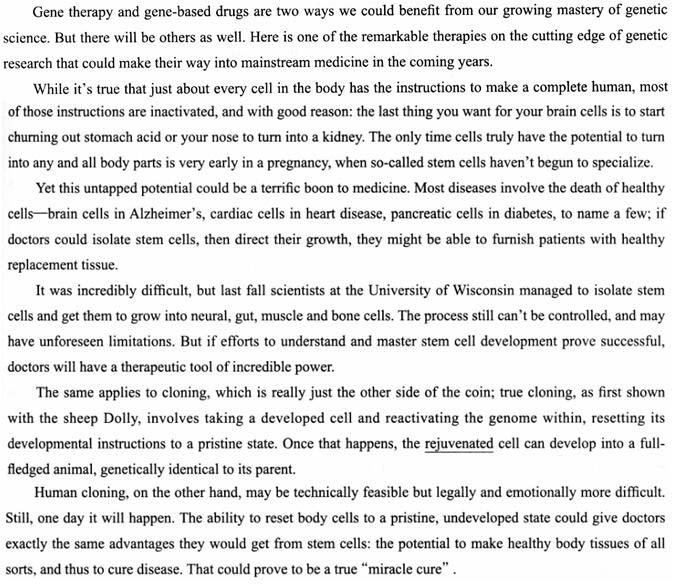
The writer holds that the potential to make healthy body tissues will( )A.aggravate moral issues of human cloning
B.bring great benefits to human beings
C.help scientists decode body instructions
D.involve employing surgical instruments答案:B解析:
-
第7题:
The theory of learning underlying the Grammar-Translation Method was Faculty Psychology. The Faculty Psychologists believed that the mind of human beings had various faculties which could be trained separately.()
正确答案:正确 -
第8题:
单选题Knowledge()human beings into civilization.Achannels
Badapts
Cturns
Dtakes
正确答案: B解析: 暂无解析 -
第9题:
单选题What is the main idea of the passage?ASalt is very important.
BIf their blood salt level is not constant, human beings may die.
CThe amount of salt in the body is secreted.
DPeople can die of thirst.
正确答案: D解析: -
第10题:
单选题What does the author intend to do in writing the passage?ATo evaluate our needs of birds to save our earth.
BTo describe various measures to protect the birds.
CTo criticize the effects of human pollution on birds.
DTo explain a basic tie between birds and human beings.
正确答案: A解析: -
第11题:
单选题What is the passage mainly about?ARhythmic patterns in literature.
BRhythm in writing.
CThe place of rhythm in the lives of human beings.
正确答案: B解析:
文章从rhythm的定义出发,首先指出节奏性是人生来就有的,人类生活在节奏中,同时受到节奏的约束。而后具体讲生理和情感的节奏性,最后指出人类生活的节奏性使文学作品也带有节奏的美感,故C项“节奏在人类生活中的位置”正确。
【录音原文】
Rhythm in literature is a more or less regular occurrence of certain elements of writing a word, a phrase, an idea, a pause, a sound, or a grammatical construction. We are also accustomed to this recurrence in the alternate heavy and light beats in music. Our love for rhythm seems to be innate; witness the response of a small child to lively music. Children love to beat on toy drums or empty boxes. They stamp their feet and chant nursery rhythms or nonsense syllables, not like primitive dancers. As children grow older, they are taught to restrain their responses to rhythm, but our love of rhythm remains. We live in rhythms; in fact we are governed by rhythms.
Physiologically, we are rhythmical. We must eat, sleep, breathe, and play regularly to maintain good health. Emotionally we are rhythmical, too, for psychologists say that all of us feel alternate periods of being in high spirits of concentration. It naturally follows that rhythm, a fundamental aspect of our lives, must be a part of any good literary works, whether poetry or prose. -
第12题:
问答题when a human infant is born into any community in any part of theworld it has two things in common with any infant, provided neither of them 1._______have been damaged in any way either before or during birth. Firstly, and most 2._______obviously, new born children are completely helpless. Apart from a powerfulcapacity to pay attention to their helplessness by using sound, there is nothing 3._______the new born child can do to ensure his own survival. Without care from someother human being or beings, be it mother, grandmother, or human group, achild is very unlikely to survive. This helplessness of human infants is in markedcontrast with the capacity of many new born animals to get on their feet within 4._______minutes of birth and run with the herd within a few hours. Although younganimals are certainly in risk, sometimes for weeks or even months after birth, 5._______compared with the human infant they very quickly develop the capacity to fend for them. 6._______ It is during this very long period in which the human infant is totallydependent on the others that it reveals the second feature which it shares with all 7._______other undamaged human infants, a capacity to learn language. For this reason,biologists now suggest that language be ‘species specific’ to the human race, 8._______that is to say, they consider the human infant to be genetic programmed in 9._______such way that it can acquire language. This suggestion implies that just 10.______as human beings are designed to see three-dimensionally and in colour, and justas they are designed to stand upright rather than to move on all fours, so theyare designed to learn and use language as part of their normal development aswell-formed human beings.正确答案:
1.在any和infant中间加other 在比较两者的异同时,要从比较对象中排除该物或该人。
2.have改为has 此处主语为neither,故谓语动词要用单数形式。
3.pay改为draw/call/attract/elicit pay attention to注意。此处要表达“吸引注意”的意思。
4.on改为to get to one’s feet起身,站起来。
5.in risk改为in danger或at risk 这里表达“在危险中,受到威胁”的意思,没有in risk这种搭配。
6.them改为themselves 这里需要的宾语和主语they都是指代上文的young animals,故要用反身代词。
7.去掉the others指“其他人(物)中的一部分”,the others则指“其他所有的人(物)”。
8.be改为is 这里suggest意为“提出,暗示”,不作“建议”讲,因此不用虚拟语气。
9.genetic改为genetically genetically用来修饰programmed,“副词+过去分词”相当于一个形容词。
10.在such和way中加入a 名词way为可数名词单数,前面要用不定冠词。解析: 暂无解析 -
第13题:
Gestures, a body language of human beings, _________widely from culture to culture.
A. change
B. vary
C. differ
D. alternate
正确答案:B
change的意思是“改变,变化”;vary的意思是“(彼此)相异,存在不同之处”;differ的意思是“相异,不同”;alternate的意思是“(使)轮流,交替”。varg from...to...这是个固定表达,一般用来表达在某一范围内的变化。题干的意思是:“作为人类的肢体语言之一,手势语在各个文化中是大不相同的。” -
第14题:
He would venture far out into places seldom visited by human beings.
参考答案: 他总是到人烟稀少的偏远地区探险。
-
第15题:
Scientists have made great contributions()development of our human beings.
A. to
B. on
C. with
参考答案:A
-
第16题:
According to Noam Chomsky, human beings are born with an innate ability to acquire and produce language known as __________.A.CAT
B.MR!
C.TG
D.LAD答案:D解析:考查语言习得机制。乔姆斯基的一个著名理论:Human beings are born with an innate ability known as Language Acquisition Device or LAD.即人类与生俱来的内在语言能力叫作语言习得机制.简称为LAD。故选D。 -
第17题:
Friends might not be always trust-worthy, but dogs are; they have long been regarded as the most( )company of human beings.A.reliable
B.regular
C.reluctant
D.religious答案:A解析:也许朋友不是常常值得信赖的,但狗可以信赖;牠们长久以来就被视为人类最可靠的伙伴。 -
第18题:
The theory of learning underlying the Grammar-Translation Method was Faculty Psychology. The Faculty Psychologists believed that the mind of human beings had various faculties which could be trained separately.()
A对
B错
对
略 -
第19题:
单选题AToxoplasma gondii causes people strange and deadly diseases.
BWith certain infection the infectious disease cannot be cured completely.
CHuman beings infected by toxoplasma gondii will have permanent brain damage.
DToxoplasma gondii is harmful to human beings, but it does no harm to mice.
正确答案: A解析: -
第20题:
单选题_____ that distinguish human beings from other primates are related to the ability of people to stand upright and walk on two legs.AMany of the physical characteristics
BOf the many physical characteristics
CThe physical characteristics
DThere are many physical characteristics
正确答案: A解析:
句意:并非所有区别人类与灵长类动物的特点都和直立行走能力有关。从语法角度而言,后面出现了动词are,知道前半句应该是句子的主语,可以排除选项B和选项D。根据句意应该选择A。C项表达错误。 -
第21题:
单选题Scientists say it may be five or six years _____ this medicine is tested on human beings.Asince
Bbefore
Cafter
Dwhen
正确答案: C解析: -
第22题:
判断题The theory of learning underlying the Grammar-Translation Method was Faculty Psychology. The Faculty Psychologists believed that the mind of human beings had various faculties which could be trained separately.()A对
B错
正确答案: 对解析: 暂无解析 -
第23题:
问答题The overuse of modern technologies in recreational activities makes human beings less creative. Do you agree or disagree? Write a composition of about 400 words on this topic.正确答案:
It is universally acknowledged that modern technologies are widely used in our everyday entertainment activities, providing joy and happiness for all. We enjoy kaleidoscopic TV programmes using signals received from satellites; we play music and show films on complex hi-fi stereos; and an increasing number of people surf the Internet every day for information and fun. Under these circumstances, many fear that the overuse of modern technologies in entertainment might result in the gradual loss of human creativity, as man grows to rely almost entirely on machines and high-tech inventions to work entertaining miracles. Honestly, I regard this point of view as downright wrong.
To begin with, it is precisely man's creativity that has made all the modern technologies possible and available, which in turn leads to their creative application in entertainment. Their wide application does not necessarily mean that man is losing his creativity, but simply indicates that this creativity has all along been turned into reality and put to use.
Secondly, rather than stunting man's imagination, the overuse of modern technologies actually enables man to be more and more creative. For instance, Dream Works, the famous American film company, has been designing and producing cartoons using computer technology. From the uni-dimensional The Prince of Egypt to the most lifelike Shrek, whatever one can imagine, it can be created by that computer, together with human intelligence and imagination.
Thirdly, history has proved that wide application of technologies in recreational activities has not affected human creativity. As a matter of fact, human beings have extensively used modern technologies to entertain themselves since the 1950s. However, we find so far no evidence which shows that man's creativity is declining. Instead, we never fail to find new creations appearing in quick succession.
Finally, the development of modern technologies depends on man's creativity. TV sets, CD players, computers and all sort of high-tech appliances are invented and developed by man. And his boundless imagination and endless thirst for more joy and fun will always inspire him to invent better technologies and then enjoy new varieties of entertainment.
To sum up, the fuss about how the overuse of modern technologies might be making people lose their creativity is totally unnecessary. For man, as a ceaseless explorer, will always develop new ways of fun using new types of advanced technologies.解析:
对于题目里提到的“娱乐活动中现代科技的滥用降低了人们的创造力”这一说法,作者在第一段末尾表示不认同。接下来正文段里分四点进行论证,其中援引了梦工厂的电影等例子作为论据。最后一段重申了中心论点。