
Passage FiveIn America, every student in his or her second year of high school is required to take a class in driver's education.The course is divided up into two parts: class time for learning laws and regulations and driving time to practice driving. Ea
题目
Passage Five
In America, every student in his or her second year of high school is required to take a class in driver's education.
The course is divided up into two parts: class time for learning laws and regulations and driving time to practice driving. Each student is required to drive a total of six hours. The students are divided up into groups of four. The students and the instructor go out driving for two hour blocks of time. Thus, each student gets half an hour driving time per outing. Drivers Ed cars are unlike other cars in which they have two sets of brakes, one on the driver's side and one on the other side where the instructor sits. Thus, if the student driver should run into difficulties the instructor can take over.
After a student has passed the driver's education course and reached the appropriate age to drive (this age differs in every state but in most cases the person must be 16 years old), he must take his driver's test. The person must pass all three tests in order to be given a driver's license. If the person does well in his or her driver's education class, he or she will pass the test with flying colors and get a driver's license.
51. In America, the driver's course mentioned above______.
A. is considered as part of the advanced education
B. is given to anyone wanting to get a driver's license
C. is carried on after students graduate from high school
D. is offered to all the students of Grade 2 in high school
相似考题
更多“Passage FiveIn America, every student in his or her second year of high school is required to take a class in driver's education.The course is divided up into two parts: class time for learning laws and regulations and driving time to practice driving. Ea”相关问题
-
第1题:
为了使程序的输出的正确结果为: Now is 2004.7.10 10:10:10. 那么应在下列程序划线处填入的正确语句是( )。 那么应在下列程序划线处填入的正确语句是( )。 #include <iostream> using namespace std; class TIME; class DATE { public: DATE(int y=2004,int m=1,int d=1) { year=y; month=m; day=d; } friend void DateTime(DATE &d, TIME &t); private: int year, month, day; }; class TIME { public: TIME(iht h=0, int m=0,int s=0) { hour=h; minute=m; second=s; } friend void DateTime(DATE &d,TIME &t); private: int hour,minute, second; }; ______________________ //函数 DateTime 的首部 { cout<<"Now is"<<d.year<<'.'<<d.month<<'.'<<d.day<< ' '<<t.hour<<":"<<t.minute<<':'<<t.second<<'.'<<end1; } int main ( ) { DATE d(2004,7,10); TIME t(10, 10, 10); DateTime(d,t); return 0; }
A.void DateTime(DATE &d,TIME &t)
B.void TIME::DateTime(DATE &d,TIME &t) const
C.friend void DateTime(DATE &d,TIME &t)
D.void DATE::DateTime(DATE &d,TIME &t)
正确答案:A
解析:本题程序中,分别在类DATE和TIME中将普通函数DateTime声明为友元函数,但该友元函数的定义是在类体外进行的。友元函数是一个普通函数,它虽然可以访问类对象的私有成员,但它毕竟不是类中的成员函数,因此在类体外定义友元函数时,不需要像成员函数一样在函数名前加上“类名::”。函数首部的其他定义照抄类中友元函数的声明。所以函数DateTime的首部为voidDateTime(DATE&d;TIME&t),即选项A。 -
第2题:
In the author’ s eyes,one who views personal growth as a process would
A.succeed in climbing up the social ladder
B.judge his ability to grow from his own achievements
C.face difficulties and take up challenges
D.aim high and reach his goal each time
正确答案:C
C项的意思是“面对困难,迎接挑战”,见第二段,作者认为一个人的成长是过程,而不是结果,成长过程是很难确定的。A,B,D项都是结果,只有C项是过程。 -
第3题:
Several days ago,some students from the US visited our school. When we talked,l discov-ered (41) differences in school life between the US and China. For example,each class (42) fifty minutes in the US. It is a little (43) than that in China. We usually have forty or forty-five minutes iii each class. Another difference is that they have less break time between (44) .13esides,although most schools in both countries finish their (45) classes at 120 'clock,the students in the US only have an-hour-long break,so they (46) eat lunch quickly. Their af-ternoon classes begin at l:00 pm and school is over (47) 3:00 pm. Then they take part in club activities or play sports.
Many Chinese students don't work during their high school years ,while the US students.like to find a part-time job in (48) free time. They don't have a dream job in mind. They think (49) is no difference between jobs. Working is a useful experience for them and they make money at the same time. Some of them even take one-year full time jobs (50 )they leave high school and then go to college.
( )41.
A. no
B. few
C.little
D. some
正确答案:D
41.D【解析】由上下句可知“我”发现了中国和美国在学校生活中的一些不同点. -
第4题:
Which of the following is true of Reagan?__________A.He finished high school and got his diploma
B.His mother had died and he lived alone
C.He had to do work to support his families
D.He was still a student with a part-time job答案:C解析:文章第三段中“Reagan also shared that his mother had passed away and he was left to carefor his two younger sisters.”可知,里根不得不找工作照顾他的家庭。故选C。 -
第5题:
共用题干
Teaching and Learning
Many teachers believe that the responsibilities for learning lie with the student.If a long reading assignment is given,instructors expect students to be familiar with the ______(1)in the reading even if they do not discuss it in class or take an examination.The ______(2) student is considered to be one who is motivated to learn for the sake of______(3) ,not the one interested only in getting high grades.Sometimes homework is returned ______(4) brief written comments but without a grade.
Even if a grade is not given,the student is ______(5) for learning the materi al assigned.When research is______(6), the professor expects the student to take it actively and to complete it with______(7) guidance.
It is the student's responsibility to find books,maga-zines,and articles in the library.Professors do not have the time to explain______(8) a university library works;they expect students______(9) graduate students to exhaust the reference______(10) in the library.Professors will help students who need it,but______(11) that their students should not be______(12)dependent on them.In the United States professors have many other duties______(13)teaching,such as administrative or research work.Therefore, the time that a professor can spend with a student outside of class is______(14).
If a student has problems with classroom work,the student should either______(15)a professor during office hours or make an appointment.1._________
A:suggestion
B:context
C:abstract
D:information答案:D解析:综合第一句的大意,只有D选项“信息”填在这里恰当,A项“提议,暗示”,B 项“语境,上下文”,C项“摘要”均不符合句意。
此句大意为“有理想的学生是为了学习而学习”,只有ideal最符合要求,故选B。
本文讲的是与学生学习相关的内容,A,B,D项均不合文意及句意,故排除。
此处要区分几个介词的含义,be returned with一般有“带着……回来”之意,此句意为“有时,被发回来的作业上只有简短的评价,并无分数”。be returned by意为“被……带回来”,而for,in于此搭配不当,所以答案选D。
be responsible for是固定搭配,表示“对……负责任”。其他选项放在此处都不合上下文含意。
此句意思是“当选定了一项研究课题时,教授们期望学生积极对待”。A和 D不合题意,最大的干扰项B意思为“分配,分布”,一般指一个整体被分散给许多个体,与之相比,C选项更为合适。
老师肯定希望学生能够在尽可能少的指导下完成研究。只有B选项意为 “最小的”,为正确答案。
首先排除B选项,因为此处需要一个关系副词充当宾语从句的状语,而 what是关系代词,之后要看整句的意思,“教授们没有时间去给学生解释一个大学图书馆是怎样运作的”。A和C虽然符合语法要求,但放此处意思不通,故选D。
A项“尤其”,B项“本质上”,C项“明显地”,D项“很少地,难得”。此处强调研究生,A选项较为合适。
此句意为“教授们期望学生,尤其是研究生阅尽图书馆中的文献资源”。A 项意为“选集”,B项为“集合”,两者一般都指文学作品的“集合”,而此处是学术界的文献。C 与D选项都有“来源,源头”的意思,但D选项侧重于“起源,开端”,C项更侧重于“原始资料”, 所以C项为正确答案。
根据下文意思,A和B选项可直接排除,教授们肯定是喜欢学生不依赖他们。D选项的含义比C选项更递进了一步,符合题意,故选D。
dependent是形容词,前面不能与such, much搭配,D选项more放在此处构成比较级,但前文并无原级与之相比较,因此只剩下A为答案,此句意为“教授们愿意帮助那些需要帮助的学生,但更希望学生不要太过依赖他们”。
此题重点在于区分三个有“除……之外”含义的介词。A选项一般翻译成 “而不是,并不是”,B选项意为“除去……之外”,D选项意为“除去……之外还……”,此句意思为“美国的教授除了教书之外还有许多其他的职责”,故D为答案。
根据上文含义,一个教授能花在学生身上的时间一定是有限的,A,C,D项不合题意,直接排除,B选项为正确答案。
此题还是承接上文含义,正因为教授时间有限,因此学生若想与之沟通,定要等教授在学校的时候,或是提前约好。C选项意为“接近,靠近”,为正确答案,A项“问候”, B项“使……厌恶”,D项“依附,伴随,添加”,意思均与文意不符。 -
第6题:
共用题干
第二篇
Going Her Own Way
When she was twelve,Maria made her first important decision about the course of her life.She decided
that she wanted to continue her education.Most girls from middle-class families chose to stay at home after
primary school,though some attended private Catholic"finishing"schools.There they learned a little about
music,art,needlework,and how to make polite conversation. This was not the sort of education that interested
Maria-or her mother. By this time,she had begun to take her studies more seriously.She read constantly
and brought her books everywhere.One time she even brought her math book to the theater and tried to study
in the dark.
Maria knew that she wanted to go on learning in a serious way.That meant attending the public high
school,something that very few girls did.In Italy at the time,there were two types of high schools:the
"classical"schools and the"technical"schools. In the classical schools,the students followed a very tradi-
tional program of studies,with courses in Latin and Greek language and literature,and Italian literature and
history. The few girls who continued studying after primary school usually chose these schools.
Maria,however,wanted to attend a technical school.The technical schools were more modern than the
classical schools and they offered courses in modern languages,mathematics,science,and accounting. Most
people一including Maria's father一believed that girls would never be able to understand these subjects.
Furthermore,they did not think it was proper for girls to study them.
Maria did not care if it was proper or not.Math and science were the subjects that interested her most.
But before she could sign up for the technical school,she had to win her father's approval. She finally did,
with her mother's help,though for many years after,there was tension in the family. Maria's father continued to
oppose her plans,while her mother helped her.
In 1883,at age thirteen,Maria entered the"Regia Scuola Tecnica Michelangelo Buonarroti"in Rome.
Her experience at this school is difficult for us to imagine.Though the courses included modern subjects,the
teaching methods were very traditional. Learning consisted of memorizing long lists of facts and repeating
them back to the teacher. Students were not supposed to ask questions or think for themselves in any way.
Teachers were very demanding;discipline in the classroom was strict;punishment was severe for those who
failed to achieve or were disobedient.Maria wanted to attend a__________.
A:private"finishing" school
B:school with Latin and Greek
C:technical high school
D:school for art and music答案:C解析:由文章第三段第一句话“Maria, however, wanted to attend a technical school.”可知答案为C。
由文章第一段第三句话“Most girls from middle-class families chose to stay at home afterprimary school...”可知答案为B
由文章第三段倒数第二句话“Most people including Maria' s father believed that girls would never be able to understand these subjects.”说明玛利亚的父亲对女人所持的是传统观念。
由文章最后一段最后一句话可知,在那时的意大利高中学校中,教师是非常严格的。
文章内容表明,玛利亚意志非常坚定,她冲破传统的束缚,进了她向往的技校。 -
第7题:
共用题干
第二篇
Going Her Own Way
When she was twelve,Maria made her first important decision about the course of her life.She decided
that she wanted to continue her education.Most girls from middle-class families chose to stay at home after
primary school,though some attended private Catholic"finishing"schools.There they learned a little about
music,art,needlework,and how to make polite conversation. This was not the sort of education that interested
Maria-or her mother. By this time,she had begun to take her studies more seriously.She read constantly
and brought her books everywhere.One time she even brought her math book to the theater and tried to study
in the dark.
Maria knew that she wanted to go on learning in a serious way.That meant attending the public high
school,something that very few girls did.In Italy at the time,there were two types of high schools:the
"classical"schools and the"technical"schools. In the classical schools,the students followed a very tradi-
tional program of studies,with courses in Latin and Greek language and literature,and Italian literature and
history. The few girls who continued studying after primary school usually chose these schools.
Maria,however,wanted to attend a technical school.The technical schools were more modern than the
classical schools and they offered courses in modern languages,mathematics,science,and accounting. Most
people一including Maria's father一believed that girls would never be able to understand these subjects.
Furthermore,they did not think it was proper for girls to study them.
Maria did not care if it was proper or not.Math and science were the subjects that interested her most.
But before she could sign up for the technical school,she had to win her father's approval. She finally did,
with her mother's help,though for many years after,there was tension in the family. Maria's father continued to
oppose her plans,while her mother helped her.
In 1883,at age thirteen,Maria entered the"Regia Scuola Tecnica Michelangelo Buonarroti"in Rome.
Her experience at this school is difficult for us to imagine.Though the courses included modern subjects,the
teaching methods were very traditional. Learning consisted of memorizing long lists of facts and repeating
them back to the teacher. Students were not supposed to ask questions or think for themselves in any way.
Teachers were very demanding;discipline in the classroom was strict;punishment was severe for those who
failed to achieve or were disobedient.We can infer from this passage that__________.
A:girls usually attended private primary schools
B:only girls attended classical schools
C:girls did not like going to school
D:Maria was a girl who had very strong will答案:D解析:由文章第三段第一句话“Maria, however, wanted to attend a technical school.”可知答案为C。
由文章第一段第三句话“Most girls from middle-class families chose to stay at home afterprimary school...”可知答案为B
由文章第三段倒数第二句话“Most people including Maria' s father believed that girls would never be able to understand these subjects.”说明玛利亚的父亲对女人所持的是传统观念。
由文章最后一段最后一句话可知,在那时的意大利高中学校中,教师是非常严格的。
文章内容表明,玛利亚意志非常坚定,她冲破传统的束缚,进了她向往的技校。 -
第8题:
About 35%of all high school graduates in America continue their education in an institution of higher learning.The word college is used to refer to either a college or a university.These institutions offer four-year programs that lead to a Bachelor of Arts(B.A.)or Bachelor Science(B.S.)degree.Some students attend a junior college(providing only a two-year program)for one to two years before entering a four-year college as a sophomore(二年级生)or junior(三年级生).
It is generally easier to be accepted at a state university than at a private one.Most private schools require strict entrance examinations and a high grade point average(GPA),as well as specific college prep classes in high school.Private schools cost considerably more than state colleges and famous private schools are very expensive.Poorer students can sometimes attend,however,by earning scholarships.Some college graduates go on to earn advanced masters or doctoral degrees in grad(graduate)school.Occupations in certain fields such as law or medicine require such advanced studies.
Since college costs are very high,most students work at part-time jobs.Some have full-time jobs and go to school part-time.Often some will take five or more years to complete a four-year program because of money/job demands on their time.
While the college and work demands take up the great part of a student’s time,most still enjoy social activities.Sports,dances,clubs,movies,and plays are all very popular.However,gathering together for long,philosophical talks at a favorite meeting place on or near the university is probably the most popular activity.
College education is_______in America.A.quite common
B.very rare
C.something difficult
D.almost impossible答案:A解析: -
第9题:
It′s that time of the yea—graduation.The end of school year is nearly in sight,and it′s an especially big deal if?you′re finishing high school or college.
One amazing(令人惊叹的)16-year-old Florida girl,Grace Bush,graduated from both high school and college this week!She actually got her college diploma(毕业证书)before her high school diploma.How′d she do that?
"Hard work and dedication(专心致志),"she told a local TV news station,"have made me succeed in doing high school and college at the same time."She started taking college courses when she was just 13.She would often?get up at 5:30 a.m.and not finish until after 11 p.m.
Doing both at once is a huge achievement,but it has also helped her family save money.She′s one of the 9?children,all home-schooled until the age of 13.Her father is a math professor while her mother is a part-time history?teacher in a high school.Grace Bush has earned her college degree in law,with a near perfect GPA of 3.8 and she?hopes to become a lawyer one day,although her parents expect her to teach at university.By the way,she also plays?basketball in her college team in her spare time.
Why does the author say that Grace is amazing?A.She finished high school earlier than others.
B.She never went to bed before 11 p.m.
C.She graduated from both high school and college at 16.
D.She got two diplomas from the same school.答案:C解析: -
第10题:
It′s that time of the yea—graduation.The end of school year is nearly in sight,and it′s an especially big deal if?you′re finishing high school or college.
One amazing(令人惊叹的)16-year-old Florida girl,Grace Bush,graduated from both high school and college this week!She actually got her college diploma(毕业证书)before her high school diploma.How′d she do that?
"Hard work and dedication(专心致志),"she told a local TV news station,"have made me succeed in doing high school and college at the same time."She started taking college courses when she was just 13.She would often?get up at 5:30 a.m.and not finish until after 11 p.m.
Doing both at once is a huge achievement,but it has also helped her family save money.She′s one of the 9?children,all home-schooled until the age of 13.Her father is a math professor while her mother is a part-time history?teacher in a high school.Grace Bush has earned her college degree in law,with a near perfect GPA of 3.8 and she?hopes to become a lawyer one day,although her parents expect her to teach at university.By the way,she also plays?basketball in her college team in her spare time.
What did the parents do to help Grace with her education?A.They shared with her college history lessons.
B.They taught her until she was 13.
C.They made her interested in math.
D.They hired a part-time teacher.答案:B解析: -
第11题:
单选题Which of the following is NOT an advantage of distance learning?AThe student may choose his or her own pace.
BThe student may study at any time to his or her convenience.
CThey can pursue their chosen career while studying.
DTheir tutorial assistance comes through regular airmail, telephone, facsimile machine, etc.
正确答案: D解析:
文章提到的优缺点是几种教育方式之间的比较,问题涉及哪个选项的内容不是远程教育的优点。前三个选项,A“学生可以选择自己的进度”,B“学生可以在他(或她)方便的时候学习”,C“在学习的同时还可以追求自己的事业”都是文章中提及的与另两种方式比较的优点。在文章第二段中的一句话“Tutorial assistance may be available via regular airmail, telephone, fax machine, and over the Internet”(辅导可以通过定期的航空邮件、电话、传真以及因特网等方式进行),作者只是提出了一种可能,实际上是弥补远程教育不足的一个建议,并不是远程教育(函授)的优点。因此选项D符合题意。 -
第12题:
问答题Practice 9 If you want to get a driver’s license, you will have to apply at a driver’s license office. There you will be required to take a written test for driving in that area. You will also need to pass an eye test. If you need glasses, make sure you wear them. In addition, you must pass an actual driving test. If you fail the written or driving tests, you can take them again on another date.正确答案:
【参考译文】
如果你想获得驾照,你必须到驾照管理办公室申请。你需要在那里参加该地区的驾驶笔试,还需要通过视力测试。如果你需要眼镜,请务必带着眼镜。此外,你必须通过实际驾驶测试。如果你没有通过笔试或者实际驾驶测试,你可以择日再考。解析:
①driver’s license驾照。
②eye test视力测试。
③In addition此外。 -
第13题:
Passage Five
In the United States, it is important to be on time, or punctual, for an appointment, a class, etc. However, this may not be true in all countries. An American professor discovered this difference while teaching a class in a Brazilian (巴西的) university. The two-hour class was scheduled' to begin at 10 A. M. and end at 12. On the first day, when the professor arrived on time, no one was in the classroom. Many students came after the scheduled time. Several arrived half an hour later. Few apologized for their lateness. Were these students being rude? He decided to study the students, behavior.
The professor talked to American and Brazilian students about lateness in both an informal and a formal situation: at a lunch with a friend and in a university class. He found that if they had a lunch appointment with a friend, the average American student defined lateness as 19 minutes after the agreed time. However, the average Brazilian student felt the friend was late after 33 minutes.
In an American university, classes not only begin at the scheduled time in the United States, but also end at the scheduled time. In the Brazilian class, only a few students left the class at 12: 00; many remained past 12: 30 to discuss the class and ask more questions. While arriving late may not be very important in Brazil, neither is staying late.
51. The word "punctual' most probably means______.
A. leaving soon after class
B. coming early
C. arriving a few minutes late
D. being on time
正确答案:D51.答案为D 根据文章第一句it is important to be on time,or punctual可知punctual的意思是“守时”。
-
第14题:
An 18-year-old is believed to take a meaningful gap year when he/she_____.
[A] lives up to his/her parents’ expectations [B] spends time being lazy and doing nothing
[C] learns skills by spending parents’ money [D] earns his or her living and gains working experience
正确答案:D
-
第15题:
What's an Apprentice?
As everyone knows, opportunities in the skilled trades are set to explode in the next five to ten years.
Many skilled trades train workers through apprenticeships - new workers spend up to 80% of their days
learning on the job, and only 20% in the classroom. This is accomplished through being paired with an expert in the trade who will guide the apprentice through their learning process.
Many countries have developed special ””pre-apprenticeship”” secondary school programs. If you are in high school, by participating in these programs you can learn job skills and earn credits towards your apprenticeship before you even graduate. Apprenticeships range from auto mechanics to cabinetmaking, construction, and pastry making
What is an apprentice according to this article?A. Anyone who spends 20% of his or her time inside a classroom
B. An expert in a skilled trade who spends 80% of his or her time on the job
C. Any high school student who is learning job skills
D. A new worker matched with an expert to learn a skilled trade答案:D解析: -
第16题:
初中英语?阅读
一、考题回顾

二、考题解析
【教案】
Teaching aims:
Knowledge aim:
Students will grasp and understand the main and detailed information of the passage.
Ability aim:
Students will improve their reading and speaking skills.
Emotional aim:
Students will foster the interest and desire of learning English and take part in speaking activities actively.
Key and difficult point:
Key Point: Students will totally understand the content of the passage.
Difficult Point: Students will foster the interest of learning English, and take part in speaking activities.
Teaching procedure:
Step 1: Warming-up
1. Greetings.
2. Show students pictures about different types of transportation and naturally lead to today’s topic.
Step 2: Pre-reading
1. Ask students two questions and some volunteers will be invited to share their answers.
Q1: How do you come to school?
Q2: How do your parents go to work?
2. Ask students to predict the main idea of the passage based on the above discussion and pictures on the screen.
Step 3: While-reading
1st reading: Ask students to read the passage for the first time and check their prediction. Besides, they need to find out which countries are mentioned in the passage and circle them.
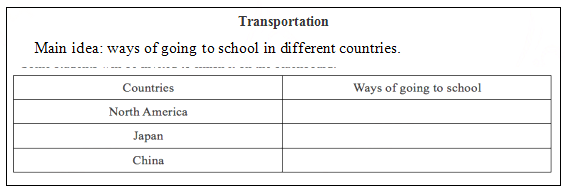
2nd reading: Ask students to read the passage for the second time and complete the following chart. Some students will be invited to finish it on the blackboard.

Step4: Post-reading
Discussion: ask students to discuss the advantages and disadvantages of different modes of transportation. Four students in a group, after five minutes, some groups are supposed to show their results.
Step5: Summary and Homework
Summary: ask a student to conclude the content of the lesson and summarize with the whole class.
Homework: ask students to investigate their friends’ way of going to school and find some interesting ways of transportation on the Internet.
Blackboard design:
1. How to improve students’ reading and speaking ability in your class?
2. How did you evaluate the performance of students in the class?答案:解析:1.
It is very important to improve students’ reading and speaking abilities. In my class, I take three specific steps to improve their reading and speaking abilities. Firstly, before reading the article, I ask the students to guess the main idea of the article according to my questions and pictures on the screen. As you heard, this can not only exercise students’ guessing ability, but also help them read the passage with questions. In the while-reading part, I set two times of reading, namely extensive reading and intensive reading. Obviously, students’ scanning ability and the ability to grasp detailed information can be improved. It also helps them form good reading habits. As for speaking ability, I organize a discussion activity without standard answers. Students can express their views freely in groups. In this way, their reading and speaking abilities can be improved a lot.
2.
Students are under a stage of growing and developing. They are eager to be evaluated and encouraged by their teachers. At the same time, students are different, and their acceptance and abilities of learning are different. Therefore, in my class, I have adopted a variety of different evaluations. For the students who answered correctly, I would praise them directly, such as “excellent”, “you can find the answer so fast”. For those students who dare not answer questions or did not find out the answers, I just encouraged them and guided them to say the answers, and gave some encouraging comments, like “nice try!”, “you’ve made a great progress”. Also, some students made mistakes. In my class, instead of directly blaming the student for being wrong, I asked other students to help him/her and give them a proper evaluation. -
第17题:
共用题干
第一篇
Goal of American Education
Education is an enormous and expensive part of American life.Its size is matched by its variety.
Differences in American schools compared with those found in the majority of other countries lie in the
fact that education here has long been intended for everyone一not just for a privileged elite.Schools are ex-
pected to meet the needs of every child,regardless of ability,and also the needs of society itself. This means
that public schools offer more than academic subjects.It surprises many people when they come here to find
high schools offering such courses as typing,sewing,radio repair,computer programming or driver training,
along with traditional academic subjects such as mathematics,history,and languages.Students choose their
curricula depending on their interests,future goals,and level of ability. The underlying goal of American edu-
cation is to develop every child to the utmost of his or her own possibilities,and to give each one a sense of
civic and community consciousness.
Schools have traditionally played an important role in creating national unity and"Americanizing"the
millions of immigrants who have poured into this country from many different backgrounds and origins.
Schools still play a large role in the community,especially in the small towns.
The approach to teaching may seem unfamiliar to many,not only because it is informal,but also
because there is not much emphasis on learning facts.Instead,Americans try to teach their children to think
for themselves and to develop their own intellectual and creative abilities.Students spend much time,learning
how to use resource materials,libraries,statistics and computers.Americans believe that if children are
taught to reason well and to research well,they will be able to find whatever facts they need throughout the
rest of their lives.Knowing how to solve problems is considered more important than the accumulation of
facts.
This is America's answer to the searching question that thoughtful parents all over the world are asking
themselves in the fast-moving time:"How can one prepare today's child for a tomorrow that one can neither
predict nor understand?"It is implied in the passage that_________.
A:all high-school students take the same courses
B:every high-school student must take some practical ability training courses
C:every public school offers the same academic subjects
D:the subjects every student takes may vary答案:D解析:A、B、D三项均只指出了美国教育口标的一个方面。C项说的是:为每个学生提供一个 充分发展他(她)的才能的机会。这是美国总的教育目标。
由文章第二段倒数第二句话“Students choose their curricula depending on their interests, future goals , and level of ability.”可知,学生可以根据自己的兴趣、将来的目标和能力来选择课 程,因此他们所学的课程是不同的。
A、B、D三项都只提到教育的某一个方面。由文章第四段第二句话“Instead, Americans try to teach their children to think for themselves and to develop their own intellectual and creative abilities.”可知,美国教育最强调的是对学生创造能力的培养。
文章中没有提到美国教育满足外国留学生的需求。
由文章第二段最后一句话“The underlying goal of American education is to develop every child to the utmost of his or her own possibilities,and to give each one a sense of civic and community consciousness.”可知,给每个学生提供最充分地发挥自己能力的机会是美国教育最重要的特点。 -
第18题:
共用题干
第二篇
Going Her Own Way
When she was twelve,Maria made her first important decision about the course of her life.She decided
that she wanted to continue her education.Most girls from middle-class families chose to stay at home after
primary school,though some attended private Catholic"finishing"schools.There they learned a little about
music,art,needlework,and how to make polite conversation. This was not the sort of education that interested
Maria-or her mother. By this time,she had begun to take her studies more seriously.She read constantly
and brought her books everywhere.One time she even brought her math book to the theater and tried to study
in the dark.
Maria knew that she wanted to go on learning in a serious way.That meant attending the public high
school,something that very few girls did.In Italy at the time,there were two types of high schools:the
"classical"schools and the"technical"schools. In the classical schools,the students followed a very tradi-
tional program of studies,with courses in Latin and Greek language and literature,and Italian literature and
history. The few girls who continued studying after primary school usually chose these schools.
Maria,however,wanted to attend a technical school.The technical schools were more modern than the
classical schools and they offered courses in modern languages,mathematics,science,and accounting. Most
people一including Maria's father一believed that girls would never be able to understand these subjects.
Furthermore,they did not think it was proper for girls to study them.
Maria did not care if it was proper or not.Math and science were the subjects that interested her most.
But before she could sign up for the technical school,she had to win her father's approval. She finally did,
with her mother's help,though for many years after,there was tension in the family. Maria's father continued to
oppose her plans,while her mother helped her.
In 1883,at age thirteen,Maria entered the"Regia Scuola Tecnica Michelangelo Buonarroti"in Rome.
Her experience at this school is difficult for us to imagine.Though the courses included modern subjects,the
teaching methods were very traditional. Learning consisted of memorizing long lists of facts and repeating
them back to the teacher. Students were not supposed to ask questions or think for themselves in any way.
Teachers were very demanding;discipline in the classroom was strict;punishment was severe for those who
failed to achieve or were disobedient.High school teachers in Italy in those days were very_________.
A:modern
B:intelligent
C:scientific
D:strict答案:D解析:由文章第三段第一句话“Maria, however, wanted to attend a technical school.”可知答案为C。
由文章第一段第三句话“Most girls from middle-class families chose to stay at home afterprimary school...”可知答案为B
由文章第三段倒数第二句话“Most people including Maria' s father believed that girls would never be able to understand these subjects.”说明玛利亚的父亲对女人所持的是传统观念。
由文章最后一段最后一句话可知,在那时的意大利高中学校中,教师是非常严格的。
文章内容表明,玛利亚意志非常坚定,她冲破传统的束缚,进了她向往的技校。 -
第19题:
共用题干
Teaching and Learning
Many teachers believe that the responsibilities for learning lie with the student.If a long reading assign-
ment is given,instructors expect students to be__________(51)with the information in the reading even if
they do not discuss it in class or__________(52)an examination.The ideal student is________(53)to
be one who is motivated to learn for the sake of learning,not the one interested only in getting high
___________(54).Sometimes homework is returned with brief written____________(55)but without a
grade.Even if a grade is not given,the student is___________(56)for learning the material assigned.
When research is_________(57),the professor expects the student to take it actively and to complete it
with minimum___________(58).It is the student's responsibility to find books,magazines,and articles in
the library.Professors do not have the time to__________(59)how a university library works;they expect
students to exhaust the___________(60)resources in the library.Professors will help students who need it,
_________(61)prefer that their students should not be too __________(62)on them.In the United
States professors have many other___________(63)besides teaching,such as administrative or research
work.Therefore,the time that a professor can spend__________(64)a student outside of class is limited.
if a student has problems with classroom work,the student should either__________(65)a professor
during office hours or make an appointment._________(61)
A:but
B:even
C:thus
D:and答案:A解析:be familiar with固定搭配,意思是“熟悉······”,符合句意。careful仔细的,小心的;happy 幸福的,高兴的;pleased高兴的,喜欢的;乐意做某事。
take an examination固定搭配,意思是“参加考试”,符合句意。
be considered to是固定搭配,意思是“被认为是”,符合句意。test测试,测验;recognize 认出,辨认出;assess评价,评定。
结合上文,该句意思是:理想的学生是为了学习知识而学习的,而不是为了获得高分而 学习的。grade意思是“成绩,分数”,符合句意。level水平,水准;degree度,度数;hope希望, 期望。
根据上下文,该句意思是:(返回的作业上)写有简单的评语但没有分数。comment意思 是“意见,评论”,符合句意。task工作,任务;declaration重要声明,宣言;question问题。
be responsible for是固定搭配,意思是“对······负责,承担责任”。anxious焦虑的,不安 的,担心的;concerned有关的,有牵连的;eager热切的,渴望的。
assign意思是“分配,指派”,符合句意。complete结束,完成;design设计;learn学习, 学会。
该句意思是:当研究内容分配下来以后,教授希望学生积极去做并且是在花费最少的 指导下完成。guidance意思是“指导,引导”,符合句意。requirement必需品,要求的事物;effort 力气,精力;evidence证据,证明。
该句意思是:教授们没有时间来解释大学图书馆是怎样运作的。explain意思是“解释, 说明”,符合句意。wonder对(某事)感到疑惑;想要知道;inquire询问,打听;speculate猜测, 推测。
reference意思是“参考,参照”,reference resources是“参考来源”的意思,符合句意。 inner内部的;personal亲自的,亲身的;natural正常的,平常的。
联系上下文,这里应该填一个表示转折的连接词,but符合句意。
dependent on意思是“依赖,依靠”,符合句意。keen感兴趣的,渴望的;energetic充满活 力的,精力充沛的;active积极的,活跃的。
该句意思是:在美国,教授们除了教学之外,还有许多其他的任务,比如管理方面或研 究方面的工作。duty意思是“责任,义务”,符合句意。opportunity机会;preference偏爱,偏好; point想法;某一事实。
结合上句意思,本句意思应该是:因此,在课堂之外一个教授能够跟学生在一起的时间 是有限的。spend with sb.意思是“花时间和某人在一起”,符合句意。
approach意思是“接近”,符合句意。trouble麻烦(某人),给(某人)添麻烦;select挑选, 选择;catch抓住。 -
第20题:
It′s that time of the yea—graduation.The end of school year is nearly in sight,and it′s an especially big deal if?you′re finishing high school or college.
One amazing(令人惊叹的)16-year-old Florida girl,Grace Bush,graduated from both high school and college this week!She actually got her college diploma(毕业证书)before her high school diploma.How′d she do that?
"Hard work and dedication(专心致志),"she told a local TV news station,"have made me succeed in doing high school and college at the same time."She started taking college courses when she was just 13.She would often?get up at 5:30 a.m.and not finish until after 11 p.m.
Doing both at once is a huge achievement,but it has also helped her family save money.She′s one of the 9?children,all home-schooled until the age of 13.Her father is a math professor while her mother is a part-time history?teacher in a high school.Grace Bush has earned her college degree in law,with a near perfect GPA of 3.8 and she?hopes to become a lawyer one day,although her parents expect her to teach at university.By the way,she also plays?basketball in her college team in her spare time.
What do Grace′s parents want her to be in future?A.A news reporter.
B.A basketball player.
C.A university teacher.
D.A lawyer.答案:C解析: -
第21题:
It′s that time of the yea—graduation.The end of school year is nearly in sight,and it′s an especially big deal if?you′re finishing high school or college.
One amazing(令人惊叹的)16-year-old Florida girl,Grace Bush,graduated from both high school and college this week!She actually got her college diploma(毕业证书)before her high school diploma.How′d she do that?
"Hard work and dedication(专心致志),"she told a local TV news station,"have made me succeed in doing high school and college at the same time."She started taking college courses when she was just 13.She would often?get up at 5:30 a.m.and not finish until after 11 p.m.
Doing both at once is a huge achievement,but it has also helped her family save money.She′s one of the 9?children,all home-schooled until the age of 13.Her father is a math professor while her mother is a part-time history?teacher in a high school.Grace Bush has earned her college degree in law,with a near perfect GPA of 3.8 and she?hopes to become a lawyer one day,although her parents expect her to teach at university.By the way,she also plays?basketball in her college team in her spare time.
Which of the following is the key to Grace′s success?A.Taking college courses at 13.
B.Doing high school and college at the same time.
C.Being born in a professor's family.
D.Being devoted to her studies.答案:D解析: -
第22题:
单选题ATo find out if he can change one of his class.
BTo ask her for a letter of recommendation.
CTo check the time of his registration appointment.
DTo learn if he still has required courses to take.
正确答案: C解析:
对话中学生提到“I wanted to check with you to see if there are any courses I still need before I transfer I think I’ve filled all the requirements, but I, uh, just wanted to make sure before, register”,可知本题选D。 -
第23题:
单选题Passage1Soon after starting his job as superintendent of the Memphis,Tenn.,public schools,Kriner Cash ordered an assessment of his new district's 104,000 students. The findings were depressing:nearly a third had been held back at least one academic year. The high school graduation rate had fallen to 67%.One in five dropped out. But what most concerned him was that the number of students considered highly mobile,meaning they had moved at least once during the school year,had ballooned to 34,000,partly because of the home-foreclosure crisis. At least 1,500 students were homeless-probably more.I had a whole array of students who were angry,depressed,not getting the rest they needed,Cash says. It led him to consider an unusual proposition: What if the best way to help kids in impoverished urban neighborhoods is to get them out?Cash is now calling for Memphis to create a residential school for 300 to 400 kids whose parents are in financial distress,with a live-in faculty rivaling those of elite New England prep schools. If Cash's dream becomes a reality,it will probably look a lot like SEED,a charter school in Southeast Washington,which stands for Schools for Educational Evolution and Development. Its 320 students-seventh-to 12th-graders-should live on campus five days a week. They are expected to adhere to a strict dress code and keep their room tidy. There are computers in the dorm's common areas, and each student in grades 10 and above is given a desktop computer. At 11:30 every night it's lights out.In his plan for Memphis, Cash wants even more time. Perhaps the most provocative aspect of his proposal is to focus on students in grades 3 through 5 for homelessness is growing sharply among kids at that critical age, when much of their educational foundation is set, Cash says. His aim: to prevent illiteracy and clear other learning roadblocks early, so the problem won't migrate into middle and high school. Students will remain on campus year-round. The school would cost up to S50,000 a day to operate-three times the cost of a traditional day school with more than twice as many students.It sounds very exciting, but the devil is in the details. says Ellen Bassuk, president of the National Center on Family Homelessness in Newton, Mass.What is Kriner Cash worried about most after knowing the result of the assessment?AThe falling rate of high school graduation.
BMiddle school student's dropping out at a very high speed every year.
CStudents being held back an academic year.
DThe growing number of students moving frequently during the school year.
正确答案: C解析: