
单选题11. abstract class Vehicle { public int speed() { return 0; } } 12. class Car extends Vehicle { public int speed() { return 60; } } 13. class RaceCar extends Car { public int speed() { return 150; }} ...... 21. RaceCar racer = new RaceCar(); 22. C
题目
0, 0,0
150, 60, 0
Compilation fails.
150, 150, 150
An exception is thrown at runtime.
相似考题
参考答案和解析
更多“单选题11. abstract class Vehicle { public int speed() { return 0; } } 12. class Car extends Vehicle { public int speed() { return 60; } } 13. class RaceCar extends Car { public int speed() { return 150; }} ...... 21. RaceCar racer = new RaceCar(); 22. C”相关问题
-
第1题:
Given:Which code, inserted at line 15, allows the class Sprite to compile?()
A.Foo { public int bar() { return 1; }
B.new Foo { public int bar() { return 1; }
C.new Foo() { public int bar() { return 1; }
D.new class Foo { public int bar() { return 1; }
参考答案:C
-
第2题:
阅读以下说明和Java代码,填充程序中的空缺,将解答填入答题纸的对应栏内。
[说明]
某应急交通控制系统(TraficControlSystem)在红灯时控制各类车辆(Vehicle)的通行,其类图如下图所示,在紧急状态下应急车辆在红灯时可通行,其余车辆按正常规则通行。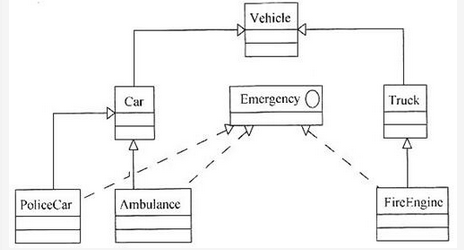
下面的Java代码实现以上设计,请完善其中的空缺。
[Java代码]abstract class Vehicle{public Vehicle(){ }abstract void run();};interface Emergency{ ______; ______;};class Car extends Vehicle{public Car(){ }void run(){ /*代码略*/ }};Class Truck extends Vehicle{public Truck(){ }void run() { /*代码略*/ }};class PoliceCar ______ {boolean isEmergency= false;public PoliceCar(){ }public PoliceCar(boolean b) {this.isEmergency=b; }public boolean isEmergent(){ return ______ }public void runRedLight(){ /*代码略*/ }};/*类Ambulance、FireEngine实现代码略*/public class TraficControlsystem { /*交通控制类*/private Vehicle[]V=new Vehicle[24];int numVehicles;public void control(){for {int i=0; i<numVehicles; i++){if(V[i]instanceof Emergency&&((Emergency)v[i]).isEmergent()){(______).runRedLight();}else______. run();}}void add(Vehicle vehicle){ v[numVehicles++]=vehicle;}/*添加车辆*/void shutDown(){/*代码略*/}public static void main(String[]args){TraficC0ntrolSystem tcs=new TraficControlSystem();tcs.add(new Car());tcs.add(new PoliceCar());tcs.add(new Ambulance());tcs.add(new Ambulance(true));tcs.add(new FireEngine(true));tcs.add(new Truck());tcs.add(new FireEngine());tcs.control();tcs.shutDown();}}答案:解析:boolean isEmergent()
void runRedLight()
extends Car implements Emergency
this.isEmergency
(Emergency)v[i]
v[i] -
第3题:
class A { protected int method1(int a, int b) { return 0; } } Which two are valid in a class that extends class A?()
- A、 public int method1(int a, int b) { return 0; }
- B、 private int method1(int a, int b) { return 0; }
- C、 private int method1(int a, long b) { return 0; }
- D、 public short method1(int a, int b) { return 0: }
- E、 static protected int method1(int a, int b) { return 0; }
正确答案:A,C -
第4题:
Given the following code, which method declarations, when inserted at the indicated position, will not cause the program to fail compilation?() public class Qdd1f { public long sum(long a, long b) { return a + b; } // insert new method declaration here }
- A、public int sum(int a, int b) { return a + b; }
- B、public int sum(long a, long b) { return 0; }
- C、abstract int sum();
- D、private long sum(long a, long b) { return a + b; }
- E、public long sum(long a, int b) { return a + b; }
正确答案:A,E -
第5题:
10. abstract public class Employee { 11. protected abstract double getSalesAmount(); 12. public double getCommision() { 13. return getSalesAmount() * 0.15; 14. } 15. } 16. class Sales extends Employee { 17. // insert method here 18. } Which two methods, inserted independently at line 17, correctly complete the Sales class?()
- A、 double getSalesAmount() { return 1230.45; }
- B、 public double getSalesAmount() { return 1230.45; }
- C、 private double getSalesAmount() { return 1230.45; }
- D、 protected double getSalesAmount() { return 1230.45; }
正确答案:B,D -
第6题:
class One { public One foo() { return this; } } class Two extends One { public One foo() { return this; } } class Three extends Two { // insert method here } Which two methods, inserted individually, correctly complete the Three class?()
- A、 public void foo() { }
- B、 public int foo() { return 3; }
- C、 public Two foo() { return this; }
- D、 public One foo() { return this; }
- E、 public Object foo() { return this; }
正确答案:C,D -
第7题:
public class Parent { public int addValue( int a, int b) { int s; s = a+b; return s; } } class Child extends Parent { } Which methods can be added into class Child?()
- A、 int addValue( int a, int b ){// do something...}
- B、 public void addValue (){// do something...}
- C、 public int addValue( int a ){// do something...}
- D、 public int addValue( int a, int b )throws MyException {//do something...}
正确答案:B,C -
第8题:
class A { public int getNumber(int a) { return a + 1; } } class B extends A { public int getNumber (int a) { return a + 2 } public static void main (String args) { A a = new B(); System.out.printIn(a.getNumber(0)); } } What is the result? ()
- A、 Compilation succeeds and 1 is printed.
- B、 Compilation succeeds and 2 is printed.
- C、 An error at line 8 causes compilation to fail.
- D、 An error at line 13 causes compilation to fail.
- E、 An error at line 14 causes compilation to fail.
正确答案:B -
第9题:
1. public class Blip { 2. protected int blipvert(int x) { return 0; } 3. } 4. class Vert extends Blip { 5. // insert code here 6. } Which five methods, inserted independently at line 5, will compile?()
- A、 public int blipvert(int x) { return 0; }
- B、 private int blipvert(int x) { return 0; }
- C、 private int blipvert(long x) { return 0; }
- D、 protected long blipvert(int x, int y) { return 0; }
- E、 protected int blipvert(long x) { return 0; }
- F、 protected long blipvert(long x) { return 0; }
- G、protected long blipvert(int x) { return 0; }
正确答案:A,C,D,E,F -
第10题:
单选题class A { public int getNumber(int a) { return a + 1; } } class B extends A { public int getNumber (int a) { return a + 2 } public static void main (String args) { A a = new B(); System.out.printIn(a.getNumber(0)); } } What is the result? ()ACompilation succeeds and 1 is printed.
BCompilation succeeds and 2 is printed.
CAn error at line 8 causes compilation to fail.
DAn error at line 13 causes compilation to fail.
EAn error at line 14 causes compilation to fail.
正确答案: C解析: 暂无解析 -
第11题:
多选题class One { public One foo() { return this; } } class Two extends One { public One foo() { return this; } } class Three extends Two { // insert method here } Which two methods, inserted individually, correctly complete the Three class?()Apublic void foo() { }
Bpublic int foo() { return 3; }
Cpublic Two foo() { return this; }
Dpublic One foo() { return this; }
Epublic Object foo() { return this; }
正确答案: C,D解析: 暂无解析 -
第12题:
多选题public abstract class Shape { private int x; private int y; public abstract void draw(); public void setAnchor(int x, int y) { this.x = x; this.y = y; } } Which two classes use the Shape class correctly?()Apublic class Circle implements Shape { private int radius; }
Bpublic abstract class Circle extends Shape { private int radius; }
Cpublic class Circle extends Shape { private int radius; public void draw(); }
Dpublic abstract class Circle implements Shape { private int radius; public void draw(); }
Epublic class Circle extends Shape { private int radius;public void draw() {/* code here */} }
Fpublic abstract class Circle implements Shape { private int radius;public void draw() { / code here */ } }
正确答案: B,F解析: 暂无解析 -
第13题:
阅读以下说明和Java代码,填充程序中的空缺,将解答填入答题纸的对应栏内。
【说明】
某应急交通控制系统(TraficControIS,stem)在红灯时控制各类车辆(Vehicle)的通
行,其类图如图6-1所示,在紧急状态下应急车辆在红灯时可通行,其余车辆按正常规
则通行。

下面的Java代码实现以上设计,请完善其中的空缺。
【Java代码】
abstract class Vehicle
public Vehicle () { }
abstract void run
};
interface Emergency {
(1) ;
(2) ;
}
class Car extends Vehicle {
public Car () { }
void run () { /*代码略*/ }
};
class Truck extends Vehicle {
public Truck () { }
void run () { /*代码略*/ }
class PoliceCar (3)
boolean isEmergency = false;
public PoliceCar () { }
public PoliceCar(boolean b) { this . isEmergency =b; }
public boolean isEmergent () { return (4); }
public void runRedLight () { /*代码略*/ }
}
/*类Ambulance. FireEngine实现代码略*/
public class TraficControISystem {/。交通控制类。/
private Vehicle[ ]V=new Vehiele [24];
int numVehicles;
public void control() {
for (int i=0; i<numVehicles; i++) {
if (v[i] instanceof Enu rgency&& ((Emergency)V [i])
isEmergent()) {
( 5 ) . runRedLigh&39;: ( ) ;
}else
(6).run( )
}
}
void add (Vehicle vehicle) { v[numVehicles++]=vehicle;)/*添加车辆*/
void shutDown()(/*代码略*/}
public static void main (Stri.ng [ ] args) {
TraficControlSystem tcs = new TraficControlSystem() ;
tcs . add (new Car () ;
tcs .add (new PoliceCar () ;
tcs .add (new Ambulance () ;
tcs . add (new Ambulance (true》 ;
tcs . add (new FireEngine ( true》 ;
tcs . add (new Truck () ;
tcs . add (new FireEngine ( ) ;
tcs . control () ;
tcs . shutDown () ;
}
}
正确答案:
本题考查Java语言程序设计的能力,涉及类、对象、方法的定义和相关操作。要求
考生根据给出的案例和执行过程说明,认真阅读理清程序思路,然后完成题目。
根据题目说明,以交通控制系统(Tn.ficControISystem)为背景,本题目中涉及的各
类车辆和是否应急状态下在红灯时的通行情况。根据说明进行设计,题目给出了类图(图
6-1类图所示)。
图中父类Vehicle,代表交通工具,设计为抽象类。在Java用abstract关键字表示,
表示行驶某一个具体的交通工具。Vehick包含一个抽象方法:run(),方法后没有实现,
直接用;来表示抽象方法,表示行驶的方法由具体子类型完成,所以Vehicle的run()为一
个抽象方法:
Abstractvoidrun()
Car和Truck都继承自Vehicle的两个子类型,所以他们都继承了Vehicle的run()方
法,各自行驶方式有所不同,所以都覆盖了Vehicle的run()方法,并加以实现:
voidrun(){/*代码略*/}
Car的两个子类型PoliceCar和Ambuance都继承自Car,从而PoliceCar和Ambulance
也都继承了Car中的run()方法。Truck的子类FireEngine也继承了Truck的run()方法。
图6-1中Emergency在Java中采用接口实现,其中约定红灯时通行的相关接口为:
isEmergent()和runRedLight().
isEmergent()接口约定应急车辆返回自身紧急情况状态,用bool类型的isEmergency
表示:this.isEmergency,其值在紧急情况下为true,非紧急情况下为false。mnRedLight()
接口约定应急车辆在红灯时如何通行(isEmer:;ency为true,则通行,isEmergency为false,
和普通车辆一样通行)。实现Emergency的类有PoliceCar、Ambulance和FireEngine,所
以在这三个类中都要实现Emergency中定义的接口。在Java中,实现接口用implements
关键字,后面加上所要实现的接口,即:
ClassNameimplementsInterfaceName
交通控制类TraficControISystem对运行的交通工具进行控制,所有交通工具用
Vehicle数组v表示;numVehicles表示交通工具数量;control函数进行控制在紧急情况
下应急车辆红灯通行,其他情况按常规通行;add()表示有车辆加入系统,shutDown()表示系统关闭。Vehicle的子类具体类型有Car、71ruck、PoliceCar、Ambulance和FireEngine,
所以v[]数组中对象有这些类型的对象,加入v[]时会自动向上转型成为Vehicle类型,
Emergency接口的应急车辆有runRedLight()方法,其他Car和Truck只有run()方法。因
此,用for循环中对每个v[i],判定是否是Emergency类型的实例,即是否实现了
Emergency。Java中判断一个对象是否是某个类型的实例用instanceof关键字。即:v[i]
instanceofEmergency,如果是,说明是应急车辆,接着判定应急车辆的状态,在判定之
前先要将应急车辆进行向下转型,Java中向]转型直接在对象前加上用括号括起来的转
换的目标类型即可,即:[Emergency)vli]).isEmergent0,如果判定为真,执行
runRedLight(),判定不成功,则调用run(),调用时动态绑定每个数组元素的实际类型,
需要通过动态类型转换并调用runRedLight():
if(v[i]instanceofEmergency&&《Emergency)v[i]).isEmergent()){
((Emergency)v[i]).runRedLight();
}else
V[i]->run();
主控逻辑代码在maln有法中实现。初始化TraficControISystem,用tcs表示,调用
tcs的add()函数添加具体的交通工具,这里会II动向上转型成为Vehicle类型,调用control()
对各车辆进行控制,调用shutDown()系统关自闭
因此,空(1)和空(2)需要定义接口sEmergent0和runRedLight0,题目代码中
已经给出用分号结尾,所以空(1)和空(2)分别为"boolisEmergent()”和“void
runRedLight()”;空(3)需要继承父类Car和实现接口Emergency,Java中继承采用extends
关键字,即应填入“extendsCarimplementsE】aergency”;空(4)要返回应急车辆对象的
状态,即填入“this.isEmergency”;空(5)剑:为动态类型转换后的对象(Emergency)v[il;
空(6)处为普通车辆对象v[i]。
答案
(1)booleanisEmergent()
(2)Voidrunredlight()
(3)extendsCarimplementsEmergency
(4)this.isEmergency
(5)(Emergency)v[i]
(6)v[i]
-
第14题:
1. class A { 2. public int getNumber(int a) { 3. return a + 1; 4. } 5. } 6. 7. class B extends A { 8. public int getNumber (int a) { 9. return a + 2 10. } 11. 12. public static void main (String args[]) { 13. A a = new B(); 14. System.out.printIn(a.getNumber(0)); 15. } 16. } What is the result?()
- A、 Compilation succeeds and 1 is printed.
- B、 Compilation succeeds and 2 is printed.
- C、 An error at line 8 causes compilation to fail.
- D、 An error at line 13 causes compilation to fail.
- E、 An error at line 14 causes compilation to fail.
正确答案:B -
第15题:
Which are syntactically valid statement at// point x?() class Person { private int a; public int change(int m){ return m; } } public class Teacher extends Person { public int b; public static void main(String arg[]){ Person p = new Person(); Teacher t = new Teacher(); int i; // point x } }
- A、 i = m;
- B、 i = b;
- C、 i = p.a;
- D、 i = p.change(30);
- E、 i = t.b.
正确答案:D,E -
第16题:
10. interface Foo { int bar(); } 11. public class Sprite { 12. public int fubar( Foo foo) { return foo.bar(); } 13. public void testFoo() { 14. fubar( 15. // insert code here 16.); 17. } 18. } Which code, inserted at line 15, allows the class Sprite to compile?()
- A、 Foo { public int bar() { return 1; } }
- B、 new Foo { public int bar() { return 1; } }
- C、 newFoo() { public int bar(){return 1; } }
- D、 new class Foo { public int bar() { return 1; } }
正确答案:C -
第17题:
10. public class SuperCaic { 11. protected static int multiply(int a, int b) { return a * b; } 12. } and: 20. public class SubCalc extends SuperCalc { 21. public static int multiply(int a, int b) { 22. int c = super.multiply(a, b); 23. return c; 24. } 25. } and: 30. SubCalc sc = new SubCalc(); 31. System.out.println(sc.multiply(3,4)); 32. System.out.println(SubCalc.multiply(2,2)); What is the result?()
- A、 12 4
- B、 The code runs with no output.
- C、 An exception is thrown at runtime.
- D、 Compilation fails because of an error in line 21.
- E、 Compilation fails because of an error in line 22.
- F、 Compilation fails because of an error in line 31.
正确答案:E -
第18题:
11. abstract class Vehicle { public int speed() { return 0; } } 12. class Car extends Vehicle { public int speed() { return 60; } } 13. class RaceCar extends Car { public int speed() { return 150; }} ...... 21. RaceCar racer = new RaceCar(); 22. Car car = new RaceCar(); 23. Vehicle vehicle = new RaceCar(); 24. System.out.println(racer.speed() + “, „ + car.speed() 25. + “, “+ vehicle.speed()); What is the result?()
- A、 0, 0,0
- B、 150, 60, 0
- C、 Compilation fails.
- D、 150, 150, 150
- E、 An exception is thrown at runtime.
正确答案:D -
第19题:
public class Car { private int wheelCount; private String vin; public Car(String vin) { this.vin = vin; this.wheelCount = 4; } public String drive() { return “zoom-zoom”; } public String getInfo() { return “VIN: “+ vin + “wheels: “+ wheelCount; } } And: public class MeGo extends Car { public MeGo(String vin) { this.wheelCount = 3; } } What two must the programmer do to correct the compilation errors?()
- A、 insert a call to this() in the Car constructor
- B、 insert a call to this() in the MeGo constructor
- C、 insert a call to super() in the MeGo constructor
- D、 insert a call to super(vin) in the MeGo constructor
- E、 change the wheelCount variable in Car to protected
- F、 change line 3 in the MeGo class to super.wheelCount = 3;
正确答案:D,E -
第20题:
public abstract class Shape { private int x; private int y; public abstract void draw(); public void setAnchor(int x, int y) { this.x = x; this.y = y; } } Which two classes use the Shape class correctly?()
- A、 public class Circle implements Shape { private int radius; }
- B、 public abstract class Circle extends Shape { private int radius; }
- C、 public class Circle extends Shape { private int radius; public void draw(); }
- D、 public abstract class Circle implements Shape { private int radius; public void draw(); }
- E、 public class Circle extends Shape { private int radius;public void draw() {/* code here */} }
- F、 public abstract class Circle implements Shape { private int radius;public void draw() { / code here */ } }
正确答案:B,E -
第21题:
多选题Which are syntactically valid statement at// point x?() class Person { private int a; public int change(int m){ return m; } } public class Teacher extends Person { public int b; public static void main(String arg[]){ Person p = new Person(); Teacher t = new Teacher(); int i; // point x } }Ai = m;
Bi = b;
Ci = p.a;
Di = p.change(30);
Ei = t.b.
正确答案: C,D解析: A:m没有被申明过,不能使用。
B:虽然b是类Teacher的public成员变量,但是在静态方法中不能使用类中的非静态成员。
C://a是类Person的private成员,在类外不能直接引用。
D://change(int m)方法是public方法,并且返回一个int型值,可以通过类的实例变量p引用并赋值给一个int型变量。
E://b是类Teacher的public成员变量,且是int型,可以通过类的实例变量t引用并赋值给一个int型变量 -
第22题:
单选题11. abstract class Vehicle { public int speed() { return 0; } } 12. class Car extends Vehicle { public int speed() { return 60; } } 13. class RaceCar extends Car { public int speed() { return 150; }} ...... 21. RaceCar racer = new RaceCar(); 22. Car car = new RaceCar(); 23. Vehicle vehicle = new RaceCar(); 24. System.out.println(racer.speed() + “, „ + car.speed() 25. + “, “+ vehicle.speed()); What is the result?()A0, 0,0
B150, 60, 0
CCompilation fails.
D150, 150, 150
EAn exception is thrown at runtime.
正确答案: E解析: 暂无解析 -
第23题:
单选题10. interface Foo { int bar(); } 11. public class Sprite { 12. public int fubar( Foo foo) { return foo.bar(); } 13. public void testFoo() { 14. fubar( 15. // insert code here 16.); 17. } 18. } Which code, inserted at line 15, allows the class Sprite to compile?()AFoo { public int bar() { return 1; } }
Bnew Foo { public int bar() { return 1; } }
CnewFoo() { public int bar(){return 1; } }
Dnew class Foo { public int bar() { return 1; } }
正确答案: D解析: 暂无解析 -
第24题:
单选题1. class A { 2. public int getNumber(int a) { 3. return a + 1; 4. } 5. } 6. 7. class B extends A { 8. public int getNumber (int a) { 9. return a + 2 10. } 11. 12. public static void main (String args[]) { 13. A a = new B(); 14. System.out.printIn(a.getNumber(0)); 15. } 16. } What is the result?()ACompilation succeeds and 1 is printed.
BCompilation succeeds and 2 is printed.
CAn error at line 8 causes compilation to fail.
DAn error at line 13 causes compilation to fail.
EAn error at line 14 causes compilation to fail.
正确答案: A解析: 暂无解析