
问答题Practice 3 Look at 2006 through a different lens and you’ll see another story, one that isn’t about conflict or great men. It’s a story about community and collaboration on a scale never seen before. It’s about the cosmic collections of knowledge Wiki
题目
相似考题
参考答案和解析
换一个角度来看2006年,你会看到另一番景象,它与冲突或伟人无关,是有关规模空前的社区与合作;它与浩如烟海的百科知识总汇Wikipedia、百万视频的大众电视网You Tube以及在线大都会MySpace有关。
使这一切成为可能的工具是万维网。它不是20世纪90年代末那个疯狂的.corn网络。这个新网络是个截然不同的事物;它是一个工具,它把数百万人的微小贡献汇集起来并使之产生意义。硅谷的咨询专家们称之为Web 2.0,仿佛它是某个旧软件的新版本,而它实际上是一场革命。
我们早已为它作好准备。只需看You Tube上视频短片背景——一片狼藉的卧室和凌乱不堪的地下休闲室,你就比花1000个小时看电视网的节目能更多地了解美国人的生活。我们并非只是观看,我们还以一种近乎疯狂的方式参与进来:我们在亚马逊网站写书评及录制自己的播客,我们写博客谈论我们支持的候选人的失败,我们摄下炸弹袭击的画面以及编写开放源代码软件。
更多“问答题Practice 3 Look at 2006 through a different lens and you’ll see another story, one that isn’t about conflict or great men. It’s a story about community and collaboration on a scale never seen before. It’s about the cosmic collections of knowledge Wiki”相关问题
-
第1题:
B
Open Letter to an Editor
I had an interesting conversation with a reporter recently---one who works for you. In fact, he's one of your best reporters. He wants to leave.
Your reporter gave me a copy of his resume (简历) and photocopies of six stories that he wrote for you. The headlines showed you played them proudly. With great enthusiasm, he talked about how he finds issues (问题), approaches them, and writes about them, which tells me he is one of your best. I'm sure you would hate to lose him. Surprisingly, your reporter is not unhappy. In fact, he told me he really likes his job. He has a great assignment (分工), and said you run a great paper. It would be easy for you to keep him, he said. He knows that the paper values him. He appreciates the responsibility you've given him, takes ownership of his profession, and enjoys his freedom.
So why is he looking for a way out?
He talked to me because he wants his editors to demand so much more of him. He wants to be pushed, challenged, coached to new heights.
The reporter believes that good stories spring from good questions, but his editors usually ask how long the story will be, when it will be in, where it can play, and what the budget is.
He longs for conversations with an editor who will help him turn his good ideas into great ones. He wants someone to get excited about what he's doing and to help him turn his story idea upside down and inside out, exploring the best ways to report it. He wants to be more valuable for your paper. That's what you want for him, too, isn't it?
So your reporter has set me thinking.
Our best hope in keeping our best reporters, copy editors, photographers, artists---everyone--is to work harder to make sure they get the help they are demanding to reach their potential. If we can't do it, they'll find someone who can.
60. What does the writer think of the reporter?
A. Optimistic.
B. Imaginative.
C. Ambitious.
D. Proud.
正确答案:C
-
第2题:
Part A
Directions: Read the following four texts. Answer the questions below each text by choosing A,B, C or D. Mark your answers on ANSWER SHEET I. (40 points)
Text 1
We can make mistakes at any age. Some mistakes we make are about money. But most mistakes are about people. "Did Jerry really care when I broke up with Helen? .... When I got that great job, did Jim really feel good about it, as a friend? Or did he envy my luck?" "And Paul—why didn't pick up that he was friendly just because I had a car?" When we look back, doubts like these can make us feel bad. But when we look back, it' s too late.
Why do we go wrong about our friends or our enemies? Sometimes what people say hides their real meaning. And if we don' t really listen we miss the feeling behind the words. Suppose someone tells you, "You' re a lucky dog." That' s being friendly. But "lucky dog?" There's a bit of envy in those words. Maybe he doesn't see it himself. But bringing in the "dog" bit puts you down a little. What he may be saying is that the doesn't think you deserve your luck.
"Just think of all the things you have to be thankful for," is another noise that says one thing and means another. It could mean that the speaker is trying to get you to see your problem as part of your life as a whole. But is he? Wrapped up in this phrase is the thought that your problem isn’t important. It' s telling you to think of all the starving people in the world when you haven' t got a date for Saturday night.
How can you tell the real meaning behind someone' s words? One way is to take a good look at the person talking. Do his words fit the way he looks? Does what he says agree with the tone of voice?
His posture? The look in his eyes? Stop and think. The minute you spend thinking about the real meaning of what people to you may save another mistake.
21. This passage is mainly about______.
A) how to interpret what people say
B) what to do when you listen to others talking
C) how to avoid mistakes when you communicate with people
D) why we go wrong with people sometimes
正确答案:C
答案:C
[试题分析]文章主旨题。
[详细解答]本文开篇就指出了我们会经常在交流时出现一些错误,然后举了一些例子做分析,最后直接给出了避免错误的建议。可见,所有的内容都是围绕怎样去避免在与人交流过程中的错误。所以正确答案为C。
-
第3题:
We can make mistakes at any age.Some mistakes we make are about money.But most mistakes?are about people."Did Jerry really care when I broke up with Helen?When I got that great job,did Jim really feel good about it,as a friend?Or did he envy my luck?"When we look back,doubts?like these can make us feel bad.But when we look back,it′s too late.
Why do we go wrong about our friends or our enemies?Sometimes what people say hides their?real meaning.And if we don′t really listen closely we miss the feeling behind the words.Suppose?someone tells you,"You′re a lucky dog."That′s being friendly.But"lucky dog"?There′s a bit?of envy in those words.Maybe he doesn′t see it himself.But bringing in the"dog"puts you down a?little.What he may be saying is that he doesn′t think you deserve your luck.
Just think of all the things you have to be thankful foris another noise that says one thing and?means another.It could mean that the speaker is trying to get you to see your problem as part of your life as a whole.But is be?Wrapped up in this phrase is the thought that your problem isn′t important.It′s telling you to think of all the starving people in the world when you haven′t got a date for Saturday night.How can you tell the real meaning behind someone′s words?One way is to take a good look at?the person talking.Do his words fit the way he looks?Does what he says agree with the tone of?voice?His posture?The look in his eyes?Stop and think.The minute you spend thinking about the?real meaning of what people say to you may save another mistake.
The author most probably is a__________.A.teacher
B.psychologist
C.philosopher
D.doctor答案:B解析:【考情点拨】推理判断题。【应试指导】通过了解文章的意思,我们可以看出作者分析了交际过程的心理因素,并从心理学角度提出建议,以使人们少犯错误=由此可知,作者可能是个心理学家。
-
第4题:
We can make mistakes at any age.Some mistakes we make are about money.But most mistakes?are about people."Did Jerry really care when I broke up with Helen?When I got that great job,did Jim really feel good about it,as a friend?Or did he envy my luck?"When we look back,doubts?like these can make us feel bad.But when we look back,it′s too late.
Why do we go wrong about our friends or our enemies?Sometimes what people say hides their?real meaning.And if we don′t really listen closely we miss the feeling behind the words.Suppose?someone tells you,"You′re a lucky dog."That′s being friendly.But"lucky dog"?There′s a bit?of envy in those words.Maybe he doesn′t see it himself.But bringing in the"dog"puts you down a?little.What he may be saying is that he doesn′t think you deserve your luck.
"Just think of all the things you have to be thankful for"is another noise that says one thing and?means another.It could mean that the speaker is trying to get you to see your problem as part of your life as a whole.But is be?Wrapped up in this phrase is the thought that your problem isn′t important.It′s telling you to think of all the starving people in the world when you haven′t got a date for Saturday night.How can you tell the real meaning behind someone′s words?One way is to take a good look at?the person talking.Do his words fit the way he looks?Does what he says agree with the tone of?voice?His posture?The look in his eyes?Stop and think.The minute you spend thinking about the?real meaning of what people say to you may save another mistake.
According to the author′,the reason why we go wrong about our friends is thatA.we fail to listen carefully when they talk
B.people tend to be annoyed when we check what they say
C.people usually state one thing but mean another
D.we tend to doubt What.our friends say答案:C解析:【考情点拨】推理判断题。【应试指导】由第二段第二句及第三段首句可知,有时人们所说的话掩饰了其真实含义,而且言不由衷。故选C。 -
第5题:
共用题干
Verne's Accurate Previw of the Future
Since the beginning of time,man has been interested in the moon.The Romans designed a special day to show admiration and respect to the moon.They called it“Moonday”,or “Monday”,as we know it today.Later,the great mind of Leonardo da Vinci studied the moon and designed a machine to carry a human to the moon.Leonardo said that one day a great machine bird would take a person to the moon and bring great honor to the home where it was born.
Four and a half centuries later,Leonardo's idea was realized.Apollo Ⅱ took three
Americans一Collins,Aldrin,and Armstrong一to the moon.The mission did fill the whole world with great surprise,as Leonardo had said it would.Numerous essays,articles,and books were written about man's first moon mission.But perhaps the most interesting story was one written before the event一over 100 years ago.
In 1865,French author Jules Verne wrote a story about the first journey to the moon.His story was very similar to the 1969 Apollo Ⅱ mission.
Verne's spacecraft also contained three men一two Americans and a Frenchman.The spacecraft was described as being almost the same size as Apollo Ⅱ .The launch site in Verne's story was also in Florida.The spacecraft in Verne's story was named the“Columbiad”aa.The Apollo Ⅱ command ship was called“Columbia”.His account of sending the space-craft into the space could easily have been written about how Apollo Ⅱ was sent into the space.
Verne's story was the same as the actual event in several other respects.The speed of Verne's spacecraft was 36,000 feet per second;Apollo's was 35,533 feet per second.Verne's spacecraft took 97 hours to reach the moon;Apollo's time was 103 hours.Like Apollo's spacemen,Verne's spacemen took pictures of the moon's surface,relaxed on their seats, cooked with gas,and experienced weightlessness.They also came down in the Pacific and were picked up by an American warship.
What were the reasons for Jules Verne's extreme accuracy in describing an event 100 years or more before it actually occurred?He based his writings on the laws of physics and astronomy(天文学).Nineteenth-century science and the vivid Verne's imagination gave people an unbelievable accurate preview of the greatest events of the 20th century.Leonardo da Vinci said that a great machine bird would______.
A:bring great honor to the moon
B:fly toward the sun
C:explore the heavens
D:take people to the moon答案:D解析:题干意为“Leonardo da Vinci说一个巨大的机器飞鸟将……”。利用题干中 的细节信息词/短语Leonardo da Vinci, a great machine bird作为定位线索,在第一段中找到 相关句:Since the beginning of time, man has been interested in the moon.The Romans designed a special day to show admiration and respect to the moon.They called it“Moonday”, or“Monday”,as we know it today.Later,the great mind of Leonardo da Vinci studied the moon and designed a machine to carry a human to the moon.Leonardo said that one day a great machine bird would take a person to the moon and bring great honor to the home where it was born.意为“Leonardo说将来有一天,一个巨大的机器飞鸟将把人带到月球上去,并因此给它所诞生的国家带来荣誉”,由此可知答案为D,把人带到月球上。
题干意为“Jules Verne关于人类访问月球的故事写于大约什么时候?”利用 题干及四个备选项中的细节信息词/短语Jules Verne, story of a man's visit to the moon, 100 years before the Apollo Ⅱ mission,10 years before the Apollo Ⅱ mission four and onehalf centuries ago, 100 years ago作为定位线索,在第三段中找到相关句:In 1865, French author Jules Verne wrote a story about the first journey to the moon.His story was very similar to the 1969 Apollo Ⅱ mission.意为“1865年,法国作家Jules Verne写了关于第一次登月旅行。他的故事与1969年阿波罗二号的太空飞行任务很相似。”通过对比两个时间可知Jules Verne所写的故事比阿波罗二号的太空飞行任务早大约100年。
题干意为“Verne所写的故事与……很相似”。利用题干及四个备选项中的 细节信息词/短语Verne's story, the first U.S.space mission, the Apollo Ⅱ mission, Leonardo da Vinci's story, numerous other books, same subject作为定位线索,在第三段中找到 相关句:In 1865 .French author Jules Verne wrote a story about the first journey to the moon.His story was very similar to the 1969 Apollo Ⅱ mission.意为“1865年,法国作家 Jules Verne写了关于第一次登月旅行。他的故事与1969年阿波罗二号的太空飞行任务很相似。”由此可知答案为B,
题干意为“短文表明Jules Verne是怎样一个人?”利用题干及四个备选项中的细节信息词/短语Jules Verne,laws of physics, writing, works of Leonardo da Vinci, fu-ture, a great deal, laws of physics and astronomy作为定位线索,在最后一段中找到相关句: What were the reasons for Jules Verne's extreme accuracy in describing an event 100 years or more before it actually occurred?He based his writings on the laws of physics and astronomy (天文学).Nineteenth-century science and the vivid Verne's imagination gave people an un-believable accurate preview of the greatest events of the 20th century.由第二句可知“他 (Jules Verne)的作品是根据物理学和天文学的规律写成的”,因此答案为D,深知物理学和天文学的规律。 -
第6题:
共用题干
Verne's Accurate Previw of the Future
Since the beginning of time,man has been interested in the moon.The Romans designed a special day to show admiration and respect to the moon.They called it“Moonday”,or “Monday”,as we know it today.Later,the great mind of Leonardo da Vinci studied the moon and designed a machine to carry a human to the moon.Leonardo said that one day a great machine bird would take a person to the moon and bring great honor to the home where it was born.
Four and a half centuries later,Leonardo's idea was realized.Apollo Ⅱ took three
Americans一Collins,Aldrin,and Armstrong一to the moon.The mission did fill the whole world with great surprise,as Leonardo had said it would.Numerous essays,articles,and books were written about man's first moon mission.But perhaps the most interesting story was one written before the event一over 100 years ago.
In 1865,French author Jules Verne wrote a story about the first journey to the moon.His story was very similar to the 1969 Apollo Ⅱ mission.
Verne's spacecraft also contained three men一two Americans and a Frenchman.The spacecraft was described as being almost the same size as Apollo Ⅱ .The launch site in Verne's story was also in Florida.The spacecraft in Verne's story was named the“Columbiad”aa.The Apollo Ⅱ command ship was called“Columbia”.His account of sending the space-craft into the space could easily have been written about how Apollo Ⅱ was sent into the space.
Verne's story was the same as the actual event in several other respects.The speed of Verne's spacecraft was 36,000 feet per second;Apollo's was 35,533 feet per second.Verne's spacecraft took 97 hours to reach the moon;Apollo's time was 103 hours.Like Apollo's spacemen,Verne's spacemen took pictures of the moon's surface,relaxed on their seats, cooked with gas,and experienced weightlessness.They also came down in the Pacific and were picked up by an American warship.
What were the reasons for Jules Verne's extreme accuracy in describing an event 100 years or more before it actually occurred?He based his writings on the laws of physics and astronomy(天文学).Nineteenth-century science and the vivid Verne's imagination gave people an unbelievable accurate preview of the greatest events of the 20th century.Jules Verne wrote his story of a man's visit to the moon about______.
A:100 years before the Apollo Ⅱ mission
B:10 years before the Apollo Ⅱ mission
C:four and one-half centuries ago
D:100 years ago答案:A解析:题干意为“Leonardo da Vinci说一个巨大的机器飞鸟将……”。利用题干中 的细节信息词/短语Leonardo da Vinci, a great machine bird作为定位线索,在第一段中找到 相关句:Since the beginning of time, man has been interested in the moon.The Romans designed a special day to show admiration and respect to the moon.They called it“Moonday”, or“Monday”,as we know it today.Later,the great mind of Leonardo da Vinci studied the moon and designed a machine to carry a human to the moon.Leonardo said that one day a great machine bird would take a person to the moon and bring great honor to the home where it was born.意为“Leonardo说将来有一天,一个巨大的机器飞鸟将把人带到月球上去,并因此给它所诞生的国家带来荣誉”,由此可知答案为D,把人带到月球上。
题干意为“Jules Verne关于人类访问月球的故事写于大约什么时候?”利用 题干及四个备选项中的细节信息词/短语Jules Verne, story of a man's visit to the moon, 100 years before the Apollo Ⅱ mission,10 years before the Apollo Ⅱ mission four and onehalf centuries ago, 100 years ago作为定位线索,在第三段中找到相关句:In 1865, French author Jules Verne wrote a story about the first journey to the moon.His story was very similar to the 1969 Apollo Ⅱ mission.意为“1865年,法国作家Jules Verne写了关于第一次登月旅行。他的故事与1969年阿波罗二号的太空飞行任务很相似。”通过对比两个时间可知Jules Verne所写的故事比阿波罗二号的太空飞行任务早大约100年。
题干意为“Verne所写的故事与……很相似”。利用题干及四个备选项中的 细节信息词/短语Verne's story, the first U.S.space mission, the Apollo Ⅱ mission, Leonardo da Vinci's story, numerous other books, same subject作为定位线索,在第三段中找到 相关句:In 1865 .French author Jules Verne wrote a story about the first journey to the moon.His story was very similar to the 1969 Apollo Ⅱ mission.意为“1865年,法国作家 Jules Verne写了关于第一次登月旅行。他的故事与1969年阿波罗二号的太空飞行任务很相似。”由此可知答案为B,
题干意为“短文表明Jules Verne是怎样一个人?”利用题干及四个备选项中的细节信息词/短语Jules Verne,laws of physics, writing, works of Leonardo da Vinci, fu-ture, a great deal, laws of physics and astronomy作为定位线索,在最后一段中找到相关句: What were the reasons for Jules Verne's extreme accuracy in describing an event 100 years or more before it actually occurred?He based his writings on the laws of physics and astronomy (天文学).Nineteenth-century science and the vivid Verne's imagination gave people an un-believable accurate preview of the greatest events of the 20th century.由第二句可知“他 (Jules Verne)的作品是根据物理学和天文学的规律写成的”,因此答案为D,深知物理学和天文学的规律。 -
第7题:
A. It was only in the twentieth century that people started to study dreams in a scientific way.
B. However, one thing they agree on this: If you dream that something terrible is going to occur, you shouldn’t panic.
C. A criminal, for example, might dream about crime.
D. He thought people could learn more about themselves by thinking about their dreams.
E. Men and women are dreamed about different things.
F. For example, the people in men’s dreams are often other men, and the dreams often involve fighting.答案:C解析: -
第8题:
I wonder if Tim could control the situation. ()
- A、It‘s none of your business.
- B、You‘ll get involved in it.
- C、Tim must be thinking about it.
- D、Well, if he can‘t control it, no one can.
正确答案:D -
第9题:
单选题Tourist: Can you take me to the US Botanical Gardens, please? Driver: I’ll do my best. Traffic is pretty bad, though. It could take a while. Walking there will probably be faster. It isn’t that far away. Tourist: Where is it? I have no idea where we are. Driver: It’s easy. Go up this street about five blocks. Tourist: OK.______ Driver: You’ll see the US Capitol on the right-hand side. Turn right at Independence Avenue, and it’s about two blocks down on your right.AHow many turns shall I make?
BFive blocks is a piece of cake.
CWhich side is it on?
DCan you give me any landmarks?
正确答案: A解析:
根据空格后面的回答,都是关于一些显著的标志性建筑物,可知空格处问的是D项。 -
第10题:
单选题Dad wondered where I'd been, and I ______ a story about being at Grandma's.Amade out
Bmade up
Clooked out
Dlooked up
正确答案: A解析:
句意:父亲问我去哪儿了,我编了一个故事说在祖母那里。动词词组的辨析。make out理解,辨认出;make up编造,虚构;make up a story表示编故事;look out注意,留神;look up仰望,查阅。 -
第11题:
单选题After reading the story what can we infer about the hospital?AIt is a children’s hospital.
BIt has strict rules about visiting hours.
CThe nurses and doctors there don’t work hard.
DA lot of patients come to this hospital every day.
正确答案: C解析:
根据最后一段I told her about the hospital rules, and she will not expect us until tomorrow,说明医院对探视病人的时间要求很严格。因此B选项正确。 -
第12题:
单选题Catherine: Here’s a present for you. Why don’t you open it? John: Thanks. It’s so prettily wrapped that I hate to undo it now. Catherine: ______AI didn’t put my heart into it.
BI was not in the least upset about it.
CI never dared to look at it.
DSince it is for you, I wrapped it nicely.
正确答案: D解析:
上文提到送给John的礼物包装的很好。所以送礼物的人接着说,因为是给你的,所以我很仔细的包装了它。故D项符合文意。 -
第13题:
SUCCESS AND FAILURE It’s clear that success and failure are important and common topics. Every business has its ups and downs, and so does every person. In other words, sometimes we succeed and sometimes we fail. Another common way of saying this is “You win some and you lose some.” Nobody wins all the time, not even in the great success stories that we read or hear about. Think of a successful entrepreneur. Now, do you think that person achieved great success on their first attempt In 99% of cases, the answer is no. Every successful businessperson learned through failure. Now have a look at your favorite business news site. You’ll see that almost every story can be put into either the category of success or that of failure. Businesses either grow or shrink but they don’t remain the same.
1. Every person has his or her ups and downs.()
2. A common saying “You win some and you lose some” means that sometimes we succeed and sometimes we fail.()
3. Ninety nine percent of successful businessmen achieved great success on their first try.()
4. Successful businessmen learn through failure.()
5. Businesses either shrink or remain the same.()
参考答案:子问题 1:T; 子问题 2:T; 子问题 3:F; 子问题 4:T; 子问题 5:F
-
第14题:
We can make mistakes at any age.Some mistakes we make are about money.But most mistakes?are about people."Did Jerry really care when I broke up with Helen?When I got that great job,did Jim really feel good about it,as a friend?Or did he envy my luck?"When we look back,doubts?like these can make us feel bad.But when we look back,it′s too late.
Why do we go wrong about our friends or our enemies?Sometimes what people say hides their?real meaning.And if we don′t really listen closely we miss the feeling behind the words.Suppose?someone tells you,"You′re a lucky dog."That′s being friendly.But"lucky dog"?There′s a bit?of envy in those words.Maybe he doesn′t see it himself.But bringing in the"dog"puts you down a?little.What he may be saying is that he doesn′t think you deserve your luck.
"Just think of all the things you have to be thankful for"is another noise that says one thing and?means another.It could mean that the speaker is trying to get you to see your problem as part of your life as a whole.But is be?Wrapped up in this phrase is the thought that your problem isn′t important.It′s telling you to think of all the starving people in the world when you haven′t got a date for Saturday night.How can you tell the real meaning behind someone′s words?One way is to take a good look at?the person talking.Do his words fit the way he looks?Does what he says agree with the tone of?voice?His posture?The look in his eyes?Stop and think.The minute you spend thinking about the?real meaning of what people say to you may save another mistake.
In the sentence"Maybe he doesn′t see it himself"in paragraph 2,the pronoun"it"refers?toA.being friendly
B.a bit of envy
C.lucky dog
D.your luck答案:B解析:【考情点拨】词语理解题。【应试指导】本句中的it指的就是上句提到的a?bit of envy。
-
第15题:
We can make mistakes at any age.Some mistakes we make are about money.But most mistakes?are about people."Did Jerry really care when I broke up with Helen?When I got that great job,did Jim really feel good about it,as a friend?Or did he envy my luck?"When we look back,doubts?like these can make us feel bad.But when we look back,it′s too late.
Why do we go wrong about our friends or our enemies?Sometimes what people say hides their?real meaning.And if we don′t really listen closely we miss the feeling behind the words.Suppose?someone tells you,"You′re a lucky dog."That′s being friendly.But"lucky dog"?There′s a bit?of envy in those words.Maybe he doesn′t see it himself.But bringing in the"dog"puts you down a?little.What he may be saying is that he doesn′t think you deserve your luck.
Just think of all the things you have to be thankful foris another noise that says one thing and?means another.It could mean that the speaker is trying to get you to see your problem as part of your life as a whole.But is be?Wrapped up in this phrase is the thought that your problem isn′t important.It′s telling you to think of all the starving people in the world when you haven′t got a date for Saturday night.How can you tell the real meaning behind someone′s words?One way is to take a good look at?the person talking.Do his words fit the way he looks?Does what he says agree with the tone of?voice?His posture?The look in his eyes?Stop and think.The minute you spend thinking about the?real meaning of what people say to you may save another mistake.
When we listen to a person talking,the most important thing for us to do is to__________.A.notice the way the person is talking
B.take a good look at the person talking
C.mind his tone,his posture and the look in his eyes
D.examine the real meaning of what he says based on his manner,his tone and his posture答案:D解析:【考情点拨】事实细节题。【应用指导】文章最后一段告诉我们要想弄懂一个人说话的真实含义。就要注意他的方式,语调和姿态。D项概括全面,故选D。
-
第16题:
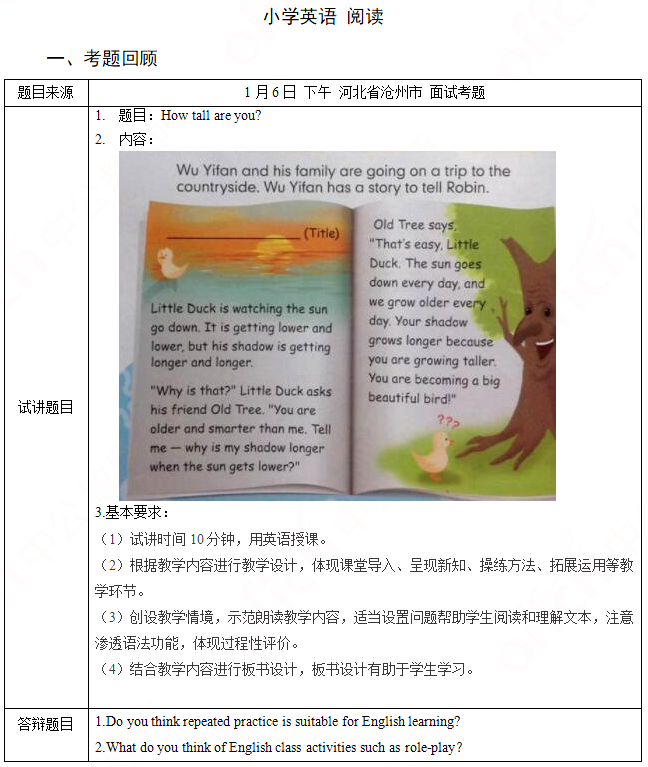
二、考题解析
【教学设计】
Teaching aims:
Knowledge aims:
Students will know about the relation between shadow and the sun through reading the passage.
Students will master the usage of comparative degree in the reading.
Ability aim:
Students will apply the comparative degree to retell the story.
Emotional aim:
Students will be more interest in learning English.
Key and difficult point:
Key Point: Students will master the usage of comparative degree in the reading.
Difficult Point: Students will apply the comparative degree to retell the story.
Teaching procedure:
Step 1: Warming-up
1. Greetings.
2. Play a riddle--it rises up and goes down every day, what is it? and students guess it’s the sun, then lead to the story about the sun.
Step 2: Pre-reading
According to the word “sun”, students have a brainstorm about what natural phenomenon about sun they have known.
Step 3: While-reading
1. Fast reading: students read the passage fast and figure out what the tree and the duck are talking about.
2. Careful reading: students read the passage carefully and answer the question: why does the shadow get longer when the sun gets lower? And underline the words with “er”.
3. The teacher explains the words with “er” to the students.
Step4: Post-reading
1. Students work in pairs to make a role-play (one is the little duck, the other is the old tree) to make a conversation according to the passage.
2. Students work in groups to find the real reason why the shadow gets longer when the sun gets lower.
Step5: Summary and Homework
Summary: ask a student to conclude the content of the lesson and summarize with the whole class.
Homework: students tell the story to their parents.
Blackboard design:

1.Do you think repeated practice is suitable for English learning?
2.What do you think of English class activities such as role-play?答案:解析:1.
Reciting is a way of practicing. There is a gap between understanding English and using English. For students, even if they think they can remember what they learn in class, after class while applying the knowledge taught in class, it possibly doesn’t work very well. So it is a practice way but we can not only use it. We need to use more practice ways together reciting to ensure the effect of teaching and learning.
2.
English class activities play an important role in English teaching. These performances can stimulate students' interest in learning English, mobilize students' enthusiasm for learning English, activate classroom atmosphere, reduce students' learning pressure, help students overcome fear of English learning, cultivate students' participation awareness, cooperation spirit and leadership ability. -
第17题:
共用题干
Verne's Accurate Previw of the Future
Since the beginning of time,man has been interested in the moon.The Romans designed a special day to show admiration and respect to the moon.They called it“Moonday”,or “Monday”,as we know it today.Later,the great mind of Leonardo da Vinci studied the moon and designed a machine to carry a human to the moon.Leonardo said that one day a great machine bird would take a person to the moon and bring great honor to the home where it was born.
Four and a half centuries later,Leonardo's idea was realized.Apollo Ⅱ took three
Americans一Collins,Aldrin,and Armstrong一to the moon.The mission did fill the whole world with great surprise,as Leonardo had said it would.Numerous essays,articles,and books were written about man's first moon mission.But perhaps the most interesting story was one written before the event一over 100 years ago.
In 1865,French author Jules Verne wrote a story about the first journey to the moon.His story was very similar to the 1969 Apollo Ⅱ mission.
Verne's spacecraft also contained three men一two Americans and a Frenchman.The spacecraft was described as being almost the same size as Apollo Ⅱ .The launch site in Verne's story was also in Florida.The spacecraft in Verne's story was named the“Columbiad”aa.The Apollo Ⅱ command ship was called“Columbia”.His account of sending the space-craft into the space could easily have been written about how Apollo Ⅱ was sent into the space.
Verne's story was the same as the actual event in several other respects.The speed of Verne's spacecraft was 36,000 feet per second;Apollo's was 35,533 feet per second.Verne's spacecraft took 97 hours to reach the moon;Apollo's time was 103 hours.Like Apollo's spacemen,Verne's spacemen took pictures of the moon's surface,relaxed on their seats, cooked with gas,and experienced weightlessness.They also came down in the Pacific and were picked up by an American warship.
What were the reasons for Jules Verne's extreme accuracy in describing an event 100 years or more before it actually occurred?He based his writings on the laws of physics and astronomy(天文学).Nineteenth-century science and the vivid Verne's imagination gave people an unbelievable accurate preview of the greatest events of the 20th century.The passage suggests that Jules Verne______.
A:developed the laws of physics
B:based his writing on the works of Leonardo da Vinci
C:was very lucky in what he had described about the future
D:knew a great deal about the laws of physics and astronomy答案:D解析:题干意为“Leonardo da Vinci说一个巨大的机器飞鸟将……”。利用题干中 的细节信息词/短语Leonardo da Vinci, a great machine bird作为定位线索,在第一段中找到 相关句:Since the beginning of time, man has been interested in the moon.The Romans designed a special day to show admiration and respect to the moon.They called it“Moonday”, or“Monday”,as we know it today.Later,the great mind of Leonardo da Vinci studied the moon and designed a machine to carry a human to the moon.Leonardo said that one day a great machine bird would take a person to the moon and bring great honor to the home where it was born.意为“Leonardo说将来有一天,一个巨大的机器飞鸟将把人带到月球上去,并因此给它所诞生的国家带来荣誉”,由此可知答案为D,把人带到月球上。
题干意为“Jules Verne关于人类访问月球的故事写于大约什么时候?”利用 题干及四个备选项中的细节信息词/短语Jules Verne, story of a man's visit to the moon, 100 years before the Apollo Ⅱ mission,10 years before the Apollo Ⅱ mission four and onehalf centuries ago, 100 years ago作为定位线索,在第三段中找到相关句:In 1865, French author Jules Verne wrote a story about the first journey to the moon.His story was very similar to the 1969 Apollo Ⅱ mission.意为“1865年,法国作家Jules Verne写了关于第一次登月旅行。他的故事与1969年阿波罗二号的太空飞行任务很相似。”通过对比两个时间可知Jules Verne所写的故事比阿波罗二号的太空飞行任务早大约100年。
题干意为“Verne所写的故事与……很相似”。利用题干及四个备选项中的 细节信息词/短语Verne's story, the first U.S.space mission, the Apollo Ⅱ mission, Leonardo da Vinci's story, numerous other books, same subject作为定位线索,在第三段中找到 相关句:In 1865 .French author Jules Verne wrote a story about the first journey to the moon.His story was very similar to the 1969 Apollo Ⅱ mission.意为“1865年,法国作家 Jules Verne写了关于第一次登月旅行。他的故事与1969年阿波罗二号的太空飞行任务很相似。”由此可知答案为B,
题干意为“短文表明Jules Verne是怎样一个人?”利用题干及四个备选项中的细节信息词/短语Jules Verne,laws of physics, writing, works of Leonardo da Vinci, fu-ture, a great deal, laws of physics and astronomy作为定位线索,在最后一段中找到相关句: What were the reasons for Jules Verne's extreme accuracy in describing an event 100 years or more before it actually occurred?He based his writings on the laws of physics and astronomy (天文学).Nineteenth-century science and the vivid Verne's imagination gave people an un-believable accurate preview of the greatest events of the 20th century.由第二句可知“他 (Jules Verne)的作品是根据物理学和天文学的规律写成的”,因此答案为D,深知物理学和天文学的规律。 -
第18题:
共用题干
Verne's Accurate Previw of the Future
Since the beginning of time,man has been interested in the moon.The Romans designed a special day to show admiration and respect to the moon.They called it“Moonday”,or “Monday”,as we know it today.Later,the great mind of Leonardo da Vinci studied the moon and designed a machine to carry a human to the moon.Leonardo said that one day a great machine bird would take a person to the moon and bring great honor to the home where it was born.
Four and a half centuries later,Leonardo's idea was realized.Apollo Ⅱ took three
Americans一Collins,Aldrin,and Armstrong一to the moon.The mission did fill the whole world with great surprise,as Leonardo had said it would.Numerous essays,articles,and books were written about man's first moon mission.But perhaps the most interesting story was one written before the event一over 100 years ago.
In 1865,French author Jules Verne wrote a story about the first journey to the moon.His story was very similar to the 1969 Apollo Ⅱ mission.
Verne's spacecraft also contained three men一two Americans and a Frenchman.The spacecraft was described as being almost the same size as Apollo Ⅱ .The launch site in Verne's story was also in Florida.The spacecraft in Verne's story was named the“Columbiad”aa.The Apollo Ⅱ command ship was called“Columbia”.His account of sending the space-craft into the space could easily have been written about how Apollo Ⅱ was sent into the space.
Verne's story was the same as the actual event in several other respects.The speed of Verne's spacecraft was 36,000 feet per second;Apollo's was 35,533 feet per second.Verne's spacecraft took 97 hours to reach the moon;Apollo's time was 103 hours.Like Apollo's spacemen,Verne's spacemen took pictures of the moon's surface,relaxed on their seats, cooked with gas,and experienced weightlessness.They also came down in the Pacific and were picked up by an American warship.
What were the reasons for Jules Verne's extreme accuracy in describing an event 100 years or more before it actually occurred?He based his writings on the laws of physics and astronomy(天文学).Nineteenth-century science and the vivid Verne's imagination gave people an unbelievable accurate preview of the greatest events of the 20th century.Verne's story is very similar to______.
A:the first U.S.space mission
B:the Apollo Ⅱ mission
C:Leonardo da Vinci's story
D:numerous other books on the same subject答案:B解析:题干意为“Leonardo da Vinci说一个巨大的机器飞鸟将……”。利用题干中 的细节信息词/短语Leonardo da Vinci, a great machine bird作为定位线索,在第一段中找到 相关句:Since the beginning of time, man has been interested in the moon.The Romans designed a special day to show admiration and respect to the moon.They called it“Moonday”, or“Monday”,as we know it today.Later,the great mind of Leonardo da Vinci studied the moon and designed a machine to carry a human to the moon.Leonardo said that one day a great machine bird would take a person to the moon and bring great honor to the home where it was born.意为“Leonardo说将来有一天,一个巨大的机器飞鸟将把人带到月球上去,并因此给它所诞生的国家带来荣誉”,由此可知答案为D,把人带到月球上。
题干意为“Jules Verne关于人类访问月球的故事写于大约什么时候?”利用 题干及四个备选项中的细节信息词/短语Jules Verne, story of a man's visit to the moon, 100 years before the Apollo Ⅱ mission,10 years before the Apollo Ⅱ mission four and onehalf centuries ago, 100 years ago作为定位线索,在第三段中找到相关句:In 1865, French author Jules Verne wrote a story about the first journey to the moon.His story was very similar to the 1969 Apollo Ⅱ mission.意为“1865年,法国作家Jules Verne写了关于第一次登月旅行。他的故事与1969年阿波罗二号的太空飞行任务很相似。”通过对比两个时间可知Jules Verne所写的故事比阿波罗二号的太空飞行任务早大约100年。
题干意为“Verne所写的故事与……很相似”。利用题干及四个备选项中的 细节信息词/短语Verne's story, the first U.S.space mission, the Apollo Ⅱ mission, Leonardo da Vinci's story, numerous other books, same subject作为定位线索,在第三段中找到 相关句:In 1865 .French author Jules Verne wrote a story about the first journey to the moon.His story was very similar to the 1969 Apollo Ⅱ mission.意为“1865年,法国作家 Jules Verne写了关于第一次登月旅行。他的故事与1969年阿波罗二号的太空飞行任务很相似。”由此可知答案为B,
题干意为“短文表明Jules Verne是怎样一个人?”利用题干及四个备选项中的细节信息词/短语Jules Verne,laws of physics, writing, works of Leonardo da Vinci, fu-ture, a great deal, laws of physics and astronomy作为定位线索,在最后一段中找到相关句: What were the reasons for Jules Verne's extreme accuracy in describing an event 100 years or more before it actually occurred?He based his writings on the laws of physics and astronomy (天文学).Nineteenth-century science and the vivid Verne's imagination gave people an un-believable accurate preview of the greatest events of the 20th century.由第二句可知“他 (Jules Verne)的作品是根据物理学和天文学的规律写成的”,因此答案为D,深知物理学和天文学的规律。 -
第19题:
What do you think about this story? ()
AThank you for telling me the story.
BYes, it‘s a real story.
CI like it very much.
DSo do I.
C
略 -
第20题:
单选题Peter: Shall we go out again tomorrow? Barbara: ______ Peter: I’ll come round at 8 o’clock to pick you up. Barbara: All right. I’ll see you thenAOh yes. That would be great.
BI’d like to, but my sister’s coming to see me.
COK. Where shall we go?
DTomorrow? Let me think about it and give you my answer tomorrow morning.
正确答案: B解析:
从Peter的回答可知,Barbara同意明天出去,选项A符合语境。 -
第21题:
单选题—This is ______ picture I told you about. —I see. Isn’t it_____ beautiful one?Aa; a
Bthe; a
Cthe; the
Da; the
正确答案: D解析:
句意:——这就是我告诉你的那幅图片。——我明白了,这难道不是一幅美丽的图吗?第一空表示特指“我告诉你的那幅图”,要用定冠词the。第二空泛指“一幅漂亮的图”,用不定冠词a。故答案是B项。 -
第22题:
单选题Which is said about The Flying Hat?AA movie about the story is coming out.
BPeople can buy the book all over the world.
CThe writer started the book because of a mistake.
DThe story is about a boy with a magic book.
正确答案: C解析:
细节理解题。根据最后一段中的“The Story is making its way into movie theaters. ”可知,关于这个故事的影片即将上映了。 -
第23题:
单选题What do you think about this story? ()AThank you for telling me the story.
BYes, it‘s a real story.
CI like it very much.
DSo do I.
正确答案: A解析: 暂无解析