
单选题下列代码将对象写入的设备是( )。ByteArrayOutputStream bout = new ByteArrayOutputStream();ObjectOutputStream out = new ObjectOutputStream(bout);Out.writeObject(this);Out.close();A 内存B 硬盘C 屏幕D 网络
题目
内存
硬盘
屏幕
网络
相似考题
更多“单选题下列代码将对象写入的设备是( )。ByteArrayOutputStream bout = new ByteArrayOutputStream();ObjectOutputStream out = new ObjectOutputStream(bout);Out.writeObject(this);Out.close();A 内存B 硬盘C 屏幕D 网络”相关问题
-
第1题:
请完成程序,首先由一个类simple实现Serializable接口,并有三个成员变量,分别为int型、double型和String型,可以用toString的方法显示这三个成员变量。在main方法中创建这个simple的持久对象,根据用户在命令行输入的三个参数来设定其中成员变量的值。然后,将这个对象写入名为TheSerial.data的文件中,并显示成员变量。最后从文件TheSerial.data中读出三个成员变量并显示出来。
注意:请勿修改main()主方法和其他已有语句内容,仅在横线处填入适当语句。
import java.io.*;
class TheSerial implements Serializable
{
private int intvalue;
private double doublevalue;
private String string;
The Serial ()
{
intvalue=123;
doublevalue=12.34;
string="Serialize Test";
}
public void setDouble(double d)
{
doublevalue=d;
}
public void setInt(int i)
{
intvalue=i;
}
public void setString(String s)
{
string=s;
}
public String to String()
{
return("int="+intvalue+" double="+doublevalue+" string="+string);
}
}
public class simple
{
public static void main(String[] args)
{
The Serial e1=new TheSerial();
TheSerial e2;
try
{
e1.setInt(Integer.parseInt(args[0]));
e1.setDouble(Double.parseDouble(args[1]));
e1.setString(args[2]);
}
catch(Exception e)
{
e1.setString(e.getMessage());
}
System.out.println(e1);
try
{
FileOutputStream S=new FileOutputStream("TheSerial.data");
ObjectOutputStream OS=new ObjectOutputStream(oS);
______;
}
catch(IOException ioException)
{
System.out.println (ioException.getMessage ());
}
try
{
FileInputStream iS=new FileInputStream("TheSerial.data");
ObjectInputStream IS=new ObjectInputStream(iS);
______;
System.out.println(e2);
}
catch(IOException ioException)
{
System.out.println(ioException.getMessage());
}
catch(ClassNotFoundException cnfException)
{
System.out.println(cnfException.getMessage());
}
}
}
正确答案:oOs.writeObject(e1) e2=(TheSerial)oIS.readObject()
oOs.writeObject(e1) e2=(TheSerial)oIS.readObject() 解析:本题考查知识点:串行化要领和目的、串行化方法、基于文本的应用。解题思路:本题主要考查串行化相关的方法和实现。解题中首先要掌握串行化的基本过程和反串行化的过程。串行化过程首先要创建一个FileOutputStream,通过该类的实例对文件进行访问,然后创建一个ObjectOutputStream对象,通过writeObject()方法来实现对象的序列化。第1个空就是使用writeObject()实现序列化。反序列化过程中用FileInputStream对象建立读取文件的连接,并使用该对象创建一个ObjectInputSream实例的readObject()方法就可以实现对象的反序列化。第2个空就是使用readObject()实现反序列化。 -
第2题:
下列程序将类C15的对象写入文件filetxt,选择正确的语句填入下列程序的横线处。 package ch2; import java.util.*; import java.io.*; class C15______ { public iht a; public void setInt(int newa) { a = newa; } } public class Testl5 { pulibc static void main(String[] args) { C15 bj = new C15(); try { FileOutputStream fos =newFileOutputStream("ch2\\filel5.txt"); ObjectOutputStream os = ObjectOutputStream(fos); Obj.setInt(10); oos.writeObject(obj); oos.close (); fos.close(); } catch(IOException ioe) { ioe.printStackTrace(); } } }
A.implements Runnable
B.implements Sedalizable
C.extends Serializable
D.implements InputStream
正确答案:B
解析:类C15必须实现Serializable接口,否则无法进行对象流的写入。 -
第3题:
下列代码将对象写入的设备是( )。
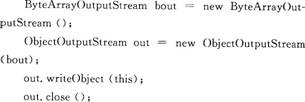
A.内存
B.硬盘
C.屏幕
D.网络
正确答案:A
ObjectOutputStream类的构造方法是ObjectOutputStream(OutputStreamout)。Java中的二进制流全都写入到内存中。 -
第4题:
阅读下列Java语句: ObjectOutputStream Ut=new ObjectOutputStream(new ("employee.dat&quo阅读下列Java语句:
ObjectOutputStream Ut=new ObjectOutputStream
(new ("employee.dat"));
在下画线处,应填的正确选项是( )。
A.File
B.FileWriter
C.FileOutputStream
D.Outputstream
正确答案:C
C。【解析】ObjectOutputStream即继承了0utputStream抽象类,又实现了ObjectOutput接口,这是Java用接口技术代替双重继承的例子,其构造方法参数是串行化了的对象。所以,此处应为串行化的文件输出流。 -
第5题:
阅读下列Java语句: ObjectOutputStream Ut=new ObjectOutputStream(new ("employee.dat")); 在下画线处,应填的正确选项是( )。
A.File
B.FileWriter
C.FileOutputStream
D.Outputstream
正确答案:C
C。【解析】ObjectOutputStream即继承了0utputStream抽象类,又实现了ObjectOutput接口,这是Java用接口技术代替双重继承的例子,其构造方法参数是串行化了的对象。所以,此处应为串行化的文件输出流。 -
第6题:
ByteArrayOutputStream类会在创建对象时就创建一个()型数组的缓冲区答案:byte
-
第7题:
( 34 )在下列程序的空白处,应填入的正确选项是
Import java.io.*;
Pulilc class ObjectStreamTest{
Publilc static void main(string args[]) throws IOException{
ObjectOutputStream s= new ObjectOutputStream
(new FileOutputStream( “ serial.bin ” ));
Java .util.Date d= new Java.util.Date();
Oos___________ (d);
ObjectInputStream is=
new ObjectInputStream(new FileOutputStream( “ serial.bin ” ));
try{
java.util.date restoredDate =
(Java.util.Date) ois.readObject();
System.out.println
( “ read object back from serial.bin file: ”
+ restoredDate);
}
Catch (ClassNotFoundException cnf) {
System.out.println ( “ class not found ” );
}
}
A ) WriterObject
B ) Writer
C )BufferedWriter
D ) WriterObject
正确答案:D
-
第8题:
在J2EE中,用JAXP转化XML文档,可以创建输出流把数据输出到屏幕上,以下创建该输出流的代码是()
- A、 Stream result = stream.newStream(System.out)
- B、 StreamResult result = new StreamResult(System.out)
- C、 Stream result = new Stream(System.out)
- D、 StreamResult result = DOMSource.newStreamResult(System.out)
正确答案:B -
第9题:
单选题在J2EE中,用JAXP转化XML文档,可以创建输出流把数据输出到屏幕上,以下创建该输出流的代码是()AStream result = stream.newStream(System.out)
BStreamResult result = new StreamResult(System.out)
CStream result = new Stream(System.out)
DStreamResult result = DOMSource.newStreamResult(System.out)
正确答案: A解析: 暂无解析 -
第10题:
单选题能清除缓冲区中的数据,并且把数据写到客户端是out对象中的方法是()。Aout.newLine()
Bout.clear()
Cout.flush()
Dout.clearBuffer()
正确答案: C解析: 暂无解析 -
第11题:
单选题阅读下列Java语句:ObjectOutputStream out=new ObjectOutputStream(new ______(employee.dat));在下画线处,应填的正确选项是( )。AFile
BFileWriter
CFileOutputStream
DOutputStream
正确答案: D解析:
将对象转换为字节流保存起来,并在日后还原这个对象,这种机制称做对象串行化。ObjectOutputStream类的构造方法参数是串行化了的对象。此处是串行化了的文件输出流FileOutputStream,本题也可以填写ByteArrayOutputStream,这两种是Java中很经典的串行化模式。 -
第12题:
单选题在J2EE中,用JAXP转化XML文档,可以创建输出流把数据输出到屏幕上,以下创建该输出流的代码是()。AStream result = stream.newStream(System.out);
BStreamResult result = new StreamResult(System.out);
CStream result = new Stream(System.out);
DStreamResult result = DOMSource.newStreamResult(System.out);
正确答案: C解析: 暂无解析 -
第13题:
阅读下面Java语句 ObjectOutputStream ut=new ObjectOutputStream(new______("employee.dat"));在下画线处,应填的正确选项是
A.File
B.FileWriter
C.FileOutputStream
D.OutputStream
正确答案:C
解析:类ObjeetOutputStream是将一个对象写到一个流中,其原型为public ObjectOutputStream(OutputStream out),即参数为一个输出流。显然,在空白处新建了一个输出流的对象,其后还有一个参数“employee.dat”,是一个文件名,本题目的意思为将对象写入一个文件输出流。public FileOutputStream(String name),创建一个向具有指定名称的文件中写入数据的输出文件流。答案为C。 -
第14题:
选择正确的语句填在下列程序的横线处,使程序正常运行。 package ch1; import java. io. *; import j ava. util. *; class C45 implements Seritizable ______Public Thread t = new Thread(new T45(), "t"); public intcnt = 0; public C45() { t. start ( ) class T45 implements Runnable public int[] a = new int[4]; public void run() { for(int i - 0; i < 4; i++) { a[i] - i +4; } } } public class ex45 { static String fileName = "ch1\\file45.txt"; public static void main(String[] args) throws Exception { C45 bj = new C45 (); FileOutputStream fos = new FileOutputStream(fileName); ObjectOutputStream os = new ObjectOutputStream(fos); oos. writeObject (obj); oos.clese (); fos.close (); System. out, println (obj . toString ( ) ); } }
A.transient
B.protected
C.package
D.final
正确答案:A
-
第15题:
在下列程序的空白处,应填入的正确选项是( )。 Importjava.io.*; PulilcclassObjectStreamTest{ Publilcstaticvoidmain(string args [])thowsIOException{ ObjectOutputStream os=new ObjectOutputStream (newFileOutputStream(“serial.bln”)); Java.util.Dated=newJava.util.Date(); Oos______(d); ObjectlnputStreamois= newObjectlnputStream(newFileOutputStream(“serial.bin”)); try{ iava.util.daterestoredDate= (Java.util.Date)ois.readObject(); System.out.println (“readobjectbackfromserial.binfile:” +restoredDate); } Catch(ClassNotFoundException cnf){ System.out.println(“classnotfound”); } }
A.WriterObject
B.Writer
C.BufferedWriter
D.writerObject
正确答案:D
解析:本题考查的是输入输出及文件操作,WriterObject方法是往数据流中写入数据。 -
第16题:
下列代码将对象写入的设备是( )。 ByteArrayOutputStream bout=new ByteArrayOut- putStream; ObjectOutputStream ut=new ObjectOutputStream (bout); out.writeObject(this); out.close;
A.内存
B.硬盘
C.屏幕
D.网络
正确答案:A
A。【解析】ObjectOutputStream类的构造方法是obiectoutputStream(OutputStreamout)。Java中的二进制流全都写入到内存中。 -
第17题:
下列程序将Date对象写入文件file42.txt中,选择正确的语句填入下列程序中的横线处。 package ch1; impbrt java. io. *; import java. util. *; public class ex42 { static String fileName = "ch1\\file42.txt"; static Date date = null; public static void main(String[] args) { date = new Date(); try { FileOutputStream fos = new FileOutputStream(file Name); ObjectOutStream os = new ObjectOutputStream(fos); oos.______; oos.close(); fos.close(); System.out.println(date.toString()); } catch(Exception e) { System.out.println(e.getMessage()); } } }
A.writeObject()
B.writeObject(date)
C.write(date)
D.writeByte(date)
正确答案:B
-
第18题:
下列选项中,关于ByteArrayOutputStream类的描述正确的是?()A.ByteArrayOutputStream流中缓冲区的大小不能被定义
B.ByteArrayOutputStream流关闭后仍可被调用,并且不会产生任何IOException
C.ByteArrayOutputStream流关闭后不能被使用,否则抛出IOException
D.ByteArrayOutputStream流必须与ByteArrayInputStream流配对使用
答案:B
解析:使用ByteArrayOutputStream(int size)构造方法便可以设置缓冲区的大小;ByteArrayOutputStream流关闭后仍可被调用,并且不会产生任何IOException。ByteArrayOutputStream流与ByteArrayInputStream流分别对应的是字节输出流和字节输入流,没有强制要求配对使用。
-
第19题:
下列哪个类的方法能够直接把简单数据类型写入文件?()
- A、OutputStream
- B、BufferedWriter
- C、ObjectOutputStream.
- D、FileWriter
正确答案:C -
第20题:
import java.io.*; public class Forest implements Serializable { private Tree tree = new Tree(); public static void main(String [] args) { Forest f= new Forest(); try { FileOutputStream fs = new FileOutputStream(”Forest.ser”); ObjectOutputStream os = new ObjectOutputStream(fs); os.writeObject(f); os.close(); } catch (Exception ex) { ex.printStackTrace(); } } } class Tree { } What is the result?()
- A、 Compilation fails.
- B、 An exception is thrown at runtime.
- C、 An instance of Forest is serialized.
- D、 A instance of Forest and an instance of Tree are both serialized.
正确答案:B -
第21题:
单选题在下列程序的空白处,应填入的正确选项是( )。import java.io.*; public class ObjectStreamTest{ public static void main(string args[])throws IOException{ ObjectOutputStream oos=new ObjectOutputStream(new FileOutputStream("serial.bin")); Java.until.Date d=new Java.until.Date(); oos.______(); ObjectInputStream ois=new ObjectlnputStream(new FileOutputStream("serial.bin")); try{ java.until.date restoredDate=(Java.until.Date)ois.readObject(); System.out.println("read object back from serial.bin file:"+restoredDate); } catch(ClassNotFoundException cnf){ System.out.println("class not found"); } }AreadObject
BWriter
CBufferedWriter
DwriteObject
正确答案: C解析:
java.io包中,提供了0bjectInputStream和ObjectOutputStream将数据流功能扩展至可读写对象。在ObjectInputStream中用readObject()方法可以直接读取一个对象,0bjectOutputStream中用writeObject()方法可以直接将对象保存到输出流中。B项和C项,Writer和BufferedWriter都为java.io包中的类。 -
第22题:
单选题import java.io.*; public class Forest implements Serializable { private Tree tree = new Tree(); public static void main(String [] args) { Forest f= new Forest(); try { FileOutputStream fs = new FileOutputStream(”Forest.ser”); ObjectOutputStream os = new ObjectOutputStream(fs); os.writeObject(f); os.close(); } catch (Exception ex) { ex.printStackTrace(); } } } class Tree { } What is the result?()ACompilation fails.
BAn exception is thrown at runtime.
CAn instance of Forest is serialized.
DA instance of Forest and an instance of Tree are both serialized.
正确答案: B解析: 暂无解析 -
第23题:
单选题阅读下列代码段:ByteArrayOutputStream bout=new ByteArrayOutputStream();ObjectOutputStream out=new ObjectOutputStream(bout);out.writeObject(this);out.close();以上代码段的作用是( )。A将对象写入内存
B将对象写入硬盘
C将对象写入光盘
D将对象写入文件
正确答案: A解析:
在java.io包中,提供了ByteArrayInputStream、ByteArrayOutputStream和StringBufferInputStream类可直接访问内存,它们是InputStream和OutputStream的子类。用ByteArrayOutputStream可以向字节数组(缓冲区)写入数据。在ObjectInputStream中用readObject()方法可以直接读取一个对象,ObjectOutputStream中用writeObject()方法可以直接将对象保存到输出流中。