
单选题如果在/etc/group文件中有一行内容是“students::600:z3,l4,w5”,那么在“students”组中有多少个用户?()A 3B 4C 5D 不清楚
题目
单选题
如果在/etc/group文件中有一行内容是“students::600:z3,l4,w5”,那么在“students”组中有多少个用户?()
A
3
B
4
C
5
D
不清楚
相似考题
更多“如果在/etc/group文件中有一行内容是“students::600:z3,l4,w5”,那么在“students””相关问题
-
第1题:
When students engaged in group work, the teacher gave feedback after each group hadstated their opinion and shown their output. This is calledA.instructing
B.observing
C.monitoring
D.evaluating答案:D解析:考查评价行为的概念。教师在每组陈述完观点后,给出自己的评价和反馈信息,这是评价行为(evaluating)。 -
第2题:
Which of the following is NOT the advantage of group workA.Creating some peaceful and quiet time in class.
B.Encouraging cooperation and negotiation skills among students.
C.Encouraging different opinions and contributions to the work.
D.Promoting students' autonomy rather than follow the teachers.答案:A解析:考查课堂活动的组织形式。只有A项不是小组活动的优势。 -
第3题:
Students can do _____ activities, such as, silent reading, doing written exercises, writing something down individually after brainstorming in a group, or individual speech preparations, etc.A.pair work
B.whole-class work
C.individual
D.group work答案:C解析:本题考查课堂管理中的课堂组织活动形式。
个体活动通常包括默读、做书面练习、在头脑风暴后写下一些自己的想法、或者个人演讲准备等等。学生可以分别做相同的任务或也可以给学生提供多个任务进行选择。综上,C选项正确。
A选项,结对活动,指的是两个学生一组做一个练习或者完成一个任务。故排除。
B选项,全班活动,指的是有些时候,所有的学生都在老师的控制下完成同一个任务。故排除。
D选项,小组活动,是指学生集合在一个小组的活动。每组有3、4或5个学生,数量根据不同的活动来定。
故正确答案为C项。 -
第4题:
小学英语《boy toy voice noise》
一、考题回顾

二、考题解析
【教案】
Teaching Aims:
Knowledge aim: Students know how to pronounce oy and oi then to use it.
Ability aim: Students can pronounce /??/ correctly and use it in other words.
Emotional aim: Students will enhance their confidence of pronouncing by realizing the practical use.
Teaching Key Points:题目来源于考生回忆
Students can have correct pronunciation of certain words of the same rule.
Teaching Difficult Points:
Students could be confident in pronouncing words.
Teaching Methods:
Communicative teaching method, inductive teaching method.
Teaching Aids:
PPT, Blackboard flashcards and so on
Teaching Procedures:
Step 1: Warming up
1.Greetings
2.Play an English song Billy boy, invite the whole students to clap when singing it. Introduce word boy to students.
Step 2: Presentation
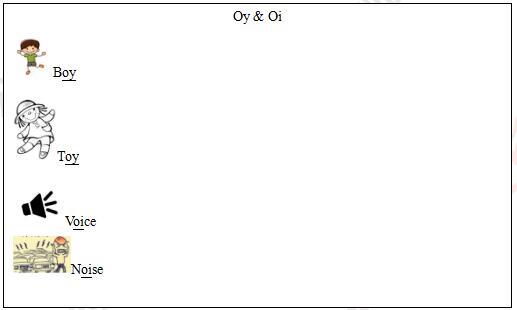
1. Draw pictures of boy and toy,then show the words after them.
2. Play a radio of voice and noise, let students know what the difference is between voice and noise, then show the English words.题目来源于考生回忆
3. Read the words together, and then let students find the common pronunciation part oy and oi.
Step 3: Practice
1. Play a game: play on the seesaw(high-low voice) then read lips guess the word.
2. Bingo: Divide four students in a group play the bingo game. Give each group a piece of paper with 9 words on it. The first group who can find the three words in a line with oy/oi should be the winner.
Step 4: Production
Read more words: Divide students into different groups then let them have a competition to read words on the flashcards, the fastest group will win the first prize. (Possible words: toy boy voice noise choice coin coy joy ploy), invite the fastest group play it in front of the class.
Step 5: Summary & Homework
Summary : students look at the blackboard and summarize this class.
Homework:students introduce the words and pronunciation to their friends or parents.
Blackboard design:
 答案:解析:暂无解析
 -
第5题:
二、考题解析
【教案】
Teaching Aims:
Knowledge aim: Students know how to pronounce oy and oi then to use it.
Ability aim: Students can pronounce /??/ correctly and use it in other words.
Emotional aim: Students will enhance their confidence of pronouncing by realizing the practical use.
Teaching Key Points:
Students can have correct pronunciation of certain words of the same rule.
Teaching Difficult Points:
Students could be confident in pronouncing words.
Teaching Methods:
Communicative teaching method, inductive teaching method.
Teaching Aids:
PPT, Blackboard flashcards and so on
Teaching Procedures:
Step 1: Warming up
1.Greetings
2.Play an English song Billy boy, invite the whole students to clap when singing it. Introduce word boy to students.
Step 2: Presentation
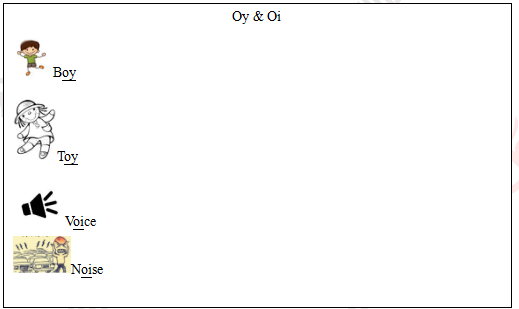
1. Draw pictures of boy and toy,then show the words after them.
2. Play a radio of voice and noise, let students know what the difference is between voice and noise, then show the English words.
3. Read the words together, and then let students find the common pronunciation part oy and oi.
Step 3: Practice
1. Play a game: play on the seesaw(high-low voice) then read lips guess the word.
2. Bingo: Divide four students in a group play the bingo game. Give each group a piece of paper with 9 words on it. The first group who can find the three words in a line with oy/oi should be the winner.
Step 4: Production
Read more words: Divide students into different groups then let them have a competition to read words on the flashcards, the fastest group will win the first prize. (Possible words: toy boy voice noise choice coin coy joy ploy), invite the fastest group play it in front of the class.
Step 5: Summary & Homework
Summary : students look at the blackboard and summarize this class.
Homework:students introduce the words and pronunciation to their friends or parents.
Blackboard design:
答案:解析:暂无解析 -
第6题:
资料:Special needs students can not only learn from regular education teachers, but can participate in collaborative learning with mainstream students as well. Collaborative learning allows students to work together in groups to complete lessons and assignments.
A number of educators with inclusion classrooms are realizing the benefits of collaborative learning and special needs students being placed in small group environments with regular education classmates. Collaborative learning allows students to converse with one another and brainstorm together in order to find solutions to problems or to complete an assignment. This type of learning allows students of varying ability levels to lend their individual strengths to the group as a whole, thereby encouraging an appreciation of diverse ideas and approaches to problem solving.
Teachers can choose to implement several different types of collaborative learning strategies, depending on the needs of students and the focus of specific assignments. Examples of small-group collaborative learning methods are:
1) The Think-Pair-Share strategy, which involves each student in the group taking one minute to formulate a response to the teacher's question, then sharing individual findings with a partner. After collaborating in pairs, students can then share input with slightly larger groups or with the entire class.
2) The Simple Jigsaw strategy, which involves four-person teams splitting a teacher-assigned task into equal parts. Each student in the group acts as an "expert" on one section of the assignment and meets with corresponding "experts" in other groups for discussion and task mastering. Students then return to their initial teams to share their knowledge of the task with other members.
3) The Three-Step Interview strategy, through which students initially break into pairs and take turns interviewing one another about an assignment. Each pair of students then combine with another pair in order to enhance the discussion.
4) The Numbered Heads Together strategy, where each team member is assigned a number, then instructed to collaborate on a question. The teacher then calls a number randomly, and the student in each group who has that number acts as spokesperson in answering the question. Each student must be prepared for the possibility of having his or her number chosen.
The benefits of collaborative learning and special needs students having the opportunity to engage in small group tasks can produce positive results in regard to classroom organization and management. Teachers who research tips on collaborative learning and implement the practice with students are likely to have a successful inclusion classroom.
What is the most distinct feature you think by the term “inclusion classroom”?( )A.It is desired for students with special needs
B.It is tutored by regular teachers for mainstream students
C.It is planned for collaborative learning by mainstream students
D.It has students with special needs and regular education classmates答案:D解析:本题考查细节理解。
【关键词】distinct feature; inclusion classroom
【主题句】第1自然段Special needs students can not only learn from regular education teachers, but can participate in collaborative learning with mainstream students as well. Collaborative learning allows students to work together in groups to complete lessons and assignments. 特殊需要的学生不仅可以从普通教师那里学习,而且可以与普通学生一起参与协作学习。协作学习允许学生小组合作完成课程和作业。第2自然段A number of educators with inclusion classrooms are realizing the benefits of collaborative learning and special needs students being placed in small group environments with regular education classmates.一些开展融合教室的教育工作者逐渐意识到了合作学习以及特殊需要的学生被安排到小组环境中与普通教育的同学们一起学习的益处。
【解析】本题的问题是“你认为‘融合教室’这一术语的最显著特征是什么?”。根据主题句可知,融合教室的最大特点就是普通教育的学生与特殊需要的学生在一起合作学习,故选D。 -
第7题:
资料:Special needs students can not only learn from regular education teachers, but can participate in collaborative learning with mainstream students as well. Collaborative learning allows students to work together in groups to complete lessons and assignments.
A number of educators with inclusion classrooms are realizing the benefits of collaborative learning and special needs students being placed in small group environments with regular education classmates. Collaborative learning allows students to converse with one another and brainstorm together in order to find solutions to problems or to complete an assignment. This type of learning allows students of varying ability levels to lend their individual strengths to the group as a whole, thereby encouraging an appreciation of diverse ideas and approaches to problem solving.
Teachers can choose to implement several different types of collaborative learning strategies, depending on the needs of students and the focus of specific assignments. Examples of small-group collaborative learning methods are:
1) The Think-Pair-Share strategy, which involves each student in the group taking one minute to formulate a response to the teacher's question, then sharing individual findings with a partner. After collaborating in pairs, students can then share input with slightly larger groups or with the entire class.
2) The Simple Jigsaw strategy, which involves four-person teams splitting a teacher-assigned task into equal parts. Each student in the group acts as an "expert" on one section of the assignment and meets with corresponding "experts" in other groups for discussion and task mastering. Students then return to their initial teams to share their knowledge of the task with other members.
3) The Three-Step Interview strategy, through which students initially break into pairs and take turns interviewing one another about an assignment. Each pair of students then combine with another pair in order to enhance the discussion.
4) The Numbered Heads Together strategy, where each team member is assigned a number, then instructed to collaborate on a question. The teacher then calls a number randomly, and the student in each group who has that number acts as spokesperson in answering the question. Each student must be prepared for the possibility of having his or her number chosen.
The benefits of collaborative learning and special needs students having the opportunity to engage in small group tasks can produce positive results in regard to classroom organization and management. Teachers who research tips on collaborative learning and implement the practice with students are likely to have a successful inclusion classroom.
What are the benefits of collarborative learning for special needs students? ( )A.It helps special needs students think creatively
B.It helps special needs students from all the attending students
C.It helps special needs students learn varied ability from classmates
D.It helps students work together on solving problems and assignments答案:D解析:本题考查细节理解。
【关键词】benefits;collaborative learning for special needs students
【主题句】第1自然段Special needs students can not only learn from regular education teachers, but can participate in collaborative learning with mainstream students as well. Collaborative learning allows students to work together in groups to complete lessons and assignments.
特殊需要的学生不仅可以从普通教育老师那里学习,还可以与普通学生一起参与合作学习。合作学习可以让学生一起开展团队合作完成课程和作业。
【解析】本题的问题是“对于特殊需要的学生来说,合作学习的益处是什么?”。根据主题句可知,合作学习可以使特殊需要的学生与主流学生一起解决问题与作业,故选D。 -
第8题:
在linux中,彻底删除一个用户可能会更改系统中的()。
- A、/etc/passwd文件
- B、/etc/shadow文件
- C、/home目录
- D、/etc/skel目录
- E、/etc/group文件
正确答案:A,B,C,E -
第9题:
如果在/etc/group文件中有一行内容是“students::600:z3,l4,w5”,那么在“students”组中有多少个用户?()
- A、3
- B、4
- C、5
- D、不清楚
正确答案:D -
第10题:
用来保存用户名、个人目录等资料的文件是()。
- A、/etc/shadow
- B、/etc/passwd
- C、/etc/inittab
- D、/etc/group
正确答案:B -
第11题:
单选题The teacher asks students to do a group-work task . Before the task, the teacher assigns roles clearly around the class, pointing to each student in turn . "You are A . . . you are B . . ., etc ."Here the teacher plays the role of ______ .Acontroller
Bprompter
Cfacilitator
Dorganizer
正确答案: B解析: -
第12题:
单选题在/etc/group中有一行students::600:z3,l4,w5,有多少用户在students组里?()A3
B4
C5
D不知道
正确答案: C解析: 暂无解析 -
第13题:
When students engaged in group work, the teacher gave feedback after each group had stated their opinion and shown their output. This is called__________.A.instructing
B.observing
C.monitoring
D.evaluating答案:D解析:考查评价行为的概念。教师在每组陈述完观点后,给出自己的评价和反馈信息,这是评价为(evaluating)。 -
第14题:
The teacher asks students to do a group-work task. Before the task, the teacher assigns roles clearly around the class, pointing to each student in turn."You are A ... you are B ..., etc."
Here the teacher plays the role of_______A.controller
B.prompter
C.facilitator
D.organizer答案:D解析:考查教师角色。教师在要求学生进行小组任务前,先给全班同学分配角色,这体现了教师的组织者角色。故选D。 -
第15题:

二、考题解析
【教案】
Teaching aims
Knowledge aim: students will know the pronunciation of the group of letter “ear”.
Ability aim: students can read words with “ear” when they learn vocabulary.
Emotional aim: students will be more interested in speaking English.
Key and difficult points:
How to pronounce the group of letter “ear”.
Teaching procedure:
Step 1: Warming-up
After greeting students, the teacher plays a game to warm up the class: I say you point. The teacher speaks out a certain part of the body and students point it quickly. For example: point your eye! Point your ear! Point your hand!
Step 2: Presentation
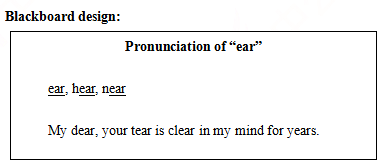
Draw a ear on the blackboard and ask students what it is. Write down the word. Then ask what ears can be used to, and they will say we use ear to hear something. Write down word “hear”. Then do the action of hearing and put hands near the ear, and write down the word “near”.
Ask students to read the three words after the teacher, and find out the similarity among them. After discussion, they will say all these words have “ear”. Then ask students how to pronounce this group of letter. We will know it pronounce as /ir/.
Step 3: practice
Give students some other words with the group of letter “ear” and ask students to read them by groups. For example, a sentence “my dear, your tear is clear in my mind for years”. Then students can have a brainstorming and think of more words with “ear”.
Play a game Hot potato to practice these words. The teacher plays a piece of music. When the music is playing, students pass the ball from one to another. When the music stops, the one who gets the ball should read words on the blackboard.
Step4: Production
Do a chant with students: put your ear, near my ear, and you will hear, and you will hear, and you will hear, NOTHING!
 答案:解析:暂无解析
 -
第16题:
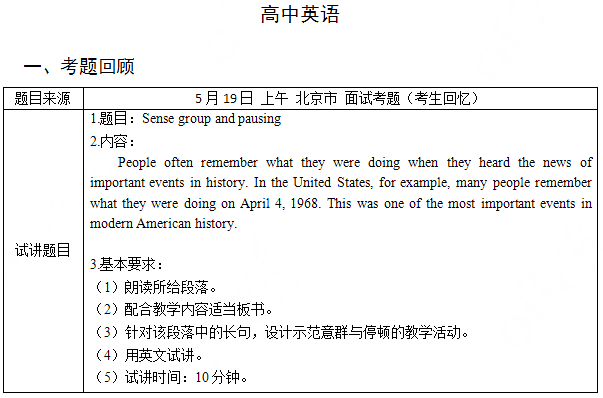
二、考题解析
【教案】
Teaching Aims:
Knowledge aim: Students will know what sense group is and master how to pause between sense groups.
Ability aim: Students can use the method to divide a long sentence into several parts and read the sentence more fluently.
Emotional aim: Students will improve their intonation and not be afraid of speaking English.
Teaching Key Points:
Students know the concept of sense group and pausing point of a long sentence.
Teaching Difficult Points:
Students can apply the pause between sense groups into daily reading to improve their pronunciation and intonation.
Teaching Methods:
Communicative teaching method, task-based teaching method, Audio-lingual teaching method.
Teaching Aids:
PPT, Blackboard and so on
Teaching Procedures:
Step 1: Warming up
1. Greetings
2.A tongue twister: I wish to wish the wish you wish to wish, but if you wish the wish the witch wishes, I won't wish the wish you wish to wish.
Step 2: Presentation
1.Ask students how to read a sentence quickly and in rhyme.
2.Read the first sentence twice. The first time without sense group pausing and the second time with it. Let students compare the two and find out the difference. Sense group is a meaning unit.
3.Explain the principle of sense group, which is according to
(1)grammar
(2)meaning
(3)punctuation
4. Divide the first sentence mainly according to grammar.
Step 3: Practice
1. Students read the first sentence, pausing according to sense group.
2. Students try to divide sense groups of the second sentence and read it.
Step 4: Production
Role-play: Students imagine a dialogue with a foreigner and apply sense group pausing in the dialogue. teacher will give them 10 minutes to prepare it and 10 minutes later, invite some students to role the conversation in the front.
Step 5: Summary & Homework
Summary : students look at the blackboard and summarize this class.
Homework: seek for a part of an English movie to make a dubbing.
Blackboard design:
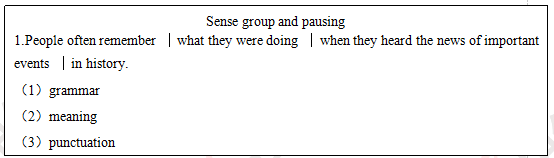 答案:解析:暂无解析
 -
第17题:
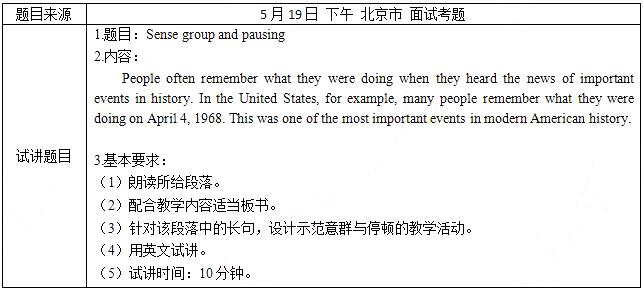
二、考题解析
【教案】
Teaching Aims:
Knowledge aim: Students will know what sense group is and master how to pause between sense groups.
Ability aim: Students can use the method to divide a long sentence into several parts and read the sentence more fluently.
Emotional aim: Students will improve their intonation and not be afraid of speaking English.
Teaching Key Points:
Students know the concept of sense group and pausing point of a long sentence.
Teaching Difficult Points:题目来源于考生回忆
Students can apply the pause between sense groups into daily reading to improve their pronunciation and intonation.
Teaching Methods:
Communicative teaching method, task-based teaching method, Audio-lingual teaching method.
Teaching Aids:
PPT, Blackboard and so on
Teaching Procedures:
Step 1: Warming up
1. Greetings
2.A tongue twister: I wish to wish the wish you wish to wish, but if you wish the wish the witch wishes, I won't wish the wish you wish to wish.
Step 2: Presentation题目来源于考生回忆
1.Ask students how to read a sentence quickly and in rhyme.
2.Read the first sentence twice. The first time without sense group pausing and the second time with it. Let students compare the two and find out the difference. Sense group is a meaning unit.
3.Explain the principle of sense group, which is according to
(1)grammar
(2)meaning
(3)punctuation
4. Divide the first sentence mainly according to grammar.
Step 3: Practice
1. Students read the first sentence, pausing according to sense group.
2. Students try to divide sense groups of the second sentence and read it.
Step 4: Production
Role-play: Students imagine a dialogue with a foreigner and apply sense group pausing in the dialogue. teacher will give them 10 minutes to prepare it and 10 minutes later, invite some students to role the conversation in the front.题目来源于考生回忆
Step 5: Summary & Homework
Summary : students look at the blackboard and summarize this class.
Homework: seek for a part of an English movie to make a dubbing.
Blackboard design:
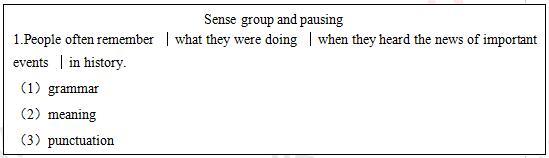 答案:解析:暂无解析
 -
第18题:
资料:Special needs students can not only learn from regular education teachers, but can participate in collaborative learning with mainstream students as well. Collaborative learning allows students to work together in groups to complete lessons and assignments.
A number of educators with inclusion classrooms are realizing the benefits of collaborative learning and special needs students being placed in small group environments with regular education classmates. Collaborative learning allows students to converse with one another and brainstorm together in order to find solutions to problems or to complete an assignment. This type of learning allows students of varying ability levels to lend their individual strengths to the group as a whole, thereby encouraging an appreciation of diverse ideas and approaches to problem solving.
Teachers can choose to implement several different types of collaborative learning strategies, depending on the needs of students and the focus of specific assignments. Examples of small-group collaborative learning methods are:
1) The Think-Pair-Share strategy, which involves each student in the group taking one minute to formulate a response to the teacher's question, then sharing individual findings with a partner. After collaborating in pairs, students can then share input with slightly larger groups or with the entire class.
2) The Simple Jigsaw strategy, which involves four-person teams splitting a teacher-assigned task into equal parts. Each student in the group acts as an "expert" on one section of the assignment and meets with corresponding "experts" in other groups for discussion and task mastering. Students then return to their initial teams to share their knowledge of the task with other members.
3) The Three-Step Interview strategy, through which students initially break into pairs and take turns interviewing one another about an assignment. Each pair of students then combine with another pair in order to enhance the discussion.
4) The Numbered Heads Together strategy, where each team member is assigned a number, then instructed to collaborate on a question. The teacher then calls a number randomly, and the student in each group who has that number acts as spokesperson in answering the question. Each student must be prepared for the possibility of having his or her number chosen.
The benefits of collaborative learning and special needs students having the opportunity to engage in small group tasks can produce positive results in regard to classroom organization and management. Teachers who research tips on collaborative learning and implement the practice with students are likely to have a successful inclusion classroom.
What is mainly depending on for teachers to collaborative learning strategies? ( )A.The varied ability levels of the special needs students
B.The needs from the special needs students
C.The difficulty levels of the learning tasks
D.The focus of the specific assignment答案:D解析:本题考查细节理解。
【关键词】depending on;collaborative learning strategies
【主题句】第3自然段Teachers can choose to implement several different types of collaborative learning strategies, depending on the needs of students and the focus of specific assignments.教师可以根据学生的需要和聚焦具体作业的特点,选择实施几种不同类型的合作学习策略。
【解析】本题的问题是“教师选择合作学习策略的主要依据是什么?”。根据主题句可知,教师根据学生的需要和聚焦具体作业的特点,选择实施不同类型的合作学习策略,故选D。选项B强调的是“特殊学生的需求”,缩小了范围,因此错误。 -
第19题:
资料:Special needs students can not only learn from regular education teachers, but can participate in collaborative learning with mainstream students as well. Collaborative learning allows students to work together in groups to complete lessons and assignments.
A number of educators with inclusion classrooms are realizing the benefits of collaborative learning and special needs students being placed in small group environments with regular education classmates. Collaborative learning allows students to converse with one another and brainstorm together in order to find solutions to problems or to complete an assignment. This type of learning allows students of varying ability levels to lend their individual strengths to the group as a whole, thereby encouraging an appreciation of diverse ideas and approaches to problem solving.
Teachers can choose to implement several different types of collaborative learning strategies, depending on the needs of students and the focus of specific assignments. Examples of small-group collaborative learning methods are:
1) The Think-Pair-Share strategy, which involves each student in the group taking one minute to formulate a response to the teacher's question, then sharing individual findings with a partner. After collaborating in pairs, students can then share input with slightly larger groups or with the entire class.
2) The Simple Jigsaw strategy, which involves four-person teams splitting a teacher-assigned task into equal parts. Each student in the group acts as an "expert" on one section of the assignment and meets with corresponding "experts" in other groups for discussion and task mastering. Students then return to their initial teams to share their knowledge of the task with other members.
3) The Three-Step Interview strategy, through which students initially break into pairs and take turns interviewing one another about an assignment. Each pair of students then combine with another pair in order to enhance the discussion.
4) The Numbered Heads Together strategy, where each team member is assigned a number, then instructed to collaborate on a question. The teacher then calls a number randomly, and the student in each group who has that number acts as spokesperson in answering the question. Each student must be prepared for the possibility of having his or her number chosen.
The benefits of collaborative learning and special needs students having the opportunity to engage in small group tasks can produce positive results in regard to classroom organization and management. Teachers who research tips on collaborative learning and implement the practice with students are likely to have a successful inclusion classroom.
Which following one is NOT true about the “Simple Jigsaw strategy”? ( )A.Task mastering students work on a teacher-assigned task
B.It involves four-person teams
C.Each student in the group acts as an “expert”
D.teacher-assigned task is divided into equal parts答案:A解析:本题考查细节理解。
【关键词】not true;Simple Jigsaw strategy
【主题句】第5自然段The Simple Jigsaw strategy, which involves four-person teams splitting a teacher-assigned task into equal parts. Each student in the group acts as an "expert" on one section of the assignment and meets with corresponding "experts" in other groups for discussion and task mastering. Students then return to their initial teams to share their knowledge of the task with other members.
简单的拼图策略,它由四人组成一组,将教师分配的任务分成相等的部分。小组中的每一个学生在作业的一部分担任“专家”,并在其他小组与同一任务的“专家”进行讨论和任务掌握。然后,学生返回到最初的团队,与其他成员分享任务的知识。
【解析】本题的问题是“关于简单的拼图策略,以下哪一项是不正确的?”。主题句中,B、C、D三个选项均有涉及,故选A。选项A强调任务是由教师分配的,因此错误。 -
第20题:
在linux中存放用户信息的文件是()。
- A、/etc/passwd
- B、/etc/login.def
- C、/etc/shadow
- D、/etc/group
正确答案:A -
第21题:
在/etc/group中有一行students:600:z3,l4,w5,有多少用户在students组里?()
- A、3
- B、4
- C、5
- D、不知道
正确答案:D -
第22题:
单选题The library’s upper floor is mainly for students to _____.Aread in a quiet place
Bhave group discussions
Ctake comfortable seats
Dget their computers fixed
正确答案: A解析:
根据Zones部分第二句话“The upper floor is a quiet zone with over a thousand places for silent reading”可知,最高的那一层楼是个供学生安静读书的地方,A项为正确答案。 -
第23题:
单选题For better classrooru management, what should the teacher do while the students are doing activities?AParticipating in a group.
BPreparing for the next procedure.
CMoving around to monitor, prompt students and provide help.
DStanding in front of the class.
正确答案: C解析: