
单选题The author believes that we feel unhappy maybe because _____.A it is our natural emotion in the lifeB culture asks us to be different from othersC everyone has their own opinions on thingsD we dislike something in the beginning
题目
it is our natural emotion in the life
culture asks us to be different from others
everyone has their own opinions on things
we dislike something in the beginning
相似考题
更多“The author believes that we feel unhappy maybe because _____”相关问题
-
第1题:
Maybe we can visit another place. This one is too ________ (tourist).
正确答案:
49. touristy -
第2题:
We are interested in the weather because it ______ us so directly — what we wear, what we do, and even how we feel.A.benefits
B.affects
C.affects
D.effects
正确答案:B
-
第3题:
The sentence "But we pay for our sensitivity." in the third paragraph implies that______.
A) we should pay a debt for, our feeling
B) we have to be hurt when We feel something
C) our pain is worth feeling
D) when we feel pain, we are suffering it
正确答案:D
答案:D
[试题分析]综合理解题。
[详细解答]根据上下文,因为下一句指出We can feel pain when the slightest thing is wrong with any part of our body.显然,这里pay for不是“付钱”的意思,而是指“为…付出”。因此,D为最佳答案。
-
第4题:
We may safely conclude that ______.
A) the author belongs to the anti-railway group
B) the author belongs to the pro-railway group
C) the author speaks highly of the railway
D) the author may never take train because of its potential dangers
正确答案:A
答案:A
[试题分析]事实判断题。
[详细解答]文中完全都是在谈论反对火车的人的一些论据,可以推断作者是反对者无疑。可以确定正确答案为 A。后三项都与文章内容不符或缺乏事实依据。
-
第5题:
Which of the following statements is true?__________A.The author believes that a born naturalist can not be a scientist
B.The author read a lot of books about the natural world and oil industry
C.The author's brothers and sisters were good at music and languages
D.The author spend a lot of time working on riddles答案:C解析:由第一段“Unlike them,I had no ear for music and languages”,可知,作者的兄弟姐妹们擅长于音乐和语言,故C项正确。A项无中生有,B项oilindustry错误,D项与第三段矛盾。 -
第6题:
资料:Procrastination comes in many disguises. We might resolve to tackle a task, but find endless reasons to defer it. We might prioritize things we can readily tick off our to-do list- answering emails, say- while leaving the big, complex stuff untouched for another day. We can look and feel busy. while artfully avoiding the tanks that really matter. And when we look at those rolling, long untouched items at the bottom of our to-do list, we can't help but feel a little disappointed in ourselves.
The problem is our brains are programmed to procrastinate. In general, we all tend to struggle with task that promise future upside in return for efforts we take now. That's because it's easier for our brains to process concrete rather than abstract things, and the immediate hassle is very tangible compared with those unknowable, uncertain future benefits. So the short-term effort easily dominates the long-term upside in our minds--an example of something that behavioral scientists call present bias.
How can you become less myopic about your elusive tasks? It's all about rebalancing the cost benefit analysis: make the benefits of action feel bigger, and the costs of action feel smaller. The reward for doing a pestering task needs to feel larger than the immediate pain of tacking it.
To make the benefits of action feel bigger and more real:
Visualize how great it will be to get it done. Researchers have discovered that people are more likely to save for their future retirement if they're shown digitally aged photographs of themselves. Why? Because it makes their future self feel more real-making the future benefits of saving also feel more weighty.
How can you become less myopic about your elusive tasks?A.Make the costs of action feel smaller.
B.Make the reward larger than the immediate pain of doing it.
C.Make the benefits of action feel bigger.
D.All the above.答案:D解析:本题考查的是细节理解。
【关键词】how; less myopic; elusive tasks
【主题句】第3自然段How can you become less myopic about your elusive tasks? It’s all about rebalancing the cost-benefit analysis: make the benefits of action feel bigger, and the costs of action feel smaller. The reward for doing a pestering task needs to feel larger than the immediate pain of tackling it. 对于困难的任务,你怎么能少一些目光短浅? 重新平衡成本效益分析很关键:让行动的好处变得更大,行动成本更小。 做困难任务的奖励需要比解决它的直接痛苦更大。
【解析】选项A意为“让行动的代价变得更小”;选项B意为“让奖励大于做它的直接痛苦”;选项C意为“让行动的好处感觉更大”;选项D意为“以上全部”。根据文章第3段的内容(主题句),可知A、B、C项原文都有提及,因此该题选D,所有都涉及。 -
第7题:
资料:Procrastination comes in many disguises. We might resolve to tackle a task, but find endless reasons to defer it. We might prioritize things we can readily tick off our to-do list- answering emails, say- while leaving the big, complex stuff untouched for another day. We can look and feel busy. while artfully avoiding the tanks that really matter. And when we look at those rolling, long untouched items at the bottom of our to-do list, we can't help but feel a little disappointed in ourselves.
The problem is our brains are programmed to procrastinate. In general, we all tend to struggle with task that promise future upside in return for efforts we take now. That's because it's easier for our brains to process concrete rather than abstract things, and the immediate hassle is very tangible compared with those unknowable, uncertain future benefits. So the short-term effort easily dominates the long-term upside in our minds--an example of something that behavioral scientists call present bias.
How can you become less myopic about your elusive tasks? It's all about rebalancing the cost benefit analysis: make the benefits of action feel bigger, and the costs of action feel smaller. The reward for doing a pestering task needs to feel larger than the immediate pain of tacking it.
To make the benefits of action feel bigger and more real:
Visualize how great it will be to get it done. Researchers have discovered that people are more likely to save for their future retirement if they're shown digitally aged photographs of themselves. Why? Because it makes their future self feel more real-making the future benefits of saving also feel more weighty.
What is the best title for this passage?A.How to beat procrastination
B.Our brain and procrastination
C.Benefits and costs of procrastination
D.The perils of procrastination答案:A解析:本题考查的是主旨大意。
【关键词】title
【主题句】第1段第1句Procrastination comes in many disguises.拖延症有很多不同形式。第2段第1句The problem is our brains are programmed to procrastinate.问题是我们的大脑是自动选择延迟的。第3段第1句How can you become less myopic about your elusive tasks?对于困难的任务如何才能少一些目光短浅呢?
【解析】本题的问题是“本文最可能的标题是什么?”。选项A意为“如何击败拖延”;选项B意为“我们的大脑和拖延”;选项C意为“拖延的好处和代价”;选项D意为“拖延的危险”。文章标题一般要结合每段的首末句,因为它们是段意的中心内容。通览文章后,我们知道文章中提到了三点:1.拖延症会以不同面目出现。 2. 解释拖延症出现的原因是因为大脑的自然选择。3.提出如何解决拖延症问题并且论述具体实施办法。这三点综合起来就是本文的中心思想,即如何击败拖延症,故A项正确。 -
第8题:
The curious looks from the strangers around her made her feel uneasy.A:difficult
B:worried
C:anxious
D:unhappy答案:C解析:本句意思:周围陌生人好奇的表情让她感到不安。uneasy意为“不安的,心神不定的”, 与anxious(焦虑的,不安的)意思相近。difficult困难的;worried担心的;unhappy不高兴的。 -
第9题:
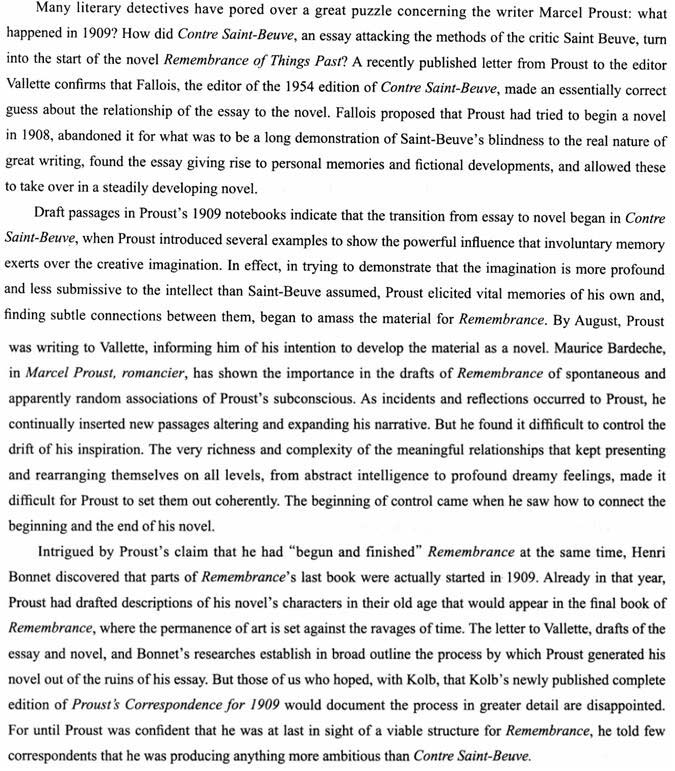
Which of the following best states the author’s attitude toward the information that scholars have gathered about Proust’s writing in 1909?( )A.The author is disappointed that no new documents have come to light since Fallois’speculations.
B.The author is dissatisfied because there are too many gaps and inconsistencies in the drafts.
C.The author is confident that Fallois’s 1954 guess has been proved largely correct,but regrets that still more detailed documentation concerning Proust’s transition from the essay to the novel has not emerged.
D.The author is satisfied that the facts of Proust’s life in 1909 have been thoroughly established,but believes such documents as drafts and correspondence are only of limited value in a critical assessment of Proust’s writing.答案:C解析: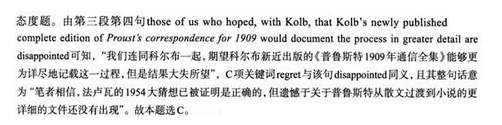
-
第10题:
单选题We can conclude that the author believes one’s sins ______.Amust be expiated
Bneed to be revealed somewhere
Cneed open atonement
Dsuffer in oblivion
正确答案: C解析:
文章第二段第三句先是提到Then there are the things one cannot tell anybody, even the closest people, because one is too ashamed,即有些事因太羞愧而不能告诉别人,也就是题干中的sins,随后就指出It is not good if they are not articulated at all: it is not good if they pass into oblivion.,即这些信息需要表达出来,B项“需要在某些地方揭示出来”,符合句意。 -
第11题:
单选题The author believes that the future of nanotechnology will be ______.Aconspicuous
Bdistinctive
Cforeseeable
Dpromising
正确答案: C解析:
推理题。文章最后提到“…nanotech has been one of science’s fastest-growing fields in recent years,with potential application in fields as diverse as energy production and toothpaste manufacture.The nanotech market is projected to be worth $1 trillion by2015.”由此可以推断出,纳米科技的发展是很有前途的,即promising,其他选项不合题意。故选D。 -
第12题:
单选题Which of the following statement is true?AThe author believes that a born naturalist cannot be a scientist.
BThe author's brothers and sisters were good at music and languages.
CThe author read a lot of books about the natural world and the oil industry.
DThe author spent a lot of time working on riddles.
正确答案: B解析:
细节题。A项属于无中生有,文中只提到“博物学家”是天生的,而“科学家”是后天培养的。并没有说天生的博物学家能否成为科学家。B项可以根据第一段的“Unlike them,I had no ear for music and languages,1 was not an early reader and I could not do mental enthusiastic”得出。C项属于对文章的误解。第三段的“burning the midnight oil”是“开夜车,点灯夜读”的意思,而非“石油工业”。D项迷惑性较大。它是对第三段“Suddenly you fancy you see the answer to the riddle”的误解。文章原意是作者通过大量的调查探索,会有所顿悟,故而解开谜团,而不是花大量的时间解谜。故B项为正确答案。 -
第13题:
Some of them did not get a chance to see the Olympic flame because of the () changes, but we, indeed, feel their passion for China and the Olympics.A.profit
B.suspend
C.escape
D.route
参考答案:D
-
第14题:
Regarding the future of the EU, the author seems to feel______.
A.pessimistic
B.desperate
C.conceited
D.hopeful
正确答案:D
解析:态度题。题干中futrue of the EU定位在最后一段,第一句中提到了too soon to write off the EU指的就是未来的欧盟,作者在第二句指出欧盟是世界最大的贸易体,第三句具体讲欧盟的优势。第四句中用了benign(仁慈)直接表明了作者的态度,因此对应[D]选项。 -
第15题:
The author suggests that______.
A) we shouldn't blame a person if he fails to act in emergencies
B) a person must feel guilty if he fails to help
C) people should be responsible for themselves in emergencies
D) when you are in trouble, people will help you anyway
正确答案:A
答案:A
[试题分析]作者态度题。
[详细解答]作者叙述的态度很客观,指出Americans often fail to act的原因不是他们没有人性,而是They were in a group.Their actions were shaped by the actions of those they were with.所以,可判断,选项A与之相符,应为正确答案。
-
第16题:
He was beginning to feel uneasy about their visit.A:difficult
B:surprised
C:anxious
D:unhappy答案:C解析:本句意思:他对他们的造访开始感到不安。uneasy意思是“担心的,忧虑的”,与anxious(忧虑的,担心的,焦虑的)意思相近。difficult困难的;surprised感到惊奇的;unhappy不高兴的。 -
第17题:
资料:Procrastination comes in many disguises. We might resolve to tackle a task, but find endless reasons to defer it. We might prioritize things we can readily tick off our to-do list- answering emails, say- while leaving the big, complex stuff untouched for another day. We can look and feel busy. while artfully avoiding the tanks that really matter. And when we look at those rolling, long untouched items at the bottom of our to-do list, we can't help but feel a little disappointed in ourselves.
The problem is our brains are programmed to procrastinate. In general, we all tend to struggle with task that promise future upside in return for efforts we take now. That's because it's easier for our brains to process concrete rather than abstract things, and the immediate hassle is very tangible compared with those unknowable, uncertain future benefits. So the short-term effort easily dominates the long-term upside in our minds--an example of something that behavioral scientists call present bias.
How can you become less myopic about your elusive tasks? It's all about rebalancing the cost benefit analysis: make the benefits of action feel bigger, and the costs of action feel smaller. The reward for doing a pestering task needs to feel larger than the immediate pain of tacking it.
To make the benefits of action feel bigger and more real:
Visualize how great it will be to get it done. Researchers have discovered that people are more likely to save for their future retirement if they're shown digitally aged photographs of themselves. Why? Because it makes their future self feel more real-making the future benefits of saving also feel more weighty.
The next paragraph is probably about____.A.The natural function of our brain
B.The other ways to make the benefits of action feel bigger and real
C.The other ways to make the benefits of action feel smaller and unreal
D.The perils of procrastination答案:B解析:本题考查的是判断推理。
【关键词】next paragraph; probably about
【主题句】倒数第2段To make the benefits of action feel bigger and more real使行动的好处感觉更强烈更真实。
【解析】本题的问题是“下一段也许会讨论什么?”。选项A意为“我们大脑的自然功能”;选项B意为“使行动的好处感觉更大更真实的其他方法”;选项C意为“使行动的好处的其他方式感觉更小和不真实”;选项D意为“拖延的危险”。通览全文可知,文章讲的是如何避免拖延,作者就该问题给出了一个建议:To make the benefits of action feel bigger and more real.
对于这个建议的实施,作者在最后一段有说明,因此接下来作者也会针对这个建议进行更多详细说明,故B项正确。 -
第18题:
资料:Procrastination comes in many disguises. We might resolve to tackle a task, but find endless reasons to defer it. We might prioritize things we can readily tick off our to-do list- answering emails, say- while leaving the big, complex stuff untouched for another day. We can look and feel busy. while artfully avoiding the tanks that really matter. And when we look at those rolling, long untouched items at the bottom of our to-do list, we can't help but feel a little disappointed in ourselves.
The problem is our brains are programmed to procrastinate. In general, we all tend to struggle with task that promise future upside in return for efforts we take now. That's because it's easier for our brains to process concrete rather than abstract things, and the immediate hassle is very tangible compared with those unknowable, uncertain future benefits. So the short-term effort easily dominates the long-term upside in our minds--an example of something that behavioral scientists call present bias.
How can you become less myopic about your elusive tasks? It's all about rebalancing the cost benefit analysis: make the benefits of action feel bigger, and the costs of action feel smaller. The reward for doing a pestering task needs to feel larger than the immediate pain of tacking it.
To make the benefits of action feel bigger and more real:
Visualize how great it will be to get it done. Researchers have discovered that people are more likely to save for their future retirement if they're shown digitally aged photographs of themselves. Why? Because it makes their future self feel more real-making the future benefits of saving also feel more weighty.
Which one is TRUE about our brain?A.Concrete things are more attractive than the abstract things.
B.The long term upside is easily dominated by short-term effort in our minds.
C.We cannot avoid present bias in our brain.
D.The brain can be trained to procrastinate often.答案:B解析:本题考查的是细节理解。
【关键词】true; brain
【主题句】第二段The problem is our brains are programmed to procrastinate. In general, we all tend to struggle with tasks that promise future upside in return for efforts we take now. That’s because it’s easier for our brains to process concrete rather than abstract things, and the immediate hassle is very tangible compared with those unknowable, uncertain future benefits. So the short-term effort easily dominates the long-term upside in our minds — an example of something that behavioral scientists call present bias.
问题是我们的大脑自动选择拖延。总的来说,我们都倾向于努力解决那些将来承诺回报的任务,以换取我们现在所做的努力。这是因为我们的大脑更容易处理具体而不是抽象的事情。与那些不可知的,不确定的未来利益相比,直接的麻烦是非常有形的。 所以短期成就在我们脑中很轻易地支配了长期优势—这是行为科学家称之为现在偏见的一个例子。
【解析】本题问“关于我们大脑,哪一项是正确的?”。选项A意为“具体事物比抽象事物更具吸引力”;
选项B意为“短期成就在我们脑中很轻易地支配了长期优势”;选项C意为“我们无法避免目前的大脑偏见”;选项D意为“大脑因被训练而经常拖延”。
根据主题句可知,对我们大脑而言,运行具体的事项要比抽象的事物更容易,但不能由此推断具体的实物比抽象的事物更有吸引力,选项A错误;文末三段都是在说如何避免拖延,故“现在拖延”是不可避免的,选项C错误;.我们大脑是自动选择拖延的,而不是因训练造成的,故选项D错误;选项B内容与原文一致,故符合题意。 -
第19题:
资料:Procrastination comes in many disguises. We might resolve to tackle a task, but find endless reasons to defer it. We might prioritize things we can readily tick off our to-do list- answering emails, say- while leaving the big, complex stuff untouched for another day. We can look and feel busy. while artfully avoiding the tanks that really matter. And when we look at those rolling, long untouched items at the bottom of our to-do list, we can't help but feel a little disappointed in ourselves.
The problem is our brains are programmed to procrastinate. In general, we all tend to struggle with task that promise future upside in return for efforts we take now. That's because it's easier for our brains to process concrete rather than abstract things, and the immediate hassle is very tangible compared with those unknowable, uncertain future benefits. So the short-term effort easily dominates the long-term upside in our minds--an example of something that behavioral scientists call present bias.
How can you become less myopic about your elusive tasks? It's all about rebalancing the cost benefit analysis: make the benefits of action feel bigger, and the costs of action feel smaller. The reward for doing a pestering task needs to feel larger than the immediate pain of tacking it.
To make the benefits of action feel bigger and more real:
Visualize how great it will be to get it done. Researchers have discovered that people are more likely to save for their future retirement if they're shown digitally aged photographs of themselves. Why? Because it makes their future self feel more real-making the future benefits of saving also feel more weighty.
According to the author, which can NOT be seen as the way of procrastination?A.We prioritize the to-do list and finish the task in time.
B.We prioritize and only do things that can be done easily and quickly.
C.We look busy but avoid the task that really matters.
D.We find endless reasons to defer a task.答案:A解析:本题考查的是细节理解。
【关键词】not; way of procrastination
【主题句】第一段Procrastination comes in many disguises. We might resolve to tackle a task, but find endless reasons to defer it. We might prioritize things we can readily tick off our to-do list — answering emails, say — while leaving the big, complex stuff untouched for another day. We can look and feel busy, while artfully avoiding the tasks that really matter. And when we look at those rolling, long-untouched items at the bottom of our to-do list, we can’t help but feel a little disappointed in ourselves.(拖延症有很多伪装。我们也许会下决心去处理一项任务,但却发现了无穷无尽的拖延的理由。我们可能会优先考虑很容易解决的待办事项清单,比如回复邮件,然后把那些大而复杂的事情原封不动地留到另一天做。我们可能看起来并且感觉很忙,然而巧妙地避开那些真正重要的任务。当我们看到那些一大串、长时间未动的项目在我们的待办事项清单的底部时,我们禁不住会对自己感到有些失望。)
【解析】本题问“根据作者,哪一项不被看做是拖延症的表现?”。选项A意为“我们优先处理待办事项清单并及时完成任务”;选项B意为“我们优先考虑并且只做能轻松快速完成的事情”;选项C意为“我们看起来很忙,但避免了真正重要的任务”;选项D意为“我们发现无尽的理由推迟一项任务”。根据文章第1段的内容(主题句),可知B、C、D项原文都有提及,A项We prioritize the to-do list and finish the task in time(我们优先考虑待办事项并且及时完成任务)与题目相违背,所以是错的。而此题为选非题。 -
第20题:
The curious looks from the strangers around her made her feel uneasy .A:difficult
B:worried
C:anxious
D:unhappy答案:C解析:句意:周围陌生人好奇的表情让她感到不安。uneasy意为“不安心、心神不定的”,与 anxious(意为“焦虑的、不安的”)意思相近。difficult困难的;worried担心的;unhappy不高兴的。 -
第21题:
单选题The author believes that the enjoyment of literature comes from ______.Ashock
Ban anticipation of phrase
Cthe originality of the thought
Dingeniousness
正确答案: B解析:
语义的理解和判断。根据录音中提到的“so that we are led to foresee, to expect, and to welcome the successive phrase. The pleasure may be heightened by…”,可知在艺术家的引导下,我们会去预测,期待并乐于接受后续语句,从而得到一种愉悦。而这种愉悦可能会因……得以加强。由此可知,对文学的享受来自于对后续语句的期待。因此选项B为正确答案。
【录音原文】
Music and literature, the two temporal arts, contrive their pattern of sound in time; or, in other words, of sounds and pauses. Communication may be made in broken words, the business of life be carried on with substantive alone; but that is not what we call literature; and the true business of the literary artist is to plait or weave his meaning, involving it around itself; so that each sentence, by successive phrases, shall first come into a kind of knot, and then, after a moment of suspended meaning, solve and clear itself. In every properly constructed sentence there should be observed this knot or hitch; so that we are led to foresee, to expect, and to welcome the successive phrase. The pleasure may be heightened by an element of surprise, as, very grossly, in the common figure of the antithesis, or with much greater subtlety, where an antithesis is first suggested and then deftly evaded. Each phrase, besides, is to be comely in itself; and between the implication and the evolution of the sentence there should be a satisfying equipoise of sound; for nothing more often disappoints the ear than a sentence solemnly and sonorously prepared, and hastily and weakly finished. Nor should the balance be too striking and exact, for the one rule is to be infinitely various; to interest, to disappoint, to surprise, and yet still to gratify; to be ever changing, as it were, the stitch, and yet still to give the effect of an ingenious neatness. -
第22题:
单选题The author thinks that crime is increasing in cities because ______.Acriminals are difficult to trace in large populations
Bpeople do not communicate with their neighbors
Cpeople feel anonymous there
Dthe trappings of success are attractive to criminals
正确答案: B解析:
事实细节题。由关键词“crime is increasing in cities定位第一段最后deviants and criminals who are drawn to the rich pickings of great cities” 即“受城市的财富吸引而来的罪犯也越来越多”可知正确答案为D项。 -
第23题:
单选题—I’d like to know ______.—Maybe in the forest.Awhether we will go camping
Bwhere we will go camping
Cwhether will we go camping
Dwhere will we go camping
正确答案: B解析:
句意:—我想知道我们要去哪野营。—可能在森林里。根据答句“在森林里”可知这是对地点进行提问。同时know后面是个宾语从句,用陈述句语序。