
单选题In this analogy, the author compares sentences to ______.A the man who wrote the sentences B words and straight pathsC a builder’s labyrinth D mechanisms used to make life easy
题目
the man who wrote the sentences
words and straight paths
a builder’s labyrinth
mechanisms used to make life easy
相似考题
更多“单选题In this analogy, the author compares sentences to ______.A the man who wrote the sentences B words and straight pathsC a builder’s labyrinth D mechanisms used to make life easy”相关问题
-
第1题:
What stage can the following grammar activity be used at
The teacher asked students to arrange the words of sentences into different columns raarked subject, predicate, object, object complement, adverbial and so on.
A. Presentation.
B. Practice.
C. Production.
D. Preparation.答案:B解析:考查语法教学内容。做句子成分分析常用于语法练习阶段。故选B。 -
第2题:
Which of the following cannot be used as a way to show the stress pattern of words,phrases,and sentencesA.Facial expressions.
B.Gestures.
C.Voices.
D.The blackboard.答案:A解析:考查语音教学。
重读练习中最重要的事情是让学生知道相关词或知语或句子在哪里重读,老师可以通过拍手或胳膊行动等手势、提高嗓音或在黑板上用不同大小的字或不同颜色的粉笔标出等方式来让学生意识到重读的地方。四个选项中只有A项不合适。
故此题的正确选项为A。 -
第3题:
高中英语?词汇
一、考题回顾
题目来源1月5日 下午 太原市 面试考题
试讲题目1.题目:
2.内容:
I am always the first one to get to the office. Meetings and phone calls take up a large part of the day.Every minute of the day is filled with urgent matters.By around eight o'clock,I usually find some time to do my own paperwork and answer some personal e-mail.
3.基本要求:
(1)十分钟全英试讲
(2)讲解划线处词汇
答辩题目What will you do if students can’t understand the words you explain?
二、考题解析
【教案】
Teaching aims:
Knowledge aim:
Students are able to master the meaning and the usage of underlined words and know the relative words and phrases:get to, take up, be filled with,arrive in/at, occupy,occupation,be full of
Ability aims:
(1) Students can guess the meaning of new words and phrases while reading
(2)After this lesson, students can learn how to use these and relative words and phrases to describe their daily life.
Emotional aim:
Students are able to love learning English after this lesson.
Key and difficult point:
Key Point: master the meaning and the usage of new words and phrases :get to, take up, be filled with,arrive in/at, occupy,occupation,be full of
Difficult Point: understand the meaning of the new words and phrases and use them in their daily life.
Teaching procedures:
Step 1: Warming-up
1. Greetings.
2. Play a video about a person who is busy with his work life and ask students several questions:
What can you see from this video?
Can you describe information in detail using your own language?
Step 2: Presentation
1. Present the paragraph on the PPT. And then ask students to read this passage to guess the meaning of underlined words and phrases. Give students 5 minutes to discuss in the group. And Invite students to give the answers.
2.Then paraphrase these words in English using the pictures. For example, get to means arrive in/at or reach. If something takes up a particular amount of time, space, or effort, it uses that amount. At the same time, present a picture with a man coming the office through the door.
3. Besides introduce the relative phrases, such as take over, take on, take in and so on.
Step 3: Practice
1.Make sentences: ask students to make sentences using the new words. Then correct the grammar mistakes and give the positive feedbacks.
2.Make up a new story: Give students several pictures in disorder and ask them to describe these pictures using the sentences which concludes the new words that have just learnt. Then rank these sentences into a new story. Give students 5 minutes to discuss with their deskmates and then invite several students to share their stories.
Step4: Production
1. Discussion: Ask students to use the words and expressions learnt to describe their daily life with their partner. After 5 minutes, invite several students to share their daily life.
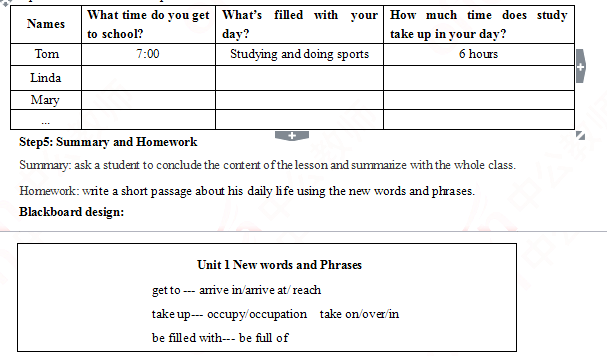
2. Survey: Ask students to make a survey about your classmates’ daily life using three questions in the group. Four person in one group and finish the chart in 10 minutes.Then invite the representatives to make a report for the whole class.
1.What will you do if students can’t understand the words you explain?
2. Do you have the experience in teaching?答案:解析:1.First, if students can’t understand the words that I explain, I will change another way to try my best way to explain this words again. Maybe last way isn’t fit for our students. For example, our students are in high school so last way may be the paraphrase, which is just in language not use other methods or approaches. I will add the video or pictures to help students to understand the new words.
Second, after class, I also need to reflect myself. Not only do I need to learn more ways to use in our class, but also I should know more my students, especially their understanding to the new knowledge in case the same situation comes again.
2.Yes, I do. I have taught a teenager in high school. She was the junior. I mainly taught her grammar. I found her grammar was not very systematic. So I taught her from the grammar in words to the grammar in sentences in order to make her master the whole grammar, especially those always appeared in her exams. And during the teaching, I find the most important that it is the teacher should have a better understanding of the whole grammar and the high school English course. Besides, the teacher should pay more attention to the patience. It will make students relax when their learning and get along with the students. -
第4题:
(),is the study of how words combine to form sentences and the rules which govern the formation of sentences.
Syntax
略 -
第5题:
The discipline that studies the rules governing the formation of words into permissible sentences in languages is called s()
正确答案:syntax -
第6题:
Syntax is different from morphology in that the former not only studies the morphemes, but also the combination of morphemes into words and words into sentences.
正确答案:错误 -
第7题:
填空题The discipline that studies the rules governing the formation of words into permissible sentences in languages is called s()正确答案: syntax解析: 暂无解析 -
第8题:
单选题Which of the following grammar activities is most communicative?AAsking the students to read and correct the mistakes in the sentences.
BAsking the students to tell the differences between two pictures in groups.
CAsking the students to make sentences with the given words.
DAsking the students to complete the translation exercises.
正确答案: B解析: -
第9题:
判断题Syntax is different from morphology in that the former not only studies the morphemes, but also the combination of morphemes into words and words into sentences.A对
B错
正确答案: 错解析: 暂无解析 -
第10题:
单选题What stage can the following grammar activity be used at? The teacher askes students to arrange the words of sentences into different columns marked subject, predicate, object, object complement, adverbial and so on. _____APresentation
BPractice
CProduction
DPreparation
正确答案: D解析:
对句子成分进行分析是语法练习阶段。 -
第11题:
单选题Which of the following cannot be used as a way to show the stress pattern of words,phrases, and sentences?AFacial expressions.
BGestures.
CVoices.
DThe blackboard.
正确答案: B解析: -
第12题:
单选题A student finds it difficult to learn the English sounds [θ]and[e]. If you are the teacher, which of the following strategies can be used? _____AExplaining how to make the sounds.
BUsing tongue twisters.
CWrite them on the blackboard.
DMaking up sentences.
正确答案: C解析:
学生对两个英语发音混淆不清的时候,教师可以向学生解释如何正确发音。本来学生就不清楚如何发音,用绕口令更容易使他分辨不清。而把语音写在黑板上容易分散学生在“听”上的注意力。造句属于产出训练阶段的练习,也不适合此处情境。因此正确答案为A项。 -
第13题:
What stage can the following grammar activity be used at?
The teacher asked students to arrange the words of sentences into different columns raarked subject, predicate, object, object complement, adverbial and so on.A. Presentation.
B. Practice.
C. Production.
D. Preparation.答案:B解析:考查语法教学内容。做句子成分分析常用于语法练习阶段。故选B。 -
第14题:
Which of the following tasks fails to develop students′ skill of recognizing discoursepatterns
A.Analyzing the structure of difficult sentences.
B.Checking the logic of the author's arguments.
C.Getting the scrambled sentences into a paragraph.
D.Marking out common openers to stories and jokes.答案:A解析:考查语篇教学。语篇是指一系列的语句和段落构成的语言整体,因此侧重的是句群和段落之间的关系。语篇通常分为会话语篇和段落语篇。A项是对一个句子内部结构的分析和理解,不属于语篇的范畴.故选A。 -
第15题:
Semantics is the study of( ).A.words
B.sentences
C.context
D.meaning答案:D解析:语言学基本概念。语义学的研究对象是语言的意义。 -
第16题:
Grammar is a description of the()of a language and the way in which linguistic units such as words and phrases are combined to produce sentences in the language.
structure
略 -
第17题:
Morphology studies how words can be formed to produce meaningful sentences.
正确答案:错误 -
第18题:
单选题Hemingway’s short sentences are powerfully loaded with the _____ which he sees in life.Aimago
Btension
Csense
Dcommitment
正确答案: D解析:
海明威的长处在于他的短句和非常具体的细节。他的短句充满了紧张感。 -
第19题:
填空题(),is the study of how words combine to form sentences and the rules which govern the formation of sentences.正确答案: Syntax解析: 暂无解析 -
第20题:
单选题What stage can the following grammar activity be used at?The teacher asked students to arrange the words of sentences into different columns marked subject, predicate, object, object complement, adverbial and so on.APresentation.
BPractice.
CProduction.
DPreparation.
正确答案: A解析: -
第21题:
单选题Which of the following tasks fails to develop students´ skill of recognizing discourse patterns?AAnalyzing the structure of difficult sentences.
BChecking the logic of the author' s arguments.
CGetting the scrambled sentences into a paragraph.
DMarking out common openers to stories and jokes.
正确答案: D解析: -
第22题:
单选题A student finds it difficult to learn the English sounds [θ] and [ð]. If you are the teacher, which of the following strategies can be used?AExplaining how to make the sounds.
BUsing tongue twisters.
CWriting them on the blackboard.
DMaking up sentences.
正确答案: A解析: -
第23题:
单选题The primary purpose of the first four sentences of Passage 1 is to ______.Aintroduce a discussion with a story
Bestablish the author's main thesis
Cdefine several key concepts
Dprovide the historical background to a debate
Echaracterize two positions on an issue
正确答案: A解析:
第一段的前四句话描述的是回收利用的支持者和反对者的立场的特点。