
问答题Should the government build art galleries?
题目
相似考题
参考答案和解析
可以回答政府应通过建设更多的艺术画廊来宣传学习艺术的重要性,这样有助于发展学生的艺术能力,提高市民的艺术修养。
更多“问答题Should the government build art galleries?”相关问题
-
第1题:
All the local governments should follow the () made by the central government.
A、order
B、guidelines
C、plans
D、blueprints
参考答案:B
-
第2题:
By saying "spending of any sort became deeply unfashionable" (Line 1-2, Para.3), the author sug- gests that( )
[A] collectors were no longer actively involved in art-market auctions
[B] people stopped every kind of spending and stayed away from galleries
[C] art collection as a fashion had lost its appeal to a great extent
[D] works of art in general had gone out of fashion so they were not worth buying
正确答案:A
作者说,“任何形式的消费都显得非常不合时宜”(第三段第一至二行),是在暗______。
[A]收藏家们不再积极参与艺术品市场的拍卖
[B]人们停止了所有种类的消费,并且远离画廊
[C]在很大程度上,作为时尚的艺术收藏已经失去了吸引力
[D]通常意义的艺术作品已经落伍,因此不再值得购买
答案解析:[A]语义理解题。文章第三段第一句“In the weeks and months that Nllowed Mr.Hirst’Ssale,spending of any sort became deeply unfashionable.”提到“在Hirst先生的作品出售之后的数周乃至数月里,任何形式的消费都显得非常不合时宜”,紧接着第二句,作者给出了进一步解释,“…that meant collectors stayed away from galleries and salerooms.”表示“这意味着收藏家远离了画廊和销售店。”很显然,这指的是收藏家不再花钱购买艺术品,即他们不再积极参与艺术品市场的拍卖了,所以[A]为正确答案。[B]的说法太绝对,直接排除。文中也没有提到艺术品已经失去了吸引力,或者不值得购买,因此[C]和[D]也应排除。 -
第3题:
Shortly after The Economist went to press,about 25,000 people were expected to tum up at the London An Fair.Your correspondent visited just before,as 128 white booths were being filled with modern paintings and sculptures.Dealers clutched mobile phones to their ears or gathered in small groups.They seemed nervous-as well ihey mighl be."I can eam a year's living in one fair,"said one harried dealer while slringing up a set of lights.Before 1999 London had just one regular contemporary art fair,remembers Will Ramsay,boss of the expanding Affordable Art Fair.This year around 20 will be held in Britain,mostly in the cap-ital.Roughly 90 will iake place worldwide.The success of larger events such as Fneze,which star ted in London,has stimulated the growth of smaller fairs specialising in craft work,ceramics and other things.Artl4,which started last year,specialises in less weU-known intemational galleries,showing art from Sub-Sahuan Africa,South Korea and Hong Kong.One explanation for the boom is the overall gromth of the modem-art market.Four-rifths of all art sold at auction worldwide last year was from the 20th or 21st century,according to Artprice,a database.In November an auction in New York of modern and contemporary art made$691m,easily breaking the previous record.As older art becomes harder to buy-much of it is locked up in museums-demand for recent works js rising.London's art market in particular has been boosted by an influx of rich immigrants from Russia,China and the Middle East."When I sttuled 23 years ago I had not a single non-Westem foreign buyer,"says Kenny Schachter,an art dealer."It's a different world now."And London's new rich buy art differenLly.They often spend little time in the capital and do not know it well.Traipsing around individual galleries is inconvenient,particularly as galleries have moved out of central London.The mall-like set-up of a fair is much more suiLable.Commercial galleries used to rely on regular visits from rich Briions seeking to fumish their stately homes.Many were family friends.The new art buyers have no such loyalty.People now visit galleries mainly to go to evenLs and to be seen,says Alan Cristea,a gallery owner on Cork street in Mayfair.Fairs,and the parties thaL spring up around them,are much better places to be spotted.Some galleries are feeling squeezed.Bernard Jacobson runs a gallery opposite Mr Cristea.The changing art market reminds him of his father,a chemist,who was eclipsed by a pharmaceutical chain,in the 1960s.Seven galleries in Cork Street relocated this month to make way for a redevel-opment;five more may follow later this year.Yet the rise of the fairs means galleries no longer require prime real estate,thinks Sarah Monk of the London Art Fair.With an inlernational clientele,many can work online or from home.Although some art fairs still require their exhibitors to have a gallery space,increasingly these are small places outside central London or beyond Lhe city altogether.One gallery owner says few rich customers ever visit his shop in south London.He makes all his contacts at the booths he sets up at fairs,which might be twice the size of his store."It's a little like fishing,"he explains."You move to where the pike is."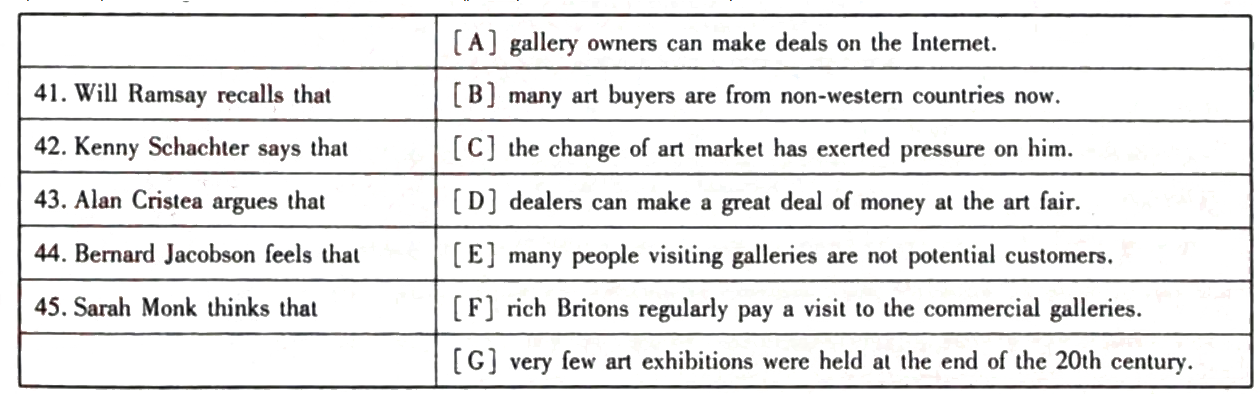
Kenny Schachter says thatA.gallery owners can make deals on the Internet.
B.many art buyers are trom non-westerm countries now.
C.the change of art markel has exerted pressure on him.
D.dealers can make a great deal of money at the art fair.
E.many people visiting galleries are not potential customers.
F.rich Britons regularly pay a visit to the commercial galleries.
G.very few art exhibitions were held al the end of the 20th century.答案:B解析:根据Kenny Schachter定位到第四段第二、三行:“When I started 23 years ago I had not a single non-Westem foreign buyer,”says Kenny Schachter,an art dealer.“It's a different world now.”而该段首句还提到:London's art market in particular has been boosted byan influx of rich immigrants from Russ18.China and the Middle East.综合这几个句子可以得出结论:如今许多艺术品购买者来自非西方国家。故选项[B]为正确答案。 -
第4题:
Text 4 Shortly after The Economist went to press,about 25,000 people were expected to rurn up at the London Art Fair.Your correspondent visited just before,as 128 white booths were being filled with modern paintings and sculptures.Dealers clutched mobile phones to their ears or gathered in small groups.They seemed nervous-as well they might be."I can eam a year's living in one fair,"said one harried dealer while stringing up a set oflights.Before 1999 London had just one regular contemporary art fair,remembers Will Ramsay,boss of the expanding Affordable Art Fair.This year around 20 will be held in Britain,mostly in the capitaL Roughly 90 will take place worldwide:The success of larger events such as Frieze,which started in London,has stimulated the growth of smaller fairs specialising in craft work,ceramics and other things.Art14,which started last year,specialises in less well-known intemational galleries,showing art from Sub-Saharan Africa,South Korea and Hong Kong.One explanation for the boom is the overall growth of the modern-art market.Four fifihs of all art sold at auction worldwide last year was from the 20th or 21st century,according to Artprice,a database.In November an auction in New York of modern and contemporary art made$691m(£422m),easily breaking the previous record.As older art becomes harder to buy-much ofit is locked up in museums-demand for recent works is rising.London's art market in particular has been boosted by an influx of rich immigrants from Russia,China and the Middle East."When I started 23 years ago I had not a single non-Western foreign buyer,"says Kenny Schachter,an art dealer."It's a different world now."And London's new rich buy arl differently.They ofien spend little time in the capital and do not know it well.Traipsing around individual galleries is inconvenient,particularly as galleries have moved out of central London.The mall-like set-up of a fair is much more suitable.Commercial galleries used to rely on regular visits from rich Britons seeking to fumish their stately homes.Many were family friends.The new art buyers have no such loyalty.People now visit galleries mainly to go to events and to be seen,says Alan Cristea,a gallery owner on Cork street in Mayfair.Fairs,and the parties that spring up around them,are much better places to be spotted.Some galleries are feeling squeezed.Bemard Jacobson runs a gallery opposite Mr Cristea.The changing art market reminds him ofwhen his father,a chemist,was eclipsed by Boots,a pharmaceutical chain,in the 1960s.Seven galleries in Cork Street relocated this month to make way for a redevelopment;five more may follow later this year.Yet the rise ofthe fairs means galleries no longer require prime real estate,thinks Sarah Monk of the London Art Fair.With an intemational clientele,many can work online or from home.Although some art fairs still require their exhibitors to have a gallery space,increasingly these are small places outside central London or beyond the city altogether.One gallery owner says few rich customers ever visit his shop in south London.He makes all his contacts at the booths he sets up at fairs,which might be twice the sizc of his store."It's a little like fishing:'he explains."You move to where the pike is."
According to the art dealers,after______,it will make their incomes increase.A.art movement in some groups
B.setting modem paintings and sculptures
C.holding an expo
D.reporting an art fair through The Economist答案:C解析:事实细节题。根据定位词定位到文章的第一段,通读后发现该段落是在说博览会,在结尾处指明“I can earn a year's living in one fair,”said one harried dealerWhile stringing up a set oflights.(一位忙碌的经销商边安装灯具边说道:“一次博览会便能让我挣足一年的生活所需。”)由此可得知,开博览会可以让经销商的收入上涨,故C项为正确选项。【干扰排除】A项在段落中没有体现,因此排除,B项和D项虽然在段落中有体现,但只是在说明博览会的信息,不能说明可以增加收入。 -
第5题:
Text 4 Shortly after The Economist went to press,about 25,000 people were expected to rurn up at the London Art Fair.Your correspondent visited just before,as 128 white booths were being filled with modern paintings and sculptures.Dealers clutched mobile phones to their ears or gathered in small groups.They seemed nervous-as well they might be."I can eam a year's living in one fair,"said one harried dealer while stringing up a set oflights.Before 1999 London had just one regular contemporary art fair,remembers Will Ramsay,boss of the expanding Affordable Art Fair.This year around 20 will be held in Britain,mostly in the capitaL Roughly 90 will take place worldwide:The success of larger events such as Frieze,which started in London,has stimulated the growth of smaller fairs specialising in craft work,ceramics and other things.Art14,which started last year,specialises in less well-known intemational galleries,showing art from Sub-Saharan Africa,South Korea and Hong Kong.One explanation for the boom is the overall growth of the modern-art market.Four fifihs of all art sold at auction worldwide last year was from the 20th or 21st century,according to Artprice,a database.In November an auction in New York of modern and contemporary art made$691m(£422m),easily breaking the previous record.As older art becomes harder to buy-much ofit is locked up in museums-demand for recent works is rising.London's art market in particular has been boosted by an influx of rich immigrants from Russia,China and the Middle East."When I started 23 years ago I had not a single non-Western foreign buyer,"says Kenny Schachter,an art dealer."It's a different world now."And London's new rich buy arl differently.They ofien spend little time in the capital and do not know it well.Traipsing around individual galleries is inconvenient,particularly as galleries have moved out of central London.The mall-like set-up of a fair is much more suitable.Commercial galleries used to rely on regular visits from rich Britons seeking to fumish their stately homes.Many were family friends.The new art buyers have no such loyalty.People now visit galleries mainly to go to events and to be seen,says Alan Cristea,a gallery owner on Cork street in Mayfair.Fairs,and the parties that spring up around them,are much better places to be spotted.Some galleries are feeling squeezed.Bemard Jacobson runs a gallery opposite Mr Cristea.The changing art market reminds him ofwhen his father,a chemist,was eclipsed by Boots,a pharmaceutical chain,in the 1960s.Seven galleries in Cork Street relocated this month to make way for a redevelopment;five more may follow later this year.Yet the rise ofthe fairs means galleries no longer require prime real estate,thinks Sarah Monk of the London Art Fair.With an intemational clientele,many can work online or from home.Although some art fairs still require their exhibitors to have a gallery space,increasingly these are small places outside central London or beyond the city altogether.One gallery owner says few rich customers ever visit his shop in south London.He makes all his contacts at the booths he sets up at fairs,which might be twice the sizc of his store."It's a little like fishing:'he explains."You move to where the pike is."
Art fairs are expanding prosperously in that______.A.the cost ofholding an art fair becomes affordable
B.cross-trade galleries take place worldwide
C.contemporary art market is growing faster than before
D.the rapid growth of the modern art market is mainly in developing countries答案:C解析:推理判断题。根据定位词我们可得知第二、三段都有提及,其中的第三段点明了题目中的原因,即One explanation for the boom is the overall growth of the modem-{ui market。(全球当代艺术市场的发展是艺术博览会快速发展的原因之一。)与这个信息相对应的选项为C项contemporary art market is growing faster than before“当代艺术市场发展速度比之前快”,故C项为正确选项。【干扰排除】A项affordable在第二段出现,即Affordable Art Fair,指平价艺术品展览会,但文中并未提及成本变平价。B项中的cross-trade是跨行业的意思,文中没有体现。D项在段落中没有体现,因此均排除。 -
第6题:
We should give our guests some art crafts authentically Chinese so that they could better understand Chinese culture.A: genuinely
B: elegantly
C: intentionally
D: thoroughly答案:A解析:句意为:我们应该送客人纯正的中国工艺品,以便他们更好地了解中国文化。authe-ntically意为“真正地”; genuinely意为“真正地、诚实地”, elegantly意为“雅致地、优雅地”; intentionally意为“故意的”, thoroughly意为“完全的、彻底的”。 -
第7题:
You need to recommend a server build for the Web servers. Which server build should you recommend?()
- A、Class 1
- B、Class 2
- C、Class 3
- D、Class 4
正确答案:A -
第8题:
问答题Expressionism Expressionism is an art movement that produced a wealth of wonderful works of art, and the lives of the artists who created them were no less colorful and exciting. The word expressionism can be used to describe art from different times and places, most of them were part of a movement that took place in Germany from 1905 to 1920. They shared some of the beliefs. Those beliefs were that art should try to change society, to make it less conservative. It should express the energy of nature—following in the footsteps of Vincent van Gogh—-and personal feeling rather than simply representing nature. It should feel uncomfortable, which means it should challenge the traditional ways of looking at the world. This differed from the opinion of Henri Matisse who believed that art should be comfortable. Expressionist art should be inspired by folk art, and the art of what were then called primitive people, for example from Africa. The aim of the Expressionists was to express personal feeling about what they were painting rather than representing it exactly as it was. It should have strong colors and shapes, be relatively direct, untutored and unplanned and should still contain recognizable things, but not be realistic. The lines could be distorted, and the colors could be strengthened or changed as in the art movement that began in 1905 called Fauvism. Expressionism was more than a style in painting. It could be found in theatre and cinema, literature and architecture. It was a sharing of ideas and experiences across all these media. The life stories of the Expressionist artists show just how much they had in common. Many began by studying applied art, such as furniture design, often to please their parents. Although they later made more personal art, they continued to make use of those technical skills. Both art critics and the public received this new movement with derision and outrage. Expressionist artists were trying to shock by challenging the traditional, conservative views held by many people. Gradually, however, it became accepted and even admired. All the Expressionists were affected by World War I (1914-18). Some fled from Germany and spent the war years in exile. Some never returned to their homeland. Most served in the war and some were killed. At first some of them hoped a war would change society for the better but they were soon disillusioned when they saw the destruction and suffering that it caused. In the years after the war, many Expressionist artist revealed the horrors they experienced in their work. After World War I, Expressionism became very fashionable in Germany, where art was allowed to flourish. This freedom ended in 1933 when Hitler declared all Expressionists were degenerate. This led to them being sacked from their jobs or forced to leave Germany. In 1937 the Nazis took thousands of art works from German museums and put them in an enormous exhibition called the Degenerate Art Exhibition, to show how bad and decadent this art was. It presented a view of the world that went against their political and cultural ambitions to rid Germany of all inferior races.正确答案: 【参考译文】
表现主义 表现主义是20世纪初至30年代盛行于欧美一些国家的艺术流派。它首先出现于美术界,后来在音乐、文学、戏剧以及电影等领域得到重大发展。艺术家们从丰富多彩的现实生活中提取素材,创作了大量优秀的艺术作品。虽然表现主义涵盖的范围很广,但本书中所提到的这些表现主义画家是1905年至1920年间,活跃在德国表现主义运动的舞台上的那部分群体。书中其他被提及的作家,有的是用作品影响了这些画家的创作,有的与这些画家有着共同的创作理念。在理念上,表现主义强调反传统,表现主义画家对社会现状不满,要求变革。受凡·高艺术的影响,在创作上,他们不满足于对客观事物的摹写,要求进一步表现事物的内在实质,突破对人的行为和人所处的环境的描绘,揭示人的灵魂和内心的感情世界,以此来引起观众的强烈震撼和共鸣,它给人们提供了看待周围世界的全新视角。表现主义的这一创作观点与野兽派亨利·马蒂斯的观点很不一致,后者认为艺术应该能给人带来内心的祥和与平静,起到抚慰的作用。
表现主义画家在创作过程中改变了以往以写实为主的油画传统,注重通过作品来表达画家个人的真实情感。表现主义的创作受到民间艺术和原始艺术,如非洲艺术的启发。其作品大都色彩鲜艳,轮廓粗犷,虽然在其间也能看见具体的形象,但绝不写实。它们直接、纯朴、直觉地表达了画家的情感。与野兽派的技法较为相近,它擅长运用扭曲的线条或是粗犷的色彩轮廓。
表现主义的影响不仅仅局限于美术界,其创作理念在戏剧、电影、文学以及建筑领域中都有所体现。表现主义画家的生平也有着许多共同之处,比如为了讨好父母,他们大都从学习应用工艺美术起步,如家居设计等。尽管他们后来也有了自己个性化的创作,但这些实用技巧仍会在他们的作品中有所体现。因为试图通过这种新的创作方式向传统而保守的社会观念发起挑战,在出现之初,便受到艺术评论家的公然嘲笑,引起了公众的极度愤慨。不过,随着时代的变迁,它逐渐为人们所接受,甚至成为年轻人崇拜的对象。
第一次世界大战对表现主义画家影响很大。战争期间,他们有的逃离了德国,过着流亡的生活,有些从此就再也没能回去。他们中的大多数都参加了战争,有的在战斗中不幸牺牲。参战之初,他们对战争抱有幻想,期望它能使这个腐化的世界变得更美好,但是战争爆发后不久,这个幻想就破灭了。在亲眼目睹了无数的流血、牺牲、人们流离失所、痛苦挣扎的情景之后,这些画家的精神受到了极大的摧残,战后纷纷在作品中对当时所经历的恐惧和伤害进行了刻画。
一战结束后,百废待兴,表现主义也在德国风靡一时,成为主流艺术。1933年,希特勒上台,情况随之发生了变化。在表现主义作品中,希特勒看到了不利于德国当时所采取的种族灭绝政策的倾向,便宣布表现主义画家都是“堕落分子”。他们在德国社会中已无立足之地,纷纷失去了工作,被迫离开祖国。1937年,纳粹当局从德国博物馆搜罗出上千幅表现主义作品,并组织了一场名为“堕落艺术”的大型展览,以此来宣扬这种艺术形式的腐朽和败坏。解析: 暂无解析 -
第9题:
单选题After a lot of work, the artist thought that he had paid the government _____.Aless tax than he should have
Bmore tax than he should have
Cas much tax as usual
Djust enough tax
正确答案: D解析:
事实细节题。题于意为“经过计算后,艺术家认为这次他缴纳的税款如何?”从文章的第三段“He believed that he owed the government something”可知,他认为自己仍欠政府的钱,应缴纳的比实缴纳的多。所以正确答案为A。 -
第10题:
问答题Topic 5:Should government relief recipients be kept from owning “luxuries”? Questions for Reference: 1. What kind of products will you define as “luxuries”? 2. Should people who receive subsistence allowance from the government be allowed to own luxuries? Why or why not? 3. What do you suggest will be the more “humane” restrictions on those who apply for subsistence allowance?正确答案: 【参考答案】
My name is... My registration number is... My topic is: Should government relief recipients be kept from owning “luxuries”?
My name is my registration number is my topic is: Should government relief recipients be kept from owning “luxuries”?
I have known from newspapers that one local government has declared that government relief recipients are not allowed to buy “luxuries” such as cell phones and computers. Once violated, the subsistence allowance will be halted. It has caused withdrawn debate among the Public. The supporters say that limited financial resources should be used where they are most needed and those who can afford top-grade commodities have no right to the subsistence allowance. Nevertheless, the opponents insist that purchasing something they think necessary is personal freedom and should not be interfered. As far as I am concerned, government relief recipients shouldn’t be kept from owning such “luxuries”. My reasons are as follows:
Firstly, I agree that it is personal freedom [or people to decide what to buy, even for the poor. How recipients use the money is their own business in which the government has no right to interfere despite its role as the provider of the relief.
Secondly, cell phones and computers are currently becoming the daily necessities for the majority of the average people, including the poor. They can help o improve people’s living standards and shake off poverty.
Thirdly, we are now living in a modern age. Information technology is developing fast with each passing day. We all need to try our best to keep up with the time.
Finally, I hope that the government will take more active measures to implement the policy of urban subsistence allowance and effectively help those from low-income families. 解析: 暂无解析 -
第11题:
单选题Passage1The medical world is gradually realizing that the quality of the environment in hospitals may play a significant role in the process of recovery from illness.As part of a nationwide effort in Britain to bring art out of the galleries and into public places,some of the country's most talented artists have been called in to transform older hospitals and to soften the hard edges of modern buildings. Of the 2,500 National Health Service hospitals in Britain,almost 100 now have significant collections of contemporary art in corridors,waiting areas and treatment rooms.These recent initiatives owe a great deal to one artist,Peter Senior,who set up his studio at a Manchester hospital in northeastern England during the early 1970s.He felt the artist had lost his place in modern society,and that art should be enjoyed by a wider audience.A typical hospital waiting room might have as many as 500 visitors each week. What better place to hold regular exhibitions of art?Senior held the first exhibition of his own paintings in the out-patients waiting area of the Manchester Royal Hospital in 1975.Believed to be Britain's first hospital artist, Senior was so much in demand that he was soon joined by a team of six young art school graduates.The effect is striking. Now in the corridors and waiting rooms the visitor experiences a full view of fresh colors, playful images and restful courtyards.The quality of the environment may reduce the need for expensive drugs when a patient is recovering from an illness. A study has shown that patients who had a view onto a garden needed half the number of strong pain killers compared with patients who had no view at all or only a brick wall to look at.According to Peter Senior, _______.Aart is losing its audience in modern society
Bart galleries should be changed into hospitals
Cpatients should be encouraged to learn painting
Dart should be encouraged in British hospitals
正确答案: B解析: -
第12题:
单选题According to the talk, for what is the Glasgow School of Art famous?AIts educational faculty.
BIts collection of art works.
CIts architectural design.
DIts museums and art galleries.
正确答案: D解析:
推理判断题。关于Glasgow School of Art(格拉斯哥艺学院)以什么而闻名遐迩,录音第一句“格拉斯哥是一个研究建筑的好地方”便奠定了主题。接下来的支持性细节提到了Glasgow School of Art,指出该学校是闻名的建筑艺术学校,其设计出于名家之手。由此可推测,选项C(其建筑设计)与录音原文相符。
【录音原文】
Glasgow is certainly a good place to study architecture. The Glasgow School of Art is famous and everywhere there are magnificent buildings like the School of Art itself, which was designed by Charles Rennie Mackintosh. -
第13题:
Upon the formulation of policies, the government should make sure their () so as to make effects.
A、passing
B、enforcement
C、publication
D、progress
参考答案:B
-
第14题:
Text 4 Shortly after The Economist went to press,about 25,000 people were expected to rurn up at the London Art Fair.Your correspondent visited just before,as 128 white booths were being filled with modern paintings and sculptures.Dealers clutched mobile phones to their ears or gathered in small groups.They seemed nervous-as well they might be."I can eam a year's living in one fair,"said one harried dealer while stringing up a set oflights.Before 1999 London had just one regular contemporary art fair,remembers Will Ramsay,boss of the expanding Affordable Art Fair.This year around 20 will be held in Britain,mostly in the capitaL Roughly 90 will take place worldwide:The success of larger events such as Frieze,which started in London,has stimulated the growth of smaller fairs specialising in craft work,ceramics and other things.Art14,which started last year,specialises in less well-known intemational galleries,showing art from Sub-Saharan Africa,South Korea and Hong Kong.One explanation for the boom is the overall growth of the modern-art market.Four fifihs of all art sold at auction worldwide last year was from the 20th or 21st century,according to Artprice,a database.In November an auction in New York of modern and contemporary art made$691m(£422m),easily breaking the previous record.As older art becomes harder to buy-much ofit is locked up in museums-demand for recent works is rising.London's art market in particular has been boosted by an influx of rich immigrants from Russia,China and the Middle East."When I started 23 years ago I had not a single non-Western foreign buyer,"says Kenny Schachter,an art dealer."It's a different world now."And London's new rich buy arl differently.They ofien spend little time in the capital and do not know it well.Traipsing around individual galleries is inconvenient,particularly as galleries have moved out of central London.The mall-like set-up of a fair is much more suitable.Commercial galleries used to rely on regular visits from rich Britons seeking to fumish their stately homes.Many were family friends.The new art buyers have no such loyalty.People now visit galleries mainly to go to events and to be seen,says Alan Cristea,a gallery owner on Cork street in Mayfair.Fairs,and the parties that spring up around them,are much better places to be spotted.Some galleries are feeling squeezed.Bemard Jacobson runs a gallery opposite Mr Cristea.The changing art market reminds him ofwhen his father,a chemist,was eclipsed by Boots,a pharmaceutical chain,in the 1960s.Seven galleries in Cork Street relocated this month to make way for a redevelopment;five more may follow later this year.Yet the rise ofthe fairs means galleries no longer require prime real estate,thinks Sarah Monk of the London Art Fair.With an intemational clientele,many can work online or from home.Although some art fairs still require their exhibitors to have a gallery space,increasingly these are small places outside central London or beyond the city altogether.One gallery owner says few rich customers ever visit his shop in south London.He makes all his contacts at the booths he sets up at fairs,which might be twice the sizc of his store."It's a little like fishing:'he explains."You move to where the pike is."
The best title of this text would be______A.The Changing Place of Galleries
B.The Proper Opening ofArt Fairs
C.The Thorny Questions ofArt Fairs
D.The Hopeless Stories ofArt Market答案:B解析:主旨大意题。做此类题目的关键为:通过做完前四道题,大致猜出文章的中心,同时再次统览各段首句,验证中心。整个文章都是在围绕着通过举办博览会会使得艺术市场更加繁荣展开讨论,能够完全概括这个信息的选项为B项The Proper Opening ofArt Fairs“艺术博览会的适时开幕”,故B项为正确选项。【干扰排除】剩余的三个选项虽然在个别段落中有提到,但是不能作为全文的中心,因此排除。 -
第15题:
Text 4 Shortly after The Economist went to press,about 25,000 people were expected to rurn up at the London Art Fair.Your correspondent visited just before,as 128 white booths were being filled with modern paintings and sculptures.Dealers clutched mobile phones to their ears or gathered in small groups.They seemed nervous-as well they might be."I can eam a year's living in one fair,"said one harried dealer while stringing up a set oflights.Before 1999 London had just one regular contemporary art fair,remembers Will Ramsay,boss of the expanding Affordable Art Fair.This year around 20 will be held in Britain,mostly in the capitaL Roughly 90 will take place worldwide:The success of larger events such as Frieze,which started in London,has stimulated the growth of smaller fairs specialising in craft work,ceramics and other things.Art14,which started last year,specialises in less well-known intemational galleries,showing art from Sub-Saharan Africa,South Korea and Hong Kong.One explanation for the boom is the overall growth of the modern-art market.Four fifihs of all art sold at auction worldwide last year was from the 20th or 21st century,according to Artprice,a database.In November an auction in New York of modern and contemporary art made$691m(£422m),easily breaking the previous record.As older art becomes harder to buy-much ofit is locked up in museums-demand for recent works is rising.London's art market in particular has been boosted by an influx of rich immigrants from Russia,China and the Middle East."When I started 23 years ago I had not a single non-Western foreign buyer,"says Kenny Schachter,an art dealer."It's a different world now."And London's new rich buy arl differently.They ofien spend little time in the capital and do not know it well.Traipsing around individual galleries is inconvenient,particularly as galleries have moved out of central London.The mall-like set-up of a fair is much more suitable.Commercial galleries used to rely on regular visits from rich Britons seeking to fumish their stately homes.Many were family friends.The new art buyers have no such loyalty.People now visit galleries mainly to go to events and to be seen,says Alan Cristea,a gallery owner on Cork street in Mayfair.Fairs,and the parties that spring up around them,are much better places to be spotted.Some galleries are feeling squeezed.Bemard Jacobson runs a gallery opposite Mr Cristea.The changing art market reminds him ofwhen his father,a chemist,was eclipsed by Boots,a pharmaceutical chain,in the 1960s.Seven galleries in Cork Street relocated this month to make way for a redevelopment;five more may follow later this year.Yet the rise ofthe fairs means galleries no longer require prime real estate,thinks Sarah Monk of the London Art Fair.With an intemational clientele,many can work online or from home.Although some art fairs still require their exhibitors to have a gallery space,increasingly these are small places outside central London or beyond the city altogether.One gallery owner says few rich customers ever visit his shop in south London.He makes all his contacts at the booths he sets up at fairs,which might be twice the sizc of his store."It's a little like fishing:'he explains."You move to where the pike is."
Which of the following is not true about art market according to Paragraphs 4 and 5?A.London's art market boosted favorite mainly from overseas.
B.London's new rich often spend multiple times in the capital and do not know it.
C.commercial galleries used to depend on regular from wealthy people.
D.people in recent years visit galleries for events and parties.答案:B解析:事实细节题。题目只是说明对应的段落在第四段和第五段,解决此题目的关键在于通读段落之后找到四个选项在文章中的位置,题目中出现了否定词not.所以在做题的时候是必须注意的,在第四段中And London's new rich buy art differently.They often spend little time in the capital and do not know it well.(伦敦新富在购买艺术品的品位上有所不同。他们在成本方面所花费的时间较少,对此也就了解甚少。)B项则说明花费了较多的时间,意思刚好相反,故B项为正确选项。【干扰排除】剩余的三个选项在这两个段落中都有提及,故不选。 -
第16题:
Text 4 Shortly after The Economist went to press,about 25,000 people were expected to rurn up at the London Art Fair.Your correspondent visited just before,as 128 white booths were being filled with modern paintings and sculptures.Dealers clutched mobile phones to their ears or gathered in small groups.They seemed nervous-as well they might be."I can eam a year's living in one fair,"said one harried dealer while stringing up a set oflights.Before 1999 London had just one regular contemporary art fair,remembers Will Ramsay,boss of the expanding Affordable Art Fair.This year around 20 will be held in Britain,mostly in the capitaL Roughly 90 will take place worldwide:The success of larger events such as Frieze,which started in London,has stimulated the growth of smaller fairs specialising in craft work,ceramics and other things.Art14,which started last year,specialises in less well-known intemational galleries,showing art from Sub-Saharan Africa,South Korea and Hong Kong.One explanation for the boom is the overall growth of the modern-art market.Four fifihs of all art sold at auction worldwide last year was from the 20th or 21st century,according to Artprice,a database.In November an auction in New York of modern and contemporary art made$691m(£422m),easily breaking the previous record.As older art becomes harder to buy-much ofit is locked up in museums-demand for recent works is rising.London's art market in particular has been boosted by an influx of rich immigrants from Russia,China and the Middle East."When I started 23 years ago I had not a single non-Western foreign buyer,"says Kenny Schachter,an art dealer."It's a different world now."And London's new rich buy arl differently.They ofien spend little time in the capital and do not know it well.Traipsing around individual galleries is inconvenient,particularly as galleries have moved out of central London.The mall-like set-up of a fair is much more suitable.Commercial galleries used to rely on regular visits from rich Britons seeking to fumish their stately homes.Many were family friends.The new art buyers have no such loyalty.People now visit galleries mainly to go to events and to be seen,says Alan Cristea,a gallery owner on Cork street in Mayfair.Fairs,and the parties that spring up around them,are much better places to be spotted.Some galleries are feeling squeezed.Bemard Jacobson runs a gallery opposite Mr Cristea.The changing art market reminds him ofwhen his father,a chemist,was eclipsed by Boots,a pharmaceutical chain,in the 1960s.Seven galleries in Cork Street relocated this month to make way for a redevelopment;five more may follow later this year.Yet the rise ofthe fairs means galleries no longer require prime real estate,thinks Sarah Monk of the London Art Fair.With an intemational clientele,many can work online or from home.Although some art fairs still require their exhibitors to have a gallery space,increasingly these are small places outside central London or beyond the city altogether.One gallery owner says few rich customers ever visit his shop in south London.He makes all his contacts at the booths he sets up at fairs,which might be twice the sizc of his store."It's a little like fishing:'he explains."You move to where the pike is."
The sentence"You move to where the pike is"(Para.6)meansA.fairs would be the most flexible way to exhibit artwork
B.there will be more rich collectors return to the galleries
C.the size of galleries would be twice than the fairs on the website
D.more galleries will move to the golden place答案:A解析:句子理解题。解决此类题目时,关键是要在通读段落后理解上下文的信息,通读段落后可得知最后一段都是在说明艺术品集市的兴起意味着画廊不再需要黄金地带。有了国际顾客,许多画廊可以通过网上进行交易或者在家办公,由此可以看出艺术品的展示可能会更加灵活。A项fairs would be the most flexible way to exhibit artwork“举办博览会是展览艺术品最灵活的方式”刚好体现了这个信息,故A项为正确选项。【干扰排除】B项在结尾处有体现,但是文章中说的是南部的伦敦很少有富裕的顾客光顾。C项的倍数在段落的结尾处有体现,但是说的是展位,而不是画展。D项与段落开头的描述是相反的,因此排除。 -
第17题:
Should UK depositors lose money, the government would have to decide whether to____for it directly.A.notify
B.compensate
C.overlook
D.trigger答案:B解析:本题考查内容为词意辨析。A选项意为“通告、通知”,B选项意为“补偿、赔偿”,C选项意为“忽视、俯瞰”,D选项意为“引发、引起”,题目意为“如果英国储户蒙受损失,政府将不得不决定是否直接____他们。”因此选B,是否直接补偿他们。
-
第18题:
If you don't promise to help build more houses, ordinary people()
- A、will not be nefit
- B、would not be nefit
- C、should not be nefit
- D、could not be nefit
正确答案:A -
第19题:
单选题It is _____ that should be given priority to.Athe government who decided
Bwhat has the government decided
Conly the government has decided
Dwhat the government has decided
正确答案: D解析:
此题为强调结构。空白处为所强调部分。A、B、C、D四个选择项中均出现谓语动词,因此可推断,强调部分为从句。根据空白后内容得知,强调的部分为主语,因此这一从句应为主语从句。据此A、C先可排除。B和D的区别在于语序,名词性从句不需倒装,因此B可排除。 -
第20题:
单选题The village leader thinks _____.Athey should destroy the temple
Bthey needn’t build new houses
CThey should build the temple to make life better
Dthey should not only build new houses but also be careful with the temple
正确答案: A解析:
根据最后一段的最后一句“He also thinks the cultural site is important and they should be careful with it as well.”可知,他认为人们应该保护好这些历史遗迹。选项D正确。 -
第21题:
问答题Do you often go to art galleries?正确答案: I don’t. To be frank I like art very much .Whereas there aren’t so many good art galleries in the region where I live. And I am busy with my work so I went to art exhibitions several times a year.解析:
考生可回答自己都去什么地方的艺术画廊,多久去一次,去画廊自己的感受如何等。 -
第22题:
单选题It is not feasible to build sea defenses to protect against erosion because _____.Ait is too costly and will endanger neighbouring areas
Bthe government is too slow in taking action
Cthey will be easily knocked down by waves and currents
Dhouse agents along the coast do not support the idea
正确答案: C解析:
细节推断题。文章第三段第二句指出,政府勘察人员说建拦海大坝是不可能的,不仅要花费数亿英镑的高额费用,而且如果建起海防会使海浪沿着海岩向前涌去,把问题从一个地区移向另一个地区。通过比较,A项符合文意。 -
第23题:
单选题The statement that “the people own the air” implies that _____.Acitizens have the right to insist on worthwhile television programs
Btelevision should be socialized to cater to the nation’s whims
Cthe government may build above present structures
Dthe people own nothing, for air is worthless
正确答案: A解析:
第三段结尾部分,作者提到“the people own the air”,随后指出“无论是在夜晚的精华时段还是清晨,人们都拥有the air,因此广播公司每一时刻由于占用the air,都owe people something”,最后,作者指出广播公司偿还的方式是搞好服务,由此可判断,作者强调人们拥有天空,是暗示人们有权要求有意义的电视节目的播放,选项A正确。