
单选题On January 1, 1993, Geraldine purchased a rare stamp for $300. The value of the rare stamp increased by 15 percent each year. If Geraldine decided to sell the stamp on January of the first year in which its value had at least doubled since she purchase
题目
1996
1997
1998
1999
2000
相似考题
更多“单选题On January 1, 1993, Geraldine purchased a rare stamp for $300. The value of the rare stamp increased by 15 percent each year. If Geraldine decided to sell the stamp on January of the first year in which its value had at least doubled since she purchase”相关问题
-
第1题:
Passage Two
How can a single postage stamp be worth $ 16,800?
Any mistake made in the printing of a stamp raises its value to stamp collectors. A mistake on one in expensive' postage stamp has made the stamp worth a million and a half times its original value.
The mistake was made more than a hundred years ago in the British colony of Mauritius, a small is land in the Indian Ocean. In 1847 an order for stamps was sent to a London printer, and Mauritius was to become the fourth country in the world to issue stamps.
Before the order was filled and delivered, a ball (舞会) was planned at Mauritius' Government House, and stamps were needed to send out the invitations. A local printer was instructed to copy the de sign for the stamps. He accidentally inscribed the words "Post Office" instead of "Post Paid" on the sever al hundred stamps that he printed.
Today there are only twenty-six of these misprinted stamps left--fourteen "One Penny Orange-Reds" and twelve "Two Penny Blues". Because of the Two Penny Blue's rareness (罕见) and age, collectors have paid as much as $ 16,800 for it.
36. A postage stamp's value to collectors is raised if ______.
A. there are few others like it
B. there are no errors on the stamps
C. a mistake is made in the ,printing
D. both A and C
正确答案:C
此题为理解题。根据第2段第1句Any mistake made in the printing of a stamp raises its value o stamp collectors可以看出,对集邮者而言,邮票的印刷的任何错误都可使该邮票升值,故C为正确答案。A也能使其增值,但文中并没有提及到。B不符常情。
-
第2题:
3 Seejoy is a famous football club but has significant cash flow problems. The directors and shareholders wish to take
steps to improve the club’s financial position. The following proposals had been drafted in an attempt to improve the
cash flow of the club. However, the directors need advice upon their implications.
(a) Sale and leaseback of football stadium (excluding the land element)
The football stadium is currently accounted for using the cost model in IAS16, ‘Property, Plant, and Equipment’.
The carrying value of the stadium will be $12 million at 31 December 2006. The stadium will have a remaining
life of 20 years at 31 December 2006, and the club uses straight line depreciation. It is proposed to sell the
stadium to a third party institution on 1 January 2007 and lease it back under a 20 year finance lease. The sale
price and fair value are $15 million which is the present value of the minimum lease payments. The agreement
transfers the title of the stadium back to the football club at the end of the lease at nil cost. The rental is
$1·2 million per annum in advance commencing on 1 January 2007. The directors do not wish to treat this
transaction as the raising of a secured loan. The implicit interest rate on the finance in the lease is 5·6%.
(9 marks)
Required:
Discuss how the above proposals would be dealt with in the financial statements of Seejoy for the year ending
31 December 2007, setting out their accounting treatment and appropriateness in helping the football club’s
cash flow problems.
(Candidates do not need knowledge of the football finance sector to answer this question.)
正确答案:

-
第3题:
(b) Donald actually decided to operate as a sole trader. The first year’s results of his business were not as he had
hoped, and he made a trading loss of £8,000 in the year to 31 March 2007. However, trading is now improving,
and Donald has sufficient orders to ensure that the business will make profits of at least £30,000 in the year to
31 March 2008.
In order to raise funds to support his business over the last 15 months, Donald has sold a painting which was
given to him on the death of his grandmother in January 1998. The probate value of the painting was £3,200,
and Donald sold it for £8,084 (after deduction of 6% commission costs) in November 2006.
He also sold other assets in the year of assessment 2006/07, realising further chargeable gains of £8,775 (after
indexation of £249 and taper relief of £975).
Required:
(i) Calculate the chargeable gain on the disposal of the painting in November 2006. (4 marks)
正确答案: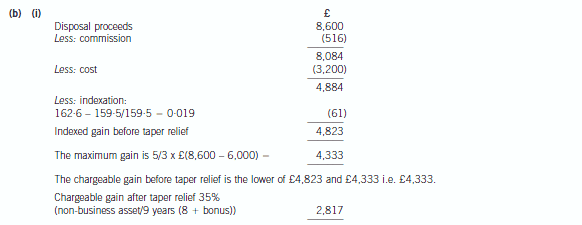
-
第4题:
(iv) The stamp duty and/or stamp duty land tax payable by the Saturn Ltd group; (2 marks)
Additional marks will be awarded for the appropriateness of the format and presentation of the memorandum
and the effectiveness with which the information is communicated. (2 marks)
正确答案:
(iv) Stamp duty and stamp duty land tax
– The purchase of Tethys Ltd will give rise to a liability to ad valorem stamp duty of £1,175 (£235,000 x 0·5%).
The stamp duty must be paid by Saturn Ltd within 30 days of the share transfer in order to avoid interest being
charged. It is not an allowable expense for the purposes of corporation tax. -
第5题:
( ) is the first month of ( ).A、The January/ the year
B、The January/ a year
C、January/ the year
D、January/ a year
参考答案:C
-
第6题:
The company ____ its sales by an average of 10% per year since its establishment in 1993.A、increases
B、increased
C、is increasing
D、has increased
参考答案:D
-
第7题:
(a) Kayte operates in the shipping industry and owns vessels for transportation. In June 2014, Kayte acquired Ceemone whose assets were entirely investments in small companies. The small companies each owned and operated one or two shipping vessels. There were no employees in Ceemone or the small companies. At the acquisition date, there were only limited activities related to managing the small companies as most activities were outsourced. All the personnel in Ceemone were employed by a separate management company. The companies owning the vessels had an agreement with the management company concerning assistance with chartering, purchase and sale of vessels and any technical management. The management company used a shipbroker to assist with some of these tasks.
Kayte accounted for the investment in Ceemone as an asset acquisition. The consideration paid and related transaction costs were recognised as the acquisition price of the vessels. Kayte argued that the vessels were only passive investments and that Ceemone did not own a business consisting of processes, since all activities regarding commercial and technical management were outsourced to the management company. As a result, the acquisition was accounted for as if the vessels were acquired on a stand-alone basis.
Additionally, Kayte had borrowed heavily to purchase some vessels and was struggling to meet its debt obligations. Kayte had sold some of these vessels but in some cases, the bank did not wish Kayte to sell the vessel. In these cases, the vessel was transferred to a new entity, in which the bank retained a variable interest based upon the level of the indebtedness. Kayte’s directors felt that the entity was a subsidiary of the bank and are uncertain as to whether they have complied with the requirements of IFRS 3 Business Combinations and IFRS 10 Consolidated Financial Statements as regards the above transactions. (12 marks)
(b) Kayte’s vessels constitute a material part of its total assets. The economic life of the vessels is estimated to be 30 years, but the useful life of some of the vessels is only 10 years because Kayte’s policy is to sell these vessels when they are 10 years old. Kayte estimated the residual value of these vessels at sale to be half of acquisition cost and this value was assumed to be constant during their useful life. Kayte argued that the estimates of residual value used were conservative in view of an immature market with a high degree of uncertainty and presented documentation which indicated some vessels were being sold for a price considerably above carrying value. Broker valuations of the residual value were considerably higher than those used by Kayte. Kayte argued against broker valuations on the grounds that it would result in greater volatility in reporting.
Kayte keeps some of the vessels for the whole 30 years and these vessels are required to undergo an engine overhaul in dry dock every 10 years to restore their service potential, hence the reason why some of the vessels are sold. The residual value of the vessels kept for 30 years is based upon the steel value of the vessel at the end of its economic life. At the time of purchase, the service potential which will be required to be restored by the engine overhaul is measured based on the cost as if it had been performed at the time of the purchase of the vessel. In the current period, one of the vessels had to have its engine totally replaced after only eight years. Normally, engines last for the 30-year economic life if overhauled every 10 years. Additionally, one type of vessel was having its funnels replaced after 15 years but the funnels had not been depreciated separately. (11 marks)
Required:
Discuss the accounting treatment of the above transactions in the financial statements of Kayte.
Note: The mark allocation is shown against each of the elements above.
Professional marks will be awarded in question 3 for clarity and quality of presentation. (2 marks)
正确答案:(a) The accounting for the transaction as an asset acquisition does not comply with the requirements of IFRS 3 Business Combinations and should have been accounted as a business combination. This would mean that transaction costs would be expensed, the vessels recognised at fair value, any deferred tax recognised at nominal value and the difference between these amounts and the consideration paid to be recognised as goodwill.
In accordance with IFRS 3, an entity should determine whether a transaction is a business combination by applying the definition of a business in IFRS 3. A business is an integrated set of activities and assets which is capable of being conducted and managed for the purpose of providing a return in the form. of dividends, lower costs or other economic benefits directly to investors or other owners, members or participants. A business consists of inputs and processes applied to those inputs which have the ability to create outputs. Although businesses usually have outputs, outputs are not required to qualify as a business.
When analysing the transaction, the following elements are relevant:
(i) Inputs: Shares in vessel owning companies, charter arrangements, outsourcing arrangements with a management company, and relationships with a shipping broker.
(ii) Processes: Activities regarding chartering and operating the vessels, financing the business, purchase and sales of vessels.
(iii) Outputs: Ceemone would generate revenue from charter agreements and has the ability to gain economic benefit from the vessels.
IFRS 3 states that whether a seller operated a set of assets and activities as a business or intends to operate it as a business is not relevant in evaluating whether it is a business. It is not relevant therefore that some activities were outsourced as Ceemone could chose to conduct and manage the integrated set of assets and activities as a business. As a result, the acquisition included all the elements which constitute a business, in accordance with IFRS 3.
IFRS 10 Consolidated Financial Statements sets out the situation where an investor controls an investee. This is the case, if and only if, the investor has all of the following elements:
(i) power over the investee, that is, the investor has existing rights which give it the ability to direct the relevant activities (the activities which significantly affect the investee’s returns);
(ii) exposure, or rights, to variable returns from its involvement with the investee;
(iii) the ability to use its power over the investee to affect the amount of the investor’s returns.
Where a party has all three elements, then it is a parent; where at least one element is missing, then it is not. In every case, IFRS 10 looks to the substance of the arrangement and not just to its legal form. Each situation needs to be assessed individually. The question arises in this case as to whether the entities created are subsidiaries of the bank. The bank is likely to have power over the investee, may be exposed to variable returns and certainly may have the power to affect the amount of the returns. Thus the bank is likely to have a measure of control but the extent will depend on the constitution of the entity.
(b) Kayte’s calculation of the residual value of the vessels with a 10-year useful life is unacceptable under IAS 16 Property, Plant and Equipment because estimating residual value based on acquisition cost does not comply with the requirements of IAS 16. Kayte should prepare a new model to determine residual value which would take account of broker valuations at the end of each reporting period and which would produce zero depreciation charge when estimated residual value was higher than the carrying amount.
IAS 16 paragraph 6 defines residual value as the estimated amount which an entity would currently obtain from disposal of the asset, after deducting the estimated costs of disposal, if the asset were already at the age and in the condition expected at the end of its useful life.
IAS 16 requires the residual value to be reviewed at least at the end of each financial year end with the depreciable amount of an asset allocated on a systematic basis over its useful life. IAS 16 specifies that the depreciable amount of an asset is determined after deducting its residual value.
Kayte’s original model implied that the residual value was constant for the vessel’s entire useful life. The residual value has to be adjusted especially when an expected sale approaches, and the residual value has to come closer to disposal proceeds minus disposal costs at the end of the useful life. IAS 16 says that in cases when the residual value is greater than the asset’s carrying amount, the depreciation charge is zero unless and until its residual value subsequently decreases to an amount below the asset’s carrying amount. The residual value should be the value at the reporting date as if the vessel were already of the age and in the condition expected at the end of its useful life. An increase in the expected residual value of an asset because of past events will affect the depreciable amount, while expectation of future changes in residual value other than the effects of expected wear and tear will not. There is no guidance in IAS 16 on how to estimate residual value when the useful life is considered to be shorter than the economic life. Undesirable volatility is not a convincing argument to support the accounting treatment, and broker valuations could be a useful starting point to estimate residual value.
As regards the vessels which are kept for the whole of their economic life, a residual value based upon the scrap value of steel is acceptable. Therefore the vessels should be depreciated based upon the cost less the scrap value of steel over the 30-year period. The engine need not be componentised as it will have the same 30-year life if maintained every 10 years. It is likely that the cost of major planned maintenance will increase over the life of a vessel due to inflation and the age of the vessel. This additional cost will be capitalised when incurred and therefore the depreciation charge on these components may be greater in the later stages of a vessel’s life.
When major planned maintenance work is to be undertaken, the cost should be capitalised. The engine overhaul will be capitalised as a new asset which will then be depreciated over the 10-year period to the next overhaul. The depreciation of the original capitalised amount will typically be calculated such that it had a net book value of nil when the overhaul is undertaken.
This is not the case with one vessel, because work was required earlier than expected. In this case, any remaining net book value of the old engine and overhaul cost should be expensed immediately.
The initial carve out of components should include all major maintenance events which are likely to occur over the economic life of the vessel. Sometimes, it may subsequently be found that the initial allocation was insufficiently detailed, in that not all components were identified. This is the case with the funnels. In this situation it is necessary to determine what the net book value of the component would currently be had it been initially identified. This will sometimes require the initial cost to be determined by reference to the replacement cost and the associated accumulated depreciation charge determined using the rate used for the vessel. This is likely to leave a significant net book value in the component being replaced, which will need to be written off at the time the replacement is capitalised.
-
第8题:
The TTL field was originally designed to hold a time stamp, which was decremented by each visited router. The datagram was ( ) when the value became zero. However, for this scheme, all the machines must have synchronized clocks and must know how long it takes for a datagram to go from one machine to another. Today, this field is used mostly to control the ( ) number of hops (routers) visited by the datagram. When a source host sends the datagram, it (请作答此空) a number in this field. Each router that processes the datagram decrements this number by 1. If this value, after being decremented, is zero, the router discards the datagram.This field is needed because routing tables in the Internet can become corrupted.A datagram may travel between two or more routers for a long time without ever getting delivered to the ( ).This field limits the ( ) of a datagram.A.controls
B.transmits
C.stores
D.receives答案:C解析:TTL的基本概念。 -
第9题:
The Labor Party had its origins in the()which was formed in January,1893.
AIndependent Labor Party
BGrand National Consolidated Trade Union
CAmalgamated Society of Engineers
DTrade Union Congress
A
略 -
第10题:
A:Where can I buy some()(邮票)? B:At the stamp counter over there.
正确答案:stamps -
第11题:
问答题Over the course of a year, a certain house appreciated in value by 10 percent while the house next door decreased in value by 10 percent as a result of foundation damage. At the end of the year, the reduced price of the second house was what percentage of the increased price of the first house? (1) The amount by which the first house increased in value was half as much as the amount by which the second house decreased in value. (2) At the end of the year, the second house was worth $70,000 more than the first house.正确答案: A解析:
根据条件1可知,价格增长了64%;根据条件2无法计算,故本题应选A项。 -
第12题:
单选题According to the passage, which of the following statements is true?AIn India, the infection rate almost reaches 12 percent of its population.
BIn China, about 50,000 people are infected with HIV.
CAIDS epidemic had caused 15,000,000 deaths in the whole world by January 2,000.
DIn the United States, HIV infection will go on to attack about 5% of the whole population.
正确答案: C解析:
第二段第一句作者提到,到2000年1月艾滋病的流行已经使1500万人死亡,4000万人感染,艾滋病病毒正在缓慢地且无情地破坏着这些人的免疫系统。 -
第13题:
4 Ryder, a public limited company, is reviewing certain events which have occurred since its year end of 31 October
2005. The financial statements were authorised on 12 December 2005. The following events are relevant to the
financial statements for the year ended 31 October 2005:
(i) Ryder has a good record of ordinary dividend payments and has adopted a recent strategy of increasing its
dividend per share annually. For the last three years the dividend per share has increased by 5% per annum.
On 20 November 2005, the board of directors proposed a dividend of 10c per share for the year ended
31 October 2005. The shareholders are expected to approve it at a meeting on 10 January 2006, and a
dividend amount of $20 million will be paid on 20 February 2006 having been provided for in the financial
statements at 31 October 2005. The directors feel that a provision should be made because a ‘valid expectation’
has been created through the company’s dividend record. (3 marks)
(ii) Ryder disposed of a wholly owned subsidiary, Krup, a public limited company, on 10 December 2005 and made
a loss of $9 million on the transaction in the group financial statements. As at 31 October 2005, Ryder had no
intention of selling the subsidiary which was material to the group. The directors of Ryder have stated that there
were no significant events which have occurred since 31 October 2005 which could have resulted in a reduction
in the value of Krup. The carrying value of the net assets and purchased goodwill of Krup at 31 October 2005
were $20 million and $12 million respectively. Krup had made a loss of $2 million in the period 1 November
2005 to 10 December 2005. (5 marks)
(iii) Ryder acquired a wholly owned subsidiary, Metalic, a public limited company, on 21 January 2004. The
consideration payable in respect of the acquisition of Metalic was 2 million ordinary shares of $1 of Ryder plus
a further 300,000 ordinary shares if the profit of Metalic exceeded $6 million for the year ended 31 October
2005. The profit for the year of Metalic was $7 million and the ordinary shares were issued on 12 November
2005. The annual profits of Metalic had averaged $7 million over the last few years and, therefore, Ryder had
included an estimate of the contingent consideration in the cost of the acquisition at 21 January 2004. The fair
value used for the ordinary shares of Ryder at this date including the contingent consideration was $10 per share.
The fair value of the ordinary shares on 12 November 2005 was $11 per share. Ryder also made a one for four
bonus issue on 13 November 2005 which was applicable to the contingent shares issued. The directors are
unsure of the impact of the above on earnings per share and the accounting for the acquisition. (7 marks)
(iv) The company acquired a property on 1 November 2004 which it intended to sell. The property was obtained
as a result of a default on a loan agreement by a third party and was valued at $20 million on that date for
accounting purposes which exactly offset the defaulted loan. The property is in a state of disrepair and Ryder
intends to complete the repairs before it sells the property. The repairs were completed on 30 November 2005.
The property was sold after costs for $27 million on 9 December 2005. The property was classified as ‘held for
sale’ at the year end under IFRS5 ‘Non-current Assets Held for Sale and Discontinued Operations’ but shown at
the net sale proceeds of $27 million. Property is depreciated at 5% per annum on the straight-line basis and no
depreciation has been charged in the year. (5 marks)
(v) The company granted share appreciation rights (SARs) to its employees on 1 November 2003 based on ten
million shares. The SARs provide employees at the date the rights are exercised with the right to receive cash
equal to the appreciation in the company’s share price since the grant date. The rights vested on 31 October
2005 and payment was made on schedule on 1 December 2005. The fair value of the SARs per share at
31 October 2004 was $6, at 31 October 2005 was $8 and at 1 December 2005 was $9. The company has
recognised a liability for the SARs as at 31 October 2004 based upon IFRS2 ‘Share-based Payment’ but the
liability was stated at the same amount at 31 October 2005. (5 marks)
Required:
Discuss the accounting treatment of the above events in the financial statements of the Ryder Group for the year
ended 31 October 2005, taking into account the implications of events occurring after the balance sheet date.
(The mark allocations are set out after each paragraph above.)
(25 marks)
正确答案:
4 (i) Proposed dividend
The dividend was proposed after the balance sheet date and the company, therefore, did not have a liability at the balance
sheet date. No provision for the dividend should be recognised. The approval by the directors and the shareholders are
enough to create a valid expectation that the payment will be made and give rise to an obligation. However, this occurred
after the current year end and, therefore, will be charged against the profits for the year ending 31 October 2006.
The existence of a good record of dividend payments and an established dividend policy does not create a valid expectation
or an obligation. However, the proposed dividend will be disclosed in the notes to the financial statements as the directors
approved it prior to the authorisation of the financial statements.
(ii) Disposal of subsidiary
It would appear that the loss on the sale of the subsidiary provides evidence that the value of the consolidated net assets of
the subsidiary was impaired at the year end as there has been no significant event since 31 October 2005 which would have
caused the reduction in the value of the subsidiary. The disposal loss provides evidence of the impairment and, therefore,
the value of the net assets and goodwill should be reduced by the loss of $9 million plus the loss ($2 million) to the date of
the disposal, i.e. $11 million. The sale provides evidence of a condition that must have existed at the balance sheet date
(IAS10). This amount will be charged to the income statement and written off goodwill of $12 million, leaving a balance of
$1 million on that account. The subsidiary’s assets are impaired because the carrying values are not recoverable. The net
assets and goodwill of Krup would form. a separate income generating unit as the subsidiary is being disposed of before the
financial statements are authorised. The recoverable amount will be the sale proceeds at the date of sale and represents the
value-in-use to the group. The impairment loss is effectively taking account of the ultimate loss on sale at an earlier point in
time. IFRS5, ‘Non-current assets held for sale and discontinued operations’, will not apply as the company had no intention
of selling the subsidiary at the year end. IAS10 would require disclosure of the disposal of the subsidiary as a non-adjusting
event after the balance sheet date.
(iii) Issue of ordinary shares
IAS33 ‘Earnings per share’ states that if there is a bonus issue after the year end but before the date of the approval of the
financial statements, then the earnings per share figure should be based on the new number of shares issued. Additionally
a company should disclose details of all material ordinary share transactions or potential transactions entered into after the
balance sheet date other than the bonus issue or similar events (IAS10/IAS33). The principle is that if there has been a
change in the number of shares in issue without a change in the resources of the company, then the earnings per share
calculation should be based on the new number of shares even though the number of shares used in the earnings per share
calculation will be inconsistent with the number shown in the balance sheet. The conditions relating to the share issue
(contingent) have been met by the end of the period. Although the shares were issued after the balance sheet date, the issue
of the shares was no longer contingent at 31 October 2005, and therefore the relevant shares will be included in the
computation of both basic and diluted EPS. Thus, in this case both the bonus issue and the contingent consideration issue
should be taken into account in the earnings per share calculation and disclosure made to that effect. Any subsequent change
in the estimate of the contingent consideration will be adjusted in the period when the revision is made in accordance with
IAS8.
Additionally IFRS3 ‘Business Combinations’ requires the fair value of all types of consideration to be reflected in the cost of
the acquisition. The contingent consideration should be included in the cost of the business combination at the acquisition
date if the adjustment is probable and can be measured reliably. In the case of Metalic, the contingent consideration has
been paid in the post-balance sheet period and the value of such consideration can be determined ($11 per share). Thus
an accurate calculation of the goodwill arising on the acquisition of Metalic can be made in the period to 31 October 2005.
Prior to the issue of the shares on 12 November 2005, a value of $10 per share would have been used to value the
contingent consideration. The payment of the contingent consideration was probable because the average profits of Metalic
averaged over $7 million for several years. At 31 October 2005 the value of the contingent shares would be included in a
separate category of equity until they were issued on 12 November 2005 when they would be transferred to the share capital
and share premium account. Goodwill will increase by 300,000 x ($11 – $10) i.e. $300,000.
(iv) Property
IFRS5 (paragraph 7) states that for a non-current asset to be classified as held for sale, the asset must be available for
immediate sale in its present condition subject to the usual selling terms, and its sale must be highly probable. The delay in
this case in the selling of the property would indicate that at 31 October 2005 the property was not available for sale. The
property was not to be made available for sale until the repairs were completed and thus could not have been available for
sale at the year end. If the criteria are met after the year end (in this case on 30 November 2005), then the non-current
asset should not be classified as held for sale in the previous financial statements. However, disclosure of the event should
be made if it meets the criteria before the financial statements are authorised (IFRS5 paragraph 12). Thus in this case,
disclosure should be made.
The property on the application of IFRS5 should have been carried at the lower of its carrying amount and fair value less
costs to sell. However, the company has simply used fair value less costs to sell as the basis of valuation and shown the
property at $27 million in the financial statements.
The carrying amount of the property would have been $20 million less depreciation $1 million, i.e. $19 million. Because
the property is not held for sale under IFRS5, then its classification in the balance sheet will change and the property will be
valued at $19 million. Thus the gain of $7 million on the wrong application of IFRS5 will be deducted from reserves, and
the property included in property, plant and equipment. Total equity will therefore be reduced by $8 million.
(v) Share appreciation rights
IFRS2 ‘Share-based payment’ (paragraph 30) requires a company to re-measure the fair value of a liability to pay cash-settled
share based payment transactions at each reporting date and the settlement date, until the liability is settled. An example of
such a transaction is share appreciation rights. Thus the company should recognise a liability of ($8 x 10 million shares),
i.e. $80 million at 31 October 2005, the vesting date. The liability recognised at 31 October 2005 was in fact based on the
share price at the previous year end and would have been shown at ($6 x 1/2) x 10 million shares, i.e. $30 million. This
liability at 31 October 2005 had not been changed since the previous year end by the company. The SARs vest over a twoyear
period and thus at 31 October 2004 there would be a weighting of the eventual cost by 1 year/2 years. Therefore, an
additional liability and expense of $50 million should be accounted for in the financial statements at 31 October 2005. The
SARs would be settled on 1 December 2005 at $9 x 10 million shares, i.e. $90 million. The increase in the value of the
SARs since the year end would not be accrued in the financial statements but charged to profit or loss in the year ended31 October 2006. -
第14题:
(c) At 1 June 2006, Router held a 25% shareholding in a film distribution company, Wireless, a public limited
company. On 1 January 2007, Router sold a 15% holding in Wireless thus reducing its investment to a 10%
holding. Router no longer exercises significant influence over Wireless. Before the sale of the shares the net asset
value of Wireless on 1 January 2007 was $200 million and goodwill relating to the acquisition of Wireless was
$5 million. Router received $40 million for its sale of the 15% holding in Wireless. At 1 January 2007, the fair
value of the remaining investment in Wireless was $23 million and at 31 May 2007 the fair value was
$26 million. (6 marks)
Required:
Discuss how the above items should be dealt with in the group financial statements of Router for the year ended
31 May 2007.Required:
Discuss how the above items should be dealt with in the group financial statements of Router for the year ended
31 May 2007.
正确答案:
(c) The investment in Wireless is currently accounted for using the equity method of accounting under IAS28 ‘Investments in
Associates’. On the sale of a 15% holding, the investment in Wireless will be accounted for in accordance with IAS39. Router
should recognise a gain on the sale of the holding in Wireless of $7 million (Working 1). The gain comprises the following:
(i) the difference between the sale proceeds and the proportion of the net assets sold and
(ii) the goodwill disposed of.
The total gain is shown in the income statement.
The remaining 10 per cent investment will be classified as an ‘available for sale’ financial asset or at ‘fair value through profit
or loss’ financial asset. Changes in fair value for these categories are reported in equity or in the income statement respectively.
At 1 January 2007, the investment will be recorded at fair value and a gain of $1 million $(23 – 22) recorded. At 31 May
2007 a further gain of $(26 – 23) million, i.e. $3 million will be recorded. In order for the investment to be categorised as
at fair value through profit or loss, certain conditions have to be fulfilled. An entity may use this designation when doing so
results in more relevant information by eliminating or significantly reducing a measurement or recognition inconsistency (an
‘accounting mismatch’) or where a group of financial assets and/or financial liabilities is managed and its performance is
evaluated on a fair value basis, in accordance with a documented risk management or investment strategy, and information
about the assets and/ or liabilities is provided internally to the entity’s key management personnel.
-
第15题:
(iii) State the value added tax (VAT) and stamp duty (SD) issues arising as a result of inserting Bold plc as
a holding company and identify any planning actions that can be taken to defer or minimise these tax
costs. (4 marks)
You should assume that the corporation tax rates for the financial year 2005 and the income tax rates
and allowances for the tax year 2005/06 apply throughout this question.
正确答案:
(iii) Bold plc will be making a taxable supply of services, likely to exceed the VAT threshold. It should therefore consider
registering for VAT – either immediately on a voluntary basis, or when its cumulative taxable supplies in the previous
twelve months exceed £60,000.
As an alternative, the new group can apply for a group VAT registration. This will simplify its VAT administration as intragroup
transactions are broadly disregarded for VAT purposes, and only one VAT return is required for the group as a
whole.
Stamp duty normally applies at 0·5% on the consideration payable in respect of transactions in shares. However, an
exemption is available in the case of a takeover, reconstruction or amalgamation where there is no real change in
ownership, i.e. the new shareholdings mirror the old shareholdings, and the transaction is for commercial purposes. The
insertion of a new holding company over an existing company, as proposed here, would qualify for this exemption.
There is no VAT on transactions in shares. -
第16题:
How can a single postage stamp be worth $16 800? Any mistake made in the printing of a stamp raises its value to stamp collectors. A mistake on one inexpensive postage stamp has made the stamp worth a million and a half times its original value. The mistake was made more than a hundred years ago in the British colony Mauritius , a small island in the Indian Ocean. In 1847 an order for stamps was sent to a London printer – Mauritius was to become the fourth country in the world to issue stamps. Before the order was filled and delivered, a ball was planned at Mauritius ’ Government House, and stamps were needed to send out the invitations. A local printer was instructed to copy
1、A postage stamp’s value to collectors is raised if ( ).
A、there are few others like it
B、 there are no errors on the stamps
C、 a mistake is made in the printing
D、 both A and C
2、The mistake in the locally printed postage stamps was in the ( ).
A、price
B、wording
C、color
D、spelling of postage
3、$16 800 is the collector’s value of ( ).
A、the One Penny Orange – Red
B、 a correctly printed 1847 stamp
C、 the Twopenny Blue
D、 both A and C
4、Which one is implied but not stated?
A、All correctly printed stamps are worthless.
B、Mauritians needed the stamps to send out invitations to a ball.
C、The printer was punished for his mistake.
D、Collectors are constantly looking for stamps with mistakes.
5、The best title for this section is ( )
A、The “Post Paid” Error
B、The Twopenny Blue
C、A London Printer’s Error
D、How Mauritius Became Famous
正确答案:1C 2B 3C 4D 5B
-
第17题:
The first United States airmail stamp has an interesting story.Printed in 1918, this 24-cent stamp with a blue plane inside rose border became the center of much attention.One hundred of the stamps sold to the public became known as "inverts", for the plane was printed upside down.Singles of these "upside down" airmail stamps are now worth over $ 100,000.
The story of these stamps began on May 14, 1918, the day after they were placed on sale.In Washington D.C., W.T.Robey, a man interested in stamps, decided to buy a sheet of the new stamps and so went to the New York Avenue branch post office in Washington.When the clerk handed him a sheet of the stamps, Robey noted that they were poorly centered.He looked at other sheets and found that none was well centered.The clerk asked Robey to return later in the day when more stamps were expected.
About noon Robey came back, and the same clerk was on duty.He reached for the new sheets and handed one to Robey.The collector's heart stood still as he saw that the sheet which had been offered him had inverted centers.
Excited by his find, Robey shopped other branch post offices for more sheets with inverted centers but found none.Then be told his friend of his discovery, and they, too, looked in the city's post offices - also in vain.
Not being a rich man, Robey decided to cash in on his good fortune.He turned down the first offer of $ 500 from a Washington stamp shop owner and took the sheet to New York.There he planned to show it to a collector, Colonel E.H.R.Green, as well as to stamp dealers.
Colonel Green was out of the city, and no one else wanted to bid on the sheet for fear that Robey's might not be the only upside down sheet.As the news of his great find spread, many people said that other such sheets had been found.These stories proved to be false.
Robey left New York without having made a sale, and stopped in Philadelphia on the way home.There, dealer Eugene Klein arranged to buy the sheet for $ 15,000 and finally did buy it.Within a few days, Klein sold the sheet to Colonel Green, the same collector whom Robey had failed to contact in New York.There is a tale that the Colonel was in Texas at the time, and that Klein phoned him there and sold him the sheet, sight unseen, for $ 20,000! Robey's sheet had cost him $ 24, and his profit was $ 14,976 while Klein gained $ 5,000.
Of the 100 stamps first bought by Mr.Robey, stamp collectors are now able to account for 96.What has happened to the others is not known.When a copy is offered for sale it is a major event in the stamp world.A block of four stamps has been sold for sale it is a major event in the stamp world.A block of four stamps has been sold for as much as $ 500,000.Few people have ever seen a copy.Yet no matter how much this valuable stamp is bought and sold, no owner can match the thrill that W.T.Robey had on that day in 1918 when he made America's luckiest stamp find!
1、This article is about().
A、the first-class stamps eighty years ago
B、revenue stamps in the United States
C、the first United States airmail stamps
D、special delivery stamps
2、These stamps were valuable because().
A、the centers of them were "upside down"
B、they were the wrong color
C、they were off center
D、there were so few of them
3、When Robey told his friends of the find, they().
A、tried to buy his stamps
B、also went to look for such stamps
C、reported Robey to the government
D、none of the above
4、The dealers knew that if there were other sheets like Robey's then ().
A、Robey must be lying
B、there were no perfect ones
C、the stamps were no good
D、Robey's stamps would be worthless
5、Robey's stamps have seen by().
A、many people
B、no one
C、few people
D、everyone
参考答案:CABDC
-
第18题:
The ___ in this stamp makes it less valuable.A.mistake
B.flaw
C.fault
D.error
参考答案:B
-
第19题:
资料:China's Fosun has offered to buy almost 17 percent of Millennium BCP, Portugal's largest listed bank, and potentially lift its stake to 30 percent, following a having in its share price in the year to date.
BCP said in a regulatory filing late on Saturday that Fosun Industrial Holdings had offered to pay ?0.02 a share, equal to Friday's closing price, in a private placement of 16.7 percent of the bank's share capital. According to the filing, Fosun was also considering increasing its shareholding to “20-30 percent”.
Fosun, one of China most acquisitive companies, made its Millennium BCP offer a week after it agreed to pay $1.1bn for 86 percent of Indian drugmaker Gland Pharma. In recent years, it has also snapped up France's Club Med and the top Portuguese insurer in Europe.
Analysts deem BCP to be in need of capital and vulnerable to a takeover after its share price fell from ?0.05 earlier this year, pushing its market value to a little over ?1.1bn.
In a recent report on Portugal's undercapitalisted banks, which are heavily burdened by bad debts, Barclays said BCP could need a capital increase of about ?2bn.
On Friday, the bank posted a ?197.3m loss for the first half of 2016, down from a profit of ?240.7 for the same period last year. But it said that stress tests by the European Banking Authority had shown it had sufficient capital to withstand a financial crisis. Under the tests, BCP had a common equity tier one ratio-a key measure of capital strength-of 6.1 per cent under stressed conditions, above the 5.5 per cent threshold seen as the minimum adequate level.
Fosun has now offered to subscribe to a private placement, reserved solely for the Chinese group, that would give it a 16.7 percent stake in BCP. It said it was “also considering increasing its stake through secondary market acquisitions or in the context of future capital increases” to up to 30 percent.
This offer, which is subject to regulatory approval by Portuguese and EU authorities, is conditional on Fosun being able to appoint at least two of the 20 BCP board members, and up to five members in the event of increasing its stake.
BCP said it recognized “the strategic potential” of Fosun's offer, saying it would swiftly proceed with an analysis of its “many positive aspects” before making a recommendation to its board of directors.
How big is the gap between BCP’s revenue for the first half of this year and the same period in the previous year?A.?197.3 million
B.?240.7 million
C.?438 million
D.?43.4 million答案:C解析:本题考查的是细节理解。
【关键词】the gap; between BCP’s revenue for the first half of this year and the same period in the previous year
【主题句】第6自然段 On Friday, the bank posted a ?197.3m loss for the first half of 2016, down from a profit of ?240.7m for the same period last year. 上周五,该行在2016年上半年公布1.973亿欧元的亏损,低于去年同期的2.47亿欧元利润。
【解析】题干意为“今年上半年,BCP的收入与前一年同期的收入差距有多大?”。根据主题句可知,今年上半年亏损1.973亿欧元,去年同期利润是2.407亿欧元,收入差距是4.38亿欧元,故选项C正确。 -
第20题:
The TTL field was originally designed to hold a time stamp, which was decremented by each visited router. The datagram was ( ) when the value became zero. However, for this scheme, all the machines must have synchronized clocks and must know how long it takes for a datagram to go from one machine to another. Today, this field is used mostly to control the ( ) number of hops (routers) visited by the datagram. When a source host sends the datagram, it ( ) a number in this field. Each router that processes the datagram decrements this number by 1. If this value, after being decremented, is zero, the router discards the datagram.This field is needed because routing tables in the Internet can become corrupted.A datagram may travel between two or more routers for a long time without ever getting delivered to the (请作答此空).This field limits the ( ) of a datagram.A.switch
B.router
C.source host
D.destination host答案:D解析:TTL的基本概念。 -
第21题:
The Labor Party had its origins in the()which was formed in January,1893.
- A、Independent Labor Party
- B、Grand National Consolidated Trade Union
- C、Amalgamated Society of Engineers
- D、Trade Union Congress
正确答案:A -
第22题:
单选题The Labor Party had its origins in the()which was formed in January,1893.AIndependent Labor Party
BGrand National Consolidated Trade Union
CAmalgamated Society of Engineers
DTrade Union Congress
正确答案: C解析: 暂无解析 -
第23题:
单选题What will the man give the woman next?AA pen
BA postcard
CA stamp
正确答案: A解析: 录音中女士表明自己要去寄明信片,问男士是否有邮票,男士说自己也没有了,接着女士问道”Can I use your pen”,从男士的回答“给你”,可知男士接下来把钢笔给了女士。
【录音原文】
W: I’ve bought this postcard to send to Sam. Do you have a stamp?
M:No, I haven’t got any left. Let me have the card and I’ll post it later.
W: OK. Just let me write her address. Can I use your pen?
M:Here you are. -
第24题:
单选题On January 1, 1993, Geraldine purchased a rare stamp for $300. The value of the rare stamp increased by 15 percent each year. If Geraldine decided to sell the stamp on January of the first year in which its value had at least doubled since she purchased it, then in which year did Geraldine sell the stamp?A1996
B1997
C1998
D1999
E2000
正确答案: C解析:
假设过了y年,邮票的价值为S(y)=300×(1.15)y,经计算y=4时,S(y)<600,y=5时,邮票的价格大约为603美元,是原来的价格的两倍,所以1998年,Geraldine将邮票售出。