
单选题Passage 2 请阅读Passage 2,完成第26-30小题。 Passage 2 Teacher education provided by U.S. colleges and universities has been routinely criticized since its inception in the early nineteenth century, sometimes deservedly. These programs, like non-university progr
题目
The criticisms have been increasing.
The criticisms may not be well justified sometimes.
The criticisms mainly focus on the quality of non-university programs.
The criticisms usually come from advocacy groups and so-called educational entrepreneurs.
相似考题
更多“Passage 2 请阅读Passage 2,完成第26-30小题。 Passage 2 Teacher educati”相关问题
-
第1题:
According to the passage, the screen or cutters are fitted to __ (1)kill bacteria (2)break up the solid waste (3)remove solid matter with large size
A.(1)
B.(2)
C.(2)(3)
D.None of (1)(2)(3) is true
正确答案:B
-
第2题:
Ifa teacher asks students to fill in the blanks in a passage with "that", "which" or "whom",he/she is least likely focusing on grammar at_________.
A.lexical level
B.syntactic level
C.discourse level
D.morphological level答案:D解析:考查语法教学内容。题干意思是:如果教师让学生用that/which/whom进行填空,那么他/她最不可能关注语法的哪个层面lexical level“词汇层面”,syntactic level“句法层面”,discourse level“语篇层面”.morphological level“形态学层面”。语法教学的内容不仅包括语言形式/结构,还包括语意和语用。语言形式/结构包括词法、句法等;语意包括语法形式与结构的意义;语用指语言在一定的语境、语篇中的表意功能。该教师让学生选择关系代词填空,目的是让学生掌握定语从句这项语法的形式、意义和运用。形态学是研究词的内部结构和构词规则的科学。故选D。 -
第3题:
From the passage we know Mrs.Janes is a__________teacher.A.patient
B.hard-working
C.proud
D.honest答案:B解析:根据第一段“Mrs.Janes knew her weakness well,and took every chance she could topractice these high tones.”以及下文的描写。可知选B。 -
第4题:
初中英语?阅读
一、考题回顾

二、考题解析
【教案】
Teaching aims:
Knowledge aim:
Students will grasp and understand the main and detailed information of the passage.
Ability aim:
Students will improve their reading and speaking skills.
Emotional aim:
Students will foster the interest and desire of learning English and take part in speaking activities actively.
Key and difficult point:
Key Point: Students will totally understand the content of the passage.
Difficult Point: Students will foster the interest of learning English, and take part in speaking activities.
Teaching procedure:
Step 1: Warming-up
1. Greetings.
2. Show students pictures about different types of transportation and naturally lead to today’s topic.
Step 2: Pre-reading
1. Ask students two questions and some volunteers will be invited to share their answers.
Q1: How do you come to school?
Q2: How do your parents go to work?
2. Ask students to predict the main idea of the passage based on the above discussion and pictures on the screen.
Step 3: While-reading
1st reading: Ask students to read the passage for the first time and check their prediction. Besides, they need to find out which countries are mentioned in the passage and circle them.
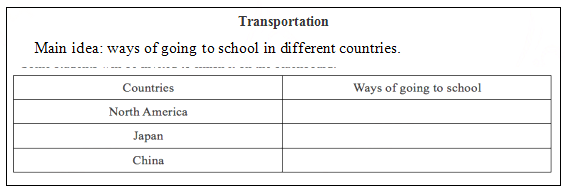
2nd reading: Ask students to read the passage for the second time and complete the following chart. Some students will be invited to finish it on the blackboard.

Step4: Post-reading
Discussion: ask students to discuss the advantages and disadvantages of different modes of transportation. Four students in a group, after five minutes, some groups are supposed to show their results.
Step5: Summary and Homework
Summary: ask a student to conclude the content of the lesson and summarize with the whole class.
Homework: ask students to investigate their friends’ way of going to school and find some interesting ways of transportation on the Internet.
Blackboard design:
1. How to improve students’ reading and speaking ability in your class?
2. How did you evaluate the performance of students in the class?答案:解析:1.
It is very important to improve students’ reading and speaking abilities. In my class, I take three specific steps to improve their reading and speaking abilities. Firstly, before reading the article, I ask the students to guess the main idea of the article according to my questions and pictures on the screen. As you heard, this can not only exercise students’ guessing ability, but also help them read the passage with questions. In the while-reading part, I set two times of reading, namely extensive reading and intensive reading. Obviously, students’ scanning ability and the ability to grasp detailed information can be improved. It also helps them form good reading habits. As for speaking ability, I organize a discussion activity without standard answers. Students can express their views freely in groups. In this way, their reading and speaking abilities can be improved a lot.
2.
Students are under a stage of growing and developing. They are eager to be evaluated and encouraged by their teachers. At the same time, students are different, and their acceptance and abilities of learning are different. Therefore, in my class, I have adopted a variety of different evaluations. For the students who answered correctly, I would praise them directly, such as “excellent”, “you can find the answer so fast”. For those students who dare not answer questions or did not find out the answers, I just encouraged them and guided them to say the answers, and gave some encouraging comments, like “nice try!”, “you’ve made a great progress”. Also, some students made mistakes. In my class, instead of directly blaming the student for being wrong, I asked other students to help him/her and give them a proper evaluation. -
第5题:
单选题The primary purpose of Passage 1 is ______.Ato persuade the author of Passage 2 of the validity of evolutionary theory
Bto describe the process by which protein is created by hemoglobin
Cto counter a common misconception about the composition of the human body
Dto deny the practical application of macroevolutionary theory
Eto deride those who underestimate the complexity of the human body
正确答案: D解析:
作者首先提出,人们普遍认为人体是一个精致的时间机器,但他不这样认为,接着作者用血红蛋白的例子证明自己的想法,故选C项。 -
第6题:
单选题Which of the following best describes the relationship between Passage 1 and Passage 2?APassage 2 offers a criticism of the political theory outlined in Passage 1.
BPassage 1 expands upon an argument made in Passage 2.
CPassage 1 refutes the conclusion drawn in Passage 2.
DPassage 2 offers a balanced counterpoint to the biased opinions expressed in Passage 1
EPassage I offers evidence to support the main idea of Passage 2.
正确答案: E解析:
第一篇文章简短地描述了遏制政策。第二篇文章主要讲的是美国之所以没能稳定越南局势是因为美国使用了遏制政策。A项最好的解释了两篇文章的关系。 -
第7题:
单选题In Passage 2, the author's tone can be characterized as ______.Aextremist and accusatory
Bjudgmental yet optimistic
Cpassionate and naive
Ddepressing but determined
Eevaluative and pessimistic
正确答案: C解析:
作者在文中表达了自己的很多消极的看法,如“chimpanzees suffer greatly”“almost no good fate for captive chimpanzees”,故选E项最合适。 -
第8题:
单选题The two passages differ in their perspectives on the debate between industrialists and environmentalists mainly in that Passage 1 emphasizes ______.Amathematics, while Passage 2 emphasizes psychology
Bdeficiencies in the debate, while Passage 2 emphasizes progress in the debate
Cthe irrelevance of externalities, while Passage 2 emphasizes their importance
Dthe impact on taxpayers, while Passage 2 emphasizes the views of politicians
Epollution, while Passage 2 emphasizes recycling
正确答案: C解析:
第一篇文章主要是关于环境保护论争论的缺陷,提到取得的进步很少,妖魔化成分太多,并提议进行更广范围的分析。第二段表明Costanza的作品认为实业家和环境保护主义者没有明显差别,论辩因此取得了进步。 -
第9题:
单选题What does the wordconstant (Line 2, Para. 3) mean in the passage?AThe same.
BAmount.
CGoing up and down.
DChanging.
正确答案: A解析: -
第10题:
单选题The author most likely begins and concludes the passage with questions for what reason?ATo suggest possible areas for current and future research
BTo pose a question that is answered in the body of the passage, and then to formulate a question that arises naturally out of the discussion
CTo gain the readers’ attention and encourage their agreement with the arguments in the passage
DTo suggest through rhetorical questions that the problems described in the passage do not actually have answers
ETo test the readers’ knowledge of the material discussed in the passage
正确答案: B解析:
推断题。文章叙述了企业对于《清洁空气法案》的不遵守问题,由此希望引起社会的注意,故本题应选C项。 -
第11题:
单选题Unlike Passage 1, Passage 2 discusses ______.Athe procedures of a specific experiment
Ba mistaken assumption
Cthe work of professional researchers
Dsocial behavior
Ehuman emotions
正确答案: B解析:
第一篇文章提到了错误的假设,文中他反驳直觉是能产生无限力量的未经开发的源泉的观点(2-3行),文中还提到职业研究人员的作品(Haight 和Daniel Kahneman的作品),社会行为(40-51)以及人类情感(36-39行)。然而并没有像第二篇一样描述了特定实验的程序。 -
第12题:
问答题What does the ‘unwanted’ deep sea life mean in Paragraph 2 according to the passage?正确答案: They have no economic value.解析:
词义理解题。像乌贼、海胆、海星等一些海洋生物由于没有经济价值因此它们不是渔民捕捞的对象,是渔民不需要的东西,所以正确答案是“They have no economic value”。 -
第13题:
To grasp the gist of a passage in a quick way, what may a reader focus on?A.The transitional paragraphs.
B.The whole passage.
C.The topic sentences.
D.Every sentence in the passage.答案:C解析:考查阅读策。题目问“要想快速抓住文章要点,读者应该集中关注什么”。因为是要求在短时间内就迅速抓住要点,很显然找到主题句是最快捷的方式。the transitional paragraph“过渡段”,the whole passage“全篇”。the topic Sentences“主题句”,every sentences in the passage“文章每一个句子”。故选C, -
第14题:
If a teacher asks students to fill in the blanks in a passage with "that", "which" or "whom",he/she is least likely focusing on grammar at __________.
A.lexical level
B.syntactic level
C.discourse level
D.morphological level答案:D解析:考查语法教学内容。题于意思是:如果教师让学生用that/which/whom进行填空,那么他/她最不可能关注语法的哪个层面lexical level“词汇层面”,syntactic level“句法层面”,discourse level“语篇层面”.morphological level“形态学层面”。语法教学的内容不仅包括语言形式/结构,还包括语意和语用。语言形式/结构包括词法、句法等;语意包括语法形式与结构的意义;语用指语言在一定的语境、语篇中的表意功能。该教师让学生选择关系代词填空.目的是让学生掌握定语从句这项语法的形式、意义和运用。形态学是研究词的内部结构和构词规则的科学。故选D。 -
第15题:
小学英语?阅读
一、考题回顾
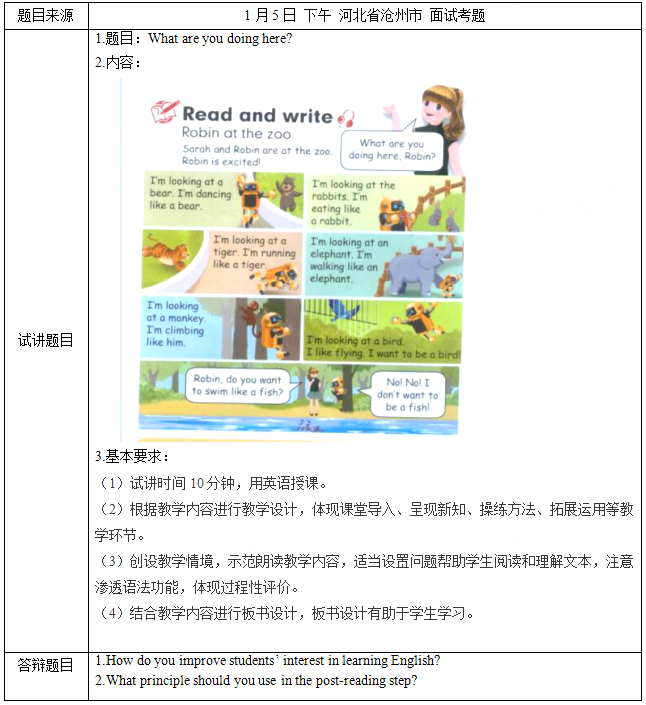
二、考题解析
【教学设计】
Teaching aims:
Knowledge aim:
Students will master the meaning and usage of the structure “be doing” through reading the passage.
Ability aim:
Students will apply the “be doing” to communicate with each other in real situation.
Emotional aim:
Students will be more interest in learning English.
Key and difficult point:
Key Point: Students will master how to improve reading abilities through finding main idea and details.
Difficult Point: Students will apply the “be doing” to communicate with each other in real situation.
Teaching procedure:
Step 1: Warming-up
1. Greetings.
2. Play a riddle and students guess the animals, such as “long nose, big ears and strong body——elephant”, then lead to the topic of “let’s go to the zoo to see what animals are doing”.
Step 2: Pre-reading
1. According to the title, students have a prediction about what kinds of animals are mentioned in the passage.
Step 3: While-reading
1. Fast reading: students read the passage fast and figure out what kinds of animals are mentioned in the passage then make a list.
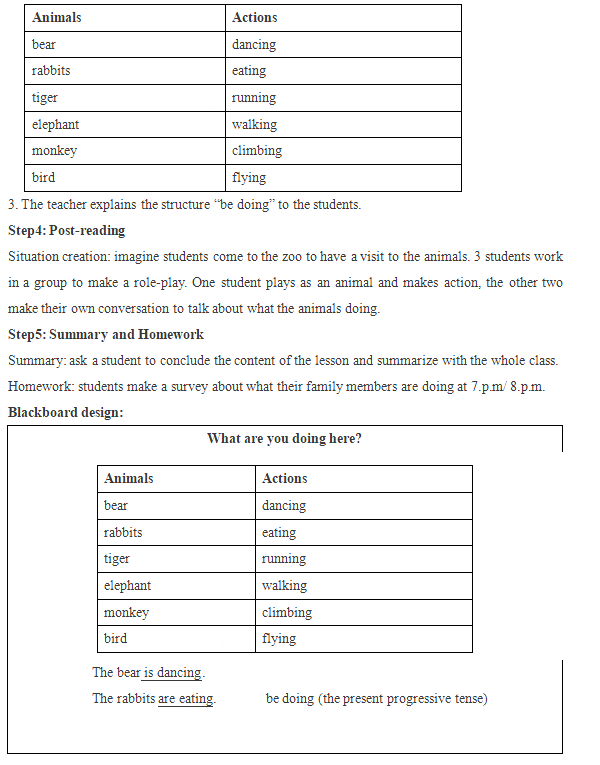
2. Careful reading: students read the passage carefully and answer the question: what are the animals doing? Then fill in the blanks.
1. How do you improve students’ interest in learning English?
2. What principle should you use in the post-reading step?答案:解析:1.
In the process of English teaching, teachers should enrich the teaching approaches, not only teach students through "listening, speaking, reading", but also integrate situational teaching, so that students can feel the diversity of teaching and learning.
Besides, teachers can make use of the form of cooperative study and organize various practice activities in the classroom to create an atmosphere of mutual assistance and cooperation, so that students have positive sense of learning.
2.
First, we should persist in the communicative principle. In the production step of reading
class, students should be organized in groups to cultivate their speaking ability and communicative ability. In this way, we can reach the New Curriculum Standard.
Then, we should insist on the truth principle. That means we should provide more real materials that are closet to students’ real life, such as situation creation like what I did in this class. In this way, students’ interest can be aroused and they can apply what they’ve learned in real communication. -
第16题:
高中英语?阅读
一、考题回顾

二、考题解析
【教案】
Teaching aims:
Knowledge aim:
Students can know the basic meaning of passage and are able to master the different greeting for the strangers.
Ability aims:
Students can practice guessing content of next paragraph according to the clues which is given in the passage.
Emotional aim:
Students are able to love learning English and like to read different English passage after this lesson.
Key and difficult point:
Key Point: guess the content of next paragraph according to the clues and know the “learned” body language, especially different greetings
Difficult Point: improve students’ reading interest.
Teaching procedures:
Step 1: Warming-up
1. Greetings.
2. Play a video about Chaplin’s mime and ask students several questions:
What kind of body language can you see from this video?
Do you know the meaning of these body language?
Step 2: Pre-reading
Present the passage on the screen and read it for all the students. Before reading, ask students one question: What’s the main ideas of these two paragraphs? And guess the main to topic of this lesson?
Then invite several students to share their ideas.
Step 3: While-reading
1.Lead the students to think one question: Is this a whole passage? And ask students to scan the whole passage and give the teacher answer.
2.Ask students to discuss in group and after 10 minutes to invite several students to share their ideas with all the students.
3.And different students may be just guess the content of several paragraphs. So give students a chart, ask them to finish discussing in 5 minutes. Then invite two representatives to state the whole passage.

Step4: Post-reading
Guessing game: Present another passage on the screen. And give students 10 minutes to read and discuss.Then make a chart and tell your own stories according to chart in your own group .Then invite the representatives to make a report for the whole class.
Step5: Summary and Homework
Summary: ask a student to conclude the content of the lesson and summarize with the whole class.
Homework: Present a passage and ask students to read and write a short passsage,which will be put behind of last paragraph.
Blackboard design:

1.Do you have the experience in teaching?
2. What will you do if you pass this exam?答案:解析:1.
Yes, I do. I have taught a teenager in high school. She was the junior. I mainly taught her grammar. I found her grammar was not very systematic. So I taught her from the grammar in words to the grammar in sentences in order to make her master the whole grammar, especially those always appeared in her exams. And during the teaching, I find the most important that it is the teacher should have a better understanding of the whole grammar and the high school English course. Besides, the teacher should pay more attention to the patience. It will make students relax when their learning and get along with the students.
2.
First, I will find a teaching job to practice my teaching ability. And at the same time to prepare the teachers’ exams for school. When I prepare, I think the most important it’s to know the content of text in high school and do many exercises to practice these knowledge.
Second, I will visit some good teachers who is teaching the high school and learn some experience and practice my teaching ability.
Last, I need to reflect myself to improve my knowledge and my teaching procedures. -
第17题:
单选题Which best characterizes how the impact of science on chimpanzees is treated in these two passages?AThe author of Passage 1 lauds the benefits science has produced, while the author of Passage 2 speaks hopefully of possible future benefits.
BBoth of the passages react with distrust to the idea of using science to assess chimpanzees.
CThe first passage lists the studies that showed positive chimp interactions, while the author of Passage 2 refutes their claims,
DThe first passage suggests that science can have a positive impact on perceptions about chimps, whereas the second passage views science as almost universally negative.
EThe author of the first passage is more apt to justify using chimps in science than the author of Passage 2.
正确答案: E解析:
两篇文章对于科学的态度是不同的。第一篇文章列举一些关于黑猩猩的科学发现,体现了科学的正面作用。而第二篇文章提到黑猩猩被滥用为科学实验的对象,故选D项。 -
第18题:
单选题Which of the following activities can be used to get the main idea of a passage? _____.Areading the passage in detail
Breading to sequence the events
Creading to fill in the charts
Dreading the first and last sentences of the passage and the paragraphs
正确答案: B解析:
阅读段落的第一句话和最后一句话便可大致判定段落主旨。 -
第19题:
单选题In Passage 2, the word check (line 60) most nearly means ______.Avalidate
Bconstrain
Cdirect
Dencourage
Ecompete
正确答案: B解析:
根据上下文,即使是疼痛也不能使那些黑猩猩服从指令,B项最合适。 -
第20题:
单选题The author of Passage 2 would most likely regard the spate of recent popular books (line 1) mentioned in Passage 1 with ______.Arighteous indignation
Binformed skepticism
Ceager anticipation
Dsentimental regret
Ebewilderment
正确答案: B解析:
第二篇文章的作者对直觉是有用的这个观点持怀疑态度。他反驳在比赛中最重要的球是最后一个进球这种观点。 -
第21题:
单选题Ifa teacher asks students to fill in the blanks in a passage with that, which or whom,he/she is least likely focusing on grammar at_________.Alexical level
Bsyntactic level
Cdiscourse level
Dmorphological level
正确答案: B解析: -
第22题:
单选题Which of the following best describes the relationship between the two passages?APassage 2 describes a significant. and discovery that contradicts the argument of Passage 1.
BPassage 2 offers a theory that supports the main point in Passage 1.
CPassage I provides a possible reason for the scientific inquiry presented in Passage 2.
DPassage 1 relates an anecdote that explains the popular misconception in Passage 2.
EPassage 2 provides a historical context for the discovery described in Passage 1.
正确答案: D解析:
第一篇文章主要讲到工具的创造是人类发展史上很重要的一步。第二篇文章主要描述了一项重大发现,即人类什么时候开始创造工具的的。C项最好地将两篇文章的关系表现出来了,第一篇文章提到工具创造对人类进化有很大的影响,第二篇文章继而对第一篇文章提出的问题作进一步研究,故选C项。 -
第23题:
单选题Which statement most accurately describes the difference between the two passages?APassage 1 deals less directly with the exportation of chimpanzees than does Passage 2.
BPassage 1 is less concerned with the interaction between man and the land than is Passage 2.
CPassage I pertains to a species in its indigenous habitat while Passage 2 addresses the same animal in nonnative settings.
DPassage I ends with an expression of optimism and Passage 2 does not.
EPassage I introduces a species and describes its status worldwide, while Passage 2 limits its discussion of that species to its activities in the Northern Hemisphere.
正确答案: A解析:
第一篇文章主要是关于黑猩猩在自然栖息地生存的情况。第二篇文章主要是关于黑猩猩在非自然栖息地生存的情况。故选C项。