
问答题根据提供的信息和语言素材设计教学方案,用英文作答。 设计任务:请阅读下面学生信息和语言素材,设计一个15分钟的英语阅读教学活动。教案没有固定格式,但须包含下列要点: • teaching objectives • teaching contents • key and difficult points • major steps and time allocation • activities and justifications 教学时间:15分钟 学生概况:某城镇普通中学初中二年级第一学期学生,
题目
问答题
根据提供的信息和语言素材设计教学方案,用英文作答。 设计任务:请阅读下面学生信息和语言素材,设计一个15分钟的英语阅读教学活动。教案没有固定格式,但须包含下列要点: • teaching objectives • teaching contents • key and difficult points • major steps and time allocation • activities and justifications 教学时间:15分钟 学生概况:某城镇普通中学初中二年级第一学期学生,班级人数40人。多数学生已经达到《义务教育英语课程标准(2011年版)》三级水平。学生课堂参与积极性一般。 语言素材: Who´s Got Talent? Everyone is good at something, but some people are truly talented. It´s always interesting to watch other people show their talents. Talent shows are getting more and more popular. First, there were shows like American Idol and America´s Got Talent. Now, there are similar shows around the world, such as China´s Got Talent. All these shows have one thing in common: Ihey try to look for the best singers, the most talented dancers, the most exciting magicians,the funniest actors and so on. MI kinds of people join these shows. But who can play the piano the best or sing the most beautifully? Ihat´s up to you to decide. When people watch the show, they usually play a role in deciding the winner. And the winner always gets a very good prize. However, not everybody enjoys watching these shows. Some think that the lives of the performers are made up. For example, some people say they are poor farmers, but in fact they are just actors. However, if you don´t take these shows too seriously, they are fun to watch. And one great thing about them is that they give people a way to make their dreams come true.
相似考题
更多“问答题根据提供的信息和语言素材设计教学方案,用英文作答。 设计任务:请阅读下面学生信息和语言素材,设计一个15分钟的英语阅读教学活动。教案没有固定格式,但须包含下列要点: • teaching objectives • teaching contents • key and difficult points • major steps and time allocation • activities and justifications 教学时间:15分钟 学生概况:某城镇普通中学初中二年级第一学期学生,”相关问题
-
第1题:
根据提供的信息和语言素材设计教学方案。用英文作答。
设计任务:请阅读下面学生信息和语言素材,设计一节英语听说课的教学方案。
教案没有固定格式,但须包含下列要点:?
teaching objectives
teaching contents
key and difficult points
major steps and time allocation
activities and justification
教学时间:45分钟?
学生概况:某城镇普通中学七年级(初中一年级)学生,班级人数40人,多数学生已经达到?
《义务教育英语课程标准(2011年版)》二级水平,学生课堂参与积极性一般。
语言素材:?
Interviewer: Scott has an interesting job. He works at a radio station. Scott, what time is your radio show?
Scott: From twelve o'clock at night to six o'clock in the morning.
Interviewer:. What time do you usually get up?
Scott: At eight thirty at night. Then ! eat breakfast at nine.
Interviewer: That's a funny time for breakfast!
Scott: Yeah. After that, I usually exercise at about ten twenty.
Interviewer: When do you go to work?
Scott: At eleven o'clock I so I'm never late for work. 答案:解析:【参考设计】
Class Type: Listening and speaking class
Teaching Contents: A dialogue between the interviewer and Scott about Scott's daily routine.
Teaching Objectives:
Knowledge objectives
(1) Students can master the following words and expressions: radio station, usually, funny, exercise.
(2) Students can use the following sentence patterns:
①What time do you usually ...
② When do you ...
Ability objectives
(1) Students can improve their listening ability by listening to the dialogue.
(2) Students can improve the speaking ability by talking about what they usually do in a day.
Emotional objectives
Through this class, students can know something about radio workers' jobs and respect them.
Teaching Key Point:
How to help students master the new words, expressions and the usage of the sentence patterns.
Teaching Difficult Point:
How to make students master the words and expressions and improve their speaking and listening skills.
Teaching Aid: multi-media
Teaching Procedures:
Step 1 Wanning up and Lead-in (5 minutes)
The teacher greets the students and asks them two questions. The first question is "What are your parents'jobs " and the second is "Do you know something about the job of a radio host " Then the teacher tells the students that Scott has an interesting job and asks them to listen to the text and get to know about Mr. Scott.
(Justification: This step can get students to combine English learning with their daily life. Also, it's easy for them to say something about their life.)
Step 2 Listening (15 minutes)
The teacher asks students to listen to the tape for the first time with the following questions. After that, asks students to try to answer the questions. Then, the teacher asks them to listen to the tape for the second time with the purpose to repeat it.
① Where does Mr. Scott work
②Does he eat breakfast in the morning as common people Why
③ When does he go to work
④Is he usually late for work
(Justification: This step can get students to have a further understanding of the dialogue.)
Step 3 Practice and Consolidation (20 minutes)
(1) Practice the sentence patterns (10 minutes)
The teacher selects an example in the dialogue, points out the sentence patterns and then makes students to make their own sentences according to the example.
Sentence Pattern 1. --What time do you usually ... --I usually ...
Sentence Pattern 2. --When do you ... --I ...
Examples: ① --What time do you usually get up
--I usually get up at 7 am.
② --When do you go to work
--I go to work ...
(Justification: This step can get students to master the sentence patterns.)
(2) Making an interview (10 minutes)
The teacher asks two students in pair. One student acts as an interviewer and the other acts as an interviewee.
The interviewer makes an interview about the interviewee's job. The interviewee should use the above sentence patterns.
(Justification: Students act out the dialogue in their own way, which helps to consolidate what they have learned in this class.)
Step 4 Summary and Homework (5 minutes)
Summary: The teacher asks one student to summarize what he/she has learned in this class.
Homework: The teacher asks students to do exercises of this part on the exercise book.
(Justification: Students can review and consolidate what they havelearned in this class.)
Blackboard Design:
Words and Expressions: radio station, usually, funny, exercise.
Sentence Patterns:
① What time do you usually ...
② When do you ...
Teaching Reflection. -
第2题:
根据提供的信息和语言素材设计教学方案,用英文作答。
设计任务:请阅读下面学生信息和语言素材,设计15分钟的英语听说教学方案。教案没有固定格式,但须包含下列要点:
●teaching objectives
●teaching contents
●key and difficultpoints
●major steps and timeallocation
●activities andjustifications
教学时间:15分钟
学生概况:某城镇普通中学七年级(初中一年级)学生,班级人数40人。多数学生已经达到《义务教育英语课程标准(2011年版)》二级水平。学生课堂参与积极性不高。
语言素材:
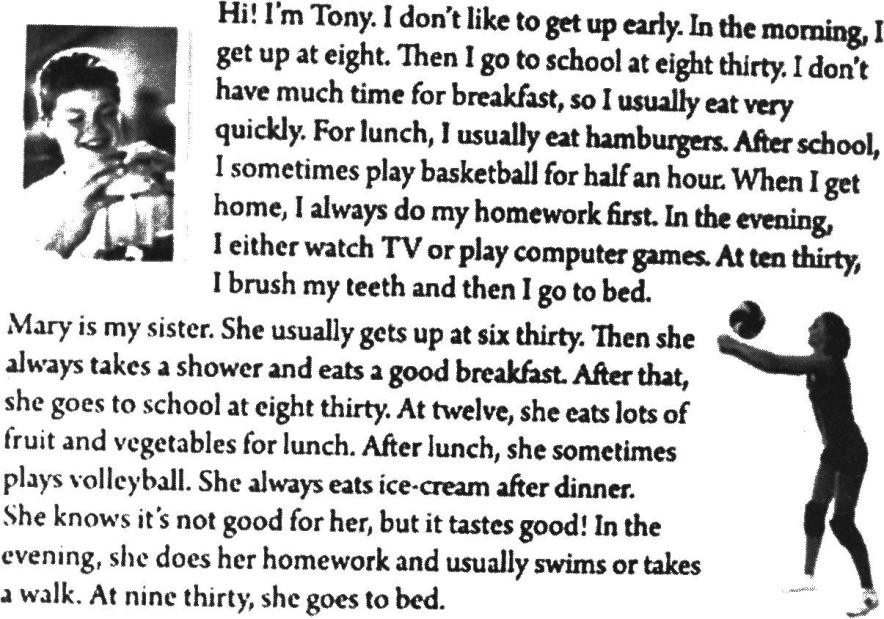 答案:解析:Ⅰ.Class Type: Listening and Speaking Class
Ⅱ.Teaching Contents: The passage is about habitsof Tony and Mary.
Ⅲ.Teaching Objectives:
(1) Knowledge objectives
①Students can master themeaning and usage of frequency words:usually, always and sometimes.
②Students can review the usage of simple presenttense.
(2) Ability objectives
①Students can understandthe main content and grasp detailed information of the listenning material byusing different listening strategies, such as summarizing and selectivelistening..
②Students can use simplepresent tense to talk about their daily activities.
(3) Emotional objective
Students can learn theimportance of good habits and cultivate healthy habits.
Ⅳ.Teaching Key andDifficult Points:
(1) Teaching key points
①Students can get themain topic and specific information of the material.
②Students can use thewords and simple present tense to talk about their daily activities (2)Teaching difficult point
Students can apply listening strategies, such assummarizing and selective listening and listening for specific information inlistening practice.
Ⅴ.Major Steps:
Step 1 Pre-listening(3minutes)
Ask students somequestions as following to share their daily life in group of four, and choosethree representatives to share their ideas.
(1) What time do youusually get up on school days
(2) What time do youhave breakfast
(3) Do you have somehealthy/unhealthy habits
(Justification: Throughgroup discussion, students can get farmiliar with the topic, and strengthentheir cooperative spirit and speaking abilities.)
Step 2 While-listening (8minutes)
1.Extensive listening
Ask students to listen tothe tape for the first time and answer the question: What is the main idea ofthe listening material
2. Listen to the tapeagain and respectively circle the activities Tony and Mary do.
3. Intensive listening
Ask students to 1istento the tape for the second time and fill in the following table.

(Justification: Throughextensive listening, students will grasp the main content of this listeningmaterial and through intensive listening, students will enhance their abilityof grasping specific information.)
Step 3 Post-listening (4minutes)
l. Read the script afterthe tape.
2. Interview : Askstudents to work in a group of 3 and interview their partners about theirhabits. Invite some volunteers to make a report in the front of the class andgive them feedback.

(Justification: Students can realize the importance of cultivatinga good habit, develop their listening and speaking abilities and enhance theirawareness of cooperating with others.) -
第3题:
根据提供的信息和语言素材设计教学方案,用英文作答。
设计任务:请阅读下面学生信息和语言素材,设计一节英语听说课的教学方案。教案没有固定格式。但须包含下列要点:
·teaching objectives
· teaching contents
· key and difficult points
·major steps and time allocation
·activities and justifications
教学时间:45分钟
学生概况:某城镇普通中学八年级(初中二年级)学生,班级人数40人,多数已经达到《义务教育英语课程标准(2011版)》四级水平,学生课堂参与积极性一般。
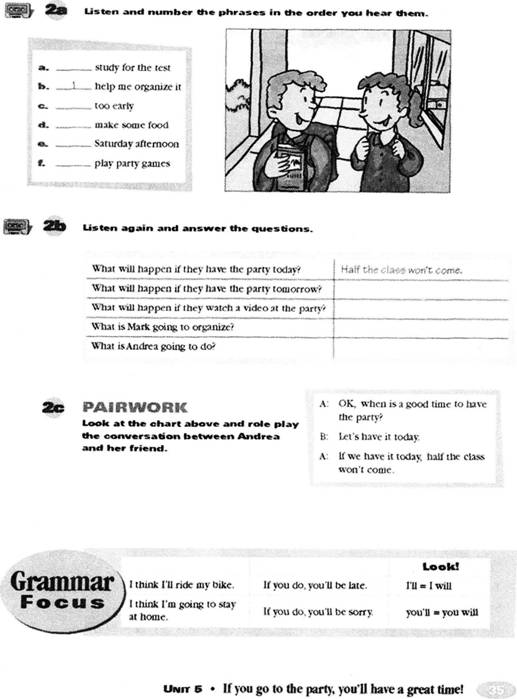
语言素材: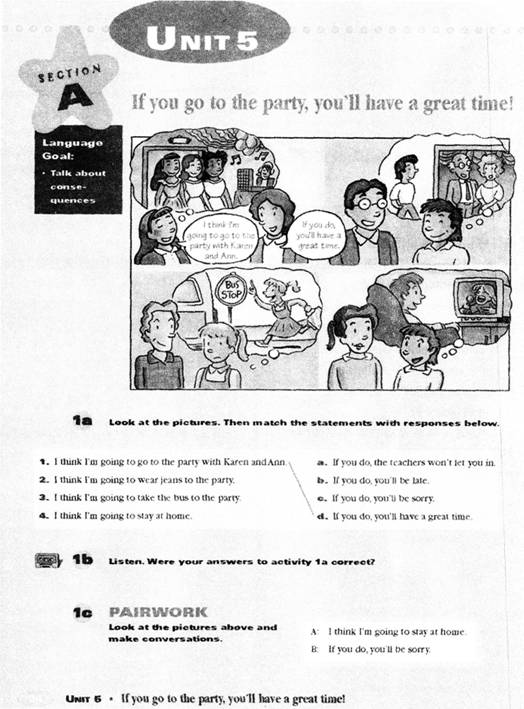
 答案:解析:Teaching Contents: In this listening and speaking class, students could learn the sentence pattern"if + simple present tense, ... will + simple future tense". Teaching Objectives :
(1) Knowledge objective
Students could master the key vocabularies, phrases and sentence.
Key Vocabulary :
flower, against, chance
Phrases :
let in / help sb do sth / at the party / bring from / during the party
Sentences :
①If you go to the party, you' 11 have a great time.
②If you do, you'll be late.
③What will happen if they have the party tomorrow
(2) Abilty objective
Students could use the vocabularies and phrases to talk about conquences correctly.
(3) Emotional objective
Students should cultivate the spirit of helping and cooperating with others.
Teaching Key Points :
Master the vocabulary, phrases and sentences correctly.
Teaching Difficult Points:
Master and use the grammar properly.
Teaching Aids: Multi-media, tape
Teaching Procedures :
Step l Leading-in (5 minutes)
(1) Play flash : If you are happy.
(2) Key language :
① If you are happy, what will you do
If I am happy, I will smile.
② What will happen if you become sad
If I become sad, I will cry.
③ What will happen if you are going to do too much work
If I am going to do too much work, I will get tired.
(Justification: The media will attract students' attention to the topic of the class.)
Step 2 Listening lb (10 minutes)
(1) Ask the students to look at the pictures and tell what they see.
(2) Play the tape and ask students to finish la.
(3) Check the answers.
statements consequences
I think l’m going to the party with Karen and Ann. If you do.you’U have a great time.
I think l’m going to wear jeans to the party. If you do,the teachers won’t let you in.
I think l’m going to take the bus to the party. If you do,you’11 be late.
I think l’m going to stay at home. If you do,you’11 be sorry.
(Justification: The listening activity can improve students' skill of listening for specific information.)
Step 3 Pair work (5 minutes)
Look at the picture above and make a conversation.
Key language :
A: I think I am going to stay at home.
B: If you do, you will be sorry.
A : Really
B: Yes, you should go to the party with me.
(Justification: Pair work could consolidate what students have learned and improve their speaking skills.)
Step 4 Listening 2a and 2b (10 minutes)
(1) Ask a student to read the six phrases.
(2) Play the recording for the first time. Ask students to grasp the main idea.
(3) Listen again and number the phrases in the order.
(4) Read the questions about the party.
(5) Listen again. Finish 2b.
(6) Check the answers.
(Justification: The listening activity can improve students' skill of listening for specific information again. )
Step 5 Group work (10 minutes)
(1) Ask students to work in groups. They are required to make a plan for the spring travel. Discuss and decide where they are going, when they are going, and how they will get there. Then ask students to give reasons.
(2) Ask several groups to show their plan to the class.
…
(Justification: Group work could develop students' spirit of cooperating with others and improve their speaking skills. )
Step 6 Summary and Homework (5 minutes)
Summary: Ask students what they have learned today. The teacher can give a clear summary.
Homework: Write ten sentences using the grammar they have learned today.
(Justification: The homework could cultivate the students' ability of writing.)
Blackboard Design:
Vocabularies : flower, against, chance
Phrases :
let in / help sb do sth / at the party / bring from / during the party
Sentences :
①If you go to the party, you' 11 have a great time.
②If you do, you'll be late.
③ What will happen if they have the party tomorrow -
第4题:
根据提供的信息和语言素材设计教学方案。用英文作答。
设计任务:请阅读下面学生信息和语言素材,设计一个30分钟的写作教学活动。
教案没有固定格式,但须包含下列要点:?
teaching objectives
teaching contents
key and difficult points
major steps and time allocation
activities and justifications
教学时间:30分钟?
学生概况:某城镇普通中学九年级(初中三年级)学生,班级人数40人,多数学生已经达到《义务教育英语课程标准(2011年版)》三级水平,学生课堂参与积极性一般。
语言素材: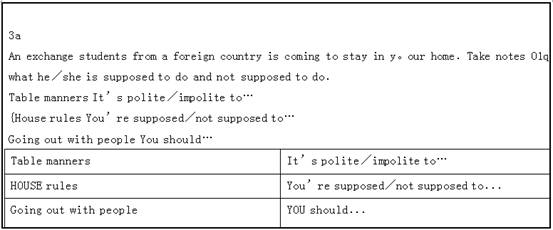
 答案:解析:Teaching Content: A class about how to writing.
Teaching Objectives:
(1) Knowledge objectives:
① Students will be able to know more Chinese customs, such as table manners, house rules, going out with people.
② Students can give some advice and suggestions about some Chinese customs to foreigners.
(2) Ability objective:
Students will improve their writing skills of giving advice and suggestions and improve the ability of communication.
(3) Emotional objectives:
① Students will have a deep understanding of the customs in our country.
② Students will foster their cross-cultural communication awareness.
Teaching Key Points:
How to give advice and suggestions on the rules of Chinese customs: table manners, house rules, going out with people.
Teaching Difficult Points:
How to master the expressions of Chinese customs and tell them to foreigners by letter.
Teaching Procedures:
Step 1 Pre-writing (10 minutes)
(1) Students are divided into ten groups. The teacher asks them to read 3a and discuss how to complete the chart. Then the students are asked to present their results and the teacher concludes their answers on the blackboard.
(2) Pair work
The teacher asks students to make a dialogue with their deskmates using the expressions:
①--What are the table manners
--It's polite/impolite to ...
②--What are the house rules
--You're supposed/not supposed to ...
③-How about going out with people
--You should ...
After the practice, the teacher invites two pairs to display their dialogue in the front of the class.
(Justification: This step can make students feel interested in the class and have things to write.)
Step 2 While-writing (15 minutes)
(1) Drafting
The teacher asks students to complete the letter of 3b according to the expressions in the chart. Then gives students 7 minuties to write the first draft.
(Justification: At this stage, the development of ideas are more important than getting grammatical structures, punctuation or spelling correct.)
(2) Peer editing
After the drafting, the teacher asks students to check each other's articles. They should read the notice and check the formation and the expressions. Also, they need to check carefully the grammar, spelling and punctuation of their writings. During the editing activity, the teacher offers guidance to students.
(Justification: Peer editing can provide an opportunity for students to share their writings and help them learn from each other. Proper guidance in revising can help students to know how to develop ideas and how to write clearly.)
Step 3 Post-writing (5 minutes)
The teacher invites two students to show their passages to all the students and gives them some evaluations.
Students will be encouraged to give some assessments too. Then the teacher asks students to revise their articles in both organisation and content based on the evaluations.
(Justification: At this stage, students can get some improvements in both organisation and contents. Revising their own articles can make them realize their mistakes more clearly.) -
第5题:
根据提供的信息和语言素材设计教学方案,用英文作答。
设计任务:请阅读下面学生信息和语言素材,设计20分钟的英语阅读教学方案。教案没有固定格式,但须包含下列要点:
·teaching objectives
·teaching contents
·key and difficult points
·major steps and time allocation
·activities and justifications
教学时间:20分钟
学生概况:某城镇普通中学七年级(初中一年级)学生。班级人数40人。多数学生已经达到《义务教育英语课程标准(2011年版)》二级水平,学生课堂参与积极性较高。 答案:解析:Teaching Contents: A passage about online shopping.
Teaching Objectives:
(1) Knowledge objectives
①Students can master the main idea of this passage.
②Students can learn the advantages and disadvantages of online shopping.
(2) Ability objective
Students can improve their reading and communicating abilities through class activities.
(3) Emotional objective
Students can improve their confidence of learning English*, and be not afraid of speaking English in class.
Teaching Key Points:
①Students can understand the advantages and disadvantages of online shopping.
②Students can comprehend the main idea of the passage.
Teaching Difficult Point:
Students can have a reasonable consumption online.
Major Steps:
Step 1 Pre-reading (6 minutes)
(1) Show some questions on the blackboard and ask students to have a discussion.
①Do you know how to buy something on the Internet
②Do you often buy things on the Interact
③What can you buy
(2) Ask students to predict the main idea of this passage.
(Justification: This step can arouse students' interest, and let them know the topic of this reading class.)
Step 2 While-reading (8 minutes)
(1) Fast reading
Ask students to read this short passage quickly in oneminute, and then conclude the main idea of each paragraph.
Ask students to examine their forecasts and conclude the main topic of this passage.
(Justification: Students can develop their skimming ability in this step.)
(2) Careful reading
Let students read this passage carefully again.
Show the table on the blackboard and ask students to discuss about the online shopping. Then ask some studentsto share their answers.
(Justification: Different ways of exploiting the text can help students not merely to cope with one particular textin class but to develop their reading strategies and reading ability.)
Step 3 Post-reading (6 minutes)
Choose two volunteers to have an interview about online shopping. One student acts as interviewer and the otherinterviewee. The knowledge they have learned in this class needs to be used in this interview.
(Justification: Students have the interview in their own way, which helps to make practical use of what they learnin this period. At the same time, students can have a better understanding of the topic.) -
第6题:
根据提供的信息和语言素材设计教学方案,用英文作答。
设计任务:请阅读下面学生信息和语言素材,设计一节英语读写课的教学方案。教案没有固定格式,但须包含下列要点:?
teaching objectives
teaching contents
key and difficult points
major steps and time allocation
activities and justifications
教学时间:45分钟?
学生概况:某城镇普通中学七年级(初中一年级)学生,班级人数40人,多数已经达到《义?
务教育英语课程标准(2011版)》二级水平,学生课堂参与积极性一般。
Listen and write these city names in the boxes above.
Beijing Moscow Toronto Boston Shanghai
Imagine you are in one of the placesin la. Talk about the weather with your friend on the phone. 答案:解析:【参考设计】
Teaching Contents: A lesson about describing the weather.
Teaching Objectives:
Knowledge objectives
(1) Students could have a good command of these following words.
rain, windy, cloudy, sunny, snow, weather
(2) Students could master these following sentence patterns.
How' s the weather
It's cloudy./It's sunny./It's raining.
Ability objective Students could know how to describe the weather.
Emotional objectives
(1) According to the guide of teaching, students could cultivate the good habits of protecting environment and other natural resources.
(2) According to talk about the weather, students could learn how to get on well with others.
Teaching Key Points:
Master the vocabularies and sentence patterns expertly.
Teaching Difficult Point:
Learn how to describe different weather in different places.
Teaching Aid:
Multi-media
Teaching Procedures :
Step I Lead-in (5 minutes)
The teacher uses multi-media to present some pictures of different weather.
T:"There are many different weather in different seasons. Different weather has different meanings to our life.
This class we will learn the weather. Now everyone has to speak out different kinds of weather as many as possible and the one who speak out the most will get a red paper star."
(Justification: These pictures on the screen can help students to know what they will learn this class. The brainstorming will stimulate their interests and incentives. )
Step 2 Presentation (15 minutes)
(1) The teacher plays the tape and asks them to listen to the tape recorder and guess the weather. At the same time, write the important sentence pattern "How's the weather " on the blackboard.
(2) Guide students to observe the weather in the five places and finish la.
(3) Make students listen to the tape, and then write the right places (lb) in the boxes above (la).
(Justification: At this step, their ability of listening for specific information will be well developed, and their participation will increase. The teacher also could guide them to speak out the key sentences.)
Step 3 Practice (10 minutes)
(1) Pair work
①Two students in a pair, speak out the weather in the five places, and check the answer of lb.
② Make a dialogue to ask the weather.
S1: How's the weather
$2: It's rainny. How's the weather in Beijing
SI: It's sunny.
(2) Group work
The teacher gives a sentence pattern"Look!The weather in ... is ...". Let students complete the sentence by using the words they have learned. Ten students in a group, which group do the best in ten minutes will be given some gifts after the class.
(Justification: This step is mainly to practice their speaking and listening skills by putting the knowledge into their daily life. This activity can let them enjoy the study.)
Step 4 Consolidation (lO minutes)
Students should write down the words they have heard from the teacher. Then check the words, if there is a mistakes, they need more practice after class.
(Justification: This step will deepen students' impression of these words and make students realize their mistakes. It's also make students know how to review after class.)
Step 5 Summary and Homework (5 minutes)
Summary: The teacher asks one student to give a summary for this class.
Homework: The teacher asks students to review the new words they have learned in this class and try to make sentences using them.
(Justification: Summary can help students to consolidate the knowledge what they have learned in the class and the homework gives a guidance for review.)
Blackboard Design:
Words: Sentences:
rain, windy, cloudy, How's the weather
sunny, snow, weatherIt's cloudy./It's sunny./It's raining.
Teaching Reflection. -
第7题:
根据提供的信息和语言素材设计教学方案,用英文作答。
设计任务:请阅读下面学生信息和语言素材,设计20分钟的英语听说教学方案。
该方案没有固定格式,但须包含下列要点:
·teaching objectives
·teaching contents
·key and difficult points
·major steps and time allocation
·activities and justifications
教学时间:20分钟
学生概况:某城镇普通中学初中一年级(七年级)学生,班级人数40人,多数学生已经达到《义务教育英语课程标准(2011年版)》二级水平。学生课堂参与积极性一般。
语言素材: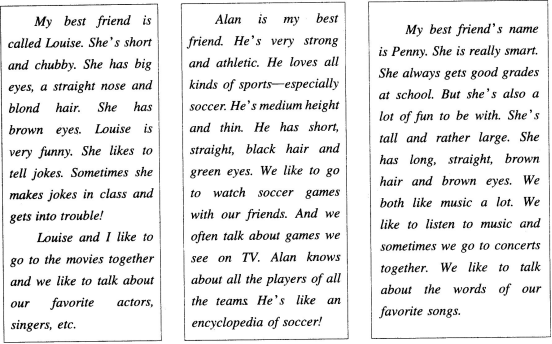 答案:解析:Teaching Contents: These three passages are about the descriptions of friends and the things they do together.
Teaching Objectives:
(1) Knowledge objectives
Students can learn some new words and expressions such as "chubby, athletic" to describe a friend's appearance,character, interests and what they like to do.
(2) Ability objectives
①Students can develop the ability to describe a friend' s appearance, character, interests and what they like to do.
②Students can improve their listening and speaking skills.
(3) Emotional objectives
Students can get a deeper understanding about friendship and strengthen the friendship with friends.
Teaching Key and Difficult Points:
(1) How to make students learn to describe a friend.
(2) How to make students improve the listening and speaking skills.
Major Steps:
Step 1 Pre-listening (5 minutes)
The teacher asks students the following questions:
(1) Who is your best friend What does he/she look like'
(2) What does he/she like to do What do you usually do
(Justification: Questions about students' friends can arouse their interest and prepare them for the class.)
Step 2 While-listening (9 minutes)
(1) Listen to the tape and fill in the blank.
(2) Listen to the tape again and finish the following question of each person: What do you like to do together
(Justification: This step helps students to get a better understanding about the listening material.)
Step 3 Post-listening (6 minutes)
(1) Show the tape scripts on the PPT.
(2) Group discussion: Talk about your ideal friends.
Then the teacher asks some students to share their ideas, then makes a conclusion about friendship andemphasizes the importance of friendship.
(Justification: This step helps students to train their speaking abilities and further their understanding aboutfriends and friendship.)
(备注:本方案设计是按照PWP模式设计的,以“听力”为主线,在听的过程中穿插“说”的活动,以提升学生的听说能力,也可以依据3P模式进行设计。) -
第8题:
设计任务:阅读下面学生信息和语言素材,设计20分钟的英语写作教学方案。
教案没有固定格式,但必须包含下列要点:
·teaching objectives
·teaching contents
·key and difficult points
·major steps and time allocation
·activities and justifications
教学时间:20分钟
学生概况:某城镇普通中学高中一年级学生,班级人数40人。多数学生已经达到《普通高中英语课程标准(实验)》五级水平。学生课堂参与积极性一般。
语言素材:
Dear Zhou Kai,
How are you We′ re doing a class survey and I have to write emails to all my pen friends inother countries. I hope you don′ t mind answering these questions.
1 Do most adults smoke in China
2 In most states in the US, it is now against the law to smoke in public buildings, such asbanks and offices, on public transport and in restaurants and cafes. Is it the same in China
3 Is the government planning to change the law about smoking in public
Hope you can answer my three questions!
Best wishes,
Paul答案:解析:Teaching Contents: This lesson is from senior high school, and it mainly talks about the adult smoking issues. Paul is making a survey on adult smoking, so he writes emails to all his pen friends in other countries to seek for help.
Teaching Objectives:
(1) Knowledge objectives
① Students can master the basic structure of an email.
② Students can get more information about smoking issues in China.
(2) Ability objectives
①Students can improve their writing and speaking abilities.
② Students can express their opinion about the smoking issues in daily life.
(3) Emotional objectives
① Students can foster the interest and desire of learning English, and be fond of taking part in class activities.
② Students can get the awareness of avoiding smoking and keeping a good health.
Teaching Key and Difficult Points:
(1) Teaching key point
Students can get to know how to write an email to analyze the phenomenon of smoking in China.
(2) Teaching difficult point
Students can organize their survey results to write an email.
Major Steps:
Step 1 Pre-writing (9 minutes)
(1) Teacher shows the email of Paul on the screen, and asks students to read it with two questions:
①What are the questions of Paul
② What' s the basic structure of an email
Students have three minutes to finish the task and share their answers.
(2) Teacher chooses two students to read their answers for the first question, and then helps students tosummarize the structure of an email: the starting address, the main body and the ending wishes.
(3) Four students in a group to help Paul to finish his survey. They need express their ideas for Paul's questionsand then exchange with the whole class.
(4) Teacher invites several groups to write down their findings on the blackboard, and asks students to arrange thewriting contents.
(Justification: Group discussion can strengthen their cooperative spirit and their imaginative ability can bedeveloped. Moreover students will get the ability to write an email to express their ideas.)
Step 2 While-writing (6 minutes)
Students need to write an email to answer Paul' s questions of adult smoking, and they have four minutes to finishtheir first draft. While their writing, teacher will give the instructions for their problems.
(Justification: Students will cultivate their ability of writing an article within certain minutes and their goodwriting habits will be formed as well.)
Step 3 Post-writing (5 minutes)
(1) Students need to check their draft by themselves and then exchange with desk-mates to do peer-editing.
(2) Teacher asks three students to read their email in front of the class and then gives them some comments.
(Justification: Editing can provide a perfect writing for students, meanwhile the comments will help studentslearn more from others and improve their writing ability promptly.) -
第9题:
根据提供的信息和语言素材设计教学方案,用英文作答。
设计任务:请阅读下面学生信息和语言素材,设计一个15分钟的英语阅读教学活动。教案没有固定格式,但须包含下列要点:
· teaching objectives
· teaching contents
· key and difficult points
·major steps and time allocation
· activities and justifications
教学时间:15分钟
学生概况:某城镇普通中学初中二年级第一学期学生,班级人数40人。多数学生已经达到《义务教育英语课程标准(2011年版)》三级水平。学生课堂参与积极性一般。
语言素材:
Who′s Got Talent
Everyone is good at something, but some people are truly talented.
It′salways interesting to watch other people show their talents. Talent showsare getting more and more popular. First, there were shows like AmericanIdol and America′s Got Talent. Now, there are similar shows around theworld, such as China′s Got Talent.
All these shows have one thing in common:
"I"hey try to look for the best singers, the mosttalented dancers, the most exciting magicians,the funniest actors and so on. MI kinds ofpeople join these shows. But who can play thepiano the best or sing the most beautifully
"Ihat′s up to you to decide. When people watchthe show, they usually play a role in decidingthe winner. And the winner always gets a verygood prize.
However, not everybody enjoys watching these shows. Some think thatthe lives of the performers are made up. For example, some people say theyare poor farmers, but in fact they are just actors. However, if you don′t takethese shows too seriously, they are fun to watch. And one great thing aboutthem is that they give people a way to make their dreams come true.答案:解析:Teaching Contents: The passage is about the hot programs of talent shows, the trend of these shows and people' s opinions of thesetalent shows.
Teaching Objectives:
(1) Knowledge objective
Students can know some basic information about talent shows and master the usage of the superlatives.
(2) Ability objectives
① Students can improve their reading and speaking abilities.
② Students can learn to talk about the talent shows and use the superlatives correctly.
(3) Emotional objective
Students can be more confident to talk with others and learn to find some shining points of others.
Teaching Key Points:
How to improve shudents' reading abilities and help them to have a better understanding of talent shows.
Teaching Difficult Points:
How to apply the superlatives to tall about things and communicate with others correctly.
Major Steps:
Step 1 Pre-reading (4 minutes)
Ask students some questions and invite some students to tall about their opinions about these talented persons.
(1) Who is the most talented person you know
(2) What can she or he do
(Justification: Through the activity, students can have more thought about talented person. Meanwhile, studentscan learn some new knowledge, and lay the foundation for the next step.)
Step 2 While-reading (6 minutes)
1. Fast reading
(1) Ask students to read the passage quickly and then conclude the main idea.
(2) Ask students to find out the three talent shows mentioned in the passage.
2. Careful reading
(1) Ask students to read the passage again and answer the following questions:
① What do talent shows have in common
②Who decides the winner
③ Why do some people not like these talent shows
④Why do some people like these shows
⑤What do you think of these shows
(2) Ask students to underline all the superlatives in the passage and give explanation by giving some examples tohelp students understand them. Then ask students to work in pairs to make sentences using at least four of them.
E.g. best singer: In my class, Tom is the best singer because he can sing fast songs very well.
(Justification: Different ways of exploiting the text can help students not merely to cope with one particular textin class but to develop students' fast reading and careful reading abilities.)
Step 3 Post-reading (5 minutes)
1. Play the tape and ask students to read the short passage after the tape and pay attention to the pronunciations ofthe words and sentences.
2. Divide students into four groups and discuss who' s got talent in the class and then make a chart. Invite one ofstudents to report the results to the whole class.
(Justification: Reading after the tape helps students to pronounce the words correctly and enhance students'understanding of the topic of talents. Through the discussion, students can train their communication skills and learn tofind others' shining points.) -
第10题:
问答题根据提供的信息和语言素材设计教学方案,用英文作答。 设计任务:请阅读下面学生信息和语言素材,设计一个15分钟的英语阅读教学活动。教案没有固定格式,但须包含下列要点: • teaching objectives • teaching contents • key and difficult points • major steps and time allocation • activities and justifications 教学时间:15分钟 学生概况:某城镇普通中学初中二年级第一学期学生,班级人数40人。多数学生已经达到《义务教育英语课程标准(2011年版)》三级水平。学生课堂参与积极性一般。 语言素材: Who´s Got Talent? Everyone is good at something, but some people are truly talented. It´s always interesting to watch other people show their talents. Talent shows are getting more and more popular. First, there were shows like American Idol and America´s Got Talent. Now, there are similar shows around the world, such as China´s Got Talent. All these shows have one thing in common: Ihey try to look for the best singers, the most talented dancers, the most exciting magicians,the funniest actors and so on. MI kinds of people join these shows. But who can play the piano the best or sing the most beautifully? Ihat´s up to you to decide. When people watch the show, they usually play a role in deciding the winner. And the winner always gets a very good prize. However, not everybody enjoys watching these shows. Some think that the lives of the performers are made up. For example, some people say they are poor farmers, but in fact they are just actors. However, if you don´t take these shows too seriously, they are fun to watch. And one great thing about them is that they give people a way to make their dreams come true.正确答案:解析: -
第11题:
问答题设计任务:请阅读下面学生信息和语言素材,设计20分钟的英语写作教学方案。教案没有固定格式,但须包含下列要点:●teaching objectives●teaching contents●key and difficult points●major steps and time allocation●activities and justifications教学时间:20分钟学生概况:某城镇普通中学初中一年级学生,班级人数40人。多数学生已经达到《义务教育英语课程标准(2011年版)》二级水平。学生课堂参与积极性一般。语言素材: Write your own note to a friend. Invite him/her to an activity in your school. Use the questions to help you. 1.What's your friend's name? 2.What does your friend like to do? 3.What activity do you have in your school? 4.When is the activity?正确答案:解析: -
第12题:
问答题根据提供的信息和语言素材设计教学方案,用英文作答。设计任务:请阅读下面学生信息和语言素材,设计20分钟的英语听力教学方案。该方案没有固定格式,但须包含下列要点:●teaching objectives●teaching contents●key and difficult points●major steps and time allocation●activities and justifications教学时间:20分钟学生概况:本班为中等城市普通学校初中一年级(七年级)学生,班级人数45人,多数学生已经达到《义务教育英语课程标准(2011年版)》二级水平。学生能够积极参与课堂活动,合作意识较强。语言素材: A: How much is the hat? B: The hat is six dollars. A: And how much are the shorts? B: Oh, they're eight dollars. A: And the sweater? How much iS the sweater? B: Let's see.The sweater is nine dollars.正确答案:解析: -
第13题:
根据提供的信息和语言素材设计教学方案。用英文作答。
设计任务:请阅读下面学生信息和语言素材,设计一节听力课的教学方案。教案没有固定格式.但须包含下列要点:?
teaching objectives?
teaching contents?
key and difficult points?
major steps and time allocation?
activities and justifications
教学时间:45分钟?
学生概况:某城镇普通中学七年级(初中一年级)学生,班级人数40人,多数学生已经达到《义务教育英语课程标准(20i l年版)》二级水平,学生课堂参与积极性一般。
语言素材:?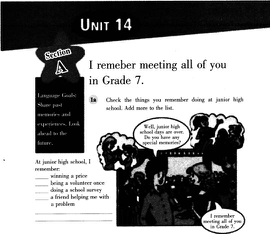
Listen and match the memory with the person.
__ Mary a. used to be scared of a teacher with high standards.
__ Frank b. remember losing a schoolbag.
__ Sarah c. remembers meeting this group of friends.
__ Peter d. has enjoyed every year of junior high school.
 答案:解析:Teaching Content: A listening material about "I remember meeting all of you in Grade 7".
Teaching Objectives:
(1) Knowledge objectives
①Students can consolidate the usage of remember and the sentence pattern "I remember doing sth".
② Students can be more familiar with the topic of memories.
(2) Ability objectives
According to study, students can improve their skills of listening for specific information and can talk about the meaningful and unforgettable memories in English freely.
(3) Emotional objectives
① Students can find out some meaningful memories from the past experience to encourage themselves studying hard.
②Students can understand we should cherish present and do our best to create a bright future.
③ Students can improve the confidence of learning English, and are not afraid of speaking English.
Teaching Key Points:
How to make students improve their skills of listening for specific information.
Teaching Difficult Point:
How to make students use the knowledge they learnt before to talk about the things happened in the past.
Teaching Aids: a tape recorder, multimedia, pictures
Teaching Methods: Communicative Approach, Task-based Teaching Method, Audio-Lingual Approach.
Teaching Procedures:
Step 1 Lead-in (5 minutes)
The teacher shows some photos about students' junior high school and play the music named"Seasons in the Sun" to let students look back on their junior high school memories, and told them today they are going to learn to express their memories in English.
T: (after listening) Now, who can tell me what's the subject of this song
S: About youth.
T: Yes, it's about youth. Very good. This is the last unit of our English book. In this unit, we will mainly talk about our past school lives.
(Justification: This step could attract students' attention and lead in the new lesson easily.)
Step 2 Pre-listening (10 minutes)
Teacher asks students to look at the picture in this unit, and asks students to finish the task in la. Then asks students to check the things they remember doing at junior high school and add more things they remember as much as possible.
T: Now, look at the picture. What kind of party do you think it is Is it a welcome party or graduation party
S: Graduation party.
T: Look at the small pictures. What are the boy and girl talking about Try to guess!
S: (Discussing)
T: OK. Let's look at the small scenes in this big picture. What does the girl remember doing According to the pictures, please have a guess and finish the task in la. Do you understand
S: Yes!
T: And you are supposed to write down some more items about what you remember doing in your past school time. Ok, now, let's do it.
(Justification: This step can attract students' attention and help and encourage them to foucus on the content of what they are about to hear.)
Step 3 While-listening (13 minutes)
(1) Teacher asks students to listen to the tape and match the memory with the person. Then asks them to tell their answers to their partners.
T: Ok, now, let's move on to our listening. Listen to the tape and match the memory with the person. And tell your answer to your partner by using sentences, such as, Peter remembers doing homework carefully to meet the standards of a strict teacher. Are you clear
S: Yes!
T: Now, let's begin!
Students listen to the tape.
T: Ok, now, who can tell us your answers
SI: Sarah remembers losing a schoolbag ...
T: Ok, very good. Sit down, please.
$2: ...
(2) Then the teacher plays the tape again, and asks students to read after the record.
T: Now, I will play the record again and you are supposed to read after the record silently. Any questions
S: No.:
T: Ok, now, please listen to the tape. While listening, please pay more attention to the pronunciation and
intonations.
(Justification:This step make students listen and enjoy what they are listening. The task of matching the memorizing and with the person makes students focus on the listening itself. )
Step 4 Post-listening (12 minutes)
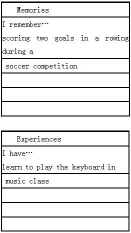
(1) The teacher asks students to make a dialogue with their deskmates by using the list in la.
T: Now, you are supposed to make a dialogue with your deskmate according to the list you wrote in la. Here is a conversation structure, you can make your dialogue according to it.
(Then the teacher writes the example on the blackboard.)
Example:
--What do you remember doing
--I remember doing my homework very late till to 12 o'clock. What do you remember doing
--Well, I remember winning a prize. And my parents took me to the biggest amusement park in our city.
--Wow!It's cool. What else do you remember
--I still remember playing basketball on the playground with you and singing songs with our best friends.
--Yes, wonderful and colorful.
The teacher chooses one student and his/her deskmate to present their dialogue in front of the class and gives
some feedback.
(2) T: Now, look at the chart on PPT, I need you to make an interview. Interview some classmates and record at least three memories of thetn. Then fill the chart and make dialogue with your deskmates. Any questions
S: No.
T: Good. Let's do it. After finished, I will invite three groups to share their dialogues, and the best group will get a reward.
(Justification: This step is easier for students' to have a high motivation to speak. According to their make dialogue with their deskmates can test the students' listening comprehension.)
Step 5 Summary and Homework (5 minutes)
Summary: Ask students to think about the key sentence structures they listened today, and then make a short summary.
Homework: Ask students to look back on their school life, and communicate these colorful feelings with their friends.
Blackboard Design:
Unit 14 I remember meeting all of you in Grade
Pre-listening:
While-listening:
Post-listening:
Example:
--What do you remember doing
--I remember doing my homework very late till to 12 o'clock. What do you remember doing
--Well, I remember winning a prize. And my parents took me to the biggest amusement park in our city.
--Wow!It's cool. What else do you remember
--I still remember playing basketball on the playground with you and singing songs with our best friends.
--Yes, wonderful and colorful.
Teaching reflection. -
第14题:
根据提供的信息和语言素材设计教学方案。用英文作答。
33.设计任务:请阅读下面学生信息和语言素材,设计一节英语听说课的教学方案。教案没有固定格式,但须包含下列要点:
·teaching objectives
· teaching contents
· key and difficult points
· major steps and time allocation
· activities and justifications
教学时间:45分钟
学生概况:某城镇普通中学八年级(初中二年级)学生,班级人数40人,多数已经达到《义务教育英语课程标准(2011版)》四级水平,学生课堂参与积极性一般。
语言素材:
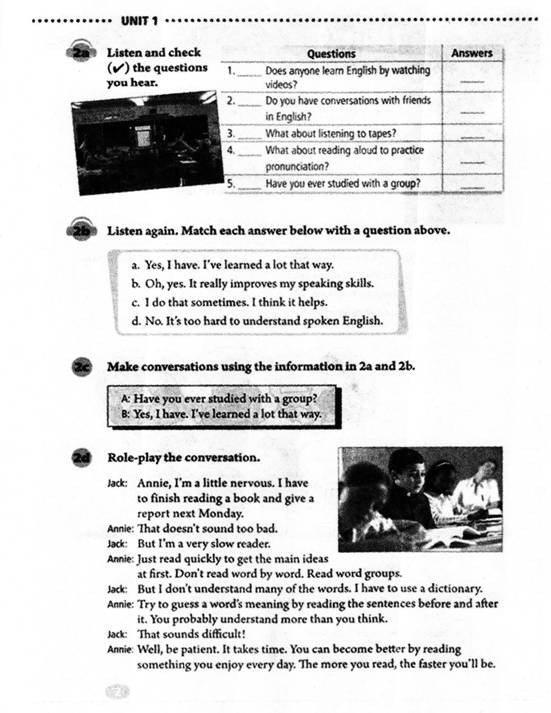 答案:解析:Teaching Content: This lesson is about the new sentence pattern"by doing". It can help the students to talk about how they study. Teaching Objectives :
( 1 ) Knowledge objective
Students could master some expressions of English learning methods and sentence patterns like "I study ... by ...".
(2) Ability objective
Students could talk about how to learn English and describe their study in sentence pattern "by doing".
(3) Emotional objective
Students could help others to learn English while communicating. It can strengthen their confidence.
Teaching Key Points:
(1) Master the usage of sentence patterns like "How do you study ... I study ... by ...".
(2) Express their ideas in the "by doing" structure.
Teaching Difficult Points:
Describe English learning methods with abundant vocabulary and use these methods effectively.
Teaching Aids :
Multi-media, some related pictures.
Teaching Procedures :
Step 1 Leading in and Warming up (5 minutes)
The teacher will play a video and lead in the topic"learning to learn". Students will talk about some learning methods they know with the language structure "by doing"
(Justifications: Playing a related video will help students recall their old times of studying and make preparations for the next step.)
Step 2 Presentation (10 minutes)
(1) Students use the pictures on Page 1 to predict phrases about learning methods with the language structure "by doing".
(2) Students will do exercise from la.
(Justifications: Students will understand the usage of"by doing" better through this part. They can also master some phrases related to English learning methods.)
Step 3 Listening (10 minutes)
Students will do some listening exercises from lb, 2a and 2b. They can gain some methods to learn English while listening.
(Justifications: Students will know the usage of"by doing" completely through listening materials. Also, they can imitate pronunciation from listening materials and gain key phrases from listening exercises.)
Step 4 Practice (10 minutes)
Two students work in a group to do a conversation exercise according to the content from 2a and 2b.
(Justifications: Students can practice making conversations according to listening materials and enhance their understanding of the usage of "by doing".)
Step 5 Consolidation (5 minutes)
Two students work in a group to practice the conversation. Then change their roles.
(Justifications : Students will enhance their understanding of English learning and improve the skills of listening and speaking.)
Step 6 Summary and Homework (5 minutes)
Summary: Students will recall what they have learned today. The teacher can repeat them.
Homework: Students will do some exercise on the textbook and make sentences with "by doing".
(Justifications: This will help students recall what they have learned today and check whether they have mastered the knowledge.)
Blackboard Design :
New sentence patterns:
How do you study for a test
I study by working with a group. -
第15题:
根据提供的信息和语言素材设计教学方案,用英文作答。?
设计任务:请阅读下面学生信息和语言素材。设计一节英语口语课的教学方案。教案没有固定格式,但须包含下列要点:?
·teaching ;objectives?
·teaching ;contents?
·key ;and ;difficult ;broints?
·major ;stebrs ;and ;time ;allocation?
· ;activities ;and ;justifications?
教学时间:45分钟?
学生概况:某城镇普通中学九年级(初中三年级)学生,班级人数40人,多数已经达到《义务教育英语课程标准(2011版)》四级水平,学生课堂参与积极性一般。?
语言素材:?
;Boy ;1: ;Wow, ;how ;luck!?
;Girl ;1 ;: ;What ;would ;you ;do ;if ;you ;won ;the ;lottery??
;Boy ;1 ;: ;If ;I ;won ;the ;lottery, ;I'd ;give ;the ;money ;to ;the ;Zoo. ;I ;want ;to ;helbr ;the ;brandas.?
;Girl ;1 ;.. ;That's ;a ;good ;idea ;! ;I ;know ;what ;I' ;d ;do. ;If ;I ;won ;the ;lottery, ;I' ;d ;buy ;a ;big ;house ;for ;my ;family.?
;Girl ;2.. ;Really? ;I'd ;brut ;the ;money ;in ;the ;bank. ;Then ;I'd ;just ;watch ;it ;grow!?
;Boy ;2: ;Hmm ;... ;I ;think ;I'd ;give ;the ;money ;to ;medical ;research. ;I'd ;want ;to ;helbr ;other ;breobrle.?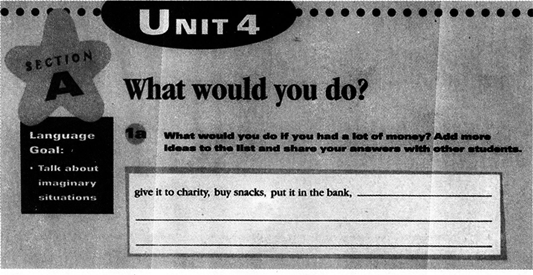
 答案:解析:Teaching Contents: In this class, students could control the structure"I would / I'd do" to talk about the imaginary situations. Teaching Objectives ..
?( 1 ) Knowledge objective
①Key Vocabulary
lottery, million, medical, research
②Target Language
Look!This girl won a million dollars in the lottery.
Wow! What would you do if you won a million dollars?
I'd give it to medical research.
③ Structure
I would / I'd do
?(2) Ability objective
Students' listening ability will be well improved.
(3) Emotional objective
Students can be more interested in English. Students should remember it's really being cool to realize your dream through great efforts.
Teaching Key Points:
(1) Target language
(2) The structure: I would / I'd do
Teaching Difficult Point:
The structure : I would / I' d do
Teaching Aid :
A tape recorder
Teaching Procedures:
Step 1 Revision (3 minutes)
Review the structure "should be allowed to" by asking students to make sentences about school rules.
(Justification: The revision can examine students' learning effect and easily lead in the text.)
Step 2 Presentation (25 minutes)
la
This activity focuses on vocabulary and structures introduced in the unit.
Read the instructions to the class.
Call students' attention to the words in the box. Ask a student to read them to the class.
T: What would you do if you had a lot of money?Add more ideas to the list.
Then share your answers with other students.
Get students to complete the task. First individually, then in groups.
As they work, walk around the room checking progress and offering any help they may need.
Collect answers from students on the blackboard.
Answers will vary but should include a mixture of ideas for helping themselves and others.
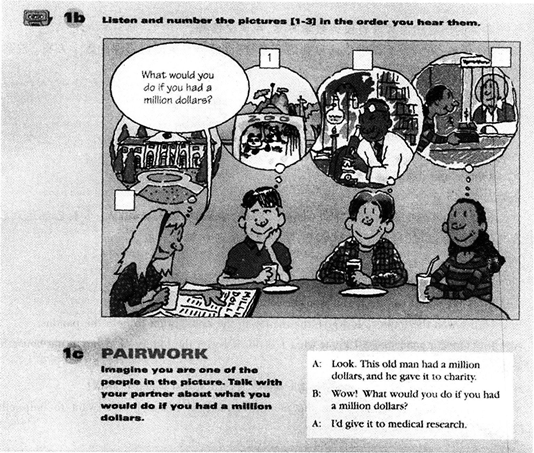
1b
The teacher reads the instructions to the class, and reads the question in the speech bubble, then explains the word "lottery" to students.
T: You will hear teenagers talking about what they would do if they won the lottery.
Point to the pictures. Ask students to describe them one by one.
For example, for Picture One, a student might say, "If I won the lottery, I' d buy a big house."
Point out the sample answer.
T: The first picture you will hear about has the number one on it.
Play the recording for the first time. Students only listen.
Play the recording again. This time students listen and number the pictures in the order they hear them.
Check the answers.
?(Justification: This step can arouse students' interests and presents the target language in spoken conversation.)
Step 3 Practice (12 minutes)
Read the instructions to the class in order to call students' attention to the conversation in the box. Then,explain the vocabulary words"million" and"medical research". Finally, invite a pair of students to read it to the class.
?S1 : Look ! This girl won a million dollars in the lottery.
?S2: Wow! What would you do if you won a million dollars?
?S1 : I'd give it to medical research.
?Write it on the blackboard.
?T: Pretend you are the people in the picture. Talk with your partner about what you would do if you won a million dollars.
Get students to work in pairs. As they work in pairs together, walk around the room offering language support as needed.
After students have had a chance to practice several exchanges, ask pairs to come to the front of the classroom and act out their conversations.
(Justification: This step can provide an oral practice using the target language for students.)
Step 4 Summary and Homework (5 minutes)
Summary: In this class, we've learned some vocabulary words and the target language"What would you do if you won the lottery?I'd give it to medical research".
Homework: If you had a large amount of money, e.g. $100,000, what would you buy?Please write down each item and its cost to see how you will spend the full amount. And bring your lists to class tomorrow.
(Justification: Homework can help students consolidate what they have learned in this class and improve their writing abilities.)
Blackboard Design :
Unit 4 What would you do?
Section A
The First Period
Target language :
A: Look. This girl won a million dollars in the lottery.
B: Wow! What would you do if you won a million dollars?
A: I'd give it to medical research. -
第16题:
设计任务:请阅读下面学生信息和语言素材,设计20分钟英语阅读的教学教案没有固定格式,但须包含下列要点:
●teaching objectives
●teaching contents
●key anddifficult points
●majorsteps and time allocation
●activities and justifications
教学时间:20分钟
学生概况:某城镇普通中学高中一年级学生,班级人数40人。多数学生已达到《普通高中英语课程标准(实验)》五级水平。学生课堂参与积极性一般。
 答案:解析:Class Type:ReadingClass
TeachingContents:The lesson mainly talks about the ThreeGorges Dam, including its features, advantages and disadvantages.
Teaching Objectives:
Knowledge objective
Students can get more information about the features, advantages anddisadvantages of the Three Gorges Dam.
Abilityobjectives
(1)Students can understand the main content and detail information ofthe passage through fast reading and detailed reading.
(2)Students can introduce the Three Gorges Damin their own words.
Emotional objective
Students can develop a sense of national pride through learning thispassage.
Teaching Key and Difficult Points:
Studentscan get a general idea of the passage and learn to use reading strategies tounderstand the material, such as summarizing, skimming and acquiring usefulinformation
Major Steps:
Step1 Pre-reading (5 minutes)
1. Show a poem of Mao Zedong on PPT:Walls of stone to hold back clouds and raintill a smooth lake rises in the narrow gorges.Students guess which placeit is. Then show some beautiful pictures of the Three Gorges Dam.
2. Students have a discussion: Why did weChinese build the Three Gorges Dam Then ask some of them to share their ideas.
(Justification: The poem and pictures canarouse students' interest in this class. Discussion will stimulate students’ backgroundinformation and students will get prepared for the reading class, and it willbe helpful to understand the material. )
Step 2 While-reading (9 minutes) .
1. Fast reading: Task 1 : Students read the passage quickly and give asummary of each paragraph. Students share their ideas and help students toanalyze the article structure.
2. Careful reading: Task 2: Students read the passage again and completethe following table. Then ask some students to show their answers and giveassessments.

Task3 : Students pay attention to Paragraph 2-5, and work in pair s to discuss thequestions below:
(1) What's the biggest advantage of the Three Gorges Dam project
(2) What has happened to the historical relics near the Three GorgesDam
Ask some pairs to show their opinions and lead students t0 1eam thenecessity of the Three Gorges Dam.
(Justification: Through three tasks, students can have a thoroughunderstanding of the passage, and improve reading skills by using different readingstrategies: such as summarizing and acquiring useful information.)
Step 3 Post-reading (6 minutes)
Interview: students work in a group of three. Two students act asengineers from the Three Gorges Dam and one student as a reporter. The reporterasks some questions about the Three Gorges Dam and their feelings about the constructionproject. After three minutes, invite some groups to show their dialogues.
(Justification: Students can improve their speaking ability by talkingabout the Three Gorges in their own words and develop a sense of national pride.) -
第17题:
根据提供的信息和语言素材设计教学方案。用英文作答。
设计任务:请阅读下面学生信息和素材,设计一个15分钟的口语教学活动,教案没有固定格式,但要包括以下几点:
·teaching objectives
·teaching contents
·key and difficult points
·major steps and time allocation
·activities andjustificatios
教学时间:l5分钟
学生概况:某城镇普通初一年级第一学期学生,40人。多数学生已经达到《义务教育英语课程标准(2011年版)》二级水平。学生课堂参与积极性一般。
语言素材:
Dear Jenny,
I am very busy on Friday.At 8 : 00 I have math.It is not fun.The teacher says it is useful, but Ithink it is difficult.Then at 9:00 I have science.It is difficult but interesting.At 10:00 I have his-tory.After that, I have P.E.at 11:00.It′ s easy and fun.Lunch is from 12:00 to 1:00, and after thatwe have Chinese.It is my favorite subject.Our Chinese teacher, Mr.Wang, is great fun.My classesfinish at 1 : 50, but after that I have an art lesson for two hours.It is really relaxing! How about you
When are your classes What is your favorite subject
Your friend,
Yu Mei答案:解析:Teaching Contents: A letter that Yu Mei writes to her friend Jenny, which talks about her study life on Friday.
Teaching Objectives:
(1) Kownledge objectives
① Students can master the meaning and usage of this writing.
②Students can use the fixed structures "I have science/math/Chinese/PE" and "It is + adj." in proper situation totalk about their study life.
(2) Ability objectives
① Students can get the main idea about what Yu Mei is talking about after listening, and can get some useful in-formation from the writing.
② Students can improve their listening and speaking abilities through class activities.
(3) Emotional objectives
① Students can improve the confidence of learning English, and are not afraid of speaking English in class.
② Students can cooperate with others actively, and complete the tasks together.
Teaching Key Point:
Students can use the new sentences "1 have science/math/Chinese/PE" and"It is + adj." to talk about theirstudy life.
Teaching Difficult Points:
(1) Students can use the new sentences correctly;
(2) Students can understand it is very necessary to talk about the study life with their friends to share theiridea.
Major Steps:
Step 1 Presentation (7 minutes)
(1) The teacher shows the passage on the PPT and asks students to read the passage and find out the following in-formation.
How does Yu Mei think of the math
What does Yu Mei have at 10: 00
What' s Yu Mei' s favorite subject
Then the teacher asks students to fill in the blanks of the table, and asks them to check the answer in pairs.
(2) The teacher plays the tape, and asks students to read after the tape, and pay more attention to the pronuncia-tion, and do the imitation.
(Justification: Through the various activities, students can understand the details of the writing and learn to com-municate with each other.)
Step 2 Practice (4 minutes)
The teacher shows the picture about one student' s study, and asks students to describe the content according tothe picture with deskmates. For instance:
A: What lessons does he have on Friday
B: He has math.
(Justification: Through this activity, students can practice the dialogue in pairs and consolidate the knowledgewhat they have learned.)
Step 3 Production (4 minutes)
The teacher chooses some volunteers to do the interview. One of the partners acts as the interviewer and the otherinterviewee. Make an interview about the study life, using the knowledge they have learnt today.
(Justification: Students do the interview in their own way, which helps to apply what they have learnt in this peri-od in real situation.) -
第18题:
根据提供的信息和语言素材设计教学方案,用英文作答。
设计任务:请阅读下面的学生信息和语言素材,设计一个l5分钟的听说教学活动。
该方案没有固定格式,但须包含下列要点:?
teaching objectives
teaching contents
key and difficult points
major steps and time allocation
activities and justifications
学生概况:某城镇普通中学七年级(初一)学生,班级人数40人。多数学生已达到《义务教育英语课程标准(2011年版)》二级水平。学生课堂参与积极性一般。
语言素材:?
A: Is this your ruler?
B: No, it isn't. It's her ruler.
C: Is this your pencil?
D: Yes, it is. It's my pencil.答案:解析:Teaching Contents: This listening and speaking class is about the sentence pattern "Is this your ... "
Teaching Objectives:
(1) Knowledge objective
Students can recognize and read the new words about stationery--"pencil, ruler" and know how to use the sentence "Is this your ... ".
(2) Ability objective
Students can understand the sentence"Is this your ... " and use it to ask others about the ownership of something.
(3) Emotional objective
Students will be more interested in sharing their ideas with others and can cooperate with their partners well.
Teaching Key Point:
How to make students master the new words and new sentence structure.
Teaching Difficult Points:
(l) How to make students communicate with others correctly and fluently.
(2) How to make students get the key information after listening.
Teaching Procedures:
Step 1 Presentation and Practice (8 minutes)
Firstly, the teacher lets students listen to the tape recorder and try to guess the meaning of new words according to the pictures that the teacher shows them. After the first listening, the teacher teaches the new words "ruler,pencil". Students master the meaning and spelling of these words by missing-letter game.
Secondly, the teacher plays the tape again and leads students to pay attention to the conversation in the listening. After this listening, the teacher asks students the questions appeared in the recorder, like "Is this your pencil ls this your ruler " and encourages them to answer these questions by using the sentences they get during the listening.
(Justification: At this step, students can learn the meaning of the new words by pictures, and know how to read them by listening to the tape recorder. The missing-letter game can help students to participate in the class actively and practice the new words. The second listening activity can help students know how to use the new sentences and practice their listening skills.)
Step 2 Consolidation (7 minutes)
Pair work: The teacher asks students to play the dialogue in pairs, and encourages them to use more words of stationery. Then several pairs are asked to show their dialogues to the class, and the teacher will give them proper assessment on their presentations.
(Justification: This step can provide students with the opportunity to speak English in real situations and their speaking ability can also be improved.) -
第19题:
根据提供的信息和语言素材设计教学方案,用英文作答。
设计任务:请阅读下面学生信息和语言素材,设计一节英语语法课的教学方案。教案没有固定格式,但须包含下列要点:?
teaching objectives
teaching contents
key and difficult points
major steps and time allocation
activities and justifications
教学时间:45分钟?
学生概况:某城镇普通中学八年级(初中二年级)学生,班级人数40人,多数已经达到《义务教育英语课程标准(2011版)》三级水平,学生课堂参与积极性一般。
语言素材:?
Grammar:
A. It is + adj. + that ...
B. It is + adj. + to-infinitive
C. It is + adj. + for ... + to-infinitive答案:解析:【参考设计】
Teaching Contents: The sentence pettern"It is + adj. + that""It is + adj. + to-infinitive""It is + adj. + for sb. + to-infinitive".
Teaching Objectives:
(1) Knowledge objectives
①To use "It is + adj. + that" to say how one feels about sth.
② To use "It is + adj. + to-infinitive" to describe actions and situations.
③ To use "It is + adj. + for ... + to-infinitive" to specify the person one is talking about.
(2) Ability objective
Students can use "It is + adj. + that ...", "It is + adj. + to-infinitive" and "It is + adj. + for ... + to-infinitive" in daily communication.
(3) Emotional objective
Students can understand the differences between the Chinese language and English.
Teaching Key Points
(1) To use "It is +adj. + that" to say how one feels about sth.
(2) To use "It is + adj. + to-infinitive" to describe actions and situations.
(3) To use "It is + adj. + for ... + to-infinitive" to specify the person one is talking about.
Teaching Difficult Points
How to enable students to master the different uses of the following structures:
(1) It is + adj. + that ...
(2) It is + adj. + to-infinitive
(3) It is + adj. + for sb. + to-infinitive
Teaching Procedures:
Step 1 Lead-in (5 minutes)
Teacher show students a beautiful place of interest and two sentences:
It is interesting that there are so many beautiful flowers in the garden.
It is cool to spend our holiday here.
Ask students to guess their meaning and pay attention to the sentence pattern.
(Justification: The present of the beautiful place of interest and sentences can arouse students' interests in the class and help the teacher lead in the new teaching content.)
Step 2 Part A (10 minutes)
(1) Tell students that we use the "it is + adj. + that" structure to say bow we feel about something.
(2) Encourage them to ask questions if they are unsure of the meaning.
(3) Ask students to complete the exercises on their own.
(4) Ask some students to make some sentences using the adjectives and the given phrases.
① We can walk 100 kilometres in 45 hours. (possible)
② There are so many different trees in the parks. (interesting)
③ There was snow on one of the mountains. (surprising)
④ Each team must raise at least HK $6,000. (important)
⑤ So many people want to help others in need. (nice)
(Justification: This step makes students understand the structure"it is + adj. + that". Doing exercises can help students have a deep understanding of how the structure are formed and how they are used.)
Step 3 Part B (10 minutes)
(I) Explain that the"It is + adj. + to-infinitive" structure is similar to the structure students learned in Part A
except that here, the adjective describes an action or activity.
(2) Encourage students to ask questions if they are unsure of the meaning.
(3) Check that students have understood the structure.
(4) Ask students to make sentences using the given structure:
It is difficult to ...
It is easy to ...
It is exciting to ...
It is necessary to ...
(Justification: This step makes students understand and master this structure "It is + adj. + to-infinitive". The teacher in this step plays the role of organizer, resource-provider and assessor.)
Step 4 Part C (9 minutes)
(1) Explain that the structure in Part C is the same as the structure in Part B except that we insert"for sb."
between the adjective and the "to-infinitive" to indicate who we are talking about.
(2) Encourage students to ask questions if they are unsure of the meaning.
(3) Check that students have understood the structure.
(4) Ask students to make sentences using the given pictures and words.
①People should not go hiking alone. (dangerous)
②Jimmy's team can raise over HK $6,000 for charity. (possible)
③You can get very hot on the hike. (important/take lots of water)
(Justification: This step makes students understand and master this structure"It is + adj. + for ... + to-infinitive". Using picture prompts and words can help them practice the target language while negotiating meaning.)
Step 5 Practice (6 minutes)
Give students one topic--travel and ask them to make sentences in groups using the three sentence patterns.
Then ask some students to report their sentences.
(Justification: A real purpose for genuine communication among students can help them practice the language in a communicative way.)
Step 6 Summary and Homework (5 minutes)
Summary:
One student acts as an assistant teacher to guide all the students to summarize the new knowledge of this lesson.
Homework:
(1) Finish the exercises.
(2) Write a short story about your life including the grammar.
(Justification: Summary can help students consolidate the knowledge what they have learned in the class.
Homework makes students combine the grammar structure with their life, and practice their writing skills at the satne time.)
Blackboard Design:
1. It is + adj. + that clause
2. It is + adj. + to do sth
3. It is + adj. + for sb + to do sth
Teaching Reflection. -
第20题:
根据提供的信息和语言素材设计教学方案,用英文作答。
设计任务:请阅读下面学生信息和语言素材,设计20分钟的英语听说教学方案。教案没有固定格式.但须包含下列要点:
·teaching objectives
·teaching contents
·key and difficult points
·major steps and time allocation
·activities and justifications
教学时间:20分钟
学生概况:某城镇普通中学初中一年级第二学期学生,班级人数40人。多数学生已经达到《义务教育英语课程标准(2011年版)》二级水平。学生课堂参与积极性一般。
语言素材:
Conversation 1
Tom:Hey,Peter.
Peter:Hi,Tom.
Tom:How′s the weather down there in Shanghai?
Peter:It′s cloudy.How′s the weather in Moscow?
Tom:It′s snowing right now.
Conversation 2
Peter:Hi,Aunt Sally.
Aunt Sally:Hello,Peter.
Peter:How′s the weather in Boston?
Aunt Sally:Oh,it′s windy.
Conversation 3
Peter:So,how′s the weather in Beijing?
Julie:It′s sunny.
Conversation 4
Peter:Hi,Uncle Bill.
Uncle Bill:Hello,Peter.
Peter:How′s the weather in Toronto?
Uncle Bill:It′s raining,as usual!答案:解析:Teaching Contents:Four dialogues about the weather.Teaching Objectives:
(1)Knowledge objectives
①Students can master some words of weather,such as"cloudy,snow,windy,sunny,rain".
②Students can talk about weather with others by using the sentence patterns"How's the weather in...?""It's...".
(2)Ability objectives
①Students can improve their listening abilities through extensive listening and intensive listening.
②Students can develop their speaking abilities by role play.
(3)Emotional objectives
①Students are willing to communicate with each other in English.
②Students can become interested in using English to describe weather in their daily life.
Teaching Key Point:
Students can master the words about weather and sentence patterns"How's the weather in...?""It's...".
Teaching Difficult Point:
Students can use new sentence patterns to talk about the weather correctly.
Major Steps:
Step 1 Pre-listening(4 minutes)
Teach these new words by presenting pictures of different weather conditions on the screen,and then,let students?read the words after the tape.
(Justification:This step can arouse students'interest and pave the way for students'listening activity.)
Step 2 While-listening(10 minutes)
Task 1
Play the tape and ask students to summarize the main idea,then talk about and write down which cities are?mentioned in the listening material.
For example:Shanghai,Moscow,Boston,Beijing,and Toronto.
Task 2
Ask students to listen to the tape for the second time and fill in the following table.

Task 3
Ask students to find out the key sentences describing weather.Then let students learn the sentence patterns by?changing the underlined part into the new words.
E.g.--How's the weather inBeijing?
--It's sunny.
(Justification:Through extensive listening,students will grasp the main content of this listening material.Through intensive listening,students will enhance their ability of grasping specific information.)
Step 3 Post-listening(6 minutes)
Group work:Role play
Ask students to do a role play in groups of four.Students act as weather reporters to give weather forecast of?different cities in turn.After 5 minutes,each group will choose a representative to perform it in front of the class.
For example:
Good morning,ladies and gentlemen.Here is the weather forecast of our city.It's cloudy tomorrow,and it's?very cold,so you should wear more clothes when you go outside.It has a strong wind in the afternoon,and it will be?raining the day after tomorrow.
(Justification:With practice,students can not only review the knowledge that they have learned,but also develop?their speaking ability.)
名师如何巧解题?查看视频解析>> -
第21题:
问答题33.根据提供的信息和语言素材设计教学方案,用英文作答。设计任务:请阅读下面学生信息和语言素材,设计20分钟的英语写作教学方案。教案没有固定格式,但须包含下列要点:●teaching objectives●teaching contents●key and difficult points●major steps and time allocation●activities and justifications教学时间:20分钟学生概况:某城镇普通中学初中一年级学生,班级人数40人。多数学生已经达到《义务教育英语课程标准(2011年版)》二级水平。学生课堂参与积极性一般。语言素材:Write your own note to a friend.Invite him/her to an activity in your school.Use the questions to help you.1.What's your friend's name?2.What does your friend like to do:;3.What activity do you have in your school'?4.When is the activity?正确答案:解析: -
第22题:
问答题根据提供的信息和语言素材设计教学方案,用英文作答。 设计任务:请阅读下面学生的信息和素材,设计一个15分钟的口语教学活动,教案没有固定格式,但要包括以下几点: Teaching objectives, teaching contects, keyand difficult points, major steps and time allocation,activities andjustifications. 教学实践:15分钟 学生概况:某城镇普通初一年级第一学期学生,40人,多数学生已经达到《普通初中英语课程标准(实验)》二级水平,学生课堂参与积极性一般。 素材(一封信) Dear Jenny, I am very busy on Friday.At 8:00 I havemath.It is not fun.The teacher says it is useful, but I think it is difficult.Thenat 9:00 I have science.It is difficult but interesting.At 10:00 I have history.Afterthat, I have P.E.at 11:00.It’s easy and fun.Lunch is from 12:00 to1:00, andafter that we have Chinese.It is my favorite subject.Our Chinese teacher, Mr.Wang,is great fun.My classes finish at 1:50, but after that I have an art lesson fortwo hours.It is really relaxing! How about you? When are your classes? What isyour favorite subject? Yourfriend, Yu Mei正确答案:解析: -
第23题:
单选题设计任务:请阅读下面学生信息和语言素材,设计20分钟的英语听力教学方案。该方案没有固定格式,但须包含下列要点:●teaching objectives●teaching contents●key and difficult points●major steps and time allocation●activities and justifications教学时间:20分钟学生概况:本班为中等城市普通学校初中一年级(七年级),班级人数45人。多数学生已经达到《义务教育英语课程标准(2011年版)》二级水平。学生能够积极参与课堂活动,合作意识较强。语言素材:AHow much is the hat?
BLet's see. The sweater is nine dollars.
正确答案: B解析: -
第24题:
问答题根据提供的信息和语言素材设计教学方案,用英文作答。 设计任务:请阅读下面学生信息和语言素材,设计20分钟的英语听说教学方案。 该方案没有固定格式,但须包含下列要点: • teaching objectives • teaching contents • key and difficult points • major steps and time allocation • activities and justifications 教学时间:20分钟 学生概况:某城镇普通中学初中一年级(七年级)学生,班级人数40人,多数学生已经达到《义务教育英语课程标准(2011年版)》二级水平。学生课堂参与积极性一般。 语言素材:正确答案:解析: