
A warehouse fact table in your Oracle 12c Database is range-partitioned by month and accessed frequently with queries that span multiple partitions The table has a local prefixed, range partitioned index. Some of these queries access very few rows in som
题目
A warehouse fact table in your Oracle 12c Database is range-partitioned by month and accessed frequently with queries that span multiple partitions The table has a local prefixed, range partitioned index. Some of these queries access very few rows in some partitions and all the rows in other partitions, but these queries still perform a full scan for all accessed partitions. This commonly occurs when the range of dates begins at the end of a month or ends close to the start of a month. You want an execution plan to be generated that uses indexed access when only a few rows are accessed from a segment, while still allowing full scans for segments where many rows are returned. Which three methods could transparently help to achieve this result?()
- A、Using a partial local Index on the warehouse fact table month column with indexing disabled to the table partitions that return most of their rows to the queries.
- B、Using a partial local Index on the warehouse fact table month column with indexing disabled for the table partitions that return a few rows to the queries.
- C、Using a partitioned view that does a UNION ALL query on the partitions of the warehouse fact table, which retains the existing local partitioned column.
- D、Converting the partitioned table to a partitioned view that does a UNION ALL query on the monthly tables, which retains the existing local partitioned column
- E、Using a partial global index on the warehouse fact table month column with indexing disabling for the table partitions that return most of their rows to the queries.
- F、Using a partial global index on the warehouse fact table month column with indexing disabled for the table partitions that return a few rows to the queries.
相似考题
更多“A warehouse fact table in your ”相关问题
-
第1题:
共用题干
第二篇
Good Table Manners
Manners play an important part in making a favorable impression at the dinner table.
Here are some general rules:
Napkin(餐巾)use
The meal begins when the host unfolds his or her napkin.This is your signal to do the
same,so place your napkin on your lap.Unfold it completely if it is a small napkin,or in
half, lengthwise(纵向地),if it is a large dinner napkin.
If you need to leave the table during the meal,place your napkin on your chair as a
signal to your server that you will be returning.Once the meal is over,place your napkin
neatly on the table to the right of your dinner plate.Do not refold it.
Use a napkin only for your mouth.Never use it for your nose,face or forehead.
Use of utensils(餐具)
Start with the knife,fork or spoon furthest from your plate,and work your way in,
using one utensil for each course.
If soup is served,remember to spoon away from yourself.This helps stop the drips.
Do not put the entire soup spoon in your mouth.Instead,fill a soup spoon about 75 per
cent with soup,and sip(啜饮)it from the side noiselessly.
After finishing dinner,place the knife and fork parallel to one another across the plate
with the knife blade facing inward toward the plate.
Using your fingers
Here's a list of finger foods:sandwiches,cookies,small fruits or berries with stems,
French fries and potato chips,and hamburgers.
Chew(咀嚼)with your mouth closed and don't make noise;don't talk with your mouth
full.
Bread must be broken with your hands.It is never cut with a knife.
Don't pick something out of your teeth.Instead,excuse yourself to the bathroom.
If possible,try not to cough at the table.
Do not put your elbows(肘)on the table.In France, it is essential to have both
hands above the table at the same time.
Do not put bones or anything else on the table.Things that are not eaten should be put
on your plate.Where is the napkin normally placed during the meal?
A:On your chair.
B:On the table.
C:On your lap.
D:On your plate.答案:C解析: -
第2题:
Passage One
Table top magic requires no secret formula.Even the simplest meal will be received with enthusiasm if the table accessories are creative and colorful.No matter what type of dinnerware you own,you can enhance its beauty with a variety of attractive table linens.
When selecting a supply of tablecloths,place mats and napkins,choose easy—care or permanent—press fabrics because these fabrics will reduce your workload when washday rolls around.Another consideration is the suitability of your linens for your dining style or the types of entertaining you do.The shape of your table will also dictate the kind of tablecloth you purchase.Circular or rounded tables look best covered with round or oval tablecloths.Square—cornered tables require squares or rectangles.
Finally,your table linens should?complement?your dinnerware.An elegant table setting requires an elegant tablecloth.A setting of stoneware looks best with heavy of colorful fabrics.
But sure to take all the necessary measurements before you start shopping for fabric of your choice.It could be embarrassing if your tablecloths are not long enough to cover the tables.It is equally distressing if your tablecloth is so long that your guests have to watch where they walk.
Linens should complement your dinnerware.The underlined word means______.A.be the same color as
B.hide defects in
C.go well with
D.serve as a contrast to答案:C解析:暂无解析 -
第3题:
Passage One
Table top magic requires no secret formula.Even the simplest meal will be received with enthusiasm if the table accessories are creative and colorful.No matter what type of dinnerware you own,you can enhance its beauty with a variety of attractive table linens.
When selecting a supply of tablecloths,place mats and napkins,choose easy—care or permanent—press fabrics because these fabrics will reduce your workload when washday rolls around.Another consideration is the suitability of your linens for your dining style or the types of entertaining you do.The shape of your table will also dictate the kind of tablecloth you purchase.Circular or rounded tables look best covered with round or oval tablecloths.Square—cornered tables require squares or rectangles.
Finally,your table linens should?complement?your dinnerware.An elegant table setting requires an elegant tablecloth.A setting of stoneware looks best with heavy of colorful fabrics.
But sure to take all the necessary measurements before you start shopping for fabric of your choice.It could be embarrassing if your tablecloths are not long enough to cover the tables.It is equally distressing if your tablecloth is so long that your guests have to watch where they walk.
Tile author suggests that you purchase table linens made of______.A.bleacsafe fabric
B.preshrunk cloth
C.easy—care material
D.stain—resistant cotton答案:C解析:暂无解析 -
第4题:
Write an essay based on the following table.In your writing,you should describe the table,and give your comments.You should write at least 150 words.You should write at least 150 words.
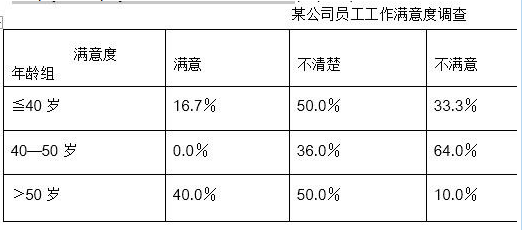 答案:解析:This table ilustrates the difference of degree of satisfaction among employees at different ages in some company.In general,the overall trend of the degree of satisfaction is different with the variation of ages.Of those who feel satisfactory about their jobs,those beyond 50 years old take up the majority,accounting for 40%,followed by those who are no more than 40 years old,which take up 16.7%.Those between 41 to 50 years old have the lowest satisfactory rate,merely0.0%.Of those who feel dissatisfactory about their jobs,those between 41 to 50 years old take up the majority,accounting for 64.0%,followed by those less than 40 years old,which take up 33.3%.Those who beyond 50years old enjoy the lowest dissatisfactory rate,taking up only 10%.Besides,there are still 50.0%of less than 40 years old employees,36.0%of those between 41 to 50 years old and 50.0%of over 50 years old employees remaining uncertain about the degree of satisfaction.The contributory factors to this result can mainly divide into three parts.Firstly,those less than 40 years old are ambitious,impractical and eager to find their places in work.With those characteristics,they often get upset find their places in work.With those characteristics,they often get upset when they fail to fulfill their goals.Secondly,those between 41 to 50 years old employees,confronted with challenges posed by their young colleagues,often face a great deal of working competition and pressure.Lastly,with their impending retirement,those beyond 50 years old face relatively small working pressure and feel satisfactory about their jobs.From this table,we can make a conclusion that if the companies want to raise the degree of satisfaction of its employees,it should make more efforts to improve the working environment,ameliorate the welfare and establish the effective incentive mechanism.
 -
第5题:
共用题干
Good Table Manners
Manners play an important part in making a favorable impression at the dinner table.Here are some general rules:
Napkin(餐巾)use
The meal begins when the host unfolds his or her napkin.This is your signal to do the same, so place your napkin on your lap.Unfold it completely if it is a small napkin,or in half,lengthwise (纵向地), if it is a large dinner napkin.
If you need to leave the table during the meal,place your napkin on your chair as a signal to your server that you will be returning.Once the meal is over,place your napkin neatly on the table to the right of your dinner plate.Do not refold it.
Use a napkin only for your mouth.Never use it for your nose,face or forehead.
Use of utensils(餐具)
Start with the knife,fork or spoon furthest from your plate,and work your way in,using one utensil for each course.
If soup is served,remember to spoon away from yourself. This helps stop the drips.Do not put the entire soup spoon in your mouth .Instead,fill a soup spoon about 75 per cent with soup,and sip(吸饮)it from the side noiselessly.
After finishing dinner,place the knife and fork parallel to one another across the plate with the knife blade facing inward toward the plate.
Using your fingers
Here's a list of finger foods:sandwiches,cookies,small fruits or berries with stems,French fries and potato chips,and hamburgers.
Chew(咀嚼)with your mouth closed and don't make noise;don't talk with your mouth full.
Bread must be broken with your hands. It is never cut with a knife.
Don't pick something out of your teeth .Instead,excuse yourself to the bathroom.
If possible,try not to cough at the table.
Do not put your elbows(肘)on the table .In France,it is essential to have both hands above the table at the same time.
Do not put bones or anything else on the table.Things that are not eaten should be put on your plate.All of the following are finger foods except______.
A: soup
B: sandwiches
C: cookies
D: hamburgers答案:A解析:问题问的是:吃饭时餐巾通常放在什么地方?A说的是“在椅子上”;B说的是“在桌子上”;C说的是“腰膝之间”;D说的是“在盘子上”。第二段有这样一个句子:“...so place your napkin on your lap.”因此把你的餐巾放在腰膝之间。lap是“腆膝之间”的意思。可见C是正确的。
问题问的是:餐巾只是用来干什么的? 第四段是这么说的:餐巾只是用来擦嘴的,因此不要用来擦你的鼻子、脸或额头。所以B是对的。
问题问的是:哪种餐具先用?A说的是“刀”;B说的是“叉”;C说的是“调羹”;D说的是“离盘子最远的那件餐具”。差不多中间的地方有一个句子是这么说的:"Start with the knife ,fork or spoon furthest from your plate...”从离盘子最远的刀、叉或勺子开始。可见D是正确的。
问题问的是:除了哪种食品其余的都可以用手?A说的是“汤”;B说的是“三明治”;C说的是“甜饼干”;D说的是“汉堡包”;因此正确答案是A。
问题问的是:下面的哪一种是吃饭的好习惯?A说的是“嘴里塞满了饭菜还在说话”;B说的是“把骨头放在盘子里”;C说的是“把肘放在桌子上”;D说的是“张开大嘴嚼东西”。B是正确的。 -
第6题:
Good Table Manners Manners play an important part in making a favorable impression at the dinner table. Here are some general rules: Napkin (餐巾) use The meal begins when the host unfolds his or her napkin. This is your signal to do the same, so place your napkin on your lap. Unfold it completely if it is a small napkin. Or in half, lengthwise (纵向地) ,if it is a large dinner napkin. If you need to leave the table during the meal, place your napkin on your chair as a signal to your server that you will be returning. Once the meal is over, place your napkin neatly on the table to the right of your dinner plate. Do not refold it. Use a napkin only for your mouth. Never use it for your nose, face or forehead. Use of utensils (餐具) Start with the knife, fork or spoon furthest from your plate, and work your way in, using one utensil for each course. If soup is served, remember to spoon away from yourself. This helps stop the drips. Do not put the entire soup spoon in your mouth. Instead, fill a soup spoon about 75 per cent with soup, and sip(啜饮)it from the side noiselessly. After finishing dinner, place the knife and fork parallel to one another across the plate with the knife blade facing inward toward the plate. Using your fingers Here's a list of finger foods: sandwiches, cookies, small fruits or berries with stems, French fries and potato chips, and hamburgers. Chew(咀嚼)with your mouth closed and don't make noise; don't talk with your mouth full. Bread must be broken with your hands. It is never cut with a knife. Don't pick something Out of your teeth. Instead, excuse yourself to the bathroom. If possible, try not to cough at the table. Do not put your elbows (肘) on the table. In France, it is essential to have both hands above the table at the same time. Do not put bones or anything else on the table. Things that are not eaten should be put on your plate. Where is the napkin normally placed during the meal?()
- A、On your chair
- B、On the table
- C、On your lap
- D、On your plate
正确答案:C -
第7题:
You are performing flashback of the ORDERS table in the Scott’s schema because some important data is deleted in the table by mistake. The SCN number was 771513 at the time of deletion. You issued the following statement to perform Flashback Table: SQL> FLASHBACK TABLE ORDERS TO SCN 771513; What is the prerequisite to perform Flashback Table?()
- A、 You must configure OMF in your database.
- B、 You must enable block change tracking feature in your database.
- C、 You must enable ROW MOVEMENT feature on the ORDERS table.
- D、 You must use the Flashback Version Query before using the Flashback Table feature.
正确答案:C -
第8题:
单选题Putting your mobile phone on a restaurant table may make your friends think _____.Ayou prefer to talk to your friends at the table
Byou value your calls more than your friends
Cyou are enjoying the company of your friends
Dyou are polite and considerate of your friends
正确答案: B解析:
短文第四段说“吃饭的时候不要把手机放在餐桌上,因为这样做传达的信息是你的电话会比你周围的人更重要”。B项是对这句话的同义转述。A项缺少依据。C项无中生有。在文中并没有这么提到。D项语意矛盾。这样的表现不是对朋友的友好相反是一种不友好不礼貌。 -
第9题:
单选题The database administrator of your company created a public synonym called HR for the HUMAN_RESOURCES table of the GENERAL schema, because many users frequently use this table. As a user of the database, you created a table called HR in your schema. What happens when you execute this query? SELECT * FROM HR;()AYou obtain the results retrieved from the public synonym HR created by the database administrator.
BYou obtain the results retrieved from the HR table that belongs to your schema.
CYou get an error message because you cannot retrieve from a table that has the same name as a public synonym.
DYou obtain the results retrieved from both the public synonym HR and the HR table that belongs to your schema, as a Cartesian product.
EYou obtain the results retrieved from both the public synonym HR and the HR table that belongs to your schema, as a FULL JOIN.
正确答案: C解析: 暂无解析 -
第10题:
单选题You are performing flashback of the ORDERS table in the Scott’s schema because some important data is deleted in the table by mistake. The SCN number was 771513 at the time of deletion. You issued the following statement to perform Flashback Table: SQL> FLASHBACK TABLE ORDERS TO SCN 771513; What is the prerequisite to perform Flashback Table?()AYou must configure OMF in your database.
BYou must enable block change tracking feature in your database.
CYou must enable ROW MOVEMENT feature on the ORDERS table.
DYou must use the Flashback Version Query before using the Flashback Table feature.
正确答案: B解析: 暂无解析 -
第11题:
多选题A warehouse fact table in your Oracle 12c Database is range-partitioned by month and accessed frequently with queries that span multiple partitions The table has a local prefixed, range partitioned index. Some of these queries access very few rows in some partitions and all the rows in other partitions, but these queries still perform a full scan for all accessed partitions. This commonly occurs when the range of dates begins at the end of a month or ends close to the start of a month. You want an execution plan to be generated that uses indexed access when only a few rows are accessed from a segment, while still allowing full scans for segments where many rows are returned. Which three methods could transparently help to achieve this result?()AUsing a partial local Index on the warehouse fact table month column with indexing disabled to the table partitions that return most of their rows to the queries.
BUsing a partial local Index on the warehouse fact table month column with indexing disabled for the table partitions that return a few rows to the queries.
CUsing a partitioned view that does a UNION ALL query on the partitions of the warehouse fact table, which retains the existing local partitioned column.
DConverting the partitioned table to a partitioned view that does a UNION ALL query on the monthly tables, which retains the existing local partitioned column
EUsing a partial global index on the warehouse fact table month column with indexing disabling for the table partitions that return most of their rows to the queries.
FUsing a partial global index on the warehouse fact table month column with indexing disabled for the table partitions that return a few rows to the queries.
正确答案: B,C,F解析: 暂无解析 -
第12题:
单选题On Monday, you dropped the DEPT table from your schema and then you re/x7fcreated the DEPT table in your schema. On Wednesday, you have a requirement to restore the DEPT table from the recycle bin. Which statement is correct?()AYou can restore the DEPT table by using the Oracle Flashback Drop feature, provided you use the RENAME TO clause.
BYou can restore the DEPT table by using the Oracle Flashback Drop feature and a systemgenerated name will be assigned to the restored table.
CYou cannot restore the DEPT table by using the Oracle Flashback Drop feature because a table withthe name DEPT already exists in your schema.
DYou cannot restore the DEPT table by using the Oracle Flashback Drop feature because the contents of the recycle bin are purged every 12 hours by default.
正确答案: B解析: 暂无解析 -
第13题:
共用题干
第二篇
Good Table Manners
Manners play an important part in making a favorable impression at the dinner table.
Here are some general rules:
Napkin(餐巾)use
The meal begins when the host unfolds his or her napkin.This is your signal to do the
same,so place your napkin on your lap.Unfold it completely if it is a small napkin,or in
half, lengthwise(纵向地),if it is a large dinner napkin.
If you need to leave the table during the meal,place your napkin on your chair as a
signal to your server that you will be returning.Once the meal is over,place your napkin
neatly on the table to the right of your dinner plate.Do not refold it.
Use a napkin only for your mouth.Never use it for your nose,face or forehead.
Use of utensils(餐具)
Start with the knife,fork or spoon furthest from your plate,and work your way in,
using one utensil for each course.
If soup is served,remember to spoon away from yourself.This helps stop the drips.
Do not put the entire soup spoon in your mouth.Instead,fill a soup spoon about 75 per
cent with soup,and sip(啜饮)it from the side noiselessly.
After finishing dinner,place the knife and fork parallel to one another across the plate
with the knife blade facing inward toward the plate.
Using your fingers
Here's a list of finger foods:sandwiches,cookies,small fruits or berries with stems,
French fries and potato chips,and hamburgers.
Chew(咀嚼)with your mouth closed and don't make noise;don't talk with your mouth
full.
Bread must be broken with your hands.It is never cut with a knife.
Don't pick something out of your teeth.Instead,excuse yourself to the bathroom.
If possible,try not to cough at the table.
Do not put your elbows(肘)on the table.In France, it is essential to have both
hands above the table at the same time.
Do not put bones or anything else on the table.Things that are not eaten should be put
on your plate.The napkin is used only for
A:your forehead.
B:your mouth,
C:your nose.
D:your face.答案:B解析: -
第14题:
Passage One
Table top magic requires no secret formula.Even the simplest meal will be received with enthusiasm if the table accessories are creative and colorful.No matter what type of dinnerware you own,you can enhance its beauty with a variety of attractive table linens.
When selecting a supply of tablecloths,place mats and napkins,choose easy—care or permanent—press fabrics because these fabrics will reduce your workload when washday rolls around.Another consideration is the suitability of your linens for your dining style or the types of entertaining you do.The shape of your table will also dictate the kind of tablecloth you purchase.Circular or rounded tables look best covered with round or oval tablecloths.Square—cornered tables require squares or rectangles.
Finally,your table linens should?complement?your dinnerware.An elegant table setting requires an elegant tablecloth.A setting of stoneware looks best with heavy of colorful fabrics.
But sure to take all the necessary measurements before you start shopping for fabric of your choice.It could be embarrassing if your tablecloths are not long enough to cover the tables.It is equally distressing if your tablecloth is so long that your guests have to watch where they walk.
Which size tablecloth would you buy for a circular table which is 30 inches high and 45 inches in diameter?A.45-inch roun
B.50-inch roun
C.70-inch roun
D.120-inch roun答案:C解析:暂无解析 -
第15题:
Directions:Write an essay based on the following table.In your writing,you should interpret the table,and give your comments.You should write about 150 words on the ANSWER SHEET.
 答案:解析:The table shows that the income sources of Chinese students are quite different from those of American students.In China,85%of students'money is from their parents while in America only 40%ofstudents'money is provided by their parents.Chinese students earn only 5%from part-timc jobs and 5%from student loan.However,American students got 20%and 25%of their money from these two sources respectively.In addition,fellowship or scholarship takes up 15%of American students'income while income from this source for Chinese students occupies only 5%.There are probably two reasons contributing to the differences.First,in China,students without sustainable income are still considered dependent on parents.Therefore,it is natural for them to ask their parents for money.By contrast,American students over 18 years have developed more senses of financial independence.Second,since America is more developed than China,it is relatively easier for American students to find part-time jobs.Therefore,a larger proportion of income comes from part-time job in America.I believe in future,more Chinese students will realize the necessity of self-dependence and try to make their own Iiving through part-timejobs and other ways.
 -
第16题:
共用题干
Good Table Manners
Manners play an important part in making a favorable impression at the dinner table.Here are some general rules:
Napkin(餐巾)use
The meal begins when the host unfolds his or her napkin.This is your signal to do the same, so place your napkin on your lap.Unfold it completely if it is a small napkin,or in half,lengthwise (纵向地), if it is a large dinner napkin.
If you need to leave the table during the meal,place your napkin on your chair as a signal to your server that you will be returning.Once the meal is over,place your napkin neatly on the table to the right of your dinner plate.Do not refold it.
Use a napkin only for your mouth.Never use it for your nose,face or forehead.
Use of utensils(餐具)
Start with the knife,fork or spoon furthest from your plate,and work your way in,using one utensil for each course.
If soup is served,remember to spoon away from yourself. This helps stop the drips.Do not put the entire soup spoon in your mouth .Instead,fill a soup spoon about 75 per cent with soup,and sip(吸饮)it from the side noiselessly.
After finishing dinner,place the knife and fork parallel to one another across the plate with the knife blade facing inward toward the plate.
Using your fingers
Here's a list of finger foods:sandwiches,cookies,small fruits or berries with stems,French fries and potato chips,and hamburgers.
Chew(咀嚼)with your mouth closed and don't make noise;don't talk with your mouth full.
Bread must be broken with your hands. It is never cut with a knife.
Don't pick something out of your teeth .Instead,excuse yourself to the bathroom.
If possible,try not to cough at the table.
Do not put your elbows(肘)on the table .In France,it is essential to have both hands above the table at the same time.
Do not put bones or anything else on the table.Things that are not eaten should be put on your plate.The napkin is used only for______.
A: your forehead
B: your mouth
C: your nose
D: your face答案:B解析:问题问的是:吃饭时餐巾通常放在什么地方?A说的是“在椅子上”;B说的是“在桌子上”;C说的是“腰膝之间”;D说的是“在盘子上”。第二段有这样一个句子:“...so place your napkin on your lap.”因此把你的餐巾放在腰膝之间。lap是“腆膝之间”的意思。可见C是正确的。
问题问的是:餐巾只是用来干什么的? 第四段是这么说的:餐巾只是用来擦嘴的,因此不要用来擦你的鼻子、脸或额头。所以B是对的。
问题问的是:哪种餐具先用?A说的是“刀”;B说的是“叉”;C说的是“调羹”;D说的是“离盘子最远的那件餐具”。差不多中间的地方有一个句子是这么说的:"Start with the knife ,fork or spoon furthest from your plate...”从离盘子最远的刀、叉或勺子开始。可见D是正确的。
问题问的是:除了哪种食品其余的都可以用手?A说的是“汤”;B说的是“三明治”;C说的是“甜饼干”;D说的是“汉堡包”;因此正确答案是A。
问题问的是:下面的哪一种是吃饭的好习惯?A说的是“嘴里塞满了饭菜还在说话”;B说的是“把骨头放在盘子里”;C说的是“把肘放在桌子上”;D说的是“张开大嘴嚼东西”。B是正确的。 -
第17题:
共用题干
第二篇
Good Table Manners
Manners play an important part in making a favorable impression at the dinner table.
Here are some general rules:
Napkin(餐巾)use
The meal begins when the host unfolds his or her napkin.This is your signal to do the s
ame,so place your napkin on your lap.Unfold it completely if it is a small napkin,or in
half , lengthwise(纵向地),if it is a large dinner napkin.
If you need to leave the table during the meal,place your napkin on your chair as a
signal to your server that you will be returning.Once the meal is over,place your napkin
neatly on the table to the right of your dinner plate.Do not refold it.
Use a napkin only for your mouth.Never use it for your nose,face or forehead.
Use of utensils(餐具)
Start with the knife,fork or spoon furthest from your plate,and work your way in,using
one utensi!for each course.
If soup is served,remember to spoon away from yourself.This helps stop the drips.
Do not put the entire soup spoon in your mouth.Instead,fill a soup spoon about 75 percent
with soup,and sip(吸饮)it from the side noiselessly.
After finishing dinner,place the尽nife and fork parallel to one another across the plate with the knife blade facing inward toward the plate.
Using your fingers
Here's a list of finger foods:sandwiches,cookies,small fruits or berries with stems,
French fries and potato chips,and hamburgers.
Chew(咀嚼)with your mouth closed don't make noise;don't talk with your mouth
full.
Bread must be broken with your hands. Itis never cut with a knife.
Don't pick something out of your teeth.Instead,excuse yourself to have both hands
above the table at the same time.
Do not put bones or anything else on the table.Things that are not eaten should be put
on your plate.Where is the napkin normally placed during the meal?
A:On your chair.
B:On the table.
C:On your lap.
D:On your plate.答案:C解析: -
第18题:
You issued the following statement in your SQL*Plus session: SQL>ALTER SESSION ENABLE RESUMABLE TIMEOUT 600; Which operation is neither suspended nor resumed using the Automatic Resumable Allocation feature in your database?()
- A、 creating a table in your schema and you exceed your allocated space quota on the tablespace
- B、 executing a long query that involves a sort operation and the statement runs out of temporary space
- C、 loading data into tables by using the SQL*Loader and the number of extents in the table reaches the maximum limit
- D、 creating a table in a dictionary-managed tablespace with an explicit MAXEXTENTS setting which results in an out of space error
正确答案:D -
第19题:
单选题You are responsible for a data warehouse application that uses records from an external table to update one of the dimension tables periodically. The records in the external table may contain data for new rows in the dimension table, or for updates to its existing rows. Which type of SQL command would you use to transfer the data from the external table to the dimension table as efficiently as possible?()AMERGE
BSELECT …CROSS JOIN
CINSERT ALL …SELECT
DCREATE VIEW …CONSTRAINT
正确答案: A解析: 暂无解析 -
第20题:
单选题Good Table Manners Manners play an important part in making a favorable impression at the dinner table. Here are some general rules: Napkin (餐巾) use The meal begins when the host unfolds his or her napkin. This is your signal to do the same, so place your napkin on your lap. Unfold it completely if it is a small napkin. Or in half, lengthwise (纵向地) ,if it is a large dinner napkin. If you need to leave the table during the meal, place your napkin on your chair as a signal to your server that you will be returning. Once the meal is over, place your napkin neatly on the table to the right of your dinner plate. Do not refold it. Use a napkin only for your mouth. Never use it for your nose, face or forehead. Use of utensils (餐具) Start with the knife, fork or spoon furthest from your plate, and work your way in, using one utensil for each course. If soup is served, remember to spoon away from yourself. This helps stop the drips. Do not put the entire soup spoon in your mouth. Instead, fill a soup spoon about 75 per cent with soup, and sip(啜饮)it from the side noiselessly. After finishing dinner, place the knife and fork parallel to one another across the plate with the knife blade facing inward toward the plate. Using your fingers Here's a list of finger foods: sandwiches, cookies, small fruits or berries with stems, French fries and potato chips, and hamburgers. Chew(咀嚼)with your mouth closed and don't make noise; don't talk with your mouth full. Bread must be broken with your hands. It is never cut with a knife. Don't pick something Out of your teeth. Instead, excuse yourself to the bathroom. If possible, try not to cough at the table. Do not put your elbows (肘) on the table. In France, it is essential to have both hands above the table at the same time. Do not put bones or anything else on the table. Things that are not eaten should be put on your plate. Which of the following shows good table manners?()ATalking with your mouth full
BPutting bones on your plate
CPutting your elbows on the table
DChewing with your month open
正确答案: B解析: 问题问的是:下面的哪一种是吃饭的好习惯?A说的是:嘴里塞满了饭菜还在说话。B说的是:把骨头放在盘子里。C说的是:把肘放在桌子上。D说的是:张开大嘴嚼东西。答案为B。 -
第21题:
单选题Good Table Manners Manners play an important part in making a favorable impression at the dinner table. Here are some general rules: Napkin (餐巾) use The meal begins when the host unfolds his or her napkin. This is your signal to do the same, so place your napkin on your lap. Unfold it completely if it is a small napkin. Or in half, lengthwise (纵向地) ,if it is a large dinner napkin. If you need to leave the table during the meal, place your napkin on your chair as a signal to your server that you will be returning. Once the meal is over, place your napkin neatly on the table to the right of your dinner plate. Do not refold it. Use a napkin only for your mouth. Never use it for your nose, face or forehead. Use of utensils (餐具) Start with the knife, fork or spoon furthest from your plate, and work your way in, using one utensil for each course. If soup is served, remember to spoon away from yourself. This helps stop the drips. Do not put the entire soup spoon in your mouth. Instead, fill a soup spoon about 75 per cent with soup, and sip(啜饮)it from the side noiselessly. After finishing dinner, place the knife and fork parallel to one another across the plate with the knife blade facing inward toward the plate. Using your fingers Here's a list of finger foods: sandwiches, cookies, small fruits or berries with stems, French fries and potato chips, and hamburgers. Chew(咀嚼)with your mouth closed and don't make noise; don't talk with your mouth full. Bread must be broken with your hands. It is never cut with a knife. Don't pick something Out of your teeth. Instead, excuse yourself to the bathroom. If possible, try not to cough at the table. Do not put your elbows (肘) on the table. In France, it is essential to have both hands above the table at the same time. Do not put bones or anything else on the table. Things that are not eaten should be put on your plate. Which utensil is used first?()AThe knife
BThe fork
CThe spoon
DThe one farthest from the plate
正确答案: B解析: 问题问的是:先用哪种餐具?A说的是:刀。B说的是:叉。C说的是:汤匙。D说的是:距盘子最远的那件餐具。文章第五段提到:Start with the knife,fork or spoon furthest from your plate… 从离盘子最远的刀、叉或汤匙开始。答案为D。 -
第22题:
单选题You issued the following statement in your SQL*Plus session: SQL>ALTER SESSION ENABLE RESUMABLE TIMEOUT 600; Which operation is neither suspended nor resumed using the Automatic Resumable Allocation feature in your database?()Acreating a table in your schema and you exceed your allocated space quota on the tablespace
Bexecuting a long query that involves a sort operation and the statement runs out of temporary space
Cloading data into tables by using the SQL*Loader and the number of extents in the table reaches the maximum limit
Dcreating a table in a dictionary-managed tablespace with an explicit MAXEXTENTS setting which results in an out of space error
正确答案: C解析: 暂无解析 -
第23题:
单选题Putting your mobile phone on a restaurant table may make your friends think ______.Ayou prefer to talk to your friends at the table.
Byou value your calls more than your friends.
Cyou are enjoying the company of your friends.
Dyou are polite and considerate of your friends.
正确答案: C解析:
考点:细节题。短文第四段说“我们吃饭的时候不要把手机放在餐桌上,因为这样做传达的信息是你的电话会比你周围的人更重要”。B项是对这句话的同义转述。A项缺少依据。C项无中生有。在文中并没有这么提到。D项语意矛盾。这样的表现不是对朋友的友好相反是一种不友好不礼貌。 -
第24题:
单选题Good Table Manners Manners play an important part in making a favorable impression at the dinner table. Here are some general rules: Napkin (餐巾) use The meal begins when the host unfolds his or her napkin. This is your signal to do the same, so place your napkin on your lap. Unfold it completely if it is a small napkin. Or in half, lengthwise (纵向地) ,if it is a large dinner napkin. If you need to leave the table during the meal, place your napkin on your chair as a signal to your server that you will be returning. Once the meal is over, place your napkin neatly on the table to the right of your dinner plate. Do not refold it. Use a napkin only for your mouth. Never use it for your nose, face or forehead. Use of utensils (餐具) Start with the knife, fork or spoon furthest from your plate, and work your way in, using one utensil for each course. If soup is served, remember to spoon away from yourself. This helps stop the drips. Do not put the entire soup spoon in your mouth. Instead, fill a soup spoon about 75 per cent with soup, and sip(啜饮)it from the side noiselessly. After finishing dinner, place the knife and fork parallel to one another across the plate with the knife blade facing inward toward the plate. Using your fingers Here's a list of finger foods: sandwiches, cookies, small fruits or berries with stems, French fries and potato chips, and hamburgers. Chew(咀嚼)with your mouth closed and don't make noise; don't talk with your mouth full. Bread must be broken with your hands. It is never cut with a knife. Don't pick something Out of your teeth. Instead, excuse yourself to the bathroom. If possible, try not to cough at the table. Do not put your elbows (肘) on the table. In France, it is essential to have both hands above the table at the same time. Do not put bones or anything else on the table. Things that are not eaten should be put on your plate. Where is the napkin normally placed during the meal?()AOn your chair
BOn the table
COn your lap
DOn your plate
正确答案: C解析: 问题问的是:吃饭时餐巾通常放在什么地方?A说的是:在椅子上;B说的是:在桌子上;C说的是:大腿部;D说的是:在盘子上。第二段有这样一个句子:… so place your napkin on your lap .因此把你的餐巾放在大腿部。lap是“大腿部”的意思。答案为C。