
查找段落的父元素中每个类名为selected的父元素,写法正确的是()。A、$("p").parent()B、$("p").parent(".selected")C、$("p").parent("selected")D、$("p").parentAll(".selected")
题目
查找段落的父元素中每个类名为selected的父元素,写法正确的是()。
- A、$("p").parent()
- B、$("p").parent(".selected")
- C、$("p").parent("selected")
- D、$("p").parentAll(".selected")
相似考题
更多“查找段落的父元素中每个类名为selected的父元素,写法正确的是()。A、$("p").parent()B、$("p").parent(".selected")C、$("p").parent("selected")D、$("p").parentAll(".selected")”相关问题
-
第1题:
阅读下列函数说明和C函数,将应填入(n)处的字句写在对应栏内。
[说明]
二叉树的二叉链表存储结构描述如下:
lypedef struct BiTNode
{ datatype data;
street BiTNode *lchiht, *rchild; /*左右孩子指针*/ } BiTNode, *BiTree;
下列函数基于上述存储结构,实现了二叉树的几项基本操作:
(1) BiTree Creale(elemtype x, BiTree lbt, BiTree rbt):建立并返回生成一棵以x为根结点的数据域值,以lbt和rbt为左右子树的二叉树;
(2) BiTree InsertL(BiTree bt, elemtype x, BiTree parent):在二叉树bt中结点parent的左子树插入结点数据元素x;
(3) BiTree DeleteL(BiTree bt, BiTree parent):在二叉树bt中删除结点parent的左子树,删除成功时返回根结点指针,否则返回空指针;
(4) frceAll(BiTree p):释放二叉树全体结点空间。
[函数]
BiTree Create(elemtype x, BiTree lbt, BiTree rbt) { BiTree p;
if ((p = (BiTNode *)malloc(sizeof(BiTNode)))= =NULL) return NULL;
p->data=x;
p->lchild=lbt;
p->rchild=rbt;
(1);
}
BiTree InsertL(BiTree bt, elemtype x,BiTree parent)
{ BiTree p;
if (parent= =NULL) return NULL;
if ((p=(BiTNode *)malloc(sizeof(BiTNode)))= =NULL) return NULL;
p->data=x;
p->lchild= (2);
p->rchild= (2);
if(parent->lchild= =NULL) (3);
else{
p->lchild=(4);
parent->lchild=p;
}
return bt;
}
BiTree DeleteL(BiTree bt, BiTree parent)
{ BiTree p;
if (parent= =NULL||parent->lchild= =NULL) return NULL;
p= parent->lchild;
parent->lchild=NULL;
freeAll((5));
return bt;
正确答案:(1) return p (2) NULL (3) parent->lchild=p (4) parent->lchild (5) p
(1) return p (2) NULL (3) parent->lchild=p (4) parent->lchild (5) p 解析:(1)此处应返回新建的二叉树;(2)新元素结点初始化时,数据域取值x,左右孩子指针指向NULL;
(3)若parent结点的左孩子结点空,则直接令其左孩子指针指向p;
(4)若parent结点的左孩子结点不空,则让新结点p充当其左子树的根;
(5)此处需释放二叉树p(parent的左子树)所占用的空间。 -
第2题:
Which agent will be selected when the Resource Selection Criteria is set to circular routing?()
- A、the agent who has been in the Available state for the longest amount of time
- B、the next available agent with the highest priority, as determined by the agent order in the Resources list
- C、the next available agent, based on the last agent selected and the agent order in the Resources list
- D、the agent assigned to the selected Resource Group and is thus qualified to be selected
正确答案:C -
第3题:
如果p是父类Parent的对象,而c是子类Child的对象,则语句c = p是正确的。
正确答案:错误 -
第4题:
设某子类Q具有P属性,则()。
- A、Q的父类也必定具有P属性,且Q的P属性值必定与其父类的P属性相同
- B、Q的父类也必定具有P属性,且Q的P属性值可以与其父类的P属性不同
- C、Q的父类要么不具有P属性,否则由于继承性,Q与其父类的P属性值必定相同
- D、Q的父类未必具有P属性,即使有,Q与其父类的P属性未必相同
正确答案:D -
第5题:
以下哪句可以获取到class为“child";的元素的父级元素?()
- A、$(".child:parent")
- B、$(".child").parentNode()
- C、$(".child"):parent
- D、$(".child").parent()
正确答案:D -
第6题:
通过()方法获得集合中每个匹配元素的祖先元素。
- A、closest()
- B、parent()
- C、parentAll()
- D、parents()
正确答案:D -
第7题:
public class Parent{ public void change(int x){} } public class Child extends Parent{ //覆盖父类change方法 } 下列哪个声明是正确的覆盖了父类的change方法?()
- A、 protected void change(int x){}
- B、 public void change(int x, int y){}
- C、 public void change(String s){}
- D、 public void change(int x){}
正确答案:D -
第8题:
单选题想要获取到select元素内被选中的option元素,以下书写正确的是()。A$(select).filter(option:selected)
B$(select).find(option:selected)
C$(select).is(option:selected)
D$(select).has(option:selected)
正确答案: B解析: 暂无解析 -
第9题:
单选题查找段落的父元素中每个类名为selected的父元素,写法正确的是()。A$(p).parent()
B$(p).parent(.selected)
C$(p).parent(selected)
D$(p).parentAll(.selected)
正确答案: B解析: 暂无解析 -
第10题:
多选题要选择列表框List1的第6项,可以使用语句()。AList1.Selected(6)=True
BList1.Selected(5)=True
CList1.ListIndex=5
DList1.Selected=5
正确答案: B,C解析: 暂无解析 -
第11题:
单选题以下的节点操作中可以获取所有的父级元素的是()。A.parent()
B.parents()
C.next()
D.find()
正确答案: D解析: 暂无解析 -
第12题:
单选题Which agent will be selected when the Resource Selection Criteria is set to circular routing?()Athe agent who has been in the Available state for the longest amount of time
Bthe next available agent with the highest priority, as determined by the agent order in the Resources list
Cthe next available agent, based on the last agent selected and the agent order in the Resources list
Dthe agent assigned to the selected Resource Group and is thus qualified to be selected
正确答案: A解析: 暂无解析 -
第13题:
( 33 ) 创建一个名为 student 的新类 , 保存新类的类库名称是 mylib, 新类的 父 类是 P erson, 正确的命令是
A ) CREATE CLASS mylib OF student A s P erson
B ) CREATE CLASS student OF P erson A s mylib
C ) CREATE CLASS student OF mylib A s P erson
D ) CREATE CLASS P erson OF mylib A s student
正确答案:C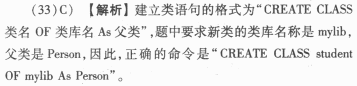
-
第14题:
class Parent { String one, two; public Parent(String a, String b){ one = a; two = b; } public void print(){ System.out.println(one); } } public class Child extends Parent { public Child(String a, String b){ super(a,b); } public void print(){ System.out.println(one + " to " + two); } public static void main(String arg[]){ Parent p = new Parent("south", "north"); Parent t = new Child("east", "west"); p.print(); t.print(); } } Which of the following is correct?()
- A、 Cause error during compilation.
- B、 south east
- C、 south to north east to west
- D、 south to north east
- E、 south east to west
正确答案:E -
第15题:
要选择列表框List1的第6项,可以使用语句()。
- A、List1.Selected(6)=True
- B、List1.Selected(5)=True
- C、List1.ListIndex=5
- D、List1.Selected=5
正确答案:B,C -
第16题:
以下的节点操作中可以获取所有的父级元素的是()。
- A、.parent()
- B、.parents()
- C、.next()
- D、.find()
正确答案:B -
第17题:
查找p元素下的span子元素,以下写法正确的是()。
- A、$("span p")
- B、$("p").find("span")
- C、$("span").find("p")
- D、$("p").has("span")
正确答案:B -
第18题:
想要获取到select元素内被选中的option元素,以下书写正确的是()。
- A、$("select").filter("option:selected")
- B、$("select").find("option:selected")
- C、$("select").is("option:selected")
- D、$("select").has("option:selected")
正确答案:B -
第19题:
Given the following code: 1) class Parent { 2) private String name; 3) public Parent(){} 4) } 5) public class Child extends Parent { 6) private String department; 7) public Child() {} 8) public String getValue(){ return name; } 9) public static void main(String arg[]) { 10) Parent p = new Parent(); 11) } 12) } Which line will cause error?()
- A、 line 3
- B、 line 6
- C、 line 7
- D、 line 8
- E、 line 10
正确答案:D -
第20题:
单选题查找p元素下的span子元素,以下写法正确的是()。A$(span p)
B$(p).find(span)
C$(span).find(p)
D$(p).has(span)
正确答案: C解析: 暂无解析 -
第21题:
填空题沟通分析理论认为,每个人都存在P(parent, 父母)、A(adult, 成人)、()三种不同的自我状态。正确答案: C(child, 儿童)解析: 暂无解析 -
第22题:
判断题如果p是父类Parent的对象,而c是子类Child的对象,则语句p=c是正确的。A对
B错
正确答案: 错解析: 暂无解析 -
第23题:
单选题以下哪句可以获取到class为“child";的元素的父级元素?()A$(.child:parent)
B$(.child).parentNode()
C$(.child):parent
D$(.child).parent()
正确答案: A解析: 暂无解析