
某程序将计算结果输出到一个有格式顺序文件中,文件名为AA.DAT,设备通道号为3,打开这个文件的语句是:()A、OPEN(UNIT=3,FILE=AA.DAT,STATUS=NEW)B、B.OPEN(UNIT=3,FILE=ADAT,STATUS=OLD.C、C.OPEN(3,FILE=′ADAT′,STATUS=′NEW′)D、D.OPEN(D,FILE=′ADAT′,STATUS=′OLD′)
题目
某程序将计算结果输出到一个有格式顺序文件中,文件名为AA.DAT,设备通道号为3,打开这个文件的语句是:()
- A、OPEN(UNIT=3,FILE=AA.DAT,STATUS=NEW)
- B、B.OPEN(UNIT=3,FILE=ADAT,STATUS=OLD.
- C、C.OPEN(3,FILE=′ADAT′,STATUS=′NEW′)
- D、D.OPEN(D,FILE=′ADAT′,STATUS=′OLD′)
相似考题
参考答案和解析
更多“某程序将计算结果输出到一个有格式顺序文件中,文件名为AA.DAT,设备通道号为3,打开这个文件的语句是:()A、OPEN(UNIT=3,FILE=AA.DAT,STATUS=NEW)B、B.OPEN(UNIT=3,FILE=ADAT,STATUS=OLD.C、C.OPEN(3,FILE=′ADAT′,STATUS=′NEW′)D、D.OPEN(D,FILE=′ADAT′,STATUS=′OLD′)”相关问题
-
第1题:
在当前文件夹中生成一个名为Filel.txt的文件,在D盘里生成一个名为mydir的文件夹,并在该文件夹中生成一个名为File2.txt的文件,最后输出文件File2.txt的完整路径。修改下列程序中的错误之处,使程序能够正确运行。
注意:不改动程序结构,不得增行或删行。
import java.io.*;
public class FileTest
{
public static void main(String args[])
{
File dirObject=new File(d:\\mydir);
File fileObjectl=new File(d:\\kmydir","Filel.txt");
File fileObject2=new File(d:/mydir","File2.txt");
System.out.println(fileObject2);
try
{
Dirobject.mkdir();
}catch(SecurityException e){}
try
{
fileObject1.createNewFile();
fileObject2.createNewFile();
}catch(I0Exception e){}
}
}
正确答案:应将程序中如下语句 File dirObject=new File(d:\\mydir); File fileObject1=new File(d:\\mydir""Filel.txt"); File fileObject2=new File(d:/mydir""File2.txt"); 改为: File dirObject=new File("d:\\mydir"); File fileObject1=new File("Filel.txt"); File
应将程序中如下语句 File dirObject=new File(d:\\mydir); File fileObject1=new File(d:\\mydir","Filel.txt"); File fileObject2=new File(d:/mydir","File2.txt"); 改为: File dirObject=new File("d:\\mydir"); File fileObject1=new File("Filel.txt"); File 解析:本题考查如何生成文件对象,这是一道简单应用题。程序中生成了3个文件对象dirObject、fileObject1和fileObject2,在对dirObject进行初始化时,因为参数为绝对路径,所以调用mkdir()方法,这样就在参数指定的路径中生成一个名为mydir的文件夹;对fileObject1进行实例化时,参数为相对路径,所以后面调用的是createNewFile()方法,程序运行后就会在当前路径下生成参数中指定的文件;fileObject2实例化后,调用createNewFile()方法,程序在参数第一个字符串变量指定的文件夹中创建一个文件,该文件的名称和相对路径由参数的第二个字符串变量指定。 -
第2题:
若磁盘上已存全路径文件名为c:\ctest\test.txt的文件,下面语句中不能打开该文件的是( )。
A.ifstream *pFile=new ifstream("c:\\ctest\\test.txt");
B.ifstream file("c:\\ctest\\test.txt");
C.ifstream file;file.open("c:\\ctest\\test.txt");
D.ifstream file("c:\etest\test.txt");
正确答案:D
-
第3题:
若磁盘上已存在某个文本文件,其全路径文件名为d:\ncre\test.txt,下列语句中不能打开该文件的是
A.ifstream file("d:\ncre\test.txt");
B.ifstream file("d:\\ncre\\test.txt");
C.ifstream file;file.open("d:\\ncre\\test.txt");
D.ifstream* pFile=new ifstream("d:\\ncre\\test.txt");
正确答案:A
解析:本题考查的知识点是转义字符。在C++的字符常量或字符串中,以“\”开头的一系列字符被看作一个特殊的字符,即转义字符。要表示'\'字符时,必须使用转义字符'\\'。故本题应该选择A。 -
第4题:
下面程序的结果是 ______。includeclass A{ public:virtual voidfun()=0{};};class 下面程序的结果是 ______。 #include<iostream.h> class A{ public: virtual void fun()=0{}; }; class B:public A{ public: void fun () {cout<< "new file" ;} }; class C: public A{ public: void fun (){cout<<"open file"<< " " } }; class D: public A{ public: void fun () {cout<< "save file\n" ;} }; void main() { A a,*p; B b; C c; D d; p=&c; p->fun (); p=&b; p->fun (); p=&d; p->fun(); }
A.new file open file save file
B.new file new file new file
C.编译出错
D.open file new file save file
正确答案:C
-
第5题:
阅读FORTRAN程序:
OPEN(8,FILE=FILE2 DAT,STATUS=NEW)
DO 10 I=1,3
WEITE(8,(4I4)JI+I,J=1,4)
10 CONTINUE
CLOSE(8)
END
程序运行后,数据文件FILE2,DAT的内容是: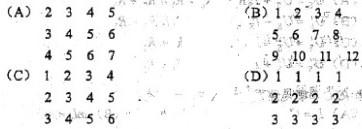 答案:A解析:
 -
第6题:
建立新图形文件,用过下拉式菜单的操作方式是()
- A、File(文件)/OPEN(打开)
- B、File(文件)/Save(存盘)
- C、File(文件)/SaveAS(另存为)
- D、File(文件)/New(新建)
正确答案:D -
第7题:
在Visual Foxpro环境下,执行下列命令: Number=""3"" File=""file""+Number use&File 当前打开的表文件的主文件名是()
- A、File3
- B、&File
- C、FileNumber
- D、File
正确答案:A -
第8题:
对OPEN(4,FILE=‘BB.DAT’,STATUS=‘OLD’,语句,下面哪个描述是正确的()?
- A、打开一个有格式顺序文件,可以读文件
- B、打开一个有格式直接文件,可以写文件
- C、打开一个有格式直接文件,可以读写
- D、打开一个直接文件
正确答案:A -
第9题:
要对顺序文件进行写操作,下列打开文件语句中正确的是()
- A、Open“file1.txt”ForBinaryAs#1
- B、Open“file1.txt”ForRandomAs#1
- C、Open“file1.txt”ForInputAs#1
- D、Open“file1.txt”ForOutputAs#1
正确答案:D -
第10题:
单选题对OPEN(4,FILE=‘BB.DAT’,STATUS=‘OLD’,语句,下面哪个描述是正确的()?A打开一个有格式顺序文件,可以读文件
B打开一个有格式直接文件,可以写文件
C打开一个有格式直接文件,可以读写
D打开一个直接文件
正确答案: D解析: 语句中STATUS=‘OLD’表明是一个已存在的老文件,打开后可顺序读取。 -
第11题:
单选题某程序将计算结果输出到一个有格式顺序文件中,文件名为AA.DAT,设备通道号为3,打开这个文件的语句是:()AOPEN(UNIT=3,FILE=AA.DAT,STATUS=NEW)
BB.OPEN(UNIT=3,FILE=ADAT,STATUS=OLD.
CC.OPEN(3,FILE=′ADAT′,STATUS=′NEW′)
DD.OPEN(D,FILE=′ADAT′,STATUS=′OLD′)
正确答案: D解析: 暂无解析 -
第12题:
单选题语句OPEN(9,FILE=‘DATA.TXT’)打开的是()文件。A无格式顺序
B有格式顺序
C无格式直接
D有格式直接
正确答案: C解析: 暂无解析 -
第13题:
下面程序的运算结果是()。includeusing namespace std;class A{public:virtual void f 下面程序的运算结果是( )。 #include<iostream> using namespace std; class A { public: virtual void fun()=0; }; class B:public A } public: void fun() {cout<<"new file"<<" ";} }; class C:public A { public: void fun() { cout<<"open file"<<" ";} }; void main() { A a, * p; B b;C c; p=&c; p->fun(); p=&b; }
A.new file open file
B.new file new file
C.编译出错
D.open file new file
正确答案:C
解析:语句Aa,*p;用抽象类说明了一个对象,这是不允许的。若把其改为A*p;则程序运行结果为D。 -
第14题:
要建立文件流并打开当前目录下的文件6le.dat用于输入,下列语句中错误的是( )。
A.ifstream fin=ffstream.open(”file.dat”);
B.ifstream*fin=new ifstream(”file.dat”);
C.ifstream fin;fin.open(”file.dat”);
D.ifstream*fin=new ifstream;fin->open(”file.dat”);
正确答案:A
本题考查对文件流输入的操作,可以调用文件流的成员函数pen,一般形式如下:文件流对象.0pen(磁盘文件名,输入/输出方式)。根据以上格式,可以判断A选项错误。 -
第15题:
执行下列命令后,当前打开的数据库文件名是Number="3"File="File"+NumberUSE&FileA.File3B.&a执行下列命令后,当前打开的数据库文件名是 Number="3" File="File"+Number USE &File
A.File3
B.&File
C.FileNumber
D.File
正确答案:A
解析:通过执行题目所示的程序段{Number="3"File="File"+Number}变量File的值为“File3”。而在VisualFoxPro中,命令USE的含义是打开数据库,因此本题中应该的打开的数据库为File3,因此答案为A。 -
第16题:
在UNIX系统中,若文件File3的权限是414,则表示
A.文件属主可执行File3
B.文件属主可读File3
C.同组用户可读File3
D.同组用户可执行File3
E.其他用户可读File3
正确答案:BDE
-
第17题:
阅读FORTAN程序:
OPEN(8,FILE=FILE2.DAT,STATUS:NEW)DO10I=1>3
WRITE(8,(4I4))(J+I,J=1,4)
10CONTINUECLOSEC8)
END
程序运行后,数据文件FIFE2.DAT的内容是: 答案:A解析:I=1,J 分别为 1,2,3,4,J+I 分别为 2,3,4,5; I=2,J 分别为 1,2,3,4,J+I 分别为 3,4,5,6;
I=3,J 分别为 1,2,3,4,J+I 分别为 4,5,6,7。 -
第18题:
欲新建一个电路原理图文件应该执行()操作。
- A、File/New/Schematic
- B、File/New/PCB
- C、File/New/SchematicLibrary
- D、File/New/PCBLibrary
正确答案:A -
第19题:
创建一个向文件“file.txt”追加内容的输出流对象的语句有()。
- A、FileOutputStream out=new FileOutputStream(“file.txt”,true);
- B、OutputStream out=new FileOutputStream(“file.txt”,“append”);
- C、OutputStream out=new FileOutputStream(“file.txt”);
- D、FileOutputStream out=new FileOutputStream(new file(“file.txt”));
- E、OutputStream out=new FileOutputStream(new File(“file.txt”),true.;
正确答案:A,E -
第20题:
An application writes to a log file in the /logs filesystem that is full. After the log file is deleted, 'df' still shows the filesystem as 100% full. What is the likely cause of the problem and what will resolve it?()
- A、The deleted file is still open by the application.The system must be rebooted before'df' will show the reduction in the filesystem.
- B、The deleted file is still open by the application.The application must be stoppedbefore 'df' will show the reduction in the filesystem.
- C、The filesystem is still marked as full in the /etc/fs.status file.The system must be rebooted before 'df' will show the reduction in the filesystem.
- D、The filesystem is still marked as full in the /etc/fs.status file.The application must be stopped before 'df' will show the reduction in the filesystem.
正确答案:B -
第21题:
When issuing the CROSSCHECK command in RMAN, if a backup file CANNOT be found, to what status is that file set?()
- A、DELETED
- B、OBSOLETE
- C、EXPIRED
- D、UNKNOWN
正确答案:C -
第22题:
单选题要建立文件流并打开当前目录下的文件file.dat用于输入,下列语句中错误的是( )。Aifstream fin=ifstream.open(“file.dat”);
Bifstream* fin=new ifstream(“file.dat”);
Cifstream fin; fin.open(“file.dat”);
Difstream* fin=new ifstream(); fin->open(“file.dat”);
正确答案: A解析:
A项,在赋值号的左侧表示建立一个输入流对象fin,赋值号右侧的表达式不正确,文件输入流类ifstream不能直接调用其成员函数open。 -
第23题:
多选题创建一个向文件“file.txt”追加内容的输出流对象的语句有()。AFileOutputStream out=new FileOutputStream(“file.txt”,true);
BOutputStream out=new FileOutputStream(“file.txt”,“append”);
COutputStream out=new FileOutputStream(“file.txt”);
DFileOutputStream out=new FileOutputStream(new file(“file.txt”));
EOutputStream out=new FileOutputStream(new File(“file.txt”),true.;
正确答案: B,E解析: 暂无解析