
Why do we say that reading aloud is not very useful for reading a text in class?
题目
Why do we say that reading aloud is not very useful for reading a text in class?
相似考题
更多“Why do we say that reading aloud is not very useful for reading a text in class?”相关问题
-
第1题:
Reading aloud every morning improves my spoken English.(改为同义句)
I improve my spoken English___ ___ aloud every morning.
正确答案:
37. by reading -
第2题:
—______—In My opinion, reading、The teacher really challenges us to work hard.A、Reading is hard to learn.
B、I dislike reading.
C、Reading is my favorite、How about you?
D、Which do you think is harder to learn, listening or reading?
参考答案:D
-
第3题:
When a teacher asks the students to find some key words from a text quickly, he/she is intended to train students' __________strategy in reading class.A. skimming
B. scanning
C. extensive reading
D. intensive reading答案:B解析:考查阅读教学。scanning“寻读”,可以帮助学生快速找到所需信息,准确定位。故选B。skimming“略读”,快速浏览文本,掌握文章大意。extensive reading"泛读”,是指进行广泛、大量的阅读.可以使学生通过频繁地接触语言材料,自觉或不自觉地学到或掌握大量词汇,开阔学生的视野。intensive reading"精读”.是指深入细致、逐字逐句地阅读,可以通过深入钻研.加深知识的积累,、 -
第4题:
__________ means reading quickly to get the gist, i.e. the main idea of the text.A.Skimming
B.Scanning
C.Speed-reading
D.Paraphrase答案:A解析:考查阅读策略。略读是一种快速浏览阅读方式,其目的是了解文章的大意。因此读者不需要细读全文,而是有选择地进行跳跃式的阅读。 -
第5题:
When a teacher asks the students to find some key words from a text quickly, be/she areintended to train students'_________ strategy in reading class.A.skimming
B.scanning
C.extensive reading
D.intensive reading答案:B解析:考查阅读教学。scanning“寻读”,可以帮助学生快速找到所需信息,准确定位。故答案选B。skimming“读”,快速浏览文本。掌握文章大意。extensive reading“泛读”,是指进行广泛、大量的阅读,可以使学生通过频繁地接触语言材料。自觉或不自觉地学到或掌握大量词汇,开阔学生的视野。intensive reading“精读”,是指深入细致、逐字逐句地阅读,可以通过深入钻研,加深知识的积累。 -
第6题:
根据下面资料,回答
Reading aloud and silent reading are two different types of reading practice. Each has a function in the teaching of reading and should not be 16 by the other. However, we need to be aware when we should use them. When we 17 teaching reading or developing reading skills, we are mostly referring to silent reading. To develop 18 readers in a foreign language, silent reading activities must be given enough 19 and time in class with the proper guidance from the 20 . Reading aloud also has its particular 21 for our students who are learning English as a foreign language. 22 can help them acquire good pronunciation and intonation, 23 them with new words and the stress patterns of English, help 24 their eontidenee in speaking the language. Therefore, opportunities should be 25 for students to read aloud only after they have comprehended the text 26 before comprehension can be very 27 and it can easily destroy their self-confidence. With 28 reading, it sets up a poor reading model for other students as well. It is 29 that we first help students learn the text through 30 reading activities and then with comprehension we give our students practice by using an audio tape to 31 a good model for practicing reading aloud. With adequate 32 , we may ask the students to read aloud to the whole class to 33 their motivation and confidence. By asking the students to read aloud, it is also a good chance for the teacher to get 34 on the students′ comprehension as we can notice 35 there are wrong pauses or mispronounced words which indicate possible difficulties or misunderstanding of the text.
第(34)题选A.suggestion
B.feedback
C.promotion
D.inspiration答案:B解析:考查名词辨析。suggestion“建议”,feedback“反馈”,promotion“提升”,inspiration“灵感”。这里指的是大声朗读也能够让教师从学生的理解中获得反馈。故选B。 -
第7题:
小学英语?阅读
一、考题回顾
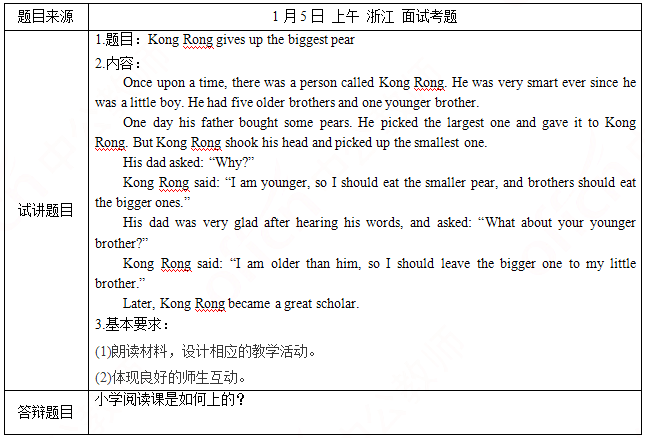
二、考题解析
【教案】
Teaching aims:
Knowledge aim:
Students will master the Chinese classical story of Kong Rong giving the big pear to brothers.
Ability aim:
Students will improve their reading skills including the skimming and scanning.
Emotional aim:
Students will be more interest in learning Chinese old story.
Key and difficult point:
Key Point: Students will master how to improve reading abilities through finding main idea and details.
Difficult Point: Students will share their feelings after reading the story.
Teaching procedure:
Step 1: Warming-up
1. Greetings.
2. Sing a song “If you’re happy”, then ask students why I’m happy and tell them in this class I will tell them an interesting story.
Step 2: Pre-reading
1. Show a picture of pear, and students have a brainstorm of what stories they can think of related to the pear.
Step 3: While-reading
Global reading: students read the passage fast and what stories it is about. Then find the main character and time of the story.
Detailed reading: students read the passage carefully and answer the question:
1. What did Kong Rong do when his father gives him one of the biggest pears?
2. Why did he do that in such way?
Step4: Post-reading
1. Role-play: 3 students in a group to play as Kong Rong, the father and the narrator, and they make a role-play in 10 minutes.
2. Discussion: students work in pairs to discuss what kind of person Kong Rong is and what they can learn from Kong Rong.
Step5: Summary and Homework
Summary: Ask a student to conclude the content of the lesson and summarize with the whole class.
Homework: Ask students to search another Chinese old story and make a poster.
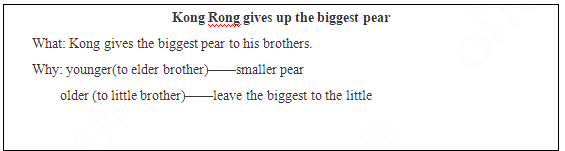
Blackboard design:
1. How do you teach students in reading class?答案:解析:1.
Reading ability plays an increasingly important role in primary school, so when I teach reading class, I will cultivate students’ reading strategies that includes skimming and scanning. Namely, first students read the passage fast to get the main idea or simple clue of the passage. After that, they can read it carefully to get the details in order to have a whole understanding of the passage. Finally, they may have a discussion to share their opinions about the passage, so that their mind would be opened or their critical thinking could be developed. -
第8题:
Why do we say that reading aloud is not very useful for reading a text in class?
Reading aloud is not very useful for reading a text in class for the following reasons: First, only one student is active at a time; the others are either not listening at all, or are listening to a bad model. Second, students’ attention is focused on pronunciation, not on understanding the meaning. Third, it is an unnatural activity as most people do not read aloud in real life. Last, it takes up a lot of time because students usually read very slowly.
略 -
第9题:
The teacher can help the students to read a text by reading it aloud while they follow in their books.()
正确答案:错误 -
第10题:
问答题Why do we say that reading aloud is not very useful for reading a text in class?正确答案: Reading aloud is not very useful for reading a text in class for the following reasons: First, only one student is active at a time; the others are either not listening at all, or are listening to a bad model. Second, students’ attention is focused on pronunciation, not on understanding the meaning. Third, it is an unnatural activity as most people do not read aloud in real life. Last, it takes up a lot of time because students usually read very slowly.解析: 暂无解析 -
第11题:
问答题Why do we say assessment has great backwash effects on foreign language teaching and learning?正确答案: Both positive and negative backwash effects. Assessment can provide teachers with feedback for lesson planning and remedial work. Students can also get information about their learning and progress, therefore have a sense of achievement. Through assessment they get to know their problems and areas for further study and improvement. However, inappropriate assessment can cause worries, discourage weak students, emphasis on grades instead of on abilities and competence, etc.解析: 暂无解析 -
第12题:
填空题Reading English aloud every day will of course help you to improve your ____ (发音).正确答案: pronunciation解析:
句意:每天都读大声的读英语当然可以对提高你的发音有帮助了。 -
第13题:
by ___________, we mean tasks that students do before they read the text in detail.A. pre-reading activities
B. while-reading activities
C. before-class preparation
D. post-reading activities
正确答案是: A
-
第14题:
During class,the teacher draws a flow chart on the blackboard to show the structure and its inner connection of a passage.What class do you think is it most possible be?A.Word class.
B.Reading and speaking class.
C.Grammar class.
D.Phonetics class.答案:B解析:考查英语阅读教学内容。
根据题干,老师在黑板上画了一个流程图来展示语篇的结构和内部联系,可知这位老师最有可能进行的就是读和说的技能的教学,所以此题B项最合适。
A项,词汇课;C项,语法课;D项,语音课;均不合题意,故排除。
故此题的正确选项为B。 -
第15题:
Which of the following is NOT a suitable pre-reading activity?A.Demonstrating "skimming" and "scanning" techniques.
B.Writing a similar text.
C.Introducing the elements of the reading text.
D.Writing questions about the topic.答案:B解析:考查阅读教学。本题要求选择哪一个活动不适合作为读前活动。A项适合,因为这是教师在阅读前向学生说明“读”和“扫读”两种阅读技能,是必要准备。C项是向学生介绍阅读文章的要素。诸如主题、正文等。D项让学生带着问题读文章。只有B项不符合。 -
第16题:
When a teacher asks the students to find some key words from a text quickly, he/she is intended to train students' __________strategy in reading class.A.skimming
B.scanning
C.extensive reading
D.intensive reading答案:B解析:考查阅读教学。scanning“寻读”,可以帮助学生快速找到所需信息,准确定位。故选B。skimming“读”,快速浏览文本,掌握文章大意。extensive reading"泛读”,是指进行广泛、大量的阅读.可以使学生通过频繁地接触语言材料,自觉或不自觉地学到或掌握大量词汇,开阔学生的视野。intensive reading"精读”.是指深入细致、逐字逐句地阅读,可以通过深入钻研.加深知识的积累,、 -
第17题:
根据下面资料,回答
Reading aloud and silent reading are two different types of reading practice. Each has a function in the teaching of reading and should not be 16 by the other. However, we need to be aware when we should use them. When we 17 teaching reading or developing reading skills, we are mostly referring to silent reading. To develop 18 readers in a foreign language, silent reading activities must be given enough 19 and time in class with the proper guidance from the 20 . Reading aloud also has its particular 21 for our students who are learning English as a foreign language. 22 can help them acquire good pronunciation and intonation, 23 them with new words and the stress patterns of English, help 24 their eontidenee in speaking the language. Therefore, opportunities should be 25 for students to read aloud only after they have comprehended the text 26 before comprehension can be very 27 and it can easily destroy their self-confidence. With 28 reading, it sets up a poor reading model for other students as well. It is 29 that we first help students learn the text through 30 reading activities and then with comprehension we give our students practice by using an audio tape to 31 a good model for practicing reading aloud. With adequate 32 , we may ask the students to read aloud to the whole class to 33 their motivation and confidence. By asking the students to read aloud, it is also a good chance for the teacher to get 34 on the students′ comprehension as we can notice 35 there are wrong pauses or mispronounced words which indicate possible difficulties or misunderstanding of the text.
第(17)题选A.work out
B.run into
C.talk about
D.take on答案:C解析:考查短语辨析。句意为“当我们________阅读教学或发展阅读技能时,我们多数指的是默读”。workout“解决,算出”,run into“遇到,陷入”,talk about“谈论”,take on“承担,呈现”,只有C项符合题意。 -
第18题:
In the following text,some sentences have been removed.For Questions 41-45,choose the most suitable one from the fist A-G to fit into each of the numbered blanks.Mark your answers on ANSWER SHEET.(10 points)How does your reading proceed?Clearly you try to comprehend,in the sense of identifying meanings for individual words and working out relationships between them,drawing on your explicit knowledge of English grammar(1)______you begin to infer a context for the text,for instance,by making decisions about what kind of speech event is involved:who is making the utterance,to whom,when and where.The ways of reading indicated here are without doubt kinds of of comprehension.But they show comprehension to consist not just passive assimilation but of active engagement inference and problem-solving.You infer information you feel the writer has invited you to grasp by presenting you with specific evidence and cues(2)_______Conceived in this way,comprehension will not follow exactly the same track for each reader.What is in question is not the retrieval of an absolute,fixed or“true”meaning that can be read off and clocked for accuracy,or some timeless relation of the text to the world.(3)_______Such background material inevitably reflects who we are,(4)_______This doesn’t,however,make interpretation merely relative or even pointless.Precisely because readers from different historical periods,places and social experiences produce different but overlapping readings of the same words on the page-including for texts that engage with fundamental human concerns-debates about texts can play an important role in social discussion of beliefs and values.How we read a given text also depends to some extent on our particular interest in reading it.(5)_______such dimensions of read suggest-as others introduced later in the book will also do-that we bring an implicit(often unacknowledged)agenda to any act of reading.It doesn’t then necessarily follow that one kind of reading is fuller,more advanced or more worthwhile than another.Ideally,different kinds of reading inform each other,and act as useful reference points for and counterbalances to one another.Together,they make up the reading component of your overall literacy or relationship to your surrounding textual environment.
[A]Are we studying that text and trying to respond in a way that fulfills the requirement of a given course?Reading it simply for pleasure?Skimming it for information?Ways of reading on a train or in bed are likely to differ considerably from reading in a seminar room.
[B]Factors such as the place and period in which we are reading,our gender ethnicity,age and social class will encourage us towards certain interpretations but at the same time obscure or even close off others.
[C]If you are unfamiliar with words or idioms,you guess at their meaning,using clues presented in the context.On the assumption that they will become relevant later,you make a mental note of discourse entities as well as possible links between them.
[D]In effect,you try to reconstruct the likely meanings or effects that any given sentence,image or reference might have had:These might be the ones the author intended.
[E]You make further inferences,for instance,about how the text may be significant to you,or about its validity—inferences that form the basis of a personal response for which the author will inevitably be far less responsible.
[F]In plays,novels and narrative poems,characters speak as constructs created by the author,not necessarily as mouthpieces for the author’s own thoughts.
[G]Rather,we ascribe meanings to texts on the basis of interaction between what we might call textual and contextual material:between kinds of organizations or patterning we perceive in a text’s formal structures(so especially its language structures)and various kinds of background,social knowledge,belief and attitude that we bring to the text.
(1)选?A.A
B.B
C.C
D.D
E.E
F.F
G.G答案:C解析:上下文语义逻辑+关键词复现从首段疑问句可以看出文章主题围绕如何阅读来进行展开。41题空在段中间,需要看空处的前一句和后一句,前一句说的是要去理解单词的含义,并关注句法,而后一句说开始推测文章语境。所以可以推测出41题空处应该说的是单词语义和语境之间的联系,关键词就是words和context。纵览选项,只有C项符合语境和关键词要求,属同词复现,上下文语义逻辑关联。故正确答案选C。 -
第19题:
The teacher can help the students to read a text by reading it aloud while they follow in their books.()
A对
B错
错
略 -
第20题:
Why do we say assessment has great backwash effects on foreign language teaching and learning?
Both positive and negative backwash effects. Assessment can provide teachers with feedback for lesson planning and remedial work. Students can also get information about their learning and progress, therefore have a sense of achievement. Through assessment they get to know their problems and areas for further study and improvement. However, inappropriate assessment can cause worries, discourage weak students, emphasis on grades instead of on abilities and competence, etc.
略 -
第21题:
单选题______ means reading quickly to get the gist, i .e . the main idea of the text .ASkimming
BScanning
CFast reading
DCareful reading
正确答案: D解析: -
第22题:
判断题The teacher can help the students to read a text by reading it aloud while they follow in their books.()A对
B错
正确答案: 对解析: 暂无解析 -
第23题:
问答题著名作家Francis Bacon曾说过: “Reading makes a full man.” 可见,阅读对于每个人的成长都有着举足轻重的作用。请你根据以下信息提示,结合自己的观点,以 “Reading Makes a Full Man” 为题,写一篇90词左右的短文,表达你对阅读的看法和计划。要求:句子结构准确,要点齐全,内容合理,篇章结构连贯。 ★Why do we need to read? To get knowledge, open the mind, be more intelligent(聪明的), learn a foreign language… ★What can we read? Textbooks, newspapers, magazines… ★What are your reading plans? Reading at least.., books in the coming holiday… ★…正确答案: 【审题构思】
根据作文题目“读书能使人充实”,我们可以从三个方面构思作文:1. 为什么我们需要读书?2. 我们可以读什么?3. 你的阅读计划是什么?所以从三个段落,分别阐述三个方面。注意谈论现在的事情用一般现在时,但是谈论读书计划可以用一般将来时。
Reading Makes a Full ManReading acts a very important role in our daily life. We can get knowledge through reading. It can not only open our minds but also make us more intelligent. Besides,reading is also one of the most important ways to learn a foreign language like English.
Textbooks,newspapers,magazines and other kinds of reading materials can also help us know more about the outside world and help us grow into an excellent person.
In order to improve myself, I’m planning to read at least five books in the coming holiday. And I’ll spend more time reading in the future. Reading makes a full man! Let’s start reading now.解析: 暂无解析 -
第24题:
单选题The reading room ______ very quiet. I enjoy reading books there.Aam
Bis
Care
DBe
正确答案: D解析:
句意:阅览室非常安静,我很喜欢在那里读书。本题考查主谓一致。主语the reading room是第三人称单数,故谓语动词也要用单数形式,因此选项B正确。