
If the teacher uses the same techniques, some students may not have the chance to learn in the way that suits them best.()
题目
If the teacher uses the same techniques, some students may not have the chance to learn in the way that suits them best.()
相似考题
更多“If the teacher uses the same techniques, some students may not have the chance to learn in the way that suits them best.()”相关问题
-
第1题:
the teacher give students 2 minutes to skim a text, and when time is up, he asks students to stop and answer some questions. in this way, the teacher’s role is a/an _____________.A. prompter
B. organizer
C. controller
D. participant
正确答案是:C
-
第2题:
They request you to recommend ()that suits the African market.
A、some material to them
B、them some materials
C、them some material
D、some material for them
参考答案:C
-
第3题:
the teacher give students 2 minutes to skim a text, and when time is up, he asks students to stop and answer some questions. in this way, the teacher's role is a/an _____________.A、participant
B、controller
C、prompter
D、organizer
参考答案:B
-
第4题:
Which of the following assumptions about vocabulary learning contradicts the modern language teaching theories?A.The best way to learn words is to use them.
B.The best way to learn vocabulary, is via rote-learning.
C.An English dictionary is an important aid to students.
D.Learning a word involves learning more than just the word itself.答案:B解析:考查词汇教学。死记硬背(rote-leaming)并非最佳的学习词汇的方式,它有悖于现代语言教学理论。词汇记忆策包括曲线记忆法、联想记忆法、词典辅助记忆法、语境记忆法等。故选B。 -
第5题:
When a teacher makes a lesson plan, he should do all of the following EXCEPT_____________A.design techniques that have easy and difficult aspects of items
B.try to design techniques that involve all students
C.take into consideration the different demands and needs of all students
D.cater only to the top range students to make sure the progress of teaching答案:D解析:考查教学设计。教师在进行教学设计时,应考虑到大多数学生的水平,并根据不同类型学生的特点设计出难易结合的教案.故选D。 -
第6题:
共用题干
第二篇
Students Learn Better with Touchscreen Desks
Observe the criticisms of nearly any major public education system in the world,and a few of the many
complaints are more or less universal.Technology moves faster than the education system.Teachers must
teach at the pace of the slowest student rather than the fastest. And一particularly in the United States一
school children as a group don't care much for,or excel(擅长)at,mathemnatics. So it's heartening to learn
that a new kind of"classroom of the future"shows promise at easing some of these problems,starting with
that fundamental piece of classroom furniture:the desk.
A UK study involving roughly 400 students,mostly aged 8一10 years,and a new generation of
multis-touch,multi-user,computerized desktop surfaces is showing that over the last three years the technology
has appreciably boosted students'math skills compared with peers learning the same material via the con-
ventional paper-and-pencil method.How?Through collaboration,mostly,as well as by giving teachers better
tools by which to micromanage individual students who need some extra instruction while allowing the rest of
the class to continue moving forward.
Traditional instruction still shows respectable efficacy(效力)at increasing students'fluency in mathe-
matics,essentially through memorization and practice一dull,repetitive practice.But the researchers have con-
cluded that these new touchscreen desks boost both fluency and flexibility一the critical thinking skills that al-
low students to solve complex problems not simply through knowing formulas and devices,but by being able
to figure out what the real problem is and the most effective means of stripping it down and solving it.
One reason for this,the researchers say,is the multi-touch aspect of the technology.Students working in
the next-gen classroom can work together at the same tabletop,each of them contributing and engaging with
the problem as part of a group.Known as SynergyNet,the software uses computer vision systems that see in
the infrared(红外线的)spectrum to distinguish between different touches on different parts of the surface,
allowing students to access and use tools on the screen,move objects and visual aids around on their desk-
tops,and otherwise physically interact with the numbers and information on their screens.By using these
screens collaboratively,the researchers say,the students are to some extent teaching themselves as those with
a stronger grasp on difficult concepts pull other students forward along with them.How does the new tech work to improve students'mathematical learning?
A:It helps fast learners to learn faster.
B:It enables them to work together.
C:It makes teachers'instruction unnecessary.
D:It allows the whole class to learn at the same pace.答案:B解析:由第一段第三句可知D项说反了,实际上公共教育系统下,老师的教学进度是适应学 得最慢的学生的。
由第二段最后一句“...giving teachers better tools by which to micromanage individual students who need some extra instruction while allowing the rest of the class to continue moving for- ward.(······给予老师更好的工具,老师们可以利用这些工具对需要额外指导的学生进行微观 处理,而班上的其他同学可以继续向前学。)”可知答案,C项是该含义的同义表述。mi- cromanage意为“微观处理,微观管理”。
由第三段第二句话“...these new touchscreen desks boost both fluency and flexibility一the critical thinking skills that allow...(这些新的触屏桌面提高了流畅性和灵活性——允许学 生······的批判性思维技巧)”可知答案。
由最后一段第二句“ Students working in the next-gen classroom can work together at the same tabletop(下一代的课堂中,学生们可以通过同一个桌面一起学习)”可排除A项。由最后 一段第三句“Known as SynergyNet , the software uses computer vision systems that see in the infra-red spectrum to distinguish between different touches on different parts of the surface,allowing students to access and use tools on the screen...(名为‘协同网络’的软件利用能在红外光谱中观 察的计算机视觉系统来区别表面不同部分的不同触摸,允许学生们访问和使用屏幕上的工 具······)”可知,该软件并不能自动识别不同的使用者,而是借助于计算机视觉系统,故排除C; 文中只是说学生可以使用屏幕上的工具,并没说是不同的工具,故排除D。所以选B,这也可通过结合第三段第二句“…these new touchscreen desks boost both fluency and flexibility一thecritical thinking skills that allow…(这些新的触屏桌面提高了流畅性和灵活性——允许学 生······的批判性思维技巧)”和第四段第一句“One reason for this, the researchers say, is themulti-touch aspect of the technology.(其中一个原因,研究者称,就是该技术的多点可触性。)”得出。
由最后一段第二句“Students working in the next-gen classroom can work together at thesame tabletop(下一代的课堂中,学生们可以通过同一个桌面一起学习)”可知答案。 -
第7题:
小学英语?语音
一、考题回顾

二、考题解析
【教案】
Teaching aims:
Knowledge aim:
Students will master the meaning and pronunciation of the word.
Ability aim:
Students will know how to pronounce “-er” in words.
Emotional aim:
Students will be interested in learning English.
Key and difficult point:
Key Point:
Students will master the meaning and pronunciation of the word.
Students will know how to pronounce “-er” in words.
Difficult Point:
Students will be interested in learning English.
Teaching procedure:
Step 1: Warming-up
1. Greetings.
2. Sing a song Finger Family.
Daddy finger, daddy finger, where are you?
Here I am, here I am, how do you do?
Mommy finger, mommy finger, where are you?
Here I am, here I am, how do you do?
Ask them if they know the name of the song. Then may guess it is Finger Family. Then tell them that we are going to learn some pronunciation in “finger”.
Step 2: Presentation
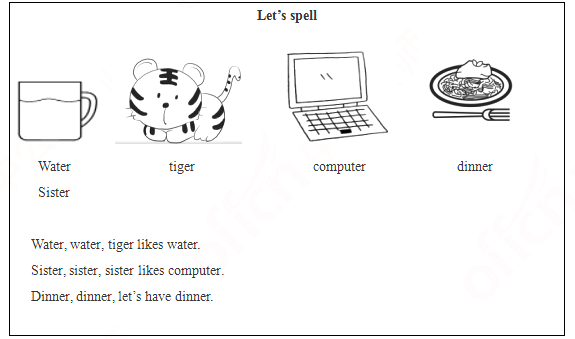
1. Use some riddles to introduce the words. For example, “I will drink it every day. What is it? Yes, it’s water.” Then draw the according pictures(introduce “sister” by explaining its meaning). And write the words at last.
2. Ask the students to read the words after the teacher for twice. Then play high and low voice. If the teacher speak one word loudly, the students should speak it lowly, and vice versa.
3. Ask students to find similarities among the words. They may say that they all contain “-er” at the end of the words. Then introduce the rules of the pronunciation.
4. Ask students if they know other words containing “-er”. They may say “winter”, “river” or others.
Step 3: Practice
1. Finish Read, underline, and say in the textbook. Check answers, and ask students to read after the teacher.
2. Finish Look, listen and write in the textbook. Then invite students share their answers on the blackboard. Give encouragement.
Step4: Production
1. Ask students to make up a chant using the words we learned. For example:
Water, water, tiger likes water.
Sister, sister, sister likes computer.
Dinner, dinner, let’s have dinner.
Step5: Summary and Homework
Summary: ask a student to conclude the content of the lesson and summarize with the whole class.
Homework: chant for the students’ parents.
Blackboard design:
1. What is a good pronunciation lesson?
2. What will you do if one of the students in your class doesn’t do homework?答案:解析:1.
A good pronunciation lesson should make students master the rules of the pronunciation, and they can apply the rules when encounter the syllables in the future. So in my lesson, I firstly let the students find similarities among the words, then I conclude the rules. After that, I ask them if they know other words that share the same pronunciations. Later, few exercises are conducted so that they can consolidate the knowledge. Thus, I believe I have given a good pronunciation lesson.
2.
Firstly, I will ask him or her to finish the homework as soon as possible. Secondly, I will try to talk with the student patiently to figure out the reason. If the student say that they have too much homework, then I will try to reduce the homework amount afterward. If the student think homework is not important, I will tell that homework is a good way to absorb the knowledge learned today, otherwise they will forget it quickly. Lastly, I will talk to his or her parents to let them also focus on the problem and address it together with us. -
第8题:

二、考题解析
【教案】
Teaching aims:
Knowledge aim:
Students will master the meaning and pronunciation of the words.
Ability aim:
Students will know how to pronounce “ch” and “sh” in words.
Emotional aim:
Students will be interested in learning English.
Key and difficult point:
Key Point:
Students will master the meaning and pronunciation of the words.
Students will know how to pronounce “ch” and “sh” in words.
Difficult Point:
Students will be interested in learning English.
Teaching procedure:
Step 1: Warming-up
1. Greetings. Talk about the weather.
2. Chant with the students
Tomato tomato wash wash wash
Tomato tomato cut cut cut
Tomato tomato cook cook cook
Tomato tomato eat eat eat
Ask them if they remember the first step in the chant. They may say that it is to “wash” the tomato. Then tell them that today we are going to learn some pronunciation in it.
Step 2: Presentation
1. Draw some pictures according to different words, and then explain the meanings to the students.
2. Play the finger show with the students to consolidate the words. For example, finger 1 refers to “chicken”, and finger 2 refers to “lunch”. When the teacher points finger 1, the students should read “chicken” loudly. The rest could be done in the same manner.
3. Ask students to find similarities and differences among the words. They may say that in the first two words, there is “ch” in the words, while in the last two words, there is “sh” in the words. And they pronounce similarly.
4. Conclude the rules of “ch” and “sh”. Tell them that when they see “ch”, they should pronounce [ch], and when they see “sh”, they should pronounce [sh]. They may sound similar, but they are different. Please be notice that.
Step 3: Practice
1. Ask a few students if there are other words containing “ch” or “sh”. They may answer “chopsticks”, “ship” or “shop”.
2. Read the words in a different order, and ask students to rank the words according to the listening. At the same time, invite one students to come to the front and write the words down on the blackboard. Check answers later.
Step4: Production
Ask students to make up dialogues with their deskmates. 5 minutes will be given. After that, invite 2 pairs to share their dialogues. Give encouragement.
Step5: Summary and Homework
Summary: Ask a student to conclude the content of the lesson and summarize with the whole class.
Homework: Read the words to their parents.
Blackboard design:

1. What will you do to help students master the pronunciation of what we need to learn?
2. What will you do if the students can’t focus on your class?答案:解析:1.
First, they should know how to pronounce the syllables. So I will pronounce them exaggeratedly to let them notice the place of articulation. I will correct their pronunciations if they make some mistakes. Then, I ask them if they know other words sharing the same syllables. Also, few activities were arranged to make them really use the rules. So I believe they will master the rules of the pronunciations.
2.
There are some options to deal with the problem. First, I could arrange some interesting activities to stimulate their interest. Second, when imparting some knowledge, I could show some examples closely related to their daily lives. They will be interested in familiar things. Third, I could ask some students to answer my questions from time to time, so they will be more focused in case of being asked. So I will try to use the most appropriate method to attract their attention. -
第9题:

二、考题解析
【教案】
Teaching aims:
Knowledge aim: Students can master the usage of formal subject.
Ability aim: Students can use formal subject to communicate in their daily life.
Emotional aim: Students can enhance their interest in learning English.
Key and difficult point: Students can use formal subject to communicate in their daily life.
Teaching procedure:
Step 1: Warming-up
The teacher plays a documentary video about the earthquake in Wenchuan. Then asks students to talk about their feelings after watching. And lead in the topic.
Step 2: Presentation
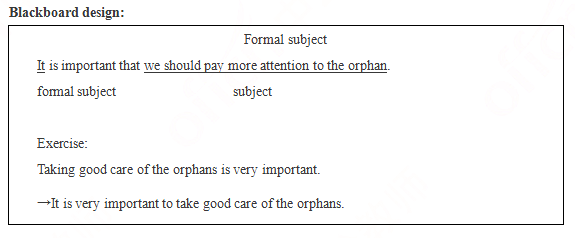
The teacher lets students to read the passage and get the main idea. Then the teacher picks the last sentence out. The teacher will use the sentence as example to explain the structure and usage of formal subject.
Step 3: Practice
After explaining, the teacher will show some normal sentences. Students should transfer them into formal subject structure.
For example: Taking good care of the orphans is very important.
→It is very important to take good care of the orphans.
Step4: Production
The teacher lets students talk with their deskmates. They should come up with some ways to help the orphans. Then invites some students to show their opinions.
Step5: Summary and Homework
The teacher summarizes what they have learnt today. Then after class, students could say something to these orphans and take a video. The teacher will help them sent it to the orphan.
答案:解析:暂无解析 -
第10题:
If the teacher uses the same techniques, some students may not have the chance to learn in the way that suits them best.()
A对
B错
对
略 -
第11题:
单选题Which of the following may better students’ ability of using a grammatical structure?AHaving them work out the rul
BHaving them give some explamples.
CHaving them explain the meanin
DHaving them explain the structure!
正确答案: A解析: -
第12题:
单选题From the whole passage, we know that ______.Amen and women have exactly the same brains in their heads
Bmen and women have quite different brains in their heads
Cmen think of mathematical problems while women think of languages
Dmen and women see the world around them in just the same way
正确答案: B解析:
文章开篇首先提出长久以来人们认为的观点,而后科学家通过研究得出结论——男女大脑并不相同。接着作者举出实例进行阐释,论证本文主题。所以B项的说法“男人和女人的大脑不一样”也即是原文的主要内容。 -
第13题:
which expression is wrong about learning students' names? ()A. It shows students that the teacher is interested in them.
B. The teacher could ask individual students to assist with demonstrations.
C. The teacher could ask individual students to assist with equipment in the class.
D. It shows the teacher is responsible.
正确答案是:D
-
第14题:
The teacher is _____ to teach the students how to learn.
A、suppose
B、supposing
C、supposed
D、supposes
正确答案:C
-
第15题:
Passage Five
In order to learn a foreign language well, it is necessary to overcome the fear of making mistakes. If the primary goal (目标) of language use is communication (交际), then mistakes are secondary considerations that may be dealt with gradually. On the other hand, students should not ignore their mistakes. The language learner may observe how native speakers express themselves, and how native expressions differ from the way the learner might say them. For example, a Spanish speaker who has been saying "I do it" to express willingness to do something in the immediate future, could, by communicating with native speakers of English, observe that native speakers actually say "I'll do it". The result can serve as a basis for the student to change his way of using the present tense in English. But a student who is unwilling to communicate in the first place would lose this opportunity to learn by trial and error.
52. According to the passage, the present tense in English is ______.
A. not used to express one's readiness to do something in the immediate future
B. used with some verbs but not with others to express future intention
C. basically the same in English as it is in Spanish
D. not the most difficult problem for foreign students
正确答案:A
52.答案为A 此考题为细节题。根据文章中的...a Spanish speaker who has been saying“I do it”to express willingness to do something in the immediate future,could,by communicating with native speakers of English,observe that native,speakers actually say“I'll do it”,可肯定A正确。 -
第16题:
Which of the following may better check students′ ability of using a grammatical structure
A.Having them work out the rule.
B.Having them give some examples.
C.Having them explain the meaning.
D.Having them explain the structure.答案:B解析:考查语法教学技能。此题是问:下列哪一项可以更好地检测学生运用语法结构的能力A项意为“让他们找出规律”,B项意为“让他们给出一些例子”,C项意为“让他们解释含义”,D项意为“让他们说明结构”。通过让学生给出一些相同语法结构的例句,可以更准确地判断出他们对于该句法结构的把握。故选B。 -
第17题:
Which of the following may better check students' ability of using a grammatical struc-ture?A.Having them work out the rule.
B.Having them give some examples.
C.Having them explain the meaning.
D.Having them explain the structure.答案:B解析:考查语法教学技能。此题是问:下列哪一项可以更好地检测学生运用语法结构的能力 A项意为“让他们找出规律”.B项意为“让他们给出一些例子”,C项意为“让他们解释含义”,D项意为“让他们说明结构”。通过让学生给出一些相同语法结构的例句,可以更准确地判断出他们对于该句法结构的把握。故选B。 -
第18题:

二、考题解析
【教案】
Teaching aims:
Knowledge aim:
Students can express their opinion and give others solutions on the topic.
Ability aim:
Students can develop their logical thinking ability through writing.
Emotional aim:
Students will know how to get along with their parents and then love and cherish their family.
Key and difficult point:
Key Point: Students make clear about how to give others suggestions. .
Difficult Point: Students can understanding the deep meaning of family.
Teaching procedure:
Step 1: Warming-up
1. Greetings.
2. Sing a song : Five Hundred Miles, then ask students the theme of the song, if they don’t know, the teacher will tell them that the song is used to express the feeling of wandering one missing his families.
Step 2: Pre-writing
1. The teacher read the letter to students and let students pay attention to the feeling of the author.
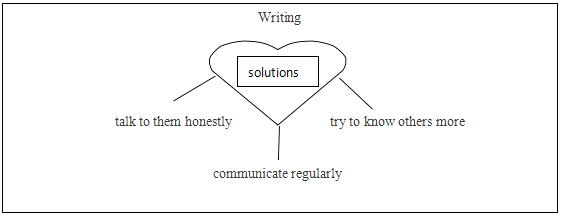
2. Brainstorming: tell students they should write a letter to the author, and what they should do is to have a discussion on the topic what the author should do to get along with her parents, and they are supposed to give as many suggestions as possible.
3. Then invite some students to write down their ideas on the blackboard.
4. Analysis the format of letter briefly.
Step 3: While-writing
Drafting: According to the analysis above, give students 15 minutes to write a letter to the author. First, remind them of the preparations we made during pre-writing. Secondly, go into them and give them some instructions when they are writing and ask them pay attention to grammar, punctuation, spelling and so on.
Step4: Post-writing
1. Peer editing: After the drafting, ask students to check the ideas or the logical development. Pay attention to the grammar, spelling and punctuation of their writings.
2. Sample show: choose several passages for them to learn and give them some evaluations from the advantages and disadvantages.Then ask them to rectify their own writings according the evaluations.
Step5: Summary and Homework
Summary: ask a student to conclude the content of the lesson and summarize with the whole class.
Homework: ask students to talk about their own problems honestly with their parents and try to solve them together.
Blackboard design:
1. Please talk about the principles of teaching writing?
2. What’s your favorite book?答案:解析:1.
There are several principles in writing: appropriate approaches; integration principle; communicative principle; realistic principle; procedural principle.
2.
Among all the books I have read, A Dream of Red Mansions, one of the four great works in China, an encyclopedia of the ancient Chinese life, is my favorite. What attracts me most in this book are the fabulous communication skills, which provokes me with great inspiration. Take Baochai for instance, though she was nice and considerate to everyone, when she was attacked by ridicules, she would fight back forcefully without hesitation. And her retort was always sparkling with wisdom, which I appreciate so much, and which I believe is indispensable in daily work. I believe that when we are challenged by some sharp questions, we should take Baochai as an example to make a tactful reply. -
第19题:

二、考题解析
【教案】
Teaching aims
Knowledge aim: students will know the pronunciation of the group of letter “ear”.
Ability aim: students can read words with “ear” when they learn vocabulary.
Emotional aim: students will be more interested in speaking English.
Key and difficult points:
How to pronounce the group of letter “ear”.
Teaching procedure:
Step 1: Warming-up
After greeting students, the teacher plays a game to warm up the class: I say you point. The teacher speaks out a certain part of the body and students point it quickly. For example: point your eye! Point your ear! Point your hand!
Step 2: Presentation
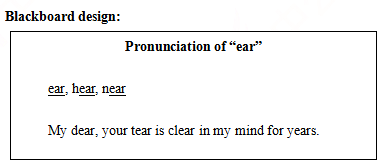
Draw a ear on the blackboard and ask students what it is. Write down the word. Then ask what ears can be used to, and they will say we use ear to hear something. Write down word “hear”. Then do the action of hearing and put hands near the ear, and write down the word “near”.
Ask students to read the three words after the teacher, and find out the similarity among them. After discussion, they will say all these words have “ear”. Then ask students how to pronounce this group of letter. We will know it pronounce as /ir/.
Step 3: practice
Give students some other words with the group of letter “ear” and ask students to read them by groups. For example, a sentence “my dear, your tear is clear in my mind for years”. Then students can have a brainstorming and think of more words with “ear”.
Play a game Hot potato to practice these words. The teacher plays a piece of music. When the music is playing, students pass the ball from one to another. When the music stops, the one who gets the ball should read words on the blackboard.
Step4: Production
Do a chant with students: put your ear, near my ear, and you will hear, and you will hear, and you will hear, NOTHING!
 答案:解析:暂无解析
 -
第20题:
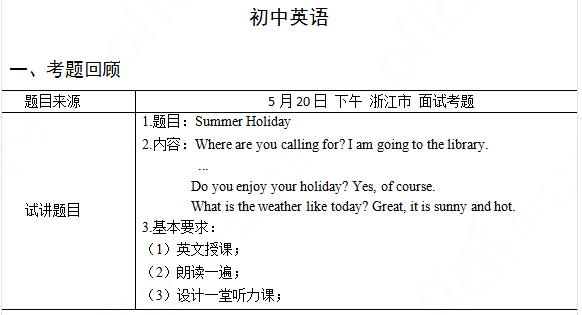
二、考题解析
【教案】
Teaching Aims:
Knowledge aim: Students will be able to describe their summer holiday and acquire some knowledge about listening strategies.
Ability aim: Students can obtain the main idea quickly from the listening material and develop the ability of grasping detail information.
Emotional aim: Students can foster their interest and desire of learning English, and be fond of taking part in kinds of practical activities.
Teaching Key Points:
Students can get the main idea and useful information from the listening material.
Teaching Difficult Points:
Students can apply these skills in their listening and apply these expression in their daily communication.
Teaching Methods:
Communicative teaching method, task-based teaching method, audio-lingual teaching method.
Teaching Aids:
PPT, Blackboard, recorder and so on
Teaching Procedures:
Step 1: Warming up
1.Greetings
2.Sing an English song Summer Holiday, invite the whole students to clap when singing together and lead to the topic.
Step 2: Pre-listening
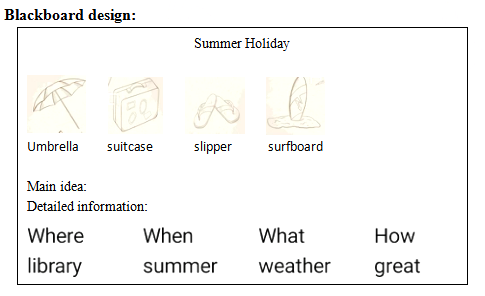
1.Brainstorm: Give students 3 minutes to say something about summer holiday as much as they can.
2.Clean up obstacle:Use pictures to teach students some difficult words or explain some words by English explanation.
Step 3: While-listening
1. Listen to the tape for the first time and ask them what the passage is mainly about, then let students share their ideas.
2.Listen to the tape for the second time and ask them to fill in the chart, then invite them to share their answers.
Step 4: Post-listening
1.Discussion: Ask students to discuss what they will do this summer holiday with their partners, and teacher will give them 3 minutes to prepare it and 3 minutes later, invite some students to share their own summer holiday in the front.
2.Report: Let students to write down plans of their own summer holiday with the key words and key sentences that they have learned today, 8 minutes later teacher invites some students to share the result of their reports.
Step 5: Summary & Homework
Summary : Invite a little teacher to help teacher make a summary of this class.
Homework: Let students prefect their plans of summer holiday and share with their parents.
 答案:解析:暂无解析
 -
第21题:
共用题干
Successful Language Learners
1.Some people seem to have a knack for learning languages.They can pick up new vocabulary,master rules or grammar,and learn to write in the new language more quickly than others.They do not seem to be any more intelligent than others,so what makes language learning so much easier for them?Perhaps if we take a close look at these successful language learners,we may discover a few of the techniques which make language learning easier for them.
2.First of all,successful language learners are independent learners.They do not depend on the book or the teacher;they discover their own way to learn the language.Instead of waiting for the teacher to explain,they try to find the patterns and the rules for themselves.They are good guessers who look for clues and form their own conclusions.When they guess wrong,they guess again.They try to learn from mistakes.
3.Successful language learning is active learning. Therefore,successful learners do not wait for a chance to use the language;they look for such a chance.They find people who speak the language and they ask these people to correct them when they make a mistake.They will try anything to com-municate.They are not afraid to repeat what they hear or to say strange things;they are willing to make mistakes and try again.When communication is difficult,they can accept information that is inexact or incomplete.It is more important for them to learn to think in the language than to know the meaning of every word.
4.Finally,successful language learners are learners with a purpose.They want to learn the language because they are interested in the language and the people who speak it.It is necessary for them to learn the language in order to communicate with these people and to learn from them.They find it easy to practice using the language regularly because they want to learn with it.
5.What kind of language learner are you?If you are a successful language learner,you have probably been learning independently,actively,and purposefully.On the other hand,if your language learning has been less than successful,you might as well try some of the techniques outlined above.Paragraph 3_________.
A:Ways to learn a language successfully.
B:Learning a language purposefully.
C:Learning a language actively.
D:Learning a language independently.
E:Learning from mistakes.
F:Learning to think in the target language.答案:C解析:本题考查的是对所读材料大意与主旨的掌握。本段首先通过举例方式说明有些人似乎学习语言比别人更快更轻松,引出该篇文章的主题:…a few of the techniques which make language learning easier for them.即成功学习语言的方法。
本题考查的是对所读材料大意与主旨的掌握。本段主要讲述的是第一个学习语言的方法,就是独立学习的能力,作者通过举例子的方式来说明这一方法,例如这些人不会依赖老师或者课本,而是自己去摸索总结出一定的模式,寻找线索,大胆地、不断地进行猜测,从错误中学习。
本题考查的是对所读材料大意与主旨的掌握。本段主要讲述第二个语言学习的方法,就是积极主动学习的能力,这些人会寻找一切使用语言的机会,找人纠正他们的错误,敢于说一些即使有些别扭的句子,愿意接受不准确或不完整的信息,对他们来说,学习另一种思维方式比知道单词的意思更加重要。
本题考查的是对所读材料大意与主旨的掌握。本段主要讲述第三个语言学习的方法,就是有目的性地学习的能力,这些人往往是因为对讲这种语言的人以及语言本身感兴趣才学习,这样,他们可以更好地和使用这种语言的当地人交流并向他们学习。
本题考查的是对阐述文章的主旨事实与细节的了解。依据是第二段第四句话:They are good guessers who look for clues and form their own conclusions.
本题考查的是对阐述文章的主旨事实与细节的了解。依据是第二段第三句话:Instead of waiting for the teacher to explain, they try to find the patterns and the rules for themselves.
本题考查的是对阐述文章的主旨事实与细节的了解。依据是第三段第二句话:Therefore, successful learners do not wait for a chance to use the language; they look for such a chance.
本题考查的是对阐述文章的主旨的了解。依据是第二段、第三段、第四段的第一句也就是每一段的主题句。本文的主旨就是介绍这三种重要的语言学习方法:独立、主动、有目的地学语言。 -
第22题:
单选题Passage2The way people work has changed. The increasing use of technology presents new and continual challenges to small and large businesses,employees and managers,teachers and students.Everyone,it seems,is being affected by the technological revolution. Store clerks,for example,now use increasingly complex computerized cash registers,while university professors must learn to adapt their teaching skills in order to lead distance learning course.In today's world,training and learning do not stop when we finish school;they must now continue throughout our working lives. The Hong Kong government conducted a survey on the employment concerns,and training needs of its workforce. For many managers and other professionals the biggest challenge,as well as change,in the workplace,was the increased use of computers and computerized machinery or equipment. The need for experienced employees who could use this kind of equipment rose drastically. Many of those in the workplace at this time experienced changes in job requirements and had to attend job-related training or re-training courses.The changing work environment is also affecting education and how we learn. In Finland, a report on strategies for education and training in the information age discussed the changing roles of both teacher and student. With the increased use of technology and the growth of distance learning, the teacher has become more of a tutor who guides a student, rather than a lecturer. In turn, the student has to take more responsibility for his or her learning in the absence of direct teacher contact. The report also stressed that high school and university students should learn computer skills in order to cope with the demands of the future workplace.The Finnish report also highlighted the need for teacher training, and re-training, and suggested that the salaries and job descriptions of teachers be reviewed because of future demands expected in their jobs. Previously university professors may have held lectures between the weekday hours of 9:00A.M. and 5:00 P.M. in large halls filled with students. Now, they may spend part of their day lecturing larger groups of students on campus, and then conduct afternoon or evening classes online, with students in five different countries.As technologies grow and develop, ongoing training will continue to be necessary. To be successful in the workplace, people will not stop learning when they leave school-lifelong learning will become a way of life.How did the changing work environment change the role of the teacher according to the Finnish report?Athe teacher became more of a tutor rather than a lecturer.
Bthe teacher had to learn more strategies for distance teaching.
Cthe teacher had to learn how to teach students without direct contact.
DThe teacher should learn computer skills to cope with the demands of the future workplace.
正确答案: C解析: -
第23题:
判断题If the teacher uses the same techniques, some students may not have the chance to learn in the way that suits them best.()A对
B错
正确答案: 错解析: 暂无解析