
To face the music Like every language, American English is full of special expressions, phrases that come from the day-to-day life of the people and develop in their own way. Our expression today is "to face the music". When someone says, "well, I
题目
To face the music
Like every
language, American English is full of special expressions, phrases that come
from the day-to-day life of the people and develop in their own way. Our
expression today is "to face the music".
When someone
says, "well, I guess I’ll have to face the music," it does not mean he’s
planning to go to the concert. It is something far less pleasant, like being
called in by your boss to explain why you did this and did that, and why you
didn’t do this or that. Sour music indeed, but it has to be faced. At sometime
or another, every one of us has had to face the music, especially as children.
We can all remember father’s angry voice, "I want to talk to you." and only
because we did not obey him. What an unpleasant business it was!
The phrase "to face the music" is familiar to every American,
young and old. It is at least 100 years old. And where did this expression come
from The first explanation comes from the American novelist, James Fenimore
Looper. He said, in 1851, that the expression was first used by actors while
waiting in the wings to go on the stage. When they got their cue to go on, they
often said, "Well, it’s time to face the music." And that was exactly what they
did-facing the orchestra which was just below them. And an actor might be
frightened or nervous as he moved on to the stage in front of an audience that
might be friendly or perhaps hostile, especially if he forgot his lines. But he
had to go out. If he did not, there would be no play. So the expression "to face
the music "come to mean "having to go through something, no matter how
unpleasant the experience might be, because you knew you had no
choice."
Other explanations about the expression go back to the
army. When the men faced an inspection by their leader, the soldiers would be
worried about how well they looked. Was their equipment clean, shinny enough to
pass the inspection Still the men had to go out and face the music of the band
as well as the inspection. What else could they do
Another
army explanation is more closely related to the idea of facing the results and
accepting the responsibility for something that should not have been done. As,
for example when a man is forced out of the army because he did something
terrible, he is dishonored. The band does not play. Only the drums tap a sad,
slow beat. The soldier is forced to leave, facing such music as it is and facing
the back of his horse.How many ways does the phrase "to face the music" comes from
- A、1
- B、2
- C、3
- D、4
相似考题
更多“To face the music<BR> Like eve”相关问题
-
第1题:
We often ___ a particular color with a piece of music, a book, a play or a person.A.refer
B.know
C.associate
D.like
正确答案: C
-
第2题:
The music()like the singing of a bird.A.hears
B.listens
C.sounds
答案:C
解析:句意:这音乐听起来像鸟鸣。sounds like 的意思是听起来像。
sounds:发出声响
hears:听说,听见(hear的第三人称单数)
listens:听,倾听;听从,听信
-
第3题:
Does Jackie Chan like listening to music?
____________
正确答案:
50. No,he doesn't. -
第4题:
Like every language,American English is full of special expressions,phrases that come from the day-to-day life of the people and develop in their own way.Our expression today is“to face the music”.
When someone says,“well,I guess I’ll have to face the music,”it does not mean he’s planning to go to the concert.It is something far less pleasant,like being called in by your boss to explain why you did this and did that,and why you didn’t do this or that.Sour music indeed,but it has to be faced At sometime or another,every one of us has had to face the music,especially as children.We can all remember father’s angry voice,“I want to talk to you.”and only because we did not obey him.What an unpleasant business it was!
The phrase“to face the music”is familiar to every American,young and old,It is at least 100 years old
.And where did this expression come from?The first explanation comes from the American novelist,James Fenimore Looper.He said,in 1851,that the expression was first used by actors while waiting in the wings to go on the stage.When they got their cue to go on,they often said,“Well,it’s time to face the music.”And that was exactly what they did—facing the orchestra which was just below them.And an actor might be frightened or nervous as he moved on to the stage in front of an audience that might be friendly or perhaps?hostile,especially if he forgot his lines.But he had to go out.If he did not,there would be no play.So the expression“to face the music”come to mean“having to go through something,no matter how unpleasant the experience might be,because you knew you had no choice.”
Other explanations about the expression go back to the army.When the men faced an inspection by their leader,the soldiers would be worried about how well they looked
.Was their equipment clean,shinny enough to pass the inspection?Still the men had to go out and face the music of the band as well as the inspection.What else could they do?
Another army explanation is more closely related to the idea of facing the results and accepting the responsibility for something that should not have been done.As,for example when a man is forced out of the army because he did something terrible,he is dishonored
.The band does not play.Only the drums tap a sad,slow beat.The soldier is forced to leave,facing such music as it is and facing the back of his horse.
Which of the following is a situation of facing the music?A.When we are playing basketbal
B.When we are making a speec
C.When we are having a part
D.When we are talking with somebod答案:B解析:暂无解析 -
第5题:
Like every language,American English is full of special expressions,phrases that come from the day-to-day life of the people and develop in their own way.Our expression today is“to face the music”.
When someone says,“well,I guess I’ll have to face the music,”it does not mean he’s planning to go to the concert.It is something far less pleasant,like being called in by your boss to explain why you did this and did that,and why you didn’t do this or that.Sour music indeed,but it has to be faced At sometime or another,every one of us has had to face the music,especially as children.We can all remember father’s angry voice,“I want to talk to you.”and only because we did not obey him.What an unpleasant business it was!
The phrase“to face the music”is familiar to every American,young and old,It is at least 100 years old
.And where did this expression come from?The first explanation comes from the American novelist,James Fenimore Looper.He said,in 1851,that the expression was first used by actors while waiting in the wings to go on the stage.When they got their cue to go on,they often said,“Well,it’s time to face the music.”And that was exactly what they did—facing the orchestra which was just below them.And an actor might be frightened or nervous as he moved on to the stage in front of an audience that might be friendly or perhaps?hostile,especially if he forgot his lines.But he had to go out.If he did not,there would be no play.So the expression“to face the music”come to mean“having to go through something,no matter how unpleasant the experience might be,because you knew you had no choice.”
Other explanations about the expression go back to the army.When the men faced an inspection by their leader,the soldiers would be worried about how well they looked
.Was their equipment clean,shinny enough to pass the inspection?Still the men had to go out and face the music of the band as well as the inspection.What else could they do?
Another army explanation is more closely related to the idea of facing the results and accepting the responsibility for something that should not have been done.As,for example when a man is forced out of the army because he did something terrible,he is dishonored
.The band does not play.Only the drums tap a sad,slow beat.The soldier is forced to leave,facing such music as it is and facing the back of his horse.
The underlined word“hostile”means_______.A.unfriendly
B.dislike
C.unkind
D.unnecessary答案:A解析:暂无解析 -
第6题:
What does the author mean by saying“writing today is like Latin on the eve of the Renaissance-the language of a scholarly establishment” ?( )A.Videos are like Italian that served as the street language
B.A video is worth more than a thousand words
C.Writing would face extinction,just as Latin
D.Writing would be less popular among ordinary people答案:D解析: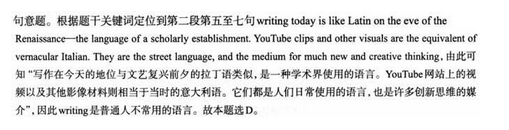
-
第7题:
Do you like country music?()
AYes, I like basketball a lot
BIt's far too crowded
CYes, I'm crazy about it
DOh, it's funny
C
略 -
第8题:
单选题Would you like _____ music?Ato listen to
Bto listening
Clistening
Dlistening to
正确答案: C解析:
would like to do sth是固定搭配,意为“想要干某事”;而动词listen是不及物动词,接宾语时应加介词to。 -
第9题:
单选题To face the music Like every language, American English is full of special expressions, phrases that come from the day-to-day life of the people and develop in their own way. Our expression today is "to face the music". When someone says, "well, I guess I’ll have to face the music," it does not mean he’s planning to go to the concert. It is something far less pleasant, like being called in by your boss to explain why you did this and did that, and why you didn’t do this or that. Sour music indeed, but it has to be faced. At sometime or another, every one of us has had to face the music, especially as children. We can all remember father’s angry voice, "I want to talk to you." and only because we did not obey him. What an unpleasant business it was! The phrase "to face the music" is familiar to every American, young and old. It is at least 100 years old. And where did this expression come from The first explanation comes from the American novelist, James Fenimore Looper. He said, in 1851, that the expression was first used by actors while waiting in the wings to go on the stage. When they got their cue to go on, they often said, "Well, it’s time to face the music." And that was exactly what they did-facing the orchestra which was just below them. And an actor might be frightened or nervous as he moved on to the stage in front of an audience that might be friendly or perhaps hostile, especially if he forgot his lines. But he had to go out. If he did not, there would be no play. So the expression "to face the music "come to mean "having to go through something, no matter how unpleasant the experience might be, because you knew you had no choice." Other explanations about the expression go back to the army. When the men faced an inspection by their leader, the soldiers would be worried about how well they looked. Was their equipment clean, shinny enough to pass the inspection Still the men had to go out and face the music of the band as well as the inspection. What else could they do Another army explanation is more closely related to the idea of facing the results and accepting the responsibility for something that should not have been done. As, for example when a man is forced out of the army because he did something terrible, he is dishonored. The band does not play. Only the drums tap a sad, slow beat. The soldier is forced to leave, facing such music as it is and facing the back of his horse.The underlined word "hostile" means ().Aunfriendly
Bdislike
Cunkind
Dunnecessary
正确答案: B解析: [解析] 词义猜测题。根据单词所在的语境:friendly or perhaps hostile, especially if he forgot his lines说明hostile与friendly意义相反,从而可推知此题答案为A。 -
第10题:
单选题Mike: Eve. I wasn’t expecting you. Eve: I hope I’m not disturbing you. Mike: No, I just couldn’t imagine who it was. Eve: Is Joey here? Where’s Joey? Mike: Joey’s in the shower. Can I get you anything? Eve: ______ Mike: No, it’s no trouble at all.AI’ll just have a cup of coffee, if you don’t mind.
BI’d like to sit down for a while, thanks
CNo, thanks, I’ll show you something.
DIf it doesn’t cause too much trouble, I’d like to see Joey.
正确答案: B解析:
前文问你想喝点什么么?故A项正确。 -
第11题:
单选题—Tim, how do your parents like pop music?—______ my dad ______ my mom likes it. They both prefer classical music.AEither; or
BNeither; nor
CNot only; but also
正确答案: B解析:
句意:——提姆,你父母喜欢流行音乐吗?——我的爸爸和妈妈都不喜欢流行音乐。他们两个都更喜欢古典音乐。本题考查neither…nor的用法。结合答语中的“他们两个都更喜欢古典音乐”可知,“我的爸爸和妈妈都不喜欢流行音乐”。故neither…nor符合题意,因此选B项。either...or或……或;not only...but also不仅……而且。 -
第12题:
单选题To face the music Like every language, American English is full of special expressions, phrases that come from the day-to-day life of the people and develop in their own way. Our expression today is "to face the music". When someone says, "well, I guess I’ll have to face the music," it does not mean he’s planning to go to the concert. It is something far less pleasant, like being called in by your boss to explain why you did this and did that, and why you didn’t do this or that. Sour music indeed, but it has to be faced. At sometime or another, every one of us has had to face the music, especially as children. We can all remember father’s angry voice, "I want to talk to you." and only because we did not obey him. What an unpleasant business it was! The phrase "to face the music" is familiar to every American, young and old. It is at least 100 years old. And where did this expression come from The first explanation comes from the American novelist, James Fenimore Looper. He said, in 1851, that the expression was first used by actors while waiting in the wings to go on the stage. When they got their cue to go on, they often said, "Well, it’s time to face the music." And that was exactly what they did-facing the orchestra which was just below them. And an actor might be frightened or nervous as he moved on to the stage in front of an audience that might be friendly or perhaps hostile, especially if he forgot his lines. But he had to go out. If he did not, there would be no play. So the expression "to face the music "come to mean "having to go through something, no matter how unpleasant the experience might be, because you knew you had no choice." Other explanations about the expression go back to the army. When the men faced an inspection by their leader, the soldiers would be worried about how well they looked. Was their equipment clean, shinny enough to pass the inspection Still the men had to go out and face the music of the band as well as the inspection. What else could they do Another army explanation is more closely related to the idea of facing the results and accepting the responsibility for something that should not have been done. As, for example when a man is forced out of the army because he did something terrible, he is dishonored. The band does not play. Only the drums tap a sad, slow beat. The soldier is forced to leave, facing such music as it is and facing the back of his horse.What’s the meaning of "to face the music"ATo face something far less pleasant.
BTo face the stage.
CTo face the back of one’s horse.
DTo face one’s leader.
正确答案: A解析: [解析] 细节题。根据文章第2段第2句It is something far less pleasant可推知此题答案为A。 -
第13题:
A:Can you say something about Pop music in China? B: -- ( ).
A、What is pop music?
B、know that.
C、I’ve never been to China.
D、Yes, I’d like to.
参考答案:D
解析:问:能谈谈中国流行音乐吗?四个选项中“非常乐意”比较合理
-
第14题:
—_________________— I’m fond of pop music.A.Do you like music?
B.Rock and roll is fun.
C.What kind of music do you like?
D.How about if we enjoy classical music?
参考答案:C
-
第15题:
The author mentions that a band’Success is dependent on all of the following factors EXCEPT
A.having patience
B.making personal contacts with people in the company
C.understanding how a record company functions
D.playing music that sounds like music of famous bands
正确答案:D
文中A、B、C项,均有提到,唯有D项“playing music that sounds like music of famous bands”未提到。 -
第16题:
Like every language,American English is full of special expressions,phrases that come from the day-to-day life of the people and develop in their own way.Our expression today is“to face the music”.
When someone says,“well,I guess I’ll have to face the music,”it does not mean he’s planning to go to the concert.It is something far less pleasant,like being called in by your boss to explain why you did this and did that,and why you didn’t do this or that.Sour music indeed,but it has to be faced At sometime or another,every one of us has had to face the music,especially as children.We can all remember father’s angry voice,“I want to talk to you.”and only because we did not obey him.What an unpleasant business it was!
The phrase“to face the music”is familiar to every American,young and old,It is at least 100 years old
.And where did this expression come from?The first explanation comes from the American novelist,James Fenimore Looper.He said,in 1851,that the expression was first used by actors while waiting in the wings to go on the stage.When they got their cue to go on,they often said,“Well,it’s time to face the music.”And that was exactly what they did—facing the orchestra which was just below them.And an actor might be frightened or nervous as he moved on to the stage in front of an audience that might be friendly or perhaps?hostile,especially if he forgot his lines.But he had to go out.If he did not,there would be no play.So the expression“to face the music”come to mean“having to go through something,no matter how unpleasant the experience might be,because you knew you had no choice.”
Other explanations about the expression go back to the army.When the men faced an inspection by their leader,the soldiers would be worried about how well they looked
.Was their equipment clean,shinny enough to pass the inspection?Still the men had to go out and face the music of the band as well as the inspection.What else could they do?
Another army explanation is more closely related to the idea of facing the results and accepting the responsibility for something that should not have been done.As,for example when a man is forced out of the army because he did something terrible,he is dishonored
.The band does not play.Only the drums tap a sad,slow beat.The soldier is forced to leave,facing such music as it is and facing the back of his horse.
What’s the meaning of“to face the music?”A.To face something far less pleasan
B.To face the stag
C.To face the back of one’s hors
D.To face one’s leade答案:A解析:暂无解析 -
第17题:

What does the author mean by saying“writing today is like Latin on the eve of the Renaissance-the language of a scholarly establishment” ?( )A.Videos are like Italian that served as the street language.
B.A video is worth more than a thousand words.
C.Writing would face extinction,just as Latin.
D.Writing would be less popular among ordinary people.答案:D解析: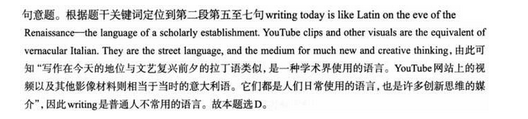
-
第18题:
What do you think of the song?()
AIt sounds sweet
BI like music very much
CI don't know the title
DIt was a pleasure
A
略 -
第19题:
Do you like country music?()
- A、Yes, I like basketball a lot
- B、It's far too crowded
- C、Yes, I'm crazy about it
- D、Oh, it's funny
正确答案:C -
第20题:
单选题As you like pop music,()I like literature.Aso
Btherefore
Cas
Dthus
正确答案: D解析: 暂无解析 -
第21题:
单选题Do you like country music?()AYes, I like basketball a lot
BIt's far too crowded
CYes, I'm crazy about it
DOh, it's funny
正确答案: D解析: 暂无解析 -
第22题:
单选题— What kind of music do you like? — Well, I like different kinds. — ______. — Er, I especially like punk rock.AI beg your pardon?
BAre you serious?
CAny in particular?
DWhy do you think so?
正确答案: D解析: 根据回答I especially like punk rock可以推测出,问话人是问另一个人具体喜欢什么音乐,所以选项C正确。 -
第23题:
单选题To face the music Like every language, American English is full of special expressions, phrases that come from the day-to-day life of the people and develop in their own way. Our expression today is "to face the music". When someone says, "well, I guess I’ll have to face the music," it does not mean he’s planning to go to the concert. It is something far less pleasant, like being called in by your boss to explain why you did this and did that, and why you didn’t do this or that. Sour music indeed, but it has to be faced. At sometime or another, every one of us has had to face the music, especially as children. We can all remember father’s angry voice, "I want to talk to you." and only because we did not obey him. What an unpleasant business it was! The phrase "to face the music" is familiar to every American, young and old. It is at least 100 years old. And where did this expression come from The first explanation comes from the American novelist, James Fenimore Looper. He said, in 1851, that the expression was first used by actors while waiting in the wings to go on the stage. When they got their cue to go on, they often said, "Well, it’s time to face the music." And that was exactly what they did-facing the orchestra which was just below them. And an actor might be frightened or nervous as he moved on to the stage in front of an audience that might be friendly or perhaps hostile, especially if he forgot his lines. But he had to go out. If he did not, there would be no play. So the expression "to face the music "come to mean "having to go through something, no matter how unpleasant the experience might be, because you knew you had no choice." Other explanations about the expression go back to the army. When the men faced an inspection by their leader, the soldiers would be worried about how well they looked. Was their equipment clean, shinny enough to pass the inspection Still the men had to go out and face the music of the band as well as the inspection. What else could they do Another army explanation is more closely related to the idea of facing the results and accepting the responsibility for something that should not have been done. As, for example when a man is forced out of the army because he did something terrible, he is dishonored. The band does not play. Only the drums tap a sad, slow beat. The soldier is forced to leave, facing such music as it is and facing the back of his horse.Which of the following is a situation of facing the musicAWhen we are playing basketball.
BWhen we are making a speech.
CWhen we are having a party.
DWhen we are talking with somebody.
正确答案: C解析: [解析] 推断题。根据文章第3段的解释:演讲与演出一样,都要面对观众,可推知此题答案为B。 -
第24题:
单选题To face the music Like every language, American English is full of special expressions, phrases that come from the day-to-day life of the people and develop in their own way. Our expression today is "to face the music". When someone says, "well, I guess I’ll have to face the music," it does not mean he’s planning to go to the concert. It is something far less pleasant, like being called in by your boss to explain why you did this and did that, and why you didn’t do this or that. Sour music indeed, but it has to be faced. At sometime or another, every one of us has had to face the music, especially as children. We can all remember father’s angry voice, "I want to talk to you." and only because we did not obey him. What an unpleasant business it was! The phrase "to face the music" is familiar to every American, young and old. It is at least 100 years old. And where did this expression come from The first explanation comes from the American novelist, James Fenimore Looper. He said, in 1851, that the expression was first used by actors while waiting in the wings to go on the stage. When they got their cue to go on, they often said, "Well, it’s time to face the music." And that was exactly what they did-facing the orchestra which was just below them. And an actor might be frightened or nervous as he moved on to the stage in front of an audience that might be friendly or perhaps hostile, especially if he forgot his lines. But he had to go out. If he did not, there would be no play. So the expression "to face the music "come to mean "having to go through something, no matter how unpleasant the experience might be, because you knew you had no choice." Other explanations about the expression go back to the army. When the men faced an inspection by their leader, the soldiers would be worried about how well they looked. Was their equipment clean, shinny enough to pass the inspection Still the men had to go out and face the music of the band as well as the inspection. What else could they do Another army explanation is more closely related to the idea of facing the results and accepting the responsibility for something that should not have been done. As, for example when a man is forced out of the army because he did something terrible, he is dishonored. The band does not play. Only the drums tap a sad, slow beat. The soldier is forced to leave, facing such music as it is and facing the back of his horse.How many ways does the phrase "to face the music" comes fromA1
B2
C3
D4
正确答案: B解析: [解析] 细节题。根据文章第三、四、五段的解释,可推知此题答案为C。