
You are the manager responsible for performing hot reviews on audit files where there is a potential disagreementbetween your firm and the client regarding a material issue. You are reviewing the going concern section of the auditfile of Dexter Co, a clie
题目
You are the manager responsible for performing hot reviews on audit files where there is a potential disagreement
between your firm and the client regarding a material issue. You are reviewing the going concern section of the audit
file of Dexter Co, a client with considerable cash flow difficulties, and other, less significant operational indicators of
going concern problems. The working papers indicate that Dexter Co is currently trying to raise finance to fund
operating cash flows, and state that if the finance is not received, there is significant doubt over the going concern
status of the company. The working papers conclude that the going concern assumption is appropriate, but it is
recommended that the financial statements should contain a note explaining the cash flow problems faced by the
company, along with a description of the finance being sought, and an evaluation of the going concern status of the
company. The directors do not wish to include the note in the financial statements.
Required:
(b) Consider and comment on the possible reasons why the directors of Dexter Co are reluctant to provide the
note to the financial statements. (5 marks)
相似考题
更多“You are the manager responsible for performing hot reviews on audit files where there is a potential disagreementbetween your firm and the client regarding a material issue. You are reviewing the going concern section of the auditfile of Dexter Co, a clie”相关问题
-
第1题:
You are an audit manager responsible for providing hot reviews on selected audit clients within your firm of Chartered
Certified Accountants. You are currently reviewing the audit working papers for Pulp Co, a long standing audit client,
for the year ended 31 January 2008. The draft statement of financial position (balance sheet) of Pulp Co shows total
assets of $12 million (2007 – $11·5 million).The audit senior has made the following comment in a summary of
issues for your review:
‘Pulp Co’s statement of financial position (balance sheet) shows a receivable classified as a current asset with a value
of $25,000. The only audit evidence we have requested and obtained is a management representation stating the
following:
(1) that the amount is owed to Pulp Co from Jarvis Co,
(2) that Jarvis Co is controlled by Pulp Co’s chairman, Peter Sheffield, and
(3) that the balance is likely to be received six months after Pulp Co’s year end.
The receivable was also outstanding at the last year end when an identical management representation was provided,
and our working papers noted that because the balance was immaterial no further work was considered necessary.
No disclosure has been made in the financial statements regarding the balance. Jarvis Co is not audited by our firm
and we have verified that Pulp Co does not own any shares in Jarvis Co.’
Required:
(b) In relation to the receivable recognised on the statement of financial position (balance sheet) of Pulp Co as
at 31 January 2008:
(i) Comment on the matters you should consider. (5 marks)
正确答案:
(b) (i) Matters to consider
Materiality
The receivable represents only 0·2% (25,000/12 million x 100) of total assets so is immaterial in monetary terms.
However, the details of the transaction could make it material by nature.
The amount is outstanding from a company under the control of Pulp Co’s chairman. Readers of the financial statements
would be interested to know the details of this transaction, which currently is not disclosed. Elements of the transaction
could be subject to bias, specifically the repayment terms, which appear to be beyond normal commercial credit terms.
Paul Sheffield may have used his influence over the two companies to ‘engineer’ the transaction. Disclosure is necessary
due to the nature of the transaction, the monetary value is irrelevant.
A further matter to consider is whether this is a one-off transaction, or indicative of further transactions between the two
companies.
Relevant accounting standard
The definitions in IAS 24 must be carefully considered to establish whether this actually constitutes a related party
transaction. The standard specifically states that two entities are not necessarily related parties just because they have
a director or other member of key management in common. The audit senior states that Jarvis Co is controlled by Peter
Sheffield, who is also the chairman of Pulp Co. It seems that Peter Sheffield is in a position of control/significant influence
over the two companies (though this would have to be clarified through further audit procedures), and thus the two
companies are likely to be perceived as related.
IAS 24 requires full disclosure of the following in respect of related party transactions:
– the nature of the related party relationship,
– the amount of the transaction,
– the amount of any balances outstanding including terms and conditions, details of security offered, and the nature
of consideration to be provided in settlement,
– any allowances for receivables and associated expense.
There is currently a breach of IAS 24 as no disclosure has been made in the notes to the financial statements. If not
amended, the audit opinion on the financial statements should be qualified with an ‘except for’ disagreement. In
addition, if practicable, the auditor’s report should include the information that would have been included in the financial
statements had the requirements of IAS 24 been adhered to.
Valuation and classification of the receivable
A receivable should only be recognised if it will give rise to future economic benefit, i.e. a future cash inflow. It appears
that the receivable is long outstanding – if the amount is unlikely to be recovered then it should be written off as a bad
debt and the associated expense recognised. It is possible that assets and profits are overstated.
Although a representation has been received indicating that the amount will be paid to Pulp Co, the auditor should be
sceptical of this claim given that the same representation was given last year, and the amount was not subsequently
recovered. The $25,000 could be recoverable in the long term, in which case the receivable should be reclassified as
a non-current asset. The amount advanced to Jarvis Co could effectively be an investment rather than a short term
receivable. Correct classification on the statement of financial position (balance sheet) is crucial for the financial
statements to properly show the liquidity position of the company at the year end.
Tutorial note: Digressions into management imposing a limitation in scope by withholding evidence are irrelevant in this
case, as the scenario states that the only evidence that the auditors have asked for is a management representation.
There is no indication in the scenario that the auditors have asked for, and been refused any evidence. -
第2题:
While reviewing the MySQL error log, you see occasions where MySQL has exceeded the number of file handles allowed to it by the operating system.Which method will reduce the number of file handles in use?()
A.Activating the MySQL Enterprise thread pool plugin
B.Relocating your data and log files to separate storage devices
C.Disconnecting idle localhost client sessions
D.Implementing storage engine data compression options
参考答案:C
-
第3题:
Following a competitive tender, your audit firm Cal & Co has just gained a new audit client Tirrol Co. You are the manager in charge of planning the audit work. Tirrol Co’s year end is 30 June 2009 with a scheduled date to complete the audit of 15 August 2009. The date now is 3 June 2009.
Tirrol Co provides repair services to motor vehicles from 25 different locations. All inventory, sales and purchasing systems are computerised, with each location maintaining its own computer system. The software in each location is
the same because the programs were written specifically for Tirrol Co by a reputable software house. Data from each location is amalgamated on a monthly basis at Tirrol Co’s head office to produce management and financial accounts.
You are currently planning your audit approach for Tirrol Co. One option being considered is to re-write Cal & Co’s audit software to interrogate the computerised inventory systems in each location of Tirrol Co (except for head office)
as part of inventory valuation testing. However, you have also been informed that any computer testing will have to be on a live basis and you are aware that July is a major holiday period for your audit firm.
Required:
(a) (i) Explain the benefits of using audit software in the audit of Tirrol Co; (4 marks)
(ii) Explain the problems that may be encountered in the audit of Tirrol Co and for each problem, explain
how that problem could be overcome. (10 marks)
(b) Following a discussion with the management at Tirrol Co you now understand that the internal audit department are prepared to assist with the statutory audit. Specifically, the chief internal auditor is prepared to provide you with documentation on the computerised inventory systems at Tirrol Co. The documentation provides details of the software and shows diagrammatically how transactions are processed through the inventory system. This documentation can be used to significantly decrease the time needed to understand the computer systems and enable audit software to be written for this year’s audit.
Required:
Explain how you will evaluate the computer systems documentation produced by the internal audit
department in order to place reliance on it during your audit. (6 marks)
正确答案:
(a)(i)BenefitsofusingauditsoftwareStandardsystemsatclientThesamecomputerisedsystemsandprogramsasusedinall25branchesofTirrolCo.Thismeansthatthesameauditsoftwarecanbeusedineachlocationprovidingsignificanttimesavingscomparedtothesituationwhereclientsystemsaredifferentineachlocation.UseactualcomputerfilesnotcopiesorprintoutsUseofauditsoftwaremeansthattheTirrolCo’sactualinventoryfilescanbetestedratherthanhavingtorelyonprintoutsorscreenimages.Thelattercouldbeincorrect,byaccidentorbydeliberatemistake.Theauditfirmwillhavemoreconfidencethatthe‘real’fileshavebeentested.TestmoreitemsUseofsoftwarewillmeanthatmoreinventoryrecordscanbetested–itispossiblethatallproductlinescouldbetestedforobsolescenceratherthanasampleusingmanualtechniques.Theauditorwillthereforegainmoreevidenceandhavegreaterconfidencethatinventoryisvaluedcorrectly.CostTherelativecostofusingauditsoftwaredecreasesthemoreyearsthatsoftwareisused.Anycostoverrunsthisyearcouldbeoffsetagainsttheauditfeesinfutureyearswhentheactualexpensewillbeless.(ii)ProblemsontheauditofTirrolTimescale–sixweekreportingdeadline–auditplanningTheauditreportisduetobesignedsixweeksaftertheyearend.Thismeansthattherewillbeconsiderablepressureontheauditortocompleteauditworkwithoutcompromisingstandardsbyrushingprocedures.Thisproblemcanbeovercomebycarefulplanningoftheaudit,useofexperiencedstaffandensuringotherstaffsuchassecondpartnerreviewsarebookedwellinadvance.Timescale–sixweekreportingdeadline–softwareissuesTheauditreportisduetobesignedaboutsixweeksaftertheyearend.Thismeansthatthereislittletimetowriteandtestauditsoftware,letaloneusethesoftwareandevaluatetheresultsoftesting.Thisproblemcanbealleviatedbycarefulplanning.AccesstoTirrolCo’ssoftwareanddatafilesmustbeobtainedassoonaspossibleandworkcommencedontailoringCal&Co’ssoftwarefollowingthis.Specialistcomputerauditstaffshouldbebookedassoonaspossibletoperform.thiswork.FirstyearauditcostsTherelativecostsofanauditinthefirstyearataclienttendtobegreaterduetotheadditionalworkofascertainingclientsystems.ThismeansthatCal&Comayhavealimitedbudgettodocumentsystemsincludingcomputersystems.Thisproblemcanbealleviatedtosomeextentagainbygoodauditplanning.Themanagermustalsomonitortheauditprocesscarefully,ensuringthatanyadditionalworkcausedbytheclientnotprovidingaccesstosystemsinformationincludingcomputersystemsisidentifiedandaddedtothetotalbillingcostoftheaudit.StaffholidaysMostoftheauditworkwillbecarriedoutinJuly,whichisalsothemonthwhenmanyofCal&Costafftaketheirannualholiday.Thismeansthattherewillbeashortageofauditstaff,particularlyasauditworkforTirrolCoisbeingbookedwithlittlenotice.Theproblemcanbealleviatedbybookingstaffassoonaspossibleandthenidentifyinganyshortages.Wherenecessary,staffmaybeborrowedfromotherofficesorevendifferentcountriesonasecondmentbasiswhereshortagesareacute.Non-standardsystemsTirrolCo’scomputersoftwareisnon-standard,havingbeenwrittenspecificallyfortheorganisation.Thismeansthatmoretimewillbenecessarytounderstandthesystemthanifstandardsystemswereused.Thisproblemcanbealleviatedeitherbyobtainingdocumentationfromtheclientorbyapproachingthesoftwarehouse(withTirrolCo’spermission)toseeiftheycanassistwithprovisionofinformationondatastructuresfortheinventorysystems.ProvisionofthisinformationwilldecreasethetimetakentotailorauditsoftwareforuseinTirrolCo.IssuesoflivetestingCal&Cohasbeeninformedthatinventorysystemsmustbetestedonalivebasis.Thisincreasestheriskofaccidentalamendmentordeletionofclientdatasystemscomparedtotestingcopyfiles.Tolimitthepossibilityofdamagetoclientsystems,Cal&CocanconsiderperforminginventorytestingondayswhenTirrolCoisnotoperatinge.g.weekends.Attheworst,backupsofdatafilestakenfromthepreviousdaycanbere-installedwhenCal&Co’stestingiscomplete.ComputersystemsTheclienthas25locations,witheachlocationmaintainingitsowncomputersystem.Itispossiblethatcomputersystemsarenotcommonacrosstheclientduetoamendmentsmadeatthebranchlevel.Thisproblemcanbeovercometosomeextentbyaskingstaffateachbranchwhethersystemshavebeenamendedandfocusingauditworkonmaterialbranches.UsefulnessofauditsoftwareTheuseofauditsoftwareatTirrolCodoesappeartohavesignificantproblemsthisyear.Thismeansthateveniftheauditsoftwareisready,theremaystillbesomeriskofincorrectconclusionsbeingderivedduetolackoftesting,etc.Thisproblemcanbealleviatedbyseriouslyconsideringthepossibilityofusingamanualauditthisyear.Themanagermayneedtoinvestigatewhetheramanualauditisfeasibleandifsowhetheritcouldbecompletedwithinthenecessarytimescalewithminimalauditrisk.(b)RelianceoninternalauditdocumentationTherearetwoissuestoconsider;theabilityofinternalaudittoproducethedocumentationandtheactualaccuracyofthedocumentationitself.Theabilityoftheinternalauditdepartmenttoproducethedocumentationcanbedeterminedby:–Ensuringthatthedepartmenthasstaffwhohaveappropriatequalifications.Provisionofarelevantqualificatione.g.membershipofacomputerrelatedinstitutewouldbeappropriate.–Ensuringthatthisandsimilardocumentationisproducedusingarecognisedplanandthatthedocumentationistestedpriortouse.Theuseofdifferentstaffintheinternalauditdepartmenttoproduceandtestdocumentationwillincreaseconfidenceinitsaccuracy.–Ensuringthatthedocumentationisactuallyusedduringinternalauditworkandthatproblemswithdocumentationarenotedandinvestigatedaspartofthatwork.Beinggivenaccesstointernalauditreportsontheinventorysoftwarewillprovideappropriateevidence.Regardingtheactualdocumentation:–Reviewingthedocumentationtoensurethatitappearslogicalandthattermsandsymbolsareusedconsistentlythroughout.Thiswillprovideevidencethattheflowcharts,etcshouldbeaccurate.–Comparingthedocumentationagainstthe‘live’inventorysystemtoensureitcorrectlyreflectstheinventorysystem.Thiscomparisonwillincludetracingindividualtransactionsthroughtheinventorysystems.–UsingpartofthedocumentationtoamendCal&Co’sauditsoftware,andthenensuringthatthesoftwareprocessesinventorysystemdataaccurately.However,thisstagemaybelimitedduetotheneedtouselivefilesatTirrolCo. -
第4题:
You are using a recovery catalog to maintain Recovery Manager (RMAN) backup information for your production database. You have registered your production database and are performing regular backups. Because of a new requirement you have added a few new tablespaces to your production database and you want them to be included in backups. Identify two options for completing this task.()
- A、 Reregistering the target database in recovery catalog
- B、 Transporting the new tablespaces to the recovery catalog database
- C、 Syncronizing the recovery catalog with the target database control file
- D、 Performing a fresh backup of the target database to include the new data files in the catalog database
正确答案:C,D -
第5题:
You are using a recovery catalog to maintain Recovery Manager (RMAN) backup information for yourproduction database. You have registered your production database and are performing regular backups. Because of a new requirement you have added a few new tablespaces to your production database and youwant them to be included in backups.Identify two options for completing this task. ()(Choose two.)
- A、Reregistering the target database in recovery catalog
- B、Transporting the new tablespaces to the recovery catalog database
- C、Syncronizing the recovery catalog with the target database control file
- D、Performing a fresh backup of the target database to include the new data files in the catalog database
正确答案:C,D -
第6题:
You notice that your RMAN script used to copy the datafiles, control files, and archived redo log files is performing very slowly. Which two changes might you want to include in your RMAN script to speed up the COPY commands?()
- A、NOCHECKSUM
- B、MAXCORRUPT
- C、CHECK LOGICAL
- D、BACKUP INCREMENTAL
- E、CONFIGURE DEVICE TYPE ... PARALLELISM
正确答案:D,E -
第7题:
You are the administrator of your company’s network. Your network has 200 Windows 2000 Professional computers and 15 Windows 2000 Server computers. Users on the network save their work files in home folders on a network server. The NTFS partition that contains the home folders has Encrypting File System (EFS) enabled. A user named John leaves the company. You move all of the files from John’s home folder to his manager’s folder. When the manager attempts to open any of the files, she receives the following error message. “Access denied.” You want the manager to be able to access the files. What should you do?()
- A、Grant the manager NTFS Full Control permission to the files.
- B、Grant the manager NTFS Take Ownership permission to the files.
- C、Log on to the network as a recovery Agent. Decrypt the files for the manager.
- D、Log on to the network as a member of the Backup Operators group. Decrypt the files for the manager.
正确答案:C -
第8题:
“您好,请问到那里?”翻译为:()
- A、Hi,where are you?
- B、Hello,where are you going to?
- C、Hello,where are you going?
- D、Hi,where to go?
正确答案:C -
第9题:
单选题How much control you want to turn over to the car may()your age and where you are going.Adepend on
Bcall on
Ccome on
Dgo on
正确答案: D解析: 暂无解析 -
第10题:
多选题You are using a recovery catalog to maintain Recovery Manager (RMAN) backup information for your production database. You have registered your production database and are performing regular backups. Because of a new requirement you have added a few new tablespaces to your production database and you want them to be included in backups. Identify two options for completing this task.()AReregistering the target database in recovery catalog
BTransporting the new tablespaces to the recovery catalog database
CSyncronizing the recovery catalog with the target database control file
DPerforming a fresh backup of the target database to include the new data files in the catalog database
正确答案: A,B解析: 暂无解析 -
第11题:
多选题You notice that your RMAN script used to copy the datafiles, control files, and archived redo log files is performing very slowly. Which two changes might you want to include in your RMAN script to speed up the COPY commands?()ANOCHECKSUM
BMAXCORRUPT
CCHECK LOGICAL
DBACKUP INCREMENTAL
ECONFIGURE DEVICE TYPE ... PARALLELISM
正确答案: C,D解析: 暂无解析 -
第12题:
单选题You have lost all your database control files. To recover them, you are going to use the results of the alter database backup controlfile to trace command. Your datafiles and your online redo logs are all intact. Which of the following is true regarding your recovery?()AYou will need to open the database with the resetlogs command.
BAll you need to do is execute the trace file from SQL*Plus and it will perform the recovery for you.
CYou will use the resetlogs version of the create controlfile command.
DYou will use the noresetlogs version of the create controlfile command.
EYou will use the trace file to create a backup control file, and then you will recover the database with the recover database using backup controlfile command
正确答案: E解析: 暂无解析 -
第13题:
4 You are an audit manager in Smith & Co, a firm of Chartered Certified Accountants. You have recently been made
responsible for reviewing invoices raised to clients and for monitoring your firm’s credit control procedures. Several
matters came to light during your most recent review of client invoice files:
Norman Co, a large private company, has not paid an invoice from Smith & Co dated 5 June 2007 for work in respect
of the financial statement audit for the year ended 28 February 2007. A file note dated 30 November 2007 states
that Norman Co is suffering poor cash flows and is unable to pay the balance. This is the only piece of information
in the file you are reviewing relating to the invoice. You are aware that the final audit work for the year ended
28 February 2008, which has not yet been invoiced, is nearly complete and the audit report is due to be issued
imminently.
Wallace Co, a private company whose business is the manufacture of industrial machinery, has paid all invoices
relating to the recently completed audit planning for the year ended 31 May 2008. However, in the invoice file you
notice an invoice received by your firm from Wallace Co. The invoice is addressed to Valerie Hobson, the manager
responsible for the audit of Wallace Co. The invoice relates to the rental of an area in Wallace Co’s empty warehouse,
with the following comment handwritten on the invoice: ‘rental space being used for storage of Ms Hobson’s
speedboat for six months – she is our auditor, so only charge a nominal sum of $100’. When asked about the invoice,
Valerie Hobson said that the invoice should have been sent to her private address. You are aware that Wallace Co
sometimes uses the empty warehouse for rental income, though this is not the main trading income of the company.
In the ‘miscellaneous invoices raised’ file, an invoice dated last week has been raised to Software Supply Co, not a
client of your firm. The comment box on the invoice contains the note ‘referral fee for recommending Software Supply
Co to several audit clients regarding the supply of bespoke accounting software’.
Required:
Identify and discuss the ethical and other professional issues raised by the invoice file review, and recommend
what action, if any, Smith & Co should now take in respect of:
(a) Norman Co; (8 marks)
正确答案:
4 Smith & Co
(a) Norman Co
The invoice is 12 months old and it appears doubtful whether the amount outstanding is recoverable. The fact that such an
old debt is unsettled indicates poor credit control by Smith & Co. Part of good practice management is to run a profitable,
cash generating audit function. The debt should not have been left outstanding for such a long period. It seems that little has
been done to secure payment since the file note was attached to the invoice in November 2007.
There is also a significant ethical issue raised. Overdue fees are a threat to objectivity and independence. Due to Norman Co
not yet paying for the 2007 year end audit, it could be perceived that the audit has been performed for free. Alternatively the
amount outstanding could be perceived as a loan to the client, creating a self-interest threat to independence.
The audit work for the year ended 28 February 2008 should not have been carried out without some investigation into the
unpaid invoice relating to the prior year audit. This also represents a self-interest threat – if fees are not collected before the
audit report is issued, an unmodified report could be seen as enhancing the prospect of securing payment. It seems that a
check has not been made to see if the prior year fee has been paid prior to the audit commencing.
It is also concerning that the audit report for the 2008 year end is about to be issued, but no invoice has been raised relating
to the work performed. To maximise cash inflow, the audit firm should invoice the client as soon as possible for work
performed.
Norman Co appears to be suffering financial distress. In this case there is a valid commercial reason why payment has not
been made – the client simply lacks cash. While this fact does not eliminate the problems noted above, it means that the
auditors can continue so long as adequate ethical safeguards are put in place, and after the monetary significance of the
amount outstanding has been evaluated.
It should also be considered whether Norman Co’s financial situation casts any doubt over the going concern of the company.
Continued cash flow problems are certainly a financial indicator of going concern problems, and if the company does not
resolve the cash flow problem then it may be unable to continue in operational existence.
Action to be taken:
– Discuss with the audit committee (if any) or those charged with governance of Norman Co:
The ethical problems raised by the non-payment of invoices, and a payment programme to secure cash payment in
stages if necessary, rather than demanding the total amount outstanding immediately.
– Notify the ethics partner of Smith & Co of the situation – the ethics partner should evaluate the ethical threat posed by
the situation and document the decision to continue to act for Norman Co.
– The documentation should include an evaluation of the monetary significance of the amount outstanding, as it will be
more difficult to justify the continuance of the audit appointment if the amount is significant.
– The ethics partner should ensure that a firm-wide policy is communicated to all audit managers requiring them to check
the payment of previous invoices before commencing new client work. This check should be documented.
– Consider an independent partner review of the working papers prepared for the 28 February 2008 audit.
– The audit working papers on going concern should be reviewed to ensure that sufficient evidence has been gathered to
support the audit opinion. Further procedures may be found to be necessary given the continued cash flow problems.
– Smith & Co have already acted to improve credit control by making a manager responsible for reviewing invoices and
monitoring subsequent cash collection. It is important that credit control procedures are quickly put into place to prevent
similar situations arising. -
第14题:
You configure your Windows 2000 Professional computer for Internet Connection Sharing and for TCP/IP filtering as shown in the exhibit.
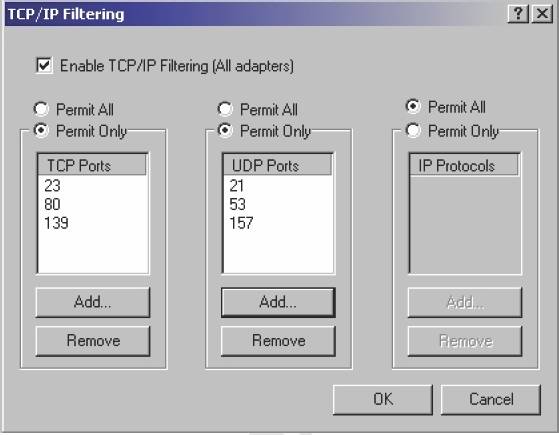
You test your TCP/IP filtering configuration from another client computer. You can access web sites, but you cannot access FTP sites.
What should you do to be able to access FTP sites?
A.Add Port 21 to the TCP Ports section.
B.Add Port 138 to the TCP Ports section.
C.Add Port 21 to the IP Ports section.
D.Add Port 138 to the IP Ports section.
正确答案:A
解析:Explanation: The FTP protocol uses the TCP port 21. In the exhibit the UDP port 21 has been incorrectly added instead of the TCP port.
Incorrect answers:
B: The FTP protocol uses Port 21 not Port 138.
C: The port 21 should be added as a TCP port 21, not as a UDP port or as an IP protocol. IP is also a network protocol and not a port.
D: The FTP protocol uses TCP port 21 not port 138. IP is also a network protocol and not a port. -
第15题:
You are an audit manager at Rockwell & Co, a firm of Chartered Certified Accountants. You are responsible for the audit of the Hopper Group, a listed audit client which supplies ingredients to the food and beverage industry worldwide.
The audit work for the year ended 30 June 2015 is nearly complete, and you are reviewing the draft audit report which has been prepared by the audit senior. During the year the Hopper Group purchased a new subsidiary company, Seurat Sweeteners Co, which has expertise in the research and design of sugar alternatives. The draft financial statements of the Hopper Group for the year ended 30 June 2015 recognise profit before tax of $495 million (2014 – $462 million) and total assets of $4,617 million (2014: $4,751 million). An extract from the draft audit report is shown below:
Basis of modified opinion (extract)
In their calculation of goodwill on the acquisition of the new subsidiary, the directors have failed to recognise consideration which is contingent upon meeting certain development targets. The directors believe that it is unlikely that these targets will be met by the subsidiary company and, therefore, have not recorded the contingent consideration in the cost of the acquisition. They have disclosed this contingent liability fully in the notes to the financial statements. We do not feel that the directors’ treatment of the contingent consideration is correct and, therefore, do not believe that the criteria of the relevant standard have been met. If this is the case, it would be appropriate to adjust the goodwill balance in the statement of financial position.
We believe that any required adjustment may materially affect the goodwill balance in the statement of financial position. Therefore, in our opinion, the financial statements do not give a true and fair view of the financial position of the Hopper Group and of the Hopper Group’s financial performance and cash flows for the year then ended in accordance with International Financial Reporting Standards.
Emphasis of Matter Paragraph
We draw attention to the note to the financial statements which describes the uncertainty relating to the contingent consideration described above. The note provides further information necessary to understand the potential implications of the contingency.
Required:
(a) Critically appraise the draft audit report of the Hopper Group for the year ended 30 June 2015, prepared by the audit senior.
Note: You are NOT required to re-draft the extracts from the audit report. (10 marks)
(b) The audit of the new subsidiary, Seurat Sweeteners Co, was performed by a different firm of auditors, Fish Associates. During your review of the communication from Fish Associates, you note that they were unable to obtain sufficient appropriate evidence with regard to the breakdown of research expenses. The total of research costs expensed by Seurat Sweeteners Co during the year was $1·2 million. Fish Associates has issued a qualified audit opinion on the financial statements of Seurat Sweeteners Co due to this inability to obtain sufficient appropriate evidence.
Required:
Comment on the actions which Rockwell & Co should take as the auditor of the Hopper Group, and the implications for the auditor’s report on the Hopper Group financial statements. (6 marks)
(c) Discuss the quality control procedures which should be carried out by Rockwell & Co prior to the audit report on the Hopper Group being issued. (4 marks)
正确答案:(a) Critical appraisal of the draft audit report
Type of opinion
When an auditor issues an opinion expressing that the financial statements ‘do not give a true and fair view’, this represents an adverse opinion. The paragraph explaining the modification should, therefore, be titled ‘Basis of Adverse Opinion’ rather than simply ‘Basis of Modified Opinion’.
An adverse opinion means that the auditor considers the misstatement to be material and pervasive to the financial statements of the Hopper Group. According to ISA 705 Modifications to Opinions in the Independent Auditor’s Report, pervasive matters are those which affect a substantial proportion of the financial statements or fundamentally affect the users’ understanding of the financial statements. It is unlikely that the failure to recognise contingent consideration is pervasive; the main effect would be to understate goodwill and liabilities. This would not be considered a substantial proportion of the financial statements, neither would it be fundamental to understanding the Hopper Group’s performance and position.
However, there is also some uncertainty as to whether the matter is even material. If the matter is determined to be material but not pervasive, then a qualified opinion would be appropriate on the basis of a material misstatement. If the matter is not material, then no modification would be necessary to the audit opinion.
Wording of opinion/report
The auditor’s reference to ‘the acquisition of the new subsidiary’ is too vague; the Hopper Group may have purchased a number of subsidiaries which this phrase could relate to. It is important that the auditor provides adequate description of the event and in these circumstances it would be appropriate to name the subsidiary referred to.
The auditor has not quantified the amount of the contingent element of the consideration. For the users to understand the potential implications of any necessary adjustments, they need to know how much the contingent consideration will be if it becomes payable. It is a requirement of ISA 705 that the auditor quantifies the financial effects of any misstatements, unless it is impracticable to do so.
In addition to the above point, the auditor should provide more description of the financial effects of the misstatement, including full quantification of the effect of the required adjustment to the assets, liabilities, incomes, revenues and equity of the Hopper Group.
The auditor should identify the note to the financial statements relevant to the contingent liability disclosure rather than just stating ‘in the note’. This will improve the understandability and usefulness of the contents of the audit report.
The use of the term ‘we do not feel that the treatment is correct’ is too vague and not professional. While there may be some interpretation necessary when trying to apply financial reporting standards to unique circumstances, the expression used is ambiguous and may be interpreted as some form. of disclaimer by the auditor with regard to the correct accounting treatment. The auditor should clearly explain how the treatment applied in the financial statements has departed from the requirements of the relevant standard.
Tutorial note: As an illustration to the above point, an appropriate wording would be: ‘Management has not recognised the acquisition-date fair value of contingent consideration as part of the consideration transferred in exchange for the acquiree, which constitutes a departure from International Financial Reporting Standards.’
The ambiguity is compounded by the use of the phrase ‘if this is the case, it would be appropriate to adjust the goodwill’. This once again suggests that the correct treatment is uncertain and perhaps open to interpretation.
If the auditor wishes to refer to a specific accounting standard they should refer to its full title. Therefore instead of referring to ‘the relevant standard’ they should refer to International Financial Reporting Standard 3 Business Combinations.
The opinion paragraph requires an appropriate heading. In this case the auditors have issued an adverse opinion and the paragraph should be headed ‘Adverse Opinion’.
As with the basis paragraph, the opinion paragraph lacks authority; suggesting that the required adjustments ‘may’ materially affect the financial statements implies that there is a degree of uncertainty. This is not the case; the amount of the contingent consideration will be disclosed in the relevant purchase agreement, so the auditor should be able to determine whether the required adjustments are material or not. Regardless, the sentence discussing whether the balance is material or not is not required in the audit report as to warrant inclusion in the report the matter must be considered material. The disclosure of the nature and financial effect of the misstatement in the basis paragraph is sufficient.
Finally, the emphasis of matter paragraph should not be included in the audit report. An emphasis of matter paragraph is only used to draw attention to an uncertainty/matter of fundamental importance which is correctly accounted for and disclosed in the financial statements. An emphasis of matter is not required in this case for the following reasons:
– Emphasis of matter is only required to highlight matters which the auditor believes are fundamental to the users’ understanding of the business. An example may be where a contingent liability exists which is so significant it could lead to the closure of the reporting entity. That is not the case with the Hopper Group; the contingent liability does not appear to be fundamental.
– Emphasis of matter is only used for matters where the auditor has obtained sufficient appropriate evidence that the matter is not materially misstated in the financial statements. If the financial statements are materially misstated, in this regard the matter would be fully disclosed by the auditor in the basis of qualified/adverse opinion paragraph and no emphasis of matter is necessary.
(b) Communication from the component auditor
The qualified opinion due to insufficient evidence may be a significant matter for the Hopper Group audit. While the possible adjustments relating to the current year may not be material to the Hopper Group, the inability to obtain sufficient appropriate evidence with regard to a material matter in Seurat Sweeteners Co’s financial statements may indicate a control deficiency which the auditor was not aware of at the planning stage and it could indicate potential problems with regard to the integrity of management, which could also indicate a potential fraud. It could also indicate an unwillingness of management to provide information, which could create problems for future audits, particularly if research and development costs increase in future years. If the group auditor suspects that any of these possibilities are true, they may need to reconsider their risk assessment and whether the audit procedures performed are still appropriate.
If the detail provided in the communication from the component auditor is insufficient, the group auditor should first discuss the matter with the component auditor to see whether any further information can be provided. The group auditor can request further working papers from the component auditor if this is necessary. However, if Seurat Sweeteners has not been able to provide sufficient appropriate evidence, it is unlikely that this will be effective.
If the discussions with the component auditor do not provide satisfactory responses to evaluate the potential impact on the Hopper Group, the group auditor may need to communicate with either the management of Seurat Sweeteners or the Hopper Group to obtain necessary clarification with regard to the matter.
Following these procedures, the group auditor needs to determine whether they have sufficient appropriate evidence to draw reasonable conclusions on the Hopper Group’s financial statements. If they believe the lack of information presents a risk of material misstatement in the group financial statements, they can request that further audit procedures be performed, either by the component auditor or by themselves.
Ultimately the group engagement partner has to evaluate the effect of the inability to obtain sufficient appropriate evidence on the audit opinion of the Hopper Group. The matter relates to research expenses totalling $1·2 million, which represents 0·2% of the profit for the year and 0·03% of the total assets of the Hopper Group. It is therefore not material to the Hopper Group’s financial statements. For this reason no modification to the audit report of the Hopper Group would be required as this does not represent a lack of sufficient appropriate evidence with regard to a matter which is material to the Group financial statements.
Although this may not have an impact on the Hopper Group audit opinion, this may be something the group auditor wishes to bring to the attention of those charged with governance. This would be particularly likely if the group auditor believed that this could indicate some form. of fraud in Seurat Sweeteners Co, a serious deficiency in financial reporting controls or if this could create problems for accepting future audits due to management’s unwillingness to provide access to accounting records.
(c) Quality control procedures prior to issuing the audit report
ISA 220 Quality Control for an Audit of Financial Statements and ISQC 1 Quality Control for Firms that Perform. Audits and Reviews of Historical Financial Information, and Other Assurance and Related Services Agreements require that an engagement quality control reviewer shall be appointed for audits of financial statements of listed entities. The audit engagement partner then discusses significant matters arising during the audit engagement with the engagement quality control reviewer.
The engagement quality control reviewer and the engagement partner should discuss the failure to recognise the contingent consideration and its impact on the auditor’s report. The engagement quality control reviewer must review the financial statements and the proposed auditor’s report, in particular focusing on the conclusions reached in formulating the auditor’s report and consideration of whether the proposed auditor’s opinion is appropriate. The audit documentation relating to the acquisition of Seurat Sweeteners Co will be carefully reviewed, and the reviewer is likely to consider whether procedures performed in relation to these balances were appropriate.
Given the listed status of the Hopper Group, any modification to the auditor’s report will be scrutinised, and the firm must be sure of any decision to modify the report, and the type of modification made. Once the engagement quality control reviewer has considered the necessity of a modification, they should consider whether a qualified or an adverse opinion is appropriate in the circumstances. This is an important issue, given that it requires judgement as to whether the matters would be material or pervasive to the financial statements.
The engagement quality control reviewer should ensure that there is adequate documentation regarding the judgements used in forming the final audit opinion, and that all necessary matters have been brought to the attention of those charged with governance.
The auditor’s report must not be signed and dated until the completion of the engagement quality control review.
Tutorial note: In the case of the Hopper Group’s audit, the lack of evidence in respect of research costs is unlikely to be discussed unless the audit engagement partner believes that the matter could be significant, for example, if they suspected the lack of evidence is being used to cover up a financial statements fraud.
-
第16题:
While reviewing the MySQL error log, you see occasions where MySQL has exceeded the number of file handles allowed to it by the operating system. Which method will reduce the number of file handles in use?()
- A、Activating the MySQL Enterprise thread pool plugin
- B、Relocating your data and log files to separate storage devices
- C、Disconnecting idle localhost client sessions
- D、Implementing storage engine data compression options
正确答案:C -
第17题:
You have lost all your database control files. To recover them, you are going to use the results of the alter database backup controlfile to trace command. Your datafiles and your online redo logs are all intact. Which of the following is true regarding your recovery?()
- A、 You will need to open the database with the resetlogs command.
- B、 All you need to do is execute the trace file from SQL*Plus and it will perform the recovery for you.
- C、 You will use the resetlogs version of the create controlfile command.
- D、 You will use the noresetlogs version of the create controlfile command.
- E、 You will use the trace file to create a backup control file, and then you will recover the database with the recover database using backup controlfile command
正确答案:D -
第18题:
You are using Recovery Manager (RMAN) to perform backups. In which three situations would you perform a compressed backup?()
- A、You are backing up to tape and your tape device performs its own compression.
- B、You are making image copies, and you have not enabled tablespace compression.
- C、You are using disk-based backups and disk space in your Flash Recovery Area, or other disk-based backup destinations are limited.
- D、You are performing your backups to some device over a network where reduced network bandwidth is more important than CPU usage.
- E、You are using some archival backup media, such as CD or DVD, where reducing backup sizes saves media costs and archival storage.
正确答案:C,D,E -
第19题:
You configure your Windows 2000 Professional portable computer to redirect your My Documents folder to your home folder. You want to ensure that you can access all of your files in you’re my Documents folder when you are not connected to the network. What should you do?()
- A、Use Windows Explorer to enable offline files.
- B、Use Windows Explorer to create shortcut to access offline files folder as desktop.
- C、Use Windows Explorer to configure the properties of your home folder to be available offline.
- D、Use synchronization manager to configure your home folder to be available offline.
- E、Create a shortcut in my network places to access your home folder.
正确答案:A,C -
第20题:
单选题To know where you are going, you are advised to _____.Aask the police for detailed information
Blook at the map before leaving the hotel
Calways travel with your business partner
Dhave a smart phone with you while traveling
正确答案: C解析:
第三段最后一句提到“Look at the map before you leave the hotel so that you know where you’re going and how to get there.”,由此可知,为了清楚知道目的地,可在离开宾馆前查看地图,故B项正确。A、D两项文中并未提及,C项表述过于绝对。 -
第21题:
多选题You work as a database administrator for Certkiller .com. In your development environmentenvironment, the developers are responsible for modifying the table structure according to the application requirements. However, you want to keep track of the ALTER TABLE commands being executed by developers, so you enable auditing to achieve this objective. Which two views would you refer to find out the audit information?()ADBA_AUDIT_TRAIL
BDBA_AUDIT_SESSION
CDBA_FGA_AUDIT_TRAIL
DDBA_COMMON_AUDIT_TRAIL
正确答案: D,B解析: 暂无解析 -
第22题:
问答题Practice 3 ● You are Head of Marketing for an international computer manufacturer. You have to make an urgent trip tonight to visit Sally Jones, a potential and influential client in US. ● Write a memo to your secretary: ● telling her who you are going to see and where and when, ● asking her to book flight tickets and make accommodation for you, ● stating the work you would like her to do in your absence. ● Write 40—50 words.正确答案: 【参考范文】
To: Lucy
From: John Marker
Date: 4 April 2009
Subject: An Urgent Business Trip
Lucy,
I’m leaving to see a potential and influential client, Sally Jones, in US tonight. Would you please book a flight ticket for me and a returned one on 8 April? You’d better make a three nights’ hotel reservation as well. I’d like you to be in charge of the daily affairs in the office in my absence.
Thanks.解析: 暂无解析 -
第23题:
单选题The key word notes are supposed to _____.Amake your presentation simple
Bmake your presentation well organized
Cremind you of the things you are going to talk about
Dhelp you memorize the material faster in preparation
正确答案: D解析:
从第二段倒数第二句话“This method makes it easy for you to recall what you plan to cover.”可知关键字注释可以提醒你要讲的内容,C项为正确答案。