
3 The Stiletto Partnership consisted of three partners, Clint, Ben and Amy, who shared the profits of the businessequally. On 28 February 2007 the partners sold the business to Razor Ltd, in exchange for shares in Razor Ltd, witheach former partner owning
题目
3 The Stiletto Partnership consisted of three partners, Clint, Ben and Amy, who shared the profits of the business
equally. On 28 February 2007 the partners sold the business to Razor Ltd, in exchange for shares in Razor Ltd, with
each former partner owning one third of the new company.
The recent, tax adjusted, trading profits of the Stiletto Partnership have been as follows:
£
Year ended 30 June 2006 92,124
1 July 2006 to 28 February 2007 81,795
Clint, who was 65 on 5 October 2006, retired when the business was sold to Razor Ltd. He is now suggesting that
if the sale of the partnership, and his retirement, had been delayed until 30 April 2007, his total tax liability would
have been reduced. Clint’s only other income is gross pension income of £6,100 per year, which he began receiving
in the tax year 2005/06. Clint did not receive any salary or dividends from Razor Ltd. It is estimated that the
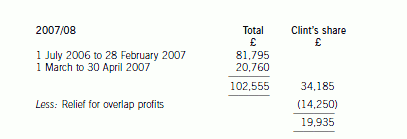
partnership’s tax adjusted trading profits for the period from 1 March 2007 to 30 April 2007 would have been
£20,760. Clint has overlap profits of £14,250 brought forward from when the partnership began trading.
Razor Ltd manufactures industrial cutting tools. On 1 July 2007, Razor Ltd will subscribe for the whole of the ordinary
share capital of Cutlass Inc, a company newly incorporated in the country of Sharpenia. It is intended that Cutlass
Inc will purchase partly finished tools from Razor Ltd and customise them in Sharpenia. It is anticipated that Cutlass
Inc’s annual profits chargeable to corporation tax will be approximately £120,000.
Ben and Amy will be the directors of Cutlass Inc, although Ben will not be involved in the company’s business on a
day-to-day basis. Amy intends to spend one or two weeks each month in the country of Sharpenia looking after the
company’s affairs. The remainder of her time will be spent in the UK. Amy has employment contracts with both Razor
Ltd and Cutlass Inc and her duties for Cutlass Inc will be carried out wholly in Sharpenia. Cutlass Inc will pay for
Amy’s flights to and from Sharpenia and for her husband and baby to visit her there twice a year. Amy is currently
UK resident and ordinarily resident.
The system of income tax and corporation tax in the country of Sharpenia is broadly similar to that in the UK although
the rate of corporation tax is 38% regardless of the level of profits. There is a double tax treaty between the UK and
Sharpenia based on the OECD model treaty. The clause in the treaty dealing with company residency states that a
company resident in both countries under domestic law will be regarded under the treaty as being resident only in the
country where it is effectively managed and controlled. Sharpenia is not a member of the European Union.
Required:
(a) (i) Calculate Clint’s taxable trading profits for the tax years 2006/07 and 2007/08 for both of the
alternative retirement dates (28 February 2007 and 30 April 2007). (3 marks)
相似考题
更多“3 The Stiletto Partnership consisted of three partners, Clint, Ben and Amy, who shared the profits of the businessequally. On 28 February 2007 the partners sold the business to Razor Ltd, in exchange for shares in Razor Ltd, witheach former partner owning”相关问题
-
第1题:
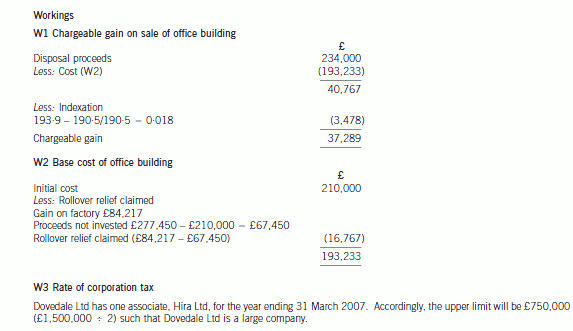
(c) Calculate the expected corporation tax liability of Dovedale Ltd for the year ending 31 March 2007 on the
assumption that all available reliefs are claimed by Dovedale Ltd but that Hira Ltd will not claim any capital
allowances in that year. (4 marks)
正确答案:
-
第2题:
(ii) The UK value added tax (VAT) implications for Razor Ltd of selling tools to and purchasing tools from
Cutlass Inc; (2 marks)
正确答案:
(ii) Value added tax (VAT)
Goods exported are zero-rated. Razor Ltd must retain appropriate documentary evidence that the export has taken place.
Razor Ltd must account for VAT on the value of the goods purchased from Cutlass Inc at the time the goods are brought
into the UK. The VAT payable should be included as deductible input tax on the company’s VAT return. -
第3题:
3 Palm plc recently acquired 100% of the ordinary share capital of Nikau Ltd from Facet Ltd. Palm plc intends to use
Nikau Ltd to develop a new product range, under the name ‘Project Sabal’. Nikau Ltd owns shares in a non-UK
resident company, Date Inc.
The following information has been extracted from client files and from a meeting with the Finance Director of Palm
plc.
Palm plc:
– Has more than 40 wholly owned subsidiaries such that all group companies pay corporation tax at 30%.
– All group companies prepare accounts to 31 March.
– Acquired Nikau Ltd on 1 November 2007 from Facet Ltd, an unrelated company.
Nikau Ltd:
– UK resident company that manufactures domestic electronic appliances for sale in the European Union (EU).
– Large enterprise for the purposes of the enhanced relief available for research and development expenditure.
– Trading losses brought forward as at 1 April 2007 of £195,700.
– Budgeted taxable trading profit of £360,000 for the year ending 31 March 2008 before taking account of ‘Project
Sabal’.
– Dividend income of £38,200 will be received in the year ending 31 March 2008 in respect of the shares in Date
Inc.
‘Project Sabal’:
– Development of a range of electronic appliances, for sale in North America.
– Project Sabal will represent a significant advance in the technology of domestic appliances.
– Nikau Ltd will spend £70,000 on staffing costs and consumables researching and developing the necessary
technology between now and 31 March 2008. Further costs will be incurred in the following year.
– Sales to North America will commence in 2009 and are expected to generate significant profits from that year.
Shares in Date Inc:
– Nikau Ltd owns 35% of the ordinary share capital of Date Inc.
– The shares were purchased from Facet Ltd on 1 June 2003 for their market value of £338,000.
– The sale was a no gain, no loss transfer for the purposes of corporation tax.
– Facet Ltd purchased the shares in Date Inc on 1 March 1994 for £137,000.
Date Inc:
– A controlled foreign company resident in the country of Palladia.
– Annual chargeable profits arising out of property investment activities are approximately £120,000, of which
approximately £115,000 is distributed to its shareholders each year.
The tax system in Palladia:
– No taxes on income or capital profits.
– 4% withholding tax on dividends paid to shareholders resident outside Palladia.
Required:
(a) Prepare detailed explanatory notes, including relevant supporting calculations, on the effect of the following
issues on the amount of corporation tax payable by Nikau Ltd for the year ending 31 March 2008.
(i) The costs of developing ‘Project Sabal’ and the significant commercial changes to the company’s
activities arising out of its implementation. (8 marks)
正确答案:
(a) Nikau Ltd – Effect on corporation tax payable for the year ending 31 March 2008
(i) Project Sabal
Research and development expenditure
The expenditure incurred in respect of research and development will give rise to an enhanced deduction for the
purposes of computing the taxable trading profits of Nikau Ltd. The enhanced deduction is 125% of the qualifying
expenditure as Nikau Ltd is a large enterprise for this purpose.
The expenditure will reduce the profits chargeable to corporation tax of Nikau Ltd by £87,500 (£70,000 x 1·25) and
its corporation tax liability by £26,250 (£87,500 x 30%).
The budgeted expenditure will qualify for the enhanced deduction because it appears to satisfy the following conditions.
– It is likely to qualify as research and development expenditure within generally accepted accounting principles as
it will result in new technical knowledge and the production of a substantially improved device for use in the
industry.
– It exceeds £10,000 in Nikau Ltd’s accounting period.
– It relates to staff costs, consumable items or other qualifying expenditure as opposed to capital items.
– It will result in further trading activities for Nikau Ltd.
Use of brought forward trading losses
The development of products for the North American market is likely to represent a major change in the nature and
conduct of the trade of Nikau Ltd. This is because the company is developing new products and intends to sell them in
a new market. It is a major change as sales to North America are expected to generate significant additional profits.
Because this change will occur within three years of the change in the ownership of Nikau Ltd on 1 November 2007,
any trading losses arising prior to that date cannot be carried forward beyond that date.
Accordingly, the trading losses brought forward may only be offset against £158,958 ((£360,000 – £87,500) x 7/12)
of the company’s trading profits for the year. The remainder of the trading losses £36,742 (£195,700 – £158,958) will
be lost resulting in lost tax relief of £11,023 (£36,742 x 30%).
Tutorial note
The profits for the year ending 31 March 2008 will be apportioned to the periods pre and post 1 November 2007 on
either a time basis or some other basis that is just and reasonable. -
第4题:
3 Spica, one of the director shareholders of Acrux Ltd, has been in dispute with the other shareholders over plans to
expand the company’s activities overseas. In order to resolve the position it has been agreed that Spica will sell her
shares back to the company. Once the purchase of her shares has taken place, the company intends to establish a
number of branches overseas and acquire a shareholding in a number of companies that are resident and trade in
overseas countries.
The following information has been obtained from client files and meetings with the parties involved.
Acrux Ltd:
– An unquoted UK resident company.
– Share capital consists of 50,000 ordinary shares issued at £1·90 per share in July 2000.
– None of the other shareholders has any connection with Spica.
The purchase of own shares:
– The company will purchase all of Spica’s shares for £8 per share.
– The transaction will take place by the end of 2008.
Spica:
– Purchased 8,000 shares in Acrux Ltd for £2 per share on 30 September 2003.
– Has no income in the tax year 2008/09.
– Has chargeable capital gains in the tax year 2008/09 of £3,800.
– Has houses in the UK and the country of Solaris and divides her time between them.
Investment in non-UK resident companies:
– Acrux Ltd will acquire between 15% and 20% of each of the non-UK resident companies.
– The companies will not be controlled foreign companies as the rates of tax in the overseas countries will be
between 23% and 42%.
– There may or may not be a double tax treaty between the UK and the overseas countries in which the companies
are resident. Where there is a treaty, it will be based on the OECD model treaty.
– None of the countries concerned levy withholding tax on dividends paid to UK companies.
– The directors of Acrux Ltd are concerned that the rate of tax suffered on the profits of the overseas companies
will be very high as they will be taxed in both the overseas country and in the UK.
Required:
(a) (i) Prepare detailed calculations to determine the most beneficial tax treatment of the payment Spica will
receive for her shares; (7 marks)
正确答案:
-
第5题:
ORGANIZING A BUSINESS IN DIFFERENT WAYS Businesses are structured in different ways to meet different needs. The simplest form. of business is called an individual or sole proprietorship. The proprietor owns all of the property of the business and is responsible for everything. Another kind of business is a partnership. Two or more people go into business together. An agreement is usually needed to decide how much of the partnership each person controls. One kind of partnership is called a limited liability partnership. These have full partners and limited partners. Limited partners may not share as much in the profits, but they also have less responsibility for the business. Doctors, lawyers and accountants often form. partnerships to share their risks and profits. A husband and wife can form. a business partnership together. Partnerships exist only for as long as the owners remain alive. The same is true of individual proprietorships. But corporations are designed to have an unlimited lifetime. A corporation is the most complex kind of business organization. Corporations can sell stock as a way to raise money. Stocks represent shares of ownership in a company. Investors who buy stock can trade their shares or keep them as long as the company is in business. A corporation is recognized as an entity-its own legal being, separate from its owners. A board of directors controls corporate policies. The directors appoint top company officers. The directors might or might not hold shares in the corporation. Corporations can have a few major shareholders, or ownership can be spread among the general public. But not all corporations are traditional businesses that sell stock. Some non-profit groups are also organized as corporations.
1. This passage is mainly about ().
A. why different forms of business run
B. when different forms of business raise money
C. how different forms of business are organized
2. What is usually needed to decide the portion of the partnership each person controls?()
A. A rule.
B. An agreement.
C. A regulation.
3. Who are not included in limited liability partnerships?()
A. Full partners.
B. Limited partners.
C. Unlimited partners.
4. How can corporations raise money?()
A. By selling stock.
B. By buying stock.
C. By holding corporation shares.
5. Who controls corporate policies in a corporation?()
A. Chairman of the board.
B. A board of directors.
C. The owner of the corporation.
参考答案:1:C; 2:B;3:C; 4:A;5:B
-
第6题:
Which Cisco support service product is sold, supported, and delivered by partners?()A. Cisco Smart Foundation Service
B. SMARTnet Partner Service
C. Cisco Smart Care Service
D. Cisco Technical Assistance Center
E. CiscoSMARTnet for SBCS
参考答案:C
-
第7题:
 A.It is criticized for doing business in a primitive way
B.It aims to deal with hyperinflation in some countries
C.It helps get rid ofmiddlemen in trade and exchange
D.It is intended to evaluate the performance of trading partners答案:C解析: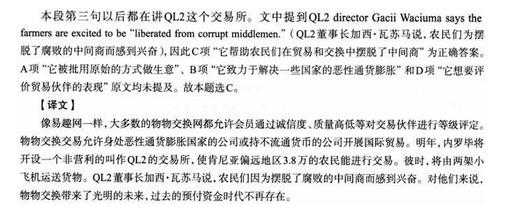
-
第8题:
What is the SMB Partner Practice Builder?()
- A、 technical support that requires an annual subscription
- B、 management consultancy service offered to develop partner business process
- C、 support for partners building a new business
- D、 program to develop Unified Communications practice
正确答案:C -
第9题:
How do smart business architecture selling tools help partners increase sales?()
- A、free partners from design tasks, which increases profitability
- B、focus on the prepare phase of thecisco lifecycle services model, which maximizes revenue
- C、enable partners to increase professional services revenue by providing A complete, integrated solution for midsize firms and SMBs
- D、highlight additional point products that the customer may want
正确答案:C -
第10题:
()表示“牙刷”的意思。
- A、Comb
- B、Toothbrush
- C、Toothpaste
- D、Razor
正确答案:B -
第11题:
单选题The ice-skating partners, who were never finishing higher than seventh place, surprised their coaches by finally winning a competition.AThe ice-skating partners, who were never finishing higher than seventh place,
BThe ice-skating partners, who had never finished higher than seventh place,
CHaving never finished higher than seventh place as ice-skating partners,
DThe ice-skating partners never finished higher than seventh place,
ENever finishing higher than seventh place, the skating partners has
正确答案: C解析:
原句中的动词短语“were never finishing”的使用形式不正确,应该用“who had never finishe”代替。D中的划线部分已经是个句子,因此不正确。E中的动词省去has,那么正确。 -
第12题:
单选题Which Cisco support service product is sold, supported, and delivered by partners?()ACisco Smart Foundation Service
BSMARTnet Partner Service
CCisco Smart Care Service
DCisco Technical Assistance Center
ECiscoSMARTnet for SBCS
正确答案: D解析: 暂无解析 -
第13题:
(ii) Analyse the effect of delaying the sale of the business of the Stiletto Partnership to Razor Ltd until
30 April 2007 on Clint’s income tax and national insurance position.
You are not required to prepare detailed calculations of his income tax or national insurance liabilities.
(4 marks)
正确答案:(ii) The implications of delaying the sale of the business
The implications of delaying the sale of the business until 30 April would have been as follows:
– Clint would have received an additional two months of profits amounting to £6,920 (£20,760 x 1/3).
– Clint’s trading income in 2006/07 would have been reduced by £13,015 (£43,723 – £30,708), much of which
would have been subject to income tax at 40%. His additional trading income in 2007/08 of £19,935 would all
have been taxed at 10% and 22%.
– Clint is entitled to the personal age allowance of £7,280 in both years. However, it is abated by £1 for every £2
by which his total income exceeds £20,100. Once Clint’s total income exceeds £24,590 (£20,100 + ((£7,280
– £5,035) x 2)), his personal allowance will be reduced to the standard amount of £5,035. Accordingly, the
increased personal allowance would not be available in 2006/07 regardless of the year in which the business was
sold. It is available in 2007/08 (although part of it is wasted) but would not have been if the sale of the business
had been delayed.
– Clint’s class 4 national insurance contributions in 2006/07 would have been reduced due to the fall in the level
of his trading income. However, much of the saving would be at 1% only. Clint is not liable to class 4 national
insurance contributions in 2007/08 as he is 65 at the start of the year.
– Changing the date on which the business was sold would have had no effect on Clint’s class 2 liability as he is
not required to make class 2 contributions once he is 65 years old.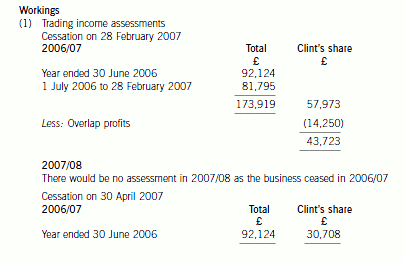
-
第14题:
5 (a) Carver Ltd was incorporated and began trading in August 2002. It is a close company with no associated
companies. It has always prepared accounts to 31 December and will continue to do so in the future.
It has been decided that Carver Ltd will sell its business as a going concern to Blade Ltd, an unconnected
company, on 31 July 2007. Its premises and goodwill will be sold for £2,135,000 and £290,000 respectively
and its machinery and equipment for £187,000. The premises, which do not constitute an industrial building,
were acquired on 1 August 2002 for £1,808,000 and the goodwill has been generated internally by the
company. The machinery and equipment cost £294,000; no one item will be sold for more than its original cost.
The tax adjusted trading profit of Carver Ltd in 2007, before taking account of both capital allowances and the
sale of the business assets, is expected to be £81,000. The balance on the plant and machinery pool for the
purposes of capital allowances as at 31 December 2006 was £231,500. Machinery costing £38,000 was
purchased on 1 March 2007. Carver Ltd is classified as a small company for the purposes of capital allowances.
On 1 August 2007, the proceeds from the sale of the business will be invested in either an office building or a
portfolio of UK quoted company shares, as follows:
Office building
The office building would be acquired for £3,100,000; the vendor is not registered for value added tax (VAT).
Carver Ltd would borrow the additional funds required from a UK bank. The building is let to a number of
commercial tenants who are not connected with Carver Ltd and will pay rent, in total, of £54,000 per calendar
quarter, in advance, commencing on 1 August 2007. The company’s expenditure for the period from 1 August
2007 to 31 December 2007 is expected to be:
£
Loan interest payable to UK bank 16,000
Building maintenance costs 7,500
Share portfolio
Shares would be purchased for the amount of the proceeds from the sale of the business with no need for further
loan finance. It is estimated that the share portfolio would generate dividends of £36,000 and capital gains, after
indexation allowance, of £10,000 in the period from 1 August 2007 to 31 December 2007.
All figures are stated exclusive of value added tax (VAT).
Required:
(i) Taking account of the proposed sale of the business on 31 July 2007, state with reasons the date(s) on
which Carver Ltd must submit its corporation tax return(s) for the year ending 31 December 2007.
(2 marks)
正确答案:
(a) (i) Due date for submission of corporation tax return
Carver Ltd intends to cease trading on 31 July 2007. This will bring to an end the accounting period that began on
1 January 2007. A new accounting period will commence on 1 August 2007 and end on the company’s accounting
reference date on 31 December 2007.
Carver Ltd is required to submit its corporation tax return by the later of:
– one year after the end of its accounting period; and
– one year after the end of the period of account in which the last day of the accounting period falls.
Accordingly, the company must submit its corporation tax returns for both accounting periods by 31 December 2008. -
第15题:
4 Coral is the owner and managing director of Reef Ltd. She is considering the manner in which she will make her first
pension contributions. In November 2007 she inherited her mother’s house in the country of Kalania.
The following information has been extracted from client files and from telephone conversations with Coral.
Coral:
– 1972 – Born in the country of Kalania. Her father, who died in 2002, was domiciled in Kalania.
– 1999 – Moved to the UK and has lived and worked here since then.
– 2001 – Subscribed for 100% of the ordinary share capital of Reef Ltd.
– Intends to sell Reef Ltd and return to live in the country of Kalania in 2012.
– No income apart from that received from Reef Ltd.
Reef Ltd:
– A UK resident company with annual profits chargeable to corporation tax of approximately £70,000.
– Four employees including Coral.
– Provides scuba diving lessons to members of the public.
Payments from Reef Ltd to Coral in 2007/08:
– Director’s fees of £460 per month.
– Dividends paid of £14,250 in June 2007 and £14,250 in September 2007.
Pension contributions:
– Coral has not so far made any pension contributions in the tax year 2007/08 but wishes to make gross pension
contributions of £9,000.
– The contributions are to be made by Reef Ltd or Coral or a combination of the two in such a way as to minimise
the total after tax cost.
– Any contributions made by Coral will be funded by an additional dividend from Reef Ltd.
House in the country of Kalania:
– Beachfront property with potential rental income of £550 per month after deduction of allowable expenditure.
– Coral will use it for holidays for two months each year.
The tax system in the country of Kalania:
– No capital gains tax or inheritance tax.
– Income tax at 8% on income arising in the country of Kalania.
– No double tax treaty with the UK.
Required:
(a) With the objective of minimising the total after tax cost, advise Coral as to whether the gross pension
contributions of £9,000 should be made:
– wholly by Reef Ltd; or
– by Coral to the extent that they are tax allowable with the balance made by Reef Ltd.
Your answer should include supporting calculations where necessary. (9 marks)
正确答案:
-
第16题:
5 Gagarin wishes to persuade a number of wealthy individuals who are business contacts to invest in his company,
Vostok Ltd. He also requires advice on the recoverability of input tax relating to the purchase of new premises.
The following information has been obtained from a meeting with Gagarin.
Vostok Ltd:
– An unquoted UK resident company.
– Gagarin owns 100% of the company’s ordinary share capital.
– Has 18 employees.
– Provides computer based services to commercial companies.
– Requires additional funds to finance its expansion.
Funds required by Vostok Ltd:
– Vostok Ltd needs to raise £420,000.
– Vostok Ltd will issue 20,000 shares at £21 per share on 31 August 2008.
– The new shareholder(s) will own 40% of the company.
– Part of the money raised will contribute towards the purchase of new premises for use by Vostok Ltd.
Gagarin’s initial thoughts:
– The minimum investment will be 5,000 shares and payment will be made in full on subscription.
– Gagarin has a number of wealthy business contacts who may be interested in investing.
– Gagarin has heard that it may be possible to obtain tax relief for up to 60% of the investment via the enterprise
investment scheme.
Wealthy business contacts:
– Are all UK resident higher rate taxpayers.
– May wish to borrow the funds to invest in Vostok Ltd if there is a tax incentive to do so.
New premises:
– Will cost £446,500 including value added tax (VAT).
– Will be used in connection with all aspects of Vostok Ltd’s business.
– Will be sold for £600,000 plus VAT in six years time.
– Vostok Ltd will waive the VAT exemption on the sale of the building.
The VAT position of Vostok Ltd:
– In the year ending 31 March 2009, 28% of Vostok Ltd’s supplies will be exempt for the purposes of VAT.
– This percentage is expected to reduce over the next few years.
– Irrecoverable input tax due to the company’s partially exempt status exceeds the de minimis limits.
Required:
(a) Prepare notes for Gagarin to use when speaking to potential investors. The notes should include:
(i) The tax incentives immediately available in respect of the amount invested in shares issued in
accordance with the enterprise investment scheme; (5 marks)
正确答案:
(a) (i) The tax incentives immediately available
Income tax
– The investor’s income tax liability for 2008/09 will be reduced by 20% of the amount subscribed for the shares.
– Up to half of the amount invested can be treated as if paid in 2007/08 rather than 2008/09. This is subject to a
maximum carryback of £50,000.
This ability to carryback relief to the previous year is useful where the investor’s income in 2008/09 is insufficient
to absorb all of the relief available.
Tutorial note
There would be no change to the income tax liability of 2007/08 where an amount is treated as if paid in that year.
This ensures that such a claim does not affect payments on account under the self assessment system. Instead, the
tax refund due is calculated by reference to 2007/08 but is deducted from the next payment of tax due from the
taxpayer or is repaid to the taxpayer.
Capital gains tax deferral
– For every £1 invested in Vostok Ltd, an investor can defer £1 of capital gain and thus, potentially, 40 pence of
capital gains tax.
– The gain deferred can be in respect of the disposal of any asset.
– The shares must be subscribed for within the four year period starting one year prior to the date on which the
disposal giving rise to the gain took place. -
第17题:
Finally, they return the()to the people who bought shares in the company.
A、 cost
B、 price
C、 profits
参考答案:C
-
第18题:
How do smart business architecture selling tools help partners increase sales?()A.free partners from design tasks, which increases profitability
B.focus on the prepare phase of thecisco lifecycle services model, which maximizes revenue
C.enable partners to increase professional services revenue by providing A complete, integrated solution for midsize firms and SMBs
D.highlight additional point products that the customer may want
参考答案:C
-
第19题:
 A.It is criticized for doing business in a primitive way.
B.It aims to deal with hyperinflation in some countries.
C.It helps get rid ofmiddlemen in trade and exchange.
D.It is intended to evaluate the performance of trading partners.答案:C解析: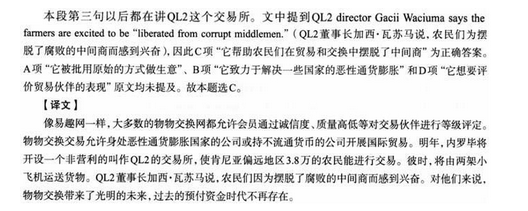
-
第20题:
Which Cisco support service product is sold, supported, and delivered by partners?()
- A、Cisco Smart Foundation Service
- B、SMARTnet Partner Service
- C、Cisco Smart Care Service
- D、Cisco Technical Assistance Center
- E、CiscoSMARTnet for SBCS
正确答案:C -
第21题:
What is the minimum level of account access that partners need to download Cisco Configuration Assistant from Cisco.com?()
- A、 Guest
- B、 Privileged
- C、 Cisco CCIE
- D、 Select
- E、 Partner
正确答案:D -
第22题:
单选题What is the SMB Partner Practice Builder?()Atechnical support that requires an annual subscription
Bmanagement consultancy service offered to develop partner business process
Csupport for partners building a new business
Dprogram to develop Unified Communications practice
正确答案: C解析: 暂无解析 -
第23题:
多选题XYZ LTD is concerned about the security in the perimeter of the network. Which three Cisco products can you offer to XYZ LTD?()AIntegrated Services Routers
BFirewall Appliances
CCisco Unified CallManager
DMultilayer switch with enhanced image
ECisco Unity
FVPN Concentrators
正确答案: F,B解析: 暂无解析