
(b) Coaching. (3 marks)
题目
(b) Coaching. (3 marks)
相似考题
更多“(b) Coaching. (3 marks)”相关问题
-
第1题:
(ii) authority; (3 marks)
正确答案:
(ii) AUTHORITY is the scope and amount of discretion given to a person to make decisions by virtue of the position held within the organisation. The authority and power structure of an organisation defines the part each member of the organisation is expected to perform. and the relationship between the organisation’s members so that its efforts are effective. The source of authority may be top down (as in formal organisations) or bottom up (as in social organizations and politics). In the scenario, authority is from the top and should be delegated downwards.
-
第2题:
(d) Job rotation. (3 marks)
正确答案:
(d) Job rotation is an important training method and is often also seen as a means of motivation. It involves moving the trainee from one job to another and is therefore more suitable for lower level employees. The trainee is required to do different jobs in logical succession, thus broadening experience and gaining a picture of the organisation’s wider activities.
-
第3题:
(ii) Analyse why moving to a ‘no frills’ low-cost strategy would be inappropriate for ONA.
Note: requirement (b) (ii) includes 3 professional marks (16 marks)
正确答案:
(ii) ‘No frills’ low-cost budget airlines are usually associated with the following characteristics. Each of these characteristics
is considered in the context of Oceania National Airlines (ONA).
– Operational economies of scale
Increased flight frequency brings operational economies and is attractive to both business and leisure travellers. In
the international sector where ONA is currently experiencing competition from established ‘no frills’ low-cost budget
airlines ONA has, on average, one flight per day to each city. It would have to greatly extend its flight network, flight
frequency and the size of its aircraft fleet if it planned to become a ‘no frills’ carrier in this sector. This fleet
expansion appears counter to the culture of an organisation that has expanded very gradually since its formation.
Table 1 shows only three aircraft added to the fleet in the period 2004–2006. It is likely that the fleet size would
have to double for ONA to become a serious ‘no frills’ operator in the international sector. In the regional sector, the
flight density, an average of three flights per day, is more characteristic of a ‘no frills’ airline. However, ONA would
have to address the relatively low utilisation of its aircraft (see Tables 1 and 2) and the cost of maintenance
associated with a relatively old fleet of aircraft.
– Reduced costs through direct sales
On-line booking is primarily aimed at eliminating commission sales (usually made through travel agents). ‘No frills’
low-cost budget airlines typically achieve over 80% of their sales on-line. The comparative figure for ONA (see
Table 2) is 40% for regional sales and 60% for international sales, compared with an average of 84% for their
competitors. Clearly a major change in selling channels would have to take place for ONA to become a ‘no frills’
low-cost budget airline. It is difficult to know whether this is possible. The low percentage of regional on-line sales
seems to suggest that the citizens of Oceania may be more comfortable buying through third parties such as travel
agents.
– Reduced customer service
‘No frills’ low-cost budget airlines usually do not offer customer services such as free meals, free drinks and the
allocation of passengers to specific seats. ONA prides itself on its in-flight customer service and this was one of the
major factors that led to its accolade as Regional Airline of the Year. To move to a ‘no frills’ strategy, ONA would
have to abandon a long held tradition of excellent customer service. This would require a major cultural change
within the organisation. It would also probably lead to disbanding the award winning (Golden Bowl) catering
department and the redundancies of catering staff could prove difficult to implement in a heavily unionised
organisation.
Johnson, Scholes and Whittington have suggested that if an organisation is to ‘achieve competitive advantage through
a low price strategy then it has two basic choices. The first is to try and identify a market segment which is unattractive
(or inaccessible) to competitors and in this way avoid competitive pressures to erode price.’ It is not possible for ONA to
pursue this policy in the international sector because of significant competition from established continental ‘no frills’
low-cost budget airlines. It may be a candidate strategy for the regional sector, but the emergence of small ‘no frills’ lowcost
budget airlines in these countries threaten this. Many of these airlines enter the market with very low overheads
and use the ‘no frills’ approach as a strategy to gain market share before progressing to alternative strategies.
Secondly, a ‘no frills’ strategy depends for its success on margin. Johnson, Scholes and Whittington suggest that ‘in the
long run, a low price strategy cannot be pursued without a low-cost base’. Evidence from the scenario suggests that ONA
does not have a low cost base. It continues to maintain overheads (such as a catering department) that its competitors
have either disbanded or outsourced. More fundamentally (from Table 2), its flight crew enjoy above average wages and
the whole company is heavily unionised. The scenario acknowledges that the company pays above industry salaries and
offers excellent benefits such as a generous non-contributory pension. Aircraft utilisation and aircraft age also suggest a
relatively high cost base. The aircraft are older than their competitors and presumably incur greater maintenance costs.
ONA’s utilisation of its aircraft is also lower than its competitors. It seems highly unlikely that ONA can achieve the
changes required in culture, cost base and operations required for it to become a ‘no frills’ low-cost budget airline. Other
factors serve to reinforce this. For example:
– Many ‘no frills’ low-cost budget airlines fly into airports that offer cheaper taking off and landing fees. Many of these
airports are relatively remote from the cities they serve. This may be acceptable to leisure travellers, but not to
business travellers – ONA’s primary market in the regional sector.
– Most ‘no frills’ low-cost budget airlines have a standardised fleet leading to commonality and familiarity in
maintenance. Although ONA has a relatively small fleet it is split between three aircraft types. This is due to
historical reasons. The Boeing 737s and Airbus A320s appear to be very similar aircraft. However, the Boeings
were inherited from OceaniaAir and the Airbuses from Transport Oceania.
In conclusion, the CEO’s decision to reject a ‘no frills’ strategy for ONA appears to be justifiable. It would require major
changes in structure, cost and culture that would be difficult to justify given ONA’s current position. Revolution is the
term used by Baligan and Hope to describe a major rapid strategic change. It is associated with a sudden transformation
required to react to extreme pressures on the organisation. Such an approach is often required when the company is
facing a crisis and needs to quickly change direction. There is no evidence to support the need for a radical
transformation. This is why the CEO brands the change to a ‘no frills’ low-cost budget airline as ‘unnecessary’. The
financial situation (Table 3) is still relatively healthy and there is no evidence of corporate predators. It can be argued
that a more incremental approach to change would be beneficial, building on the strengths of the organisation and the
competencies of its employees. Moving ONA to a ‘no frills’ model would require seismic changes in cost and culture. If
ONA really wanted to move into this sector then they would be better advised to start afresh with a separate brand andairline and to concentrate on the regional sector where it has a head start over many of its competitors. -
第4题:
(b) (i) Discusses the principles involved in accounting for claims made under the above warranty provision.
(6 marks)
(ii) Shows the accounting treatment for the above warranty provision under IAS37 ‘Provisions, Contingent
Liabilities and Contingent Assets’ for the year ended 31 October 2007. (3 marks)
Appropriateness of the format and presentation of the report and communication of advice. (2 marks)
正确答案:(b) Provisions – IAS37
An entity must recognise a provision under IAS37 if, and only if:
(a) a present obligation (legal or constructive) has arisen as a result of a past event (the obligating event)
(b) it is probable (‘more likely than not’), that an outflow of resources embodying economic benefits will be required to settle
the obligation
(c) the amount can be estimated reliably
An obligating event is an event that creates a legal or constructive obligation and, therefore, results in an enterprise having
no realistic alternative but to settle the obligation. A constructive obligation arises if past practice creates a valid expectation
on the part of a third party. If it is more likely than not that no present obligation exists, the enterprise should disclose a
contingent liability, unless the possibility of an outflow of resources is remote.
The amount recognised as a provision should be the best estimate of the expenditure required to settle the present obligation
at the balance sheet date, that is, the amount that an enterprise would rationally pay to settle the obligation at the balance
sheet date or to transfer it to a third party. This means provisions for large populations of events such as warranties, are
measured at a probability weighted expected value. In reaching its best estimate, the entity should take into account the risks
and uncertainties that surround the underlying events.
Expected cash outflows should be discounted to their present values, where the effect of the time value of money is material
using a risk adjusted rate (it should not reflect risks for which future cash flows have been adjusted). If some or all of the
expenditure required to settle a provision is expected to be reimbursed by another party, the reimbursement should be
recognised as a separate asset when, and only when, it is virtually certain that reimbursement will be received if the entity
settles the obligation. The amount recognised should not exceed the amount of the provision. In measuring a provision future
events should be considered. The provision for the warranty claim will be determined by using the expected value method.
The past event which causes the obligation is the initial sale of the product with the warranty given at that time. It would be
appropriate for the company to make a provision for the Year 1 warranty of $280,000 and Year 2 warranty of $350,000,
which represents the best estimate of the obligation (see Appendix 2). Only if the insurance company have validated the
counter claim will Macaljoy be able to recognise the asset and income. Recovery has to be virtually certain. If it is virtually
certain, then Macaljoy may be able to recognise the asset. Generally contingent assets are never recognised, but disclosed
where an inflow of economic benefits is probable.
The company could discount the provision if it was considered that the time value of money was material. The majority of
provisions will reverse in the short term (within two years) and, therefore, the effects of discounting are likely to be immaterial.
In this case, using the risk adjusted rate (IAS37), the provision would be reduced to $269,000 in Year 1 and $323,000 in
Year 2. The company will have to determine whether this is material.
Appendix 1
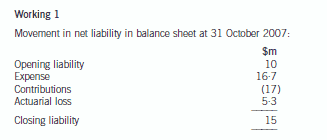
The accounting for the defined benefit plan is as follows:

-
第5题:
(b) Briefly explain THREE limitations of negotiated transfer prices. (3 marks)
正确答案:
(b) Negotiated transfer prices suffer from the following limitations:
– The transfer price which is the final outcome of negotiations may not be close to the transfer price that would be optimal
for the organisation as a whole since it can be dependent on the negotiating skills and bargaining powers of individual
managers.
– They can lead to conflict between divisions which may necessitate the intervention of top management to mediate.
– The measure of divisional profitability can be dependent on the negotiating skills of managers who may have unequal
bargaining power.
– They can be time-consuming for the managers involved, particularly where large numbers of transactions are involved. -
第6题:
(iii) Whether or not you agree with the statement of the marketing director in note (9) above. (5 marks)
Professional marks for appropriateness of format, style. and structure of the report. (4 marks)
正确答案:(iii) The marketing director is certainly correct in recognising that success is dependent on levels of service quality provided
by HFG to its clients. However, whilst the number of complaints is an important performance measure, it needs to be
used with caution. The nature of a complaint is, very often, far more indicative of the absence, or a lack, of service
quality. For example, the fact that 50 clients complained about having to wait for a longer time than they expected to
access gymnasium equipment is insignificant when compared to an accident arising from failure to maintain properly a
piece of gymnasium equipment. Moreover, the marketing director ought to be aware that the absolute number of
complaints may be misleading as much depends on the number of clients serviced during any given period. Thus, in
comparing the number of complaints received by the three centres then a relative measure of complaints received per
1,000 client days would be far more useful than the absolute number of complaints received.
The marketing director should also be advised that the number of complaints can give a misleading picture of the quality
of service provision since individuals have different levels of willingness to complain in similar situations.
The marketing director seems to accept the current level of complaints but is unwilling to accept any increase above this
level. This is not indicative of a quality-oriented organisation which would seek to reduce the number of complaints over
time via a programme of ‘continuous improvement’.
From the foregoing comments one can conclude that it would be myopic to focus on the number of client complaints
as being the only performance measure necessary to measure the quality of service provision. Other performance
measures which may indicate the level of service quality provided to clients by HFG are as follows:
– Staff responsiveness assumes critical significance in service industries. Hence the time taken to resolve client
queries by health centre staff is an important indicator of the level of service quality provided to clients.
– Staff appearance may be viewed as reflecting the image of the centres.
– The comfort of bedrooms and public rooms including facilities such as air-conditioning, tea/coffee-making and cold
drinks facilities, and office facilities such as e-mail, facsimile and photocopying.
– The availability of services such as the time taken to gain an appointment with a dietician or fitness consultant.
– The cleanliness of all areas within the centres will enhance the reputation of HFG. Conversely, unclean areas will
potentially deter clients from making repeat visits and/or recommendations to friends, colleagues etc.
– The presence of safety measures and the frequency of inspections made regarding gymnasium equipment within
the centres and compliance with legislation are of paramount importance in businesses like that of HFG.
– The achievement of target reductions in weight that have been agreed between centre consultants and clients.
(Other relevant measures would be acceptable.)
-
第7题:
6 (a) Explain the term ‘money laundering’. (3 marks)
正确答案:
6 MONEY LAUNDERING
Tutorial note: The answer which follows is indicative of the range of points which might be made. Other relevant material will
be given suitable credit.
(a) Meaning of the term
■ Money laundering is the process by which criminals attempt to conceal the true origin and ownership of the proceeds
of their criminal activity (‘dirty’ money) allowing them to maintain control over the proceeds and, ultimately, providing a
legitimate cover for their sources of income.
■ The term is widely defined to include:
– possessing; or
– in any way dealing with; or
– concealing
the proceeds of any crime (‘criminal property’).
■ It also includes:
– an attempt or conspiracy or incitement to commit such an offence; or
– aiding, abetting, counselling or procuring the commission of such an offence.
■ Further, it includes failure by an individual in a regulated sector to inform. the financial intelligence unit (FIU), as soon
as practicable, of knowledge or suspicion that another person is engaged in money laundering.
Tutorial note: The FIU serves as a national centre for receiving (and, as permitted, requesting), analysing and
disseminating suspicious transaction reports (STRs). -
第8题:
In relation to company law, explain:
(a) the limitations on the use of company names; (4 marks)
(b) the tort of ‘passing off’; (4 marks)
(c) the role of the company names adjudicators under the Companies Act 2006. (2 marks)
正确答案:(a) Except in relation to specifically exempted companies, such as those involved in charitable work, companies are required to indicate that they are operating on the basis of limited liability. Thus private companies are required to end their names, either with the word ‘limited’ or the abbreviation ‘ltd’, and public companies must end their names with the words ‘public limited company’ or the abbreviation ‘plc’. Welsh companies may use the Welsh language equivalents (Companies Act (CA)2006 ss.58, 59 & 60).
Companies Registry maintains a register of business names, and will refuse to register any company with a name that is the same as one already on that index (CA 2006 s.66).
Certain categories of names are, subject to the decision of the Secretary of State, unacceptable per se, as follows:
(i) names which in the opinion of the Secretary of State constitute a criminal offence or are offensive (CA 2006 s.53)
(ii) names which are likely to give the impression that the company is connected with either government or local government authorities (s.54).
(iii) names which include a word or expression specified under the Company and Business Names Regulations 1981 (s.26(2)(b)). This category requires the express approval of the Secretary of State for the use of any of the names or expressions contained on the list, and relates to areas which raise a matter of public concern in relation to their use.
Under s.67 of the Companies Act 2006 the Secretary of State has power to require a company to alter its name under the following circumstances:
(i) where it is the same as a name already on the Registrar’s index of company names.
(ii) where it is ‘too like’ a name that is on that index.
The name of a company can always be changed by a special resolution of the company so long as it continues to comply with the above requirements (s.77).(b) The tort of passing off was developed to prevent one person from using any name which is likely to divert business their way by suggesting that the business is actually that of some other person or is connected in any way with that other business. It thus enables people to protect the goodwill they have built up in relation to their business activity. In Ewing v Buttercup
Margarine Co Ltd (1917) the plaintiff successfully prevented the defendants from using a name that suggested a link with
his existing dairy company. It cannot be used, however, if there is no likelihood of the public being confused, where for example the companies are conducting different businesses (Dunlop Pneumatic Tyre Co Ltd v Dunlop Motor Co Ltd (1907)
and Stringfellow v McCain Foods GB Ltd (1984). Nor can it be used where the name consists of a word in general use (Aerators Ltd v Tollitt (1902)).
Part 41 of the Companies Act (CA) 2006, which repeals and replaces the Business Names Act 1985, still does not prevent one business from using the same, or a very similar, name as another business so the tort of passing off will still have an application in the wider business sector. However the Act introduced a new procedure to deal specifically with company names. As previously under the CA 1985, a company cannot register with a name that was the same as any already registered (s.665 Companies Act (CA) 2006) and under CA s.67 the Secretary of State may direct a company to change its name if it has been registered in a name that is the same as, or too like a name appearing on the registrar’s index of company names. In addition, however, a completely new system of complaint has been introduced.(c) Under ss.69–74 of CA 2006 a new procedure has been introduced to cover situations where a company has been registered with a name
(i) that it is the same as a name associated with the applicant in which he has goodwill, or
(ii) that it is sufficiently similar to such a name that its use in the United Kingdom would be likely to mislead by suggesting a connection between the company and the applicant (s.69).
Section 69 can be used not just by other companies but by any person to object to a company names adjudicator if a company’s name is similar to a name in which the applicant has goodwill. There is list of circumstances raising a presumption that a name was adopted legitimately, however even then, if the objector can show that the name was registered either, to obtain money from them, or to prevent them from using the name, then they will be entitled to an order to require the company to change its name.
Under s.70 the Secretary of State is given the power to appoint company names adjudicators and their staff and to finance their activities, with one person being appointed Chief Adjudicator.
Section 71 provides the Secretary of State with power to make rules for the proceedings before a company names adjudicator.
Section 72 provides that the decision of an adjudicator and the reasons for it, are to be published within 90 days of the decision.
Section 73 provides that if an objection is upheld, then the adjudicator is to direct the company with the offending name to change its name to one that does not similarly offend. A deadline must be set for the change. If the offending name is not changed, then the adjudicator will decide a new name for the company.
Under s.74 either party may appeal to a court against the decision of the company names adjudicator. The court can either uphold or reverse the adjudicator’s decision, and may make any order that the adjudicator might have made. -
第9题:
What was the price of US dollar against mark on Monday?
A.1.53 marks.
B.1.57 marks.
C.1.55 marks.
D.122.75 yen.
正确答案:B
解析:文章第二段最后一句提到On Monday trading, technical factor...as low as 1.57 marks。在星期一的交易中,由于技术的原因导致美元进一步下跌,只得以低于1.57marks的价格上市。 -
第10题:
Examine the description of the MARKS table: STD_ID NUMBER(4) STUDENT_NAME VARCHAR2(30) SUBJ1 NUMBER(3) SUBJ2 NUMBER(3) SUBJ1 and SUBJ2 indicate the marks obtained by a student in two subjects. Examine this SELECT statement based on the MARKS table: SELECT subj1+subj2 total_marks, std_id FROM marks WHERE subj1 > AVG(subj1) AND subj2 > AVG(subj2) ORDER BY total_marks; What is the result of the SELECT statement?()
- A、The statement executes successfully and returns the student ID and sum of all marks for each student who obtained more than the average mark in each subject.
- B、The statement returns an error at the SELECT clause.
- C、The statement returns an error at the WHERE clause.
- D、The statement returns an error at the ORDER BY clause.
正确答案:C -
第11题:
多选题Examine the description of the MARKS table: STD_ID NUMBER(4) STUDENT_NAME VARCHAR2(30) SUBJ1 NUMBER(3) SUBJ2 NUMBER(3) SUBJ3 NUMBER(3) SUBJ1, SUBJ2, and SUBJ3 indicate the marks (grades) obtained by a student in the three subjects. Which two statements are valid? ()ASELECT SUM(subj1, subj2, subj3) FROM marks;
BSELECT SUM(subj1 + subj2 + subj3) FROM marks;
CSELECT SUM(subj1), SUM(subj2), SUM(subj3) FROM marks;
DSELECT MAX(subj1, subj2, subj3) FROM marks;
ESELECT MINIMUM(subj1) FROM marks;
FSELECT COUNT(std_id) FROM marks WHERE subj1 >= AVG(subj1);
正确答案: D,F解析: 暂无解析 -
第12题:
单选题Examine the description of the MARKS table: STD_ID NUMBER(4) STUDENT_NAME VARCHAR2(30) SUBJ1 NUMBER(3) SUBJ2 NUMBER(3) SUBJ1 and SUBJ2 indicate the marks obtained by a student in two subjects. Examine this SELECT statement based on the MARKS table: SELECT subj1+subj2 total_marks, std_id FROM marks WHERE subj1 > AVG(subj1) AND subj2 > AVG(subj2) ORDER BY total_ marks; What is the result of the SELECT statement? ()AThe statement executes successfully and returns the student ID and sum of all marks for each student who obtained more than the average mark in each subject.
BThe statement returns an error at the SELECT clause.
CThe statement returns an error at the WHERE clause.
DThe statement returns an error at the ORDER BY clause.
正确答案: C解析: 暂无解析 -
第13题:
(iii) delegation. (3 marks)
正确答案:
(iii) DELEGATION is giving a subordinate the discretion to make decisions within a certain, defined sphere of influence. Therefore the superior must possess the authority to delegate. The key element here is discretion and the level of authority within a specific sphere which is behind the problems at Flavours Fine Foods. Authority should be clearly delegated as appropriate to the managers and, through them, to the supervisors.
-
第14题:
(c) Briefly describe three advantages to Bailey’s of counselling. (3 marks)
正确答案:
(c) For Bailey’s the advantages of counselling as a means of understanding and addressing the problems are that it provides a confidential service to the employee to discuss problems away from and not involving management or supervision. There is no obvious human resources policy at Bailey’s and counselling provides an opportunity to develop an appropriate policy from understanding individual problems.
This in turn will demonstrate organisational commitment to the employees that has been lacking in the past at Bailey’s and begin the process of better performance and increase in commitment.
At another level, counselling can provide a link to other external agencies to assist with personal problems that may be deemed too specific for resolution within Bailey’s.
-
第15题:
(ii) the strategy of the business regarding its treasury policies. (3 marks)
(Marks will be awarded in part (b) for the identification and discussion of relevant points and for the style. of the
report.)
正确答案:
(ii) Strategy of the business regarding its treasury policies
Treasury policies are reviewed regularly by the Board. It is group policy to account for all financial instruments as cash
flow hedges. As a result, changes in the fair values of financial instruments are deferred in reserves to the extent the
hedge is effective and released to profit or loss in the time periods in which the hedged item impacts profit or loss.
The Group contracts fixed rate currency swaps and issues floating to fixed rate interest rate swaps to meet the objective
of protecting borrowing costs. The cash flow effects of the interest rate swaps match the cash flows on the underlying
instruments so that there is no net cash flow effect from movements in market interest rates. If the interest rate swaps
had not been transacted there could have been an increase in the annual net interest payable to the Group. The strategy
of the group is to minimise the exposure to interest rate fluctuations.
-
第16题:
(b) Explain how the use of SWOT analysis may be of assistance to the management of Diverse Holdings Plc.
(3 marks)
正确答案:
(b) The use of SWOT analysis will focus management attention on current strengths and weaknesses of each subsidiary company
which will be of assistance in the formulating of the business strategy of Diverse Holdings Plc. It will also enable management
to monitor trends and developments in the constantly changing environments of their subsidiaries. Each trend or development
may be classified as an opportunity or a threat that will provide a stimulus for an appropriate management response.
Management can make an assessment of the feasibility of required actions in order that the company may capitalise upon
opportunities whilst considering how best to negate or minimise the effect of any threats.
A SWOT analysis should assist the management of Diverse Holdings Plc as they must identify their strengths, weaknesses,
opportunities and threats. These may be classified as follows:
Strengths which appear to include both OFL and HTL.
Weaknesses which must include PSL and its limited outlets, which generate little growth and could collapse overnight. KAL
is also a weakness due to its declining profitability.
Opportunities where OFT, HTL and OPL are operating in growth markets.
Threats from which KAL is suffering.
If these four categories are identified and analysed then the group should be strengthened. -
第17题:
(iii) whether you agree or not with the statement of the production director. (3 marks)
正确答案:
(iii) ‘If we implement a reward scheme then it is bound to be beneficial for BGL’.
The statement of the manufacturing director is not necessarily correct. Indeed there is much evidence to support the
proposition that the existence of performance-related reward schemes can encourage dysfunctional behaviour. This often
manifests itself in the form. of ‘budgetary slack’ which is incorporated into budgets in anticipation of subsequent cuts by
higher levels of management or to make subsequent performance look better. -
第18题:
(ii) State the taxation implications of both equity and loan finance from the point of view of a company.
(3 marks)
正确答案:
(ii) A company needs to be aware of the following issues:
Equity
(1) Costs incurred in issuing share capital are not allowed as a trading deduction.
(2) Distributions to investors are not allowed as a trading deduction.
(3) The cost of making distributions to shareholders are disallowable.
(4) Where profits are taxed at an effective rate of less than 19%, any profits used to make a distribution to noncorporate
shareholders will themselves be taxed at the full 19% rate.
Loan finance/debt
(1) The incidental costs of obtaining/raising loan finance are broadly deductible as a trading expense.
(2) Capital costs of raising loan finance (for example, loans issued at a discount) are not deductible for tax purposes.
(3) Interest incurred on a loan to finance a business is deductible from trading income. -
第19题:
In relation to the law of contract, distinguish between and explain the effect of:
(a) a term and a mere representation; (3 marks)
(b) express and implied terms, paying particular regard to the circumstances under which terms may be implied in contracts. (7 marks)
正确答案:This question requires candidates to consider the law relating to terms in contracts. It specifically requires the candidates to distinguish between terms and mere representations and then to establish the difference between express and implied terms in contracts.
(a) As the parties to a contract will be bound to perform. any promise they have contracted to undertake, it is important to distinguish between such statements that will be considered part of the contract, i.e. terms, and those other pre-contractual statements which are not considered to be part of the contract, i.e. mere representations. The reason for distinguishing between them is that there are different legal remedies available if either statement turns out to be incorrect.
A representation is a statement that induces a contract but does not become a term of the contract. In practice it is sometimes difficult to distinguish between the two, but in attempting to do so the courts will focus on when the statement was made in relation to the eventual contract, the importance of the statement in relation to the contract and whether or not the party making the statement had specialist knowledge on which the other party relied (Oscar Chess v Williams (1957) and Dick
Bentley v Arnold Smith Motors (1965)).
(b) Express terms are statements actually made by one of the parties with the intention that they become part of the contract and
thus binding and enforceable through court action if necessary. It is this intention that distinguishes the contractual term from
the mere representation, which, although it may induce the contractual agreement, does not become a term of the contract.
Failure to comply with the former gives rise to an action for breach of contract, whilst failure to comply with the latter only gives rise to an action for misrepresentation.Such express statements may be made by word of mouth or in writing as long as they are sufficiently clear for them to be enforceable. Thus in Scammel v Ouston (1941) Ouston had ordered a van from the claimant on the understanding that the balance of the purchase price was to be paid ‘on hire purchase terms over two years’. When Scammel failed to deliver the van Ouston sued for breach of contract without success, the court holding that the supposed terms of the contract were too
uncertain to be enforceable. There was no doubt that Ouston wanted the van on hire purchase but his difficulty was that
Scammel operated a range of hire purchase terms and the precise conditions of his proposed hire purchase agreement were
never sufficiently determined.
Implied terms, however, are not actually stated or expressly included in the contract, but are introduced into the contract by implication. In other words the exact meaning and thus the terms of the contract are inferred from its context. Implied terms can be divided into three types.
Terms implied by statute
In this instance a particular piece of legislation states that certain terms have to be taken as constituting part of an agreement, even where the contractual agreement between the parties is itself silent as to that particular provision. For example, under s.5 of the Partnership Act 1890, every member of an ordinary partnership has the implied power to bind the partnership in a contract within its usual sphere of business. That particular implied power can be removed or reduced by the partnership agreement and any such removal or reduction of authority would be effective as long as the other party was aware of it. Some implied terms, however, are completely prescriptive and cannot be removed.
Terms implied by custom or usage
An agreement may be subject to terms that are customarily found in such contracts within a particular market, trade or locality. Once again this is the case even where it is not actually specified by the parties. For example, in Hutton v Warren (1836), it was held that customary usage permitted a farm tenant to claim an allowance for seed and labour on quitting his tenancy. It should be noted, however, that custom cannot override the express terms of an agreement (Les Affreteurs Reunnis SA v Walford (1919)).
Terms implied by the courts Generally, it is a matter for the parties concerned to decide the terms of a contract, but on occasion the court will presume that the parties intended to include a term which is not expressly stated. They will do so where it is necessary to give business efficacy to the contract.Whether a term may be implied can be decided on the basis of the officious bystander test. Imagine two parties, A and B, negotiating a contract, when a third party, C, interrupts to suggest a particular provision. A and B reply that that particular term is understood. In just such a way, the court will decide that a term should be implied into a contract.
In The Moorcock (1889), the appellants, owners of a wharf, contracted with the respondents to permit them to discharge their ship at the wharf. It was apparent to both parties that when the tide was out the ship would rest on the riverbed. When the tide was out, the ship sustained damage by settling on a ridge. It was held that there was an implied warranty in the contract that the place of anchorage should be safe for the ship. As a consequence, the ship owner was entitled to damages for breach of that term.
Alternatively the courts will imply certain terms into unspecific contracts where the parties have not reduced the general agreement into specific details. Thus in contracts of employment the courts have asserted the existence of implied terms to impose duties on both employers and employees, although such implied terms can be overridden by express contractual provision to the contrary. -
第20题:
3 (a) Discuss why the identification of related parties, and material related party transactions, can be difficult for
auditors. (5 marks)
正确答案:
3 Pulp Co
(a) Identification of related parties
Related parties and associated transactions are often difficult to identify, as it can be hard to establish exactly who, or what,
are the related parties of an entity. IAS 24 Related Party Disclosures contains definitions which in theory serve to provide a
framework for identifying related parties, but deciding whether a definition is met can be complex and subjective. For example,
related party status can be obtained via significant interest, but in reality it can be difficult to establish the extent of influence
that potential related parties can actually exert over a company.
The directors may be reluctant to disclose to the auditors the existence of related parties or transactions. This is an area of
the financial statements where knowledge is largely confined to management, and the auditors often have little choice but to
rely on full disclosure by management in order to identify related parties. This is especially the case for a close family member
of those in control or having influence over the entity, whose identity can only be revealed by management.
Identification of material related party transactions
Related party transactions may not be easy to identify from the accounting systems. Where accounting systems are not
capable of separately identifying related party transactions, management need to carry out additional analysis, which if not
done makes the transactions extremely difficult for auditors to find. For example sales made to a related party will not
necessarily be differentiated from ‘normal’ sales in the accounting systems.
Related party transactions may be concealed in whole, or in part, from auditors for fraudulent purposes. A transaction may
not be motivated by normal business considerations, for example, a transaction may be recognised in order to improve the
appearance of the financial statements by ‘window dressing’. Clearly if the management is deliberately concealing the true
nature of these items it will be extremely difficult for the auditor to discover the rationale behind the transaction and to consider
the impact on the financial statements.
Finally, materiality is a difficult concept to apply to related party transactions. Once a transaction has been identified, the
auditor must consider whether it is material. However, materiality has a particular application in this situation. ISA 550
Related Parties states that the auditor should consider the effect of a related party transaction on the financial statements.
The problem is that a transaction could occur at an abnormally small, even nil, value. Determining materiality based on
monetary value is therefore irrelevant, and the auditor should instead be alert to the unusual nature of the transaction making
it material. -
第21题:
Examine the description of the MARKS table: STD_ID NUMBER(4) STUDENT_NAME VARCHAR2(30) SUBJ1 NUMBER(3) SUBJ2 NUMBER(3) SUBJ3 NUMBER(3) SUBJ1, SUBJ2, and SUBJ3 indicate the marks (grades) obtained by a student in the three subjects. Which two statements are valid? ()
- A、SELECT SUM(subj1, subj2, subj3) FROM marks;
- B、SELECT SUM(subj1 + subj2 + subj3) FROM marks;
- C、SELECT SUM(subj1), SUM(subj2), SUM(subj3) FROM marks;
- D、SELECT MAX(subj1, subj2, subj3) FROM marks;
- E、SELECT MINIMUM(subj1) FROM marks;
- F、SELECT COUNT(std_id) FROM marks WHERE subj1 >= AVG(subj1);
正确答案:B,C -
第22题:
单选题Examine the description of the MARKS table: STD_ID NUMBER(4) STUDENT_NAME VARCHAR2(30) SUBJ1 NUMBER(3) SUBJ2 NUMBER(3) SUBJ1 and SUBJ2 indicate the marks obtained by a student in two subjects. Examine this SELECT statement based on the MARKS table: SELECT subj1+subj2 total_marks, std_id FROM marks WHERE subj1 > AVG(subj1) AND subj2 > AVG(subj2) ORDER BY total_ marks; What is the result of the SELECT statement?()AThe statement executes successfully and returns the student ID and sum of all marks for each student who obtained more than the average mark in each subject.
BThe statement returns an error at the SELECT clause.
CThe statement returns an error at the WHERE clause.
DThe statement returns an error at the ORDER BY clause.
正确答案: D解析: 暂无解析 -
第23题:
单选题The International Association of Lighthouse authorities (IALA) buoyage system “A” uses some types of marks to distinguish safe navigation? Which type(s) does(do) not belong to the system?()Alateral marks and cardinal marks
Bsafe water marks
Cisolated danger marks and special marks
Ddangerous water marks
正确答案: B解析: 暂无解析