
(ii) job enlargement; (5 marks)
题目
(ii) job enlargement; (5 marks)
相似考题
更多“(ii) job enlargement; (5 marks) ”相关问题
-
第1题:
(ii) An evaluation of the environmental and sustainability implications of the Giant Dam Project; (8 marks)
正确答案:
(ii) Environmental and sustainability implications of the Giant Dam Project
In our preparation for the bid to act as principal contractor for the Giant Dam Project, we established that there were
two prominent negative implications of the project but these are, in our view, more than offset by two major
environmental positives.
The environmental arguments against the Giant Dam Project both concern the flooding of the valley behind the dam.
Regrettably, it seems that there will be some loss of important habitats. This, in turn, may mean the removal of balanced
environmental conditions for certain animal and plant species. In addition, the flooding of the valley will result in the
loss of productive farmland. This will mean reduced capacity for the host country to grow food and thus support citizens
such as the members of First Nation. From our point of view, as the board of R&M, however, we would remind
shareholders and other observers that the decisions involving the size and positioning of the Giant Dam were taken by
the client, the government. It is R&M’s job, having won the contract as principal contractor, to now carry out the plans,
regardless of our own views.
Happily, however, there are two very powerful environmental arguments in favour of the Giant Dam Project. It will create
a large source of clean energy for economic development that will be sustainable, as it will create no carbon emissions
nor will it consume any non-renewable resources as it does so (compared to, for example, fossil fuels).
At a time when people are becoming very concerned about greenhouse gases produced from conventional power
generation, the Giant Dam Project will contribute to the East Asian country’s internationally agreed carbon reduction
targets. This, in turn, will contribute to the reduction of greenhouse gases in the environment.
It is clear that the construction of the Giant Dam Project is an environmental conundrum with strong arguments on both
sides. The deciding factor may be the opinion that we each have of the desirability of economic growth in the East Asian
country (which the energy from the dam is intended to support). It seems that Stop-the-dam values the preservation of
the original environment more than the economic growth that the energy from the dam would support. The client does
not agree with this assessment and we are happy to be involved with a project that will create such a useful source of
renewable and non-polluting energy. -
第2题:
(ii) Briefly discuss TWO factors which could reduce the rate of return earned by the investment as per the
results in part (a). (4 marks)
正确答案:
(ii) Two factors which might reduce the return earned by the investment are as follows:
(i) Poor product quality
The very nature of the product requires that it is of the highest quality i.e. the cakes are made for human
consumption. Bad publicity via a ‘product recall’ could potentially have a catastrophic effect on the total sales to
Superstores plc over the eighteen month period.
(ii) The popularity of the Mighty Ben character
There is always the risk that the popularity of the character upon which the product is based will diminish with a
resultant impact on sales volumes achieved. In this regard it would be advisable to attempt to negotiate with
Superstores plc in order to minimise potential future losses. -
第3题:
(ii) evaluates the relative performance of the four depots as indicated by the analysis in the summary table
prepared in (i); (5 marks)
正确答案:
(ii) The summary analysis in (a)(i) shows that using overall points gained, Michaelangelotown has achieved the best
performance with 12 points. Donatellotown and Leonardotown have achieved a reasonable level of performance with
eight points each. Raphaeltown has under performed, however, gaining only four out of the available 12 points.
Michaelangelotown is the only depot to have achieved both an increase in revenue over budget and an increased
profit:revenue percentage.
In the customer care and service delivery statistics, Michaelangelotown has achieved all six of the target standards,
Donatellotown four; Leonardotown three. The Raphaeltown statistic of achieving only one out of six targets indicates the
need for investigation.
With regard to the credit control and administrative efficiency statistics, Leonardotown and Michaelangelotown achieved
all four standards and Donatellotown achieved three of the four standards. Once again, Raphaeltown is the ‘poor
performer’ achieving only two of the four standards. -
第4题:
(ii) Using the previous overhead allocation basis (as per note 4), calculate the budgeted profit/(loss)
attributable to each type of service for the year ending 31 December 2006 and comment on the results
obtained using the previous and revised methods of overhead allocation. (5 marks)
正确答案: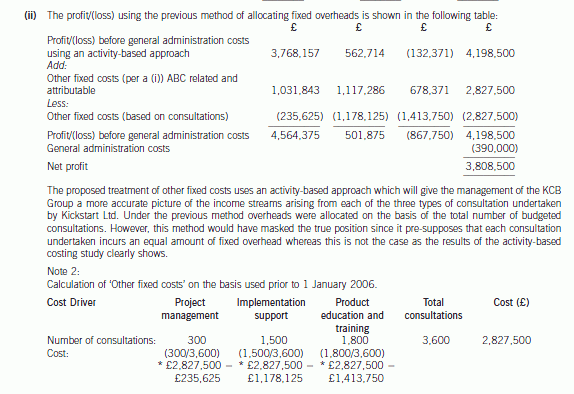
-
第5题:
(ii) the factors that should be considered in the design of a reward scheme for BGL; (7 marks)
正确答案:
(ii) The factors that should be considered in the design of a reward scheme for BGL.
– Whether performance targets should be set with regard to results or effort. It is more difficult to set targets for
administrative and support staff since in many instances the results of their efforts are not easily quantifiable. For
example, sales administrators will improve levels of customer satisfaction but quantifying this is extremely difficult.
– Whether rewards should be monetary or non-monetary. Money means different things to different people. In many
instances people will prefer increased job security which results from improved organisational performance and
adopt a longer term-perspective. Thus the attractiveness of employee share option schemes will appeal to such
individuals. Well designed schemes will correlate the prosperity of the organisation with that of the individuals it
employs.
– Whether the reward promise should be implicit or explicit. Explicit reward promises are easy to understand but in
many respects management will have their hands tied. Implicit reward promises such as the ‘promise’ of promotion
for good performance is also problematic since not all organisations are large enough to offer a structured career
progression. Thus in situations where not everyone can be promoted there needs to be a range of alternative reward
systems in place to acknowledge good performance and encourage commitment from the workforce.
– The size and time span of the reward. This can be difficult to determine especially in businesses such as BGL
which are subject to seasonal variations. i.e. summerhouses will invariably be purchased prior to the summer
season! Hence activity levels may vary and there remains the potential problem of assessing performance when
an organisation operates with surplus capacity.
– Whether the reward should be individual or group based. This is potentially problematic for BGL since the assembly
operatives comprise some individuals who are responsible for their own output and others who work in groups.
Similarly with regard to the sales force then the setting of individual performance targets is problematic since sales
territories will vary in terms of geographical spread and customer concentration.
– Whether the reward scheme should involve equity participation? Such schemes invariably appeal to directors and
senior managers but should arguably be open to all individuals if ‘perceptions of inequity’ are to be avoided.
– Tax considerations need to be taken into account when designing a reward scheme.