
(b) Advise on the capital gains implications should Trent Limited’s old building be sold as proposed. Support youradvice with relevant calculations. (4 marks)
题目
(b) Advise on the capital gains implications should Trent Limited’s old building be sold as proposed. Support your
advice with relevant calculations. (4 marks)
相似考题
更多“(b) Advise on the capital gains implications should Trent Limited’s old building be sold as proposed. Support youradvice with relevant calculations. (4 marks)”相关问题
-
第1题:
(ii) State, giving reasons, the tax reliefs in relation to inheritance tax (IHT) and capital gains tax (CGT) which
would be available to Alasdair if he acquires the warehouse and leases it to Gallus & Co, rather than to
an unconnected tenant. (4 marks)
正确答案:
(ii) Apart from the fact that Alasdair can keep an eye on his tenant, the main advantages are twofold:
IHT: If the firm are the tenants, the property will be land and buildings used in a business carried on by a partnership
in which the donor is a partner. Thus, Alasdair will be able to claim business property relief (BPR) at a rate of 50%
so long as he remains a partner in the firm. However, this relief would not be available until Alasdair has owned
the property for at least two years from his firm taking up the tenancy.
CGT: As Alasdair is a partner in the firm using the building, it will also be a qualifying asset for the purposes of rollover
relief on any gains arising from the disposal of the property. Assuming that Alasdair acquires a replacement asset
which will be used in the trade, the gain on sale can be deferred against the tax base cost of the replacement asset.
In the event that rollover relief cannot be used, any gains on disposal will be subject to business asset taper relief. -
第2题:
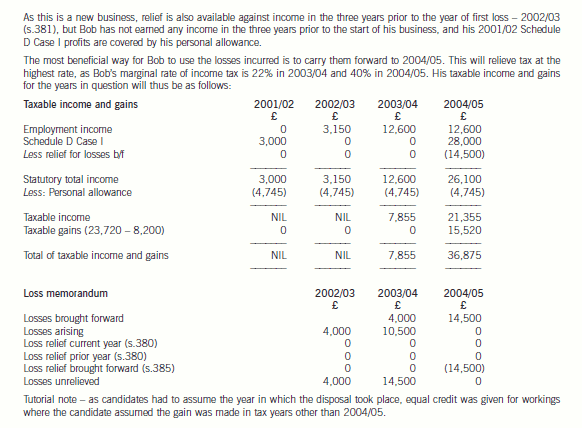
(b) Assuming that the income from the sale of the books is not treated as trading income, calculate Bob’s taxable
income and gains for all relevant tax years, using any loss reliefs in the most tax-efficient manner. Your
answer should include an explanation of the loss reliefs available and your reasons for using (or not using)
them. (12 marks)
Assume that the rates and allowances for 2004/05 apply throughout this part of the question.
正确答案:
-
第3题:
(ii) Explain the income tax (IT), national insurance (NIC) and capital gains tax (CGT) implications arising on
the grant to and exercise by an employee of an option to buy shares in an unapproved share option
scheme and on the subsequent sale of these shares. State clearly how these would apply in Henry’s
case. (8 marks)
正确答案:
(ii) Exercising of share options
The share option is not part of an approved scheme, and will not therefore enjoy the benefits of such a scheme. There
are three events with tax consequences – grant, exercise and sale.
Grant. If shares or options over shares are sold or granted at less than market value, an income tax charge can arise on
the difference between the price paid and the market value. [Weight v Salmon]. In addition, if options can be exercised
more than 10 years after the date of the grant, an employment income charge can arise. This is based on the market
value at the date of grant less the grant and exercise priced.
In Henry’s case, the options were issued with an exercise price equal to the then market value, and cannot be exercised
more than 10 years from the grant. No income tax charge therefore arises on grant.
Exercise. On exercise, the individual pays the agreed amount in return for a number of shares in the company. The price
paid is compared with the open market value at that time, and if less, the difference is charged to income tax. National
insurance also applies, and the company has to pay Class 1 NIC. If the company and shareholder agree, the national
insurance can be passed onto the individual, and the liability becomes a deductible expense in calculating the income
tax charge.
In Henry’s case on exercise, the difference between market value (£14) and the price paid (£1) per share will be taxed
as income. Therefore, £130,000 (10,000 x (£14 – £1)) will be taxed as income. In addition, national insurance will
be chargeable on the company at 12·8% (£16,640) and on Henry at the rate of 1% (£1,300).
Sale. The base cost of the shares is taken to be the market value at the time of exercise. On the sale of the shares, any
gain or loss arising falls under the capital gains tax rules, and CGT will be payable on any gain. Business asset taper
relief will be available as the company is an unquoted trading company, but the relief will only run from the time that
the share options are exercised – i.e. from the time when the shares were acquired.
In Henry’s case, the sale of the shares will immediately follow the exercise of the option (6 days later). The sale proceeds
and the market value at the time of exercise are likely to be similar; thus little to no gain is likely to arise. -
第4题:
(c) (i) Compute Gloria’s capital gains tax liability for 2006/07 ignoring any claims or elections available to
reduce the liability. (3 marks)
正确答案:
-
第5题:
(ii) Assuming the relief in (i) is available, advise Sharon on the maximum amount of cash she could receive
on incorporation, without triggering a capital gains tax (CGT) liability. (3 marks)
正确答案:
(ii) As Sharon is entitled to the full rate of business asset taper relief, any gain will be reduced by 75%. The position is
maximised where the chargeable gain equals Sharon’s unused capital gains tax annual exemption of £8,500. Thus,
before taper relief, the gain she requires is £34,000 (1/0·25 x £8,500).
The amount to be held over is therefore £46,000 (80,000 – 34,000). Where part of the consideration is in the form
of cash, the gain eligible for incorporation relief is calculated using the formula:
Gain deferred = Gain x value of shares issued/total consideration
The formula is manipulated on the following basis:
£46,000 = £80,000 x (shares/120,000)
Shares/120,000 = £46,000/80,000
Shares = £46,000 x 120,000/80,000
i.e. £69,000.
As the total consideration is £120,000, this means that Sharon can take £51,000 (£120,000 – £69,000) in cash
without any CGT consequences. -
第6题:
(b) Peter, one of Linden Limited’s non-executive directors, having lived and worked in the UK for most of his adult
life, sold his home near London on 22 March 2006 and, together with his wife (a French citizen), moved to live
in a villa which she owns in the south of France. Peter is now demanding that the tax deducted from his director’s
fees, for the board meetings held on 18 April and 16 May 2006, be refunded, on the grounds that, as he is no
longer resident in the UK, he is no longer liable to UK income tax. All of the company’s board meetings are held
at its offices in Cambridge.
Despite Peter’s assurance that none of the other companies of which he is a director has disputed his change of
tax status, Damian is uncertain whether he should make the refunds requested. However, as Peter is a friend of
the company’s founder, Linden Limited’s managing director is urging him to do so, stating that if the tax does
have to be paid, then Linden Limited could always bear the cost.
Required:
Advise Damian whether Peter is correct in his assertion regarding his tax position and in the case that there
is a UK tax liability the implications of the managing director’s suggestion. You are not required to consider
national insurance (NIC) issues. (4 marks)
正确答案:
(b) Peter will have been resident and ordinarily resident in the UK. When such individuals leave the UK for a purpose other than
to take up full time employment abroad, they normally continue to still be so regarded unless their absence spans a complete
tax year. But, where someone intends to live permanently abroad or to do so for a period of at least three tax years, they may
be treated as non-resident and non-ordinarily resident from the day after the date of their departure, if they can provide
evidence to HMRC of that intention. Selling a residence in the UK and setting up home abroad will normally constitute such
evidence. However to retain non-resident status the intention must actually be fulfilled, and visits to the UK must not exceed
182 days in any tax year or average more than 90 days per year over a period of four tax years. Given that Peter would appear
to have several company directorships in the UK, it is possible that he might fail to satisfy the 90 day average ‘substantial
visits’ rule.
Even if Peter is classed as non-resident, any remuneration earned in the UK will still be liable to UK income tax, and subject
to PAYE, unless it is for duties incidental to an overseas employment, which is unlikely to be the case for fees paid to a nonexecutive
director for attending board meetings. Thus, income tax should still be deducted from the fees under PAYE. Where
PAYE should have been deducted from a director’s emoluments and it has not been, but the tax is nevertheless accounted
for by the company to HMRC, then to the extent that the tax is not reimbursed by the director, he will be treated as receiving
a benefit equivalent to the amount of tax. -
第7题:
(iii) Explain the potential corporation tax (CT) implications of Tay Limited transferring work to Trent Limited,
and suggest how these can be minimised or eliminated. (3 marks)
正确答案:
(iii) Trading losses may not be carried forward where, within a period of three years there is both a change in the ownership
of a company and a major change in the nature or conduct of its trade. The transfer of work from Tay Limited to Trent
Limited is likely to constitute a major change in the nature or conduct of the latter’s trade. As a consequence, any tax
losses at the date of acquisition will be forfeited. Assuming losses were incurred uniformly in 2005, the tax losses at the
date of acquisition were £380,000 (300,000 + 2/3 x 120,000)). This is worth £114,000 assuming a corporation tax
rate of 30%.
Thus, Tay Limited should not consider transferring any trade to Trent Limited until after the third anniversary of the date
of the change of ownership i.e. not before 1 September 2008. As the trades are similar, there should be little problem
in transferring work from that date onwards. -
第8题:
(ii) Advise Andrew of the tax implications arising from the disposal of the 7% Government Stock, clearly
identifying the tax year in which any liability will arise and how it will be paid. (3 marks)
正确答案:
(ii) Government stock is an exempt asset for the purposes of capital gains tax, however, as Andrew’s holding has a nominal
value in excess of £5,000, a charge to income tax will arise under the accrued income scheme. This charge to income
tax will arise in 2005/06, being the tax year in which the next interest payment following disposal falls due (20 April
2005) and it will relate to the income accrued for the period 21 October 2004 to 14 March 2005 of £279 (145/182
x £350). As interest on Government Stock is paid gross (unless the holder applies to receive it net), the tax due of £112
(£279 x 40%) will be collected via the self-assessment system and as the interest was an ongoing source of income
will be included within Andrew’s half yearly payments on account payable on 31 January and 31 July 2006. -
第9题:
(b) Calculate Alvaro Pelorus’s capital gains tax liability for the tax year 2006/07 on the assumption that all
available reliefs are claimed. (8 marks)
正确答案: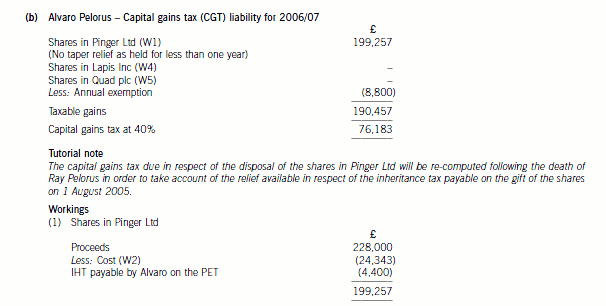

-
第10题:
(ii) Advise Mr Fencer of the income tax implications of the proposed financing arrangements. (2 marks)
正确答案:
(ii) The income tax implications of the proposed financing arrangements
Mr Fencer has borrowed money from a UK bank in order to make a loan to Rapier Ltd, a close company. The interest
paid by Mr Fencer to the bank will be an allowable charge on income as long as he continues to hold more than 5% of
Rapier Ltd. Charges on income are deductible in arriving at an individual’s statutory total income.
Mr Fencer will receive interest from Rapier Ltd net of 20% income tax. The gross amount of interest will be subject to
income tax at either 10%, 20% or 40% depending on whether the income falls into Mr Fencer’s starting rate, basic rate
or higher rate tax band. Mr Fencer will obtain a tax credit for the 20% income tax suffered at source. -
第11题:
(b) Prepare a reasoned explanation of how any capital gains tax arising in the UK on the sale of the paintings
can be minimised. (2 marks)
正确答案:
(b) Minimising capital gains tax on the sale of the paintings
Galileo will become resident and ordinarily resident from the date he arrives in the UK as he intends to stay for more than
three years. Prior to that date he will be neither resident nor ordinarily resident such that he will not be subject to UK capital
gains tax.
Galileo should sell the paintings before he leaves Astronomeria; this will avoid UK capital gains tax completely.
Tutorial note
The gains would be taxable on the remittance basis if the paintings were sold after Galileo’s arrival in the UK. However, this
would not help Galileo to minimise the capital gains tax due as he needs to bring the sales proceeds into the UK in order
to purchase a house. -
第12题:
(c) (i) Calculate Benny’s capital gains tax liability for 2006/07. (6 marks)
正确答案:
-
第13题:
(c) (i) Explain the capital gains tax (CGT) implications of a takeover where the consideration is in the form. of
shares (a ‘paper for paper’ transaction) stating any conditions that need to be satisfied. (4 marks)
正确答案:
(c) (i) Paper for paper rules
The proposed transaction broadly falls under the ‘paper for paper’ rules. Where this is the case, chargeable gains do not
arise. Instead, the new holding stands in the shoes (and inherits the base cost) of the original holding.
The company issuing the new shares must:
(i) end up with more than 25% of the ordinary share capital (or a majority of the voting power) of the old company,
OR
(ii) make a general offer to shareholders in the other company with a condition that, if satisfied, would give the
acquiring company control of the other company.
The exchange must be for bona fide commercial reasons and must not have as its main purpose (or one of its main
purposes) the avoidance of CGT or corporation tax. The acquiring company can obtain advance clearance from the
Inland Revenue that the conditions will be met.
If part of the offer consideration is in the form. of cash, a gain must be calculated using the part disposal rules. If the
cash received is not more than the higher of £3,000 or 5% of the total value on takeover, then the amount received in
cash can be deducted from the base cost of the securities under the small distribution rules. -
第14题:
(c) Advise Alan on the proposed disposal of the shares in Mobile Ltd. Your answer should include calculations
of the potential capital gain, and explain any options available to Alan to reduce this tax liability. (7 marks)
正确答案: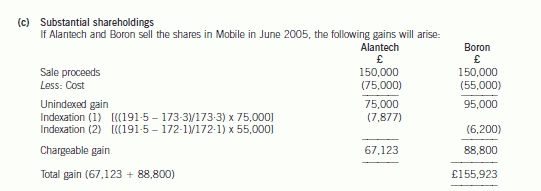
However, an exemption from corporation tax exists for any gain arising when a trading company (or member of a trading
group) sells the whole or any part of a substantial shareholding in another trading company.
A substantial shareholding is one where the investing company holds 10% of the ordinary share capital and is beneficially
entitled to at least 10% of the
(i) profits available for distribution to equity holders and
(ii) assets of the company available for distribution to equity holders on a winding up.
In meeting the 10% test, shares owned by a chargeable gains group may be amalgamated. The 10% test must have been
met for a continuous 12 month period during the 2 years preceding the disposal.
The companies making the disposals must have been trading companies (or members of a trading group) throughout the
12 month period, as well as at the date of disposal. In addition, they must also be trading companies (or members of a trading
group) immediately after the disposal.
The exemption is given automatically, and acts to deny losses as well as eliminate gains.
While Alantech Ltd has owned its holding in Mobile Ltd for 33 months, its ownership of the Boron holding has only lasted
for 10 months (at 1 June 2005) since Boron was acquired on 1 July 2004. Selling the shares in June 2005 will fail the
12 month test, and the gain will become chargeable.
It would be better for the companies to wait for a further month until July 2005 before selling the amalgamated shareholding.
By doing so, they will both be able to take advantage of the substantial shareholdings relief, thereby saving tax of £29,625
assuming a corporation tax rate of 19%. -
第15题:
(b) Explain by reference to Hira Ltd’s loss position why it may be beneficial for it not to claim any capital
allowances for the year ending 31 March 2007. Support your explanation with relevant calculations.
(6 marks)
正确答案:
(b) The advantage of Hira Ltd not claiming any capital allowances
In the year ending 31 March 2007 Hira Ltd expects to make a tax adjusted trading loss, before deduction of capital
allowances, of £55,000 and to surrender the maximum amount possible of trading losses to Belgrove Ltd and Dovedale Ltd.
For the first nine months of the year from 1 April 2006 to 31 December 2006 Hira Ltd is in a loss relief group with Belgrove
Ltd. The maximum surrender to Belgrove Ltd for this period is the lower of:
– the available loss of £41,250 (£55,000 x 9/12); and
– the profits chargeable to corporation tax of Belgrove of £28,500 (£38,000 x 9/12).
i.e. £28,500. This leaves losses of £12,750 (£41,250 – £28,500) unrelieved.
For the remaining three months from 1 January 2007 to 31 March 2007 Hira Ltd is a consortium company because at least
75% of its share capital is owned by companies, each of which own at least 5%. It can surrender £8,938 (£55,000 x 3/12
x 65%) to Dovedale Ltd and £4,812 (£55,000 x 3/12 x 35%) to Belgrove Ltd as both companies have sufficient taxable
profits to offset the losses. Accordingly, there are no losses remaining from the three-month period.
The unrelieved losses from the first nine months must be carried forward as Hira Ltd has no income or gains in that year or
the previous year. However, the losses cannot be carried forward beyond 1 January 2007 (the date of the change of
ownership of Hira Ltd) if there is a major change in the nature or conduct of the trade of Hira Ltd. Even if the losses can be
carried forward, the earliest year in which they can be relieved is the year ending 31 March 2009 as Hira Ltd is expected to
make a trading loss in the year ending 31 March 2008.
Any capital allowances claimed by Hira Ltd in the year ending 31 March 2007 would increase the tax adjusted trading loss
for that year and consequently the unrelieved losses arising in the first nine months.
If the capital allowances are not claimed, the whole of the tax written down value brought forward of £96,000 would be
carried forward to the year ending 31 March 2008 thus increasing the capital allowances and the tax adjusted trading loss,
for that year. By not claiming any capital allowances, Hira Ltd can effectively transfer a current period trading loss, which
would be created by capital allowances, of £24,000 (25% x £96,000) from the year ending 31 March 2007 to the following
year where it can be surrendered to the two consortium members. -
第16题:
(d) Explain how Gloria would be taxed in the UK on the dividends paid by Bubble Inc and the capital gains tax
and inheritance tax implications of a future disposal of the shares. Clearly state, giving reasons, whether or
not the payment made to Eric is allowable for capital gains tax purposes. (9 marks)
You should assume that the rates and allowances for the tax year 2005/06 apply throughout this question.
正确答案:
(d) UK tax implications of shares in Bubble Inc
Income tax
Gloria is UK resident and is therefore subject to income tax on her worldwide income. However, because she is non-UK
domiciled, she will only be taxed on the foreign dividends she brings into the UK.
Dividends brought into the UK will be grossed up for any tax paid in Oceania. The gross amount is taxed at 10% if it falls
into the starting or basic rate band and at 321/2% if it falls into the higher rate band. The tax suffered in Oceania is available
for offset against the UK tax liability. The offset is restricted to a maximum of the UK tax on the dividend income.
Capital gains tax
Individuals are subject to capital gains tax on worldwide assets if they are resident or ordinarily resident in the UK. However,
because Gloria is non-UK domiciled and the shares are situated abroad, the gain is only taxable to the extent that the sales
proceeds are brought into the UK. Any tax suffered in Oceania in respect of the gain is available for offset against the UK
capital gains tax liability arising on the shares.
Any loss arising on the disposal of the shares would not be available for relief in the UK.
In computing a capital gain or allowable loss, a deduction is available for the incidental costs of acquisition. However, to be
allowable, such costs must be incurred wholly and exclusively for the purposes of acquiring the asset. The fee paid to Eric
related to general investment advice and not to the acquisition of the shares and therefore, would not be deductible in
computing the gain.
Taper relief will be at non-business asset rates as Bubble Inc is an investment company.
Inheritance tax
Assets situated abroad owned by non-UK domiciled individuals are excluded property for the purposes of inheritance tax.
However, Gloria will be deemed to be UK domiciled (for the purposes of inheritance tax only) if she has been resident in the
UK for 17 out of the 20 tax years ending with the year in which the disposal occurs.
Gloria has been running a business in the UK since June 1992 and would therefore, appear to have been resident for at least
15 tax years (1992/93 to 2006/07 inclusive).
If Gloria is deemed to be UK domiciled such that the shares in Bubble Inc are not excluded property, business property relief
will not be available because Bubble Inc is an investment company. -
第17题:
3 Damian is the finance director of Linden Limited, a medium sized, unquoted, UK trading company, with a 31 July
year end. Damian personally owns 10% of the ordinary issued share capital of Linden Limited, for which he paid
£10,000 in June 1998. He estimates that the current market value of Linden Limited is £9 million and that the
company will make taxable profits of £1·4 million in the forthcoming year to 31 July 2007.
(a) Damian believes that Linden Limited should conduct its activities in a socially responsible manner and to this
end has proposed that in future all cars purchased by the company should be low emission vehicles. The sales
director has stated that several of his staff, who are the main recipients of company cars, other than the directors,
are extremely unhappy with this proposal, perceiving it as downgrading their value and status.
The cars currently provided to the sales staff have a list price of £19,600, on which Linden Limited receives a
bulk purchase discount of 6% from the dealer, and a CO2 emission rate of 168 grams/kilometre. The company
pays for up to £400 of accessories, of the salesmen’s own choice to be fitted to the cars and all of the running
costs, including private petrol. The cars are replaced every three years and the ‘old’ cars are sold at auction,
because they are high mileage vehicles.
The low emission cars it is proposed to purchase will have the same list price as the current cars, but the dealer
is only prepared to offer a bulk discount of 5% on these vehicles. Damian does not propose to make any other
changes to Linden Limited’s company car policy or practice.
Required:
(i) Explain the tax consequences of the proposed move to low emission vehicles for both the individual
salesmen and Linden Limited, illustrating your answer by means of relevant calculations of the tax and
national insurance (NIC) savings arising. (9 marks)
正确答案:
(a) (i) Individual salesmen
The taxable benefit is determined by the list price of the vehicle plus the cost of the accessories (£20,000) and the CO2
emission rate. The current vehicles have a CO2 emission rate of 168 grams/kilometre, so the benefit will be calculated
at the rate of 20% ((168 – 140)/5 + 15), resulting in a total annual car and car fuel benefit charge of £6,880 (20,000
x 20% + 14,400 x 20%). The low emission vehicles will be chargeable at the basic percentage rate of 15% resulting
in a total annual car and fuel benefit charge of £5,160 (20,000 x 15% + 14,400 x 15%). The salesmen will thus
make an annual income tax saving at their marginal rate of tax, i.e. £378 (1,720 x 22%) if they are basic rate taxpayers
and £688 (1,720 x 40%) if they are higher rate taxpayers.
Linden Limited
The current vehicles will be classed as ‘expensive’ cars based on the discounted list price plus the cost of the accessories
of £18,824 (19,600 x 94% + 400). The annual writing down allowances will thus be restricted to £3,000 throughout
the period of ownership, but there will be no restriction of the balancing allowance available on disposal. The low
emission vehicles will be eligible for a 100% first year allowance of £19,020 (19,600 x 95% + 400), but there will
also be a balancing charge on disposal equivalent to the sales proceeds. Therefore, the total of the allowances available
over the life of the cars will be effectively the same in both cases. As a single company with taxable profits of
£1·4 million, Linden Limited will pay corporation tax at the small companies marginal rate of 32·75% in the year to
31 July 2007, giving a tax benefit in that year of £5,247 for each low emission car purchased ((19,020 – 3,000) x
32·75%).
The company will also make an annual saving in terms of the Class 1A national insurance contributions payable on the
salesmen’s benefits of £220 ((6,880 – 5,160) x 12·8%). But, as these Class 1A contributions are deductible for
corporation tax, the net saving will only be £205 (220 x (100 – 32·75)%).
As the VAT liability payable on the provision of private fuel is based on engine capacity (not the CO2 emission rate) this
will not necessarily be affected. -
第18题:
(c) For commercial reasons, Damian believes that it would be sensible to place a new holding company, Bold plc,
over the existing company, Linden Limited. Bold plc would also be unquoted and would acquire the existing
Linden Limited shares in exchange for the issue of its own shares.
If the new structure is implemented, Bold plc will provide management services to Linden Limited, but the
amount that will be charged for these services is yet to be determined.
Required:
(i) State the capital gains tax (CGT) issues that Damian should be aware of before disposing of his shares
in Linden Limited to Bold plc. Your answer should include details of any conditions that will need to be
satisfied if an immediate charge to tax is to be avoided. (4 marks)
正确答案:
(c) (i) The proposed transaction broadly falls under the ‘paper for paper’ rules. Where this is the case, chargeable gains do not
arise. Instead, the new holding stands in the shoes (and inherits the base cost) of the original holding.
The company issuing the new shares must:
(i) end up with more than 25% of the ordinary share capital or a majority of the voting power of the old company,
OR
(ii) make a general offer to shareholders in the old company with a condition which would give the acquiring company
control of the company if accepted.
The exchange must be for bona fide commercial reasons and not have as its main purpose (or one of its main purposes)
the avoidance of capital gains tax or corporation tax.
The issue of shares by Bold plc satisfies these conditions, thus Damian, as a shareholder of Linden Limited, will not be
taxed on the exchange of shares. -
第19题:
(d) Advise Trent Limited of the consequences arising from the submission of the incorrect value added tax (VAT)
return, assuming that the company has previously had a good compliance record with regard to accounting
for VAT. (6 marks)
正确答案:
(d) Default surcharge
Although the VAT return was submitted on time (i.e. within one month of the end of the tax period), part of the quarterly VAT
liability has not yet been paid. As a result this payment will be made late and a surcharge liability notice will be issued on
the company. The surcharge period will run from the date of the notice until the anniversary of the end of the period for which
the VAT was paid late (i.e. until 31 March 2007). During this period any further default will extend the surcharge period and
any further late payments of VAT will attract a surcharge penalty of 2% on the first occasion, rising to 15% for successive late
payments.
Mis-declaration penalty
As the return understates the VAT payable, a potential mis-declaration penalty arises. The amount understated exceeds 30%
of the sum of the true input tax and output tax, known as the gross amount of tax (GAT) ((30% of (87,500 + 55,000) +
40,000) = 54,750). There has, thus, been a significant understatement of the true VAT return liability, resulting in a penalty
rate of 15% of the VAT which would have been lost had the error not been discovered. However, where an under declaration
arises out of a true error i.e. there is no intention to evade tax involved, and it is voluntarily disclosed, then a mis-declaration
penalty is not normally imposed. Although the company is still within the ‘period of grace’ allowed by HMRC for the correction
of errors in the next following VAT return, it would be advisable for Trent Limited to notify HMRC of the error immediately, in
writing, unless it has a ‘reasonable excuse’ for the error having occurred.
Default interest
Default interest is chargeable when an assessment to VAT arises for an amount that has been under declared in a previous
period, whether as a result of voluntary disclosure or as identified by HMRC. Interest is charged on a daily basis from the
date the under declaration should have been declared (i.e. 1 May 2006) to the date shown on the notice of assessment or
notice of voluntary disclosure. As given the size of the error the de minimis relief for voluntarily declared errors of less than
£2,000 is not applicable, the only way for Trent Limited to minimise the interest charge is by means of early disclosure and
payment of the additional VAT due. -
第20题:
(b) (i) Advise Andrew of the income tax (IT) and capital gains tax (CGT) reliefs available on his investment in
the ordinary share capital of Scalar Limited, together with any conditions which need to be satisfied.
Your answer should clearly identify any steps that should be taken by Andrew and the other investors
to obtain the maximum relief. (13 marks)
正确答案:
(b) (i) Andrew may be able to take advantage of tax reliefs under the enterprise investment scheme (EIS) provided the
necessary conditions are met. The conditions that have to be satisfied before full relief is available fall into three areas,
and broadly require that a ‘qualifying individual’ subscribes for ‘eligible shares’ in a ‘qualifying company’.
‘Qualifying Individual’
To be a qualifying individual, Andrew must not be connected with the EIS company. This means that he should not be
an employee (or, at the time the shares are issued, a director) or have an interest in (i.e. control) 30% or more of the
capital of the company. These conditions need to be satisfied throughout the period beginning two years before the share
issue and three years after the ‘relevant date’. Where the relevant date is defined as the later of the date the shares were
issued and the date on which the company commenced trading.
Andrew does not intend to become an employee (or director) of Scalar Limited, but he needs to exercise caution as to
how many shares he subscribes for. If only three investors subscribe for 100% of the shares, each will hold 33% of the
share capital. This exceeds the 30% limit and will mean that EIS relief (other than deferral relief) will not be available.
Therefore, Andrew and the other two investors should ensure not only that the potential fourth investor is recruited, but
that s/he subscribes for sufficient shares, such that none of them will hold 30% or more of the issued share capital, as
only then will they all attain qualifying individual status.
‘Eligible shares’
Qualifying shares need to be new ordinary shares which are subscribed for in cash and fully paid up at the time of issue.
The shares must not be redeemable for at least three years from the relevant date, and not carry any preferential rights
to dividends. On the basis of the information provided, the shares of Scalar Limited would qualify as eligible shares.
‘Qualifying Company’
The company must be unquoted, not controlled by another company, and engaged in qualifying business activities. The
latter requires that the company engage in a trading activity, which is carried on wholly or mainly in the UK, throughout
the three years following the relevant date. While certain trading activities, such as dealing in shares or trading in land,
are excluded, the manufacturing trade Scalar Limited proposes to carry on will qualify.
However, it is also necessary for at least 80% of the money raised to be used for the qualifying business activity within
12 months of the relevant date and the remaining 20% to be so used within the following 12 months. Andrew and the
other investors will thus have to ensure that Scalar Limited has not raised more funds than it is able to employ in the
business within the appropriate time periods.
Reliefs available:
Andrew can claim income tax relief at 20% income tax relief on the amount invested up to a maximum of £200,000
in any one tax year. The relief is given in the form. of a tax reducing allowance, which can reduce the investor’s income
tax liability to nil, but cannot be used to generate a tax refund. If the investment is made prior to 6 October in the tax
year, then 50% of the amount invested (up to a maximum of £25,000) can be treated as having been made in the
previous tax year.
Any capital gains arising on the sale of EIS shares will be fully exempt from capital gains tax provided that income tax
relief was given on the investment when made and has not been withdrawn. If the EIS shares are disposed of at a loss,
capital losses are still allowable, but reduced by the amount of any EIS relief attributable to the shares disposed of.
In addition, gains from the disposal of other assets can be deferred against the base cost of EIS shares acquired within
one year before and three years after their disposal. Such gains will, thus, not normally become chargeable until the EIS
shares themselves are disposed of. Further, for deferral relief to be available, it is not necessary for the investment to
qualify for EIS income tax relief, i.e. deferral is available even where the investor is not a qualifying individual. Thus,
Andrew could still defer the gain arising on the disposal of the residential property lease made in order to raise part of
the funds for his EIS investment, even if no fourth investor were to be found and his shareholding were to exceed 30%
of the issued share capital of Scalar Limited. Does not require the existence of income tax relief in order to be claimed.
Withdrawal of relief:
Any EIS relief claimed by Andrew will be withdrawn (partially or fully) if, within three year of the relevant date:
(1) he disposes of the shares;
(2) he receives value from the company;
(3) he ceases to be a qualifying individual; or
(4) Scalar Limited ceases to be a qualifying company.
With regard to receiving value from the company, the definition excludes dividends which do not exceed a normal rate
of return, but does include the repayment of any loans made to the company before the shares were issued, the provision
of benefits and the purchase of assets from the company at an undervalue. In this regard, Andrew and the other
subscribers should ensure that the £50,000 they are to invest in Scalar Limited as loan capital is appropriately timed
and structured relative to the issue of the EIS shares. -
第21题:
(ii) Advise Clifford of the capital gains tax implications of the alternative of selling the Oxford house and
garden by means of two separate disposals as proposed. Calculations are not required for this part of
the question. (3 marks)
正确答案:
(ii) The implications of selling the Oxford house and garden in two separate disposals
The additional sales proceeds would result in an increase in Clifford’s capital gains and consequently his tax liability.
When computing the gain on the sale of the house together with a small part of the garden, the allowable cost would
be a proportion of the original cost. That proportion would be A/A + B where A is the value of the house and garden
that has been sold and B is the value of the part of the garden that has been retained. Principal private residence relief
and taper relief would be available in the same way as that set out in (i) above.
When computing the gain on the sale of the remainder of the garden, the cost would be the original cost of the property
less the amount used in computing the gain on the earlier disposal. Principal private residence relief would not be
available as the land sold is not a dwelling house or part of one. -
第22题:
(d) Evaluate the effect on Gerard of the changes to be made by Fizz plc to its performance related bonus scheme.
You should ignore the effect of any pension contributions to be made by Gerard in the future, consider both
the value and timing of amounts received by Gerard and include relevant supporting calculations.
(5 marks)
Note: – You should assume that the income tax rates and allowances for the tax year 2006/07 apply throughout
this question.
正确答案:
(d) Implications for Gerard of the changes to Fizz plc’s bonus scheme
Value received
Under the existing scheme Gerard receives approximately £4,500 each year. This is subject to income tax at 40% and
national insurance contributions at 1% such that Gerard receives £2,655 (£4,500 x 59%) after all taxes.
Under the proposed share incentive plan (SIP), Gerard expects to receive free shares worth £3,500 (£2,100 + £1,400).
Provided the shares remain in the plan for at least five years there will be no income tax or national insurance contributions
in respect of the value received. Gerard’s base cost in the shares for the purposes of capital gains tax will be their value at
the time they are withdrawn from the scheme.
In addition, the amount he spends on partnership shares will be allowable for both income tax and national insurance such
that he will obtain shares with a value of £700 for a cost of only £413 (£700 x 59%).
Accordingly, Gerard will receive greater value under the SIP than he does under the existing bonus scheme. However, as noted
below, he will not be able to sell the free or matching shares until they have been in the scheme for at least three years by
which time they may have fallen in value.
Timing of receipt of benefit
Under the existing scheme Gerard receives a cash bonus each year.
The value of free and matching shares awarded under a SIP cannot be realised until the shares are withdrawn from the
scheme and sold. This withdrawal cannot take place until at least three years after the shares are awarded to Gerard.
Accordingly, Gerard will not have access to the value of the bonuses he receives under the SIP until the scheme has been in
operation for at least three years. In addition, if the shares are withdrawn within five years of being awarded, income tax and
national insurance contributions will become payable on the lower of their value at the time of the award and their value at
the time of withdrawal thus reducing the value of Gerard’s bonus. -
第23题:
(c) State the specific inquiries you should make of Robson Construction Co’s management relevant to its
accounting for construction contracts. (6 marks)
正确答案:
(c) Specific inquiries – accounting for construction contracts
Tutorial note: This answer is illustrative of the types of inquiry that should be made. Other relevant answer points will be
awarded similar credit. For each full mark to be earned an inquiry should address the specifics of Robson (e.g. that its
accounting policies are ‘generally less prudent’). The identification of asset overstatement/liability understatement may
reduce the purchase price offered by Prescott.
■ Are any constructions being undertaken without signed contracts?
Tutorial note: Any expenditure on constructions without contracts (e.g. of a speculative nature, perhaps to keep the
workforce employed) must be accounted for under IAS ‘Inventories’; revenue cannot be recognised nor profit taken.
■ Is full provision made for future losses foreseen on loss-making contracts?
Tutorial note: The information in the brief is that ‘provisions are made’. The level of provision is not indicated and
could be less than full.
■ Which contracts started during the year are likely to be/have been identified as loss-making (for which no provision has
yet been made)?
Tutorial note: Profits and losses are only determined by contract at each financial year end.
■ What are management’s assumptions and judgments on the likely future outcome on the Sarwar contract (and other
actual and contingent liabilities)?
Tutorial note: Robson would be imprudent if it underestimates the probability of an unfavourable outcome (or
overestimates the likelihood of successful recourse).
■ What claims history has Robson experienced? (What proportion of contracts have been subject to claims? What
proportion of claims brought have been successful? How have they been settled? Under insurance? Out-of-court
settlement?) How effective are the penalty clauses? (Is Robson having to pay penalties for overrunning on contracts?)
■ What are the actual useful lives of assets used in construction? What level of losses are made on disposal?
Tutorial note: If such assets are depreciated over useful lives that are estimated to be too long, depreciation costs
incurred to date (and estimated depreciation to be included in costs to completion) will be understated. This will result
in too much profit/too little loss being calculated on contracts.
■ What is the cause of losses on contracts? For example, if due to theft of building supplies Robson’s management is not
exercising sufficient control over the company’s assets.