
(iii) Advice in connection with the sale of the manufacturing premises by Tethys Ltd; (7 marks)
题目
(iii) Advice in connection with the sale of the manufacturing premises by Tethys Ltd; (7 marks)
相似考题
更多“(iii) Advice in connection with the sale of the manufacturing premises by Tethys Ltd; (7 marks)”相关问题
-
第1题:
(iii) A statement on the importance of confidentiality in the financing of the early stage working capital needs
and an explanation of how this conflicts with the duty of transparency in matters of corporate
governance. (6 marks)
Professional marks for layout, logical flow and persuasiveness of the statement. (4 marks)
正确答案:
(iii) Importance of confidentiality in the financing of the project and the normal duty of transparency.
I have been asked to include a statement in my remarks on the balance between our duty to be transparent whenever
possible and the need for discretion and confidentiality in some situations. In the case of our initial working capital needs
for the Giant Dam Project, the importance of confidentiality in financing is due to the potential for adverse publicity that
may arise for the lender. It is important that R&M have the project adequately financed, especially in the early stages
before the interim payments from the client become fully effective.
In general, of course, we at R&M attempt to observe the highest standards of corporate governance and this involves
adopting a default position of transparency rather than concealment wherever possible. We recognise that transparency
is important to underpin investor confidence and to provide investors with the information they need to make fund
allocation decisions.
Whilst it is normal to disclose the amount of debt we carry at any given point (on the balance sheet), it is rarely normal
practice to disclose the exact sources of those loans. In the case of the financing of initial working capital for the Giant
Dam Project, I’m sure you will realise that in this unique situation, disclosure of the lender’s identity could threaten the
progress of the project. For this reason we must resist any attempts to release this into the public domain. We are aware
of one pressure group that is actively seeking to discover this information in order to disrupt the project’s progress and
we shall be taking all internal measures necessary to ensure they do not obtain the information.
Thank you for listening. -
第2题:
(b) Identify and explain THREE approaches that the directors of Moffat Ltd might apply in assessing the
QUALITATIVE benefits of the proposed investment in a new IT system. (6 marks)
正确答案:
(b) One approach that the directors of Moffat Ltd could adopt would be to ignore the qualitative benefits that may arise on the
basis that there is too much subjectivity involved in their assessment. The problem that this causes is that the investment will
probably look unattractive since all costs will be included in the evaluation whereas significant benefits and savings will have
been ignored. Hence such an approach is lacking in substance and is not recommended.
An alternative approach would involve attempting to attribute values to each of the identified benefits that are qualitative in
nature. Such an approach will necessitate the use of management estimates in order to derive the cash flows to be
incorporated in a cost benefit analysis. The problems inherent in this approach include gaining consensus among interested
parties regarding the footing of the assumptions from which estimated cash flows have been derived. Furthermore, if the
proposed investment does take place then it may well be impossible to prove that the claimed benefits of the new system
have actually been realised.
Perhaps the preferred approach is to acknowledge the existence of qualitative benefits and attempt to assess them in a
reasonable manner acceptable to all parties including the company’s bank. The financial evaluation would then not only
incorporate ‘hard’ facts relating to costs and benefits that are quantitative in nature, but also would include details of
qualitative benefits which management consider exist but have not attempted to assess in financial terms. Such benefits might
include, for example, the average time saved by location managers in analysing information during each operating period.
Alternatively the management of Moffat Ltd could attempt to express qualitative benefits in specific terms linked to a hierarchy
of organisational requirements. For example, qualitative benefits could be categorised as being:
(1) Essential to the business
(2) Very useful attributes
(3) Desirable, but not essential
(4) Possible, if funding is available
(5) Doubtful and difficult to justify. -
第3题:
(c) Explain how the use of activity-based techniques may benefit Taliesin Ltd. (5 marks)
正确答案:
(c) The usefulness of activity-based techniques is accentuated in situations where overheads comprise a significant proportion of
product costs. Manufacturing overheads comprise 30·9% of turnover during the year ended 31 May 2005. Traditional
methods of allocating overheads to products might result in product cost information which is misleading and detrimental to
managerial decision-making. Calculations of product costs are more prone to error in situations where higher levels of
overhead exist. The consequences can prove disastrous as, for example, in the under-pricing or over-pricing of products.
Since Taliesin Ltd is going to confine its activities to its home country it must be prepared to face increased competition and
this increases the need for greater visibility and more accurate product cost information.
At present, Taliesin Ltd offers a range of products which is increasing in number and this may lead to the need for a more
detailed costing system. Traditional absorption systems might well be inadequate as the number of product variants increases.
One would expect that each new product developed is more complex than its predecessors. The company would probably
start with simple Vanilla, then a few basic flavours but as Taliesin Ltd has expanded one would expect it to take longer to
originate and test new products until they are ready to be introduced. It will probably take longer to mix the ingredients for a
run of each product.
These two, development and mixing ingredients, are examples of activities which arise when new products are considered.
If traditional absorption costing and budgeting are used based on machine-time in production then the effect of these activities
would be ignored.
In order to gain a full appreciation of the impact of new product introduction activity-based techniques should be used to
guide Taliesin Ltd into the easiest way to maintain its policy of growth. It may be a better decision to expand abroad or into
new markets at home with the existing products than pursue growth by introducing new products to a dwindling number of
customers.
We are not told of the composition of the customer base of Taliesin Ltd. However, one thing we do know is that the scope of
activity-based techniques extends beyond products and services. For example, the application of activity-based costing can
provide vital information that enables management to undertake customer profitability analysis, thereby further improving
management decision-making and operating performance.
-
第4题:
(b) Advise the management of SCC Ltd of THREE strategies that should be considered in order to improve the
future performance of SCC Ltd. (6 marks)
正确答案:
(b) The four quadrants of the Boston-growth share matrix summarise expected profits and resultant cash flows and recommends
an outline strategy to follow which rather simplistically may be summarised as invest in stars, scrutinise the problem children,
milk the cows and divest the dogs.
Value Chain Analysis
It is vital that the management of SCC Ltd undertake a value chain analysis of each of its divisions in order to identify and
eliminate all non-value added activities, thereby improving profitability and cash flow without necessarily increasing turnover
or market share.
Divestment of the Footwear division
Serious consideration should be given to the divestment of the Footwear division. This will enable resources to be redirected
to divisions categorised as problem children i.e. the Industrial and Children’s divisions.
Support the Stars
As far as the Fashion division is concerned, it is obviously in a growth market and currently performing well. It is vital, given
the forecast performance of the other subsidiaries that the management of SCC Ltd do not concentrate on the poor performers
to the detriment of its only star. -
第5题:
(iii) Whether or not you agree with the statement of the marketing director in note (9) above. (5 marks)
Professional marks for appropriateness of format, style. and structure of the report. (4 marks)
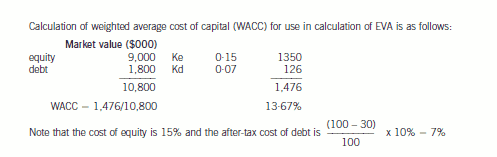
正确答案:(iii) The marketing director is certainly correct in recognising that success is dependent on levels of service quality provided
by HFG to its clients. However, whilst the number of complaints is an important performance measure, it needs to be
used with caution. The nature of a complaint is, very often, far more indicative of the absence, or a lack, of service
quality. For example, the fact that 50 clients complained about having to wait for a longer time than they expected to
access gymnasium equipment is insignificant when compared to an accident arising from failure to maintain properly a
piece of gymnasium equipment. Moreover, the marketing director ought to be aware that the absolute number of
complaints may be misleading as much depends on the number of clients serviced during any given period. Thus, in
comparing the number of complaints received by the three centres then a relative measure of complaints received per
1,000 client days would be far more useful than the absolute number of complaints received.
The marketing director should also be advised that the number of complaints can give a misleading picture of the quality
of service provision since individuals have different levels of willingness to complain in similar situations.
The marketing director seems to accept the current level of complaints but is unwilling to accept any increase above this
level. This is not indicative of a quality-oriented organisation which would seek to reduce the number of complaints over
time via a programme of ‘continuous improvement’.
From the foregoing comments one can conclude that it would be myopic to focus on the number of client complaints
as being the only performance measure necessary to measure the quality of service provision. Other performance
measures which may indicate the level of service quality provided to clients by HFG are as follows:
– Staff responsiveness assumes critical significance in service industries. Hence the time taken to resolve client
queries by health centre staff is an important indicator of the level of service quality provided to clients.
– Staff appearance may be viewed as reflecting the image of the centres.
– The comfort of bedrooms and public rooms including facilities such as air-conditioning, tea/coffee-making and cold
drinks facilities, and office facilities such as e-mail, facsimile and photocopying.
– The availability of services such as the time taken to gain an appointment with a dietician or fitness consultant.
– The cleanliness of all areas within the centres will enhance the reputation of HFG. Conversely, unclean areas will
potentially deter clients from making repeat visits and/or recommendations to friends, colleagues etc.
– The presence of safety measures and the frequency of inspections made regarding gymnasium equipment within
the centres and compliance with legislation are of paramount importance in businesses like that of HFG.
– The achievement of target reductions in weight that have been agreed between centre consultants and clients.
(Other relevant measures would be acceptable.)
-
第6题:
(c) Advise Alan on the proposed disposal of the shares in Mobile Ltd. Your answer should include calculations
of the potential capital gain, and explain any options available to Alan to reduce this tax liability. (7 marks)
正确答案: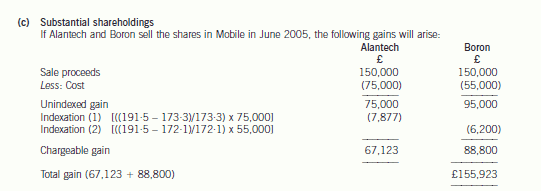
However, an exemption from corporation tax exists for any gain arising when a trading company (or member of a trading
group) sells the whole or any part of a substantial shareholding in another trading company.
A substantial shareholding is one where the investing company holds 10% of the ordinary share capital and is beneficially
entitled to at least 10% of the
(i) profits available for distribution to equity holders and
(ii) assets of the company available for distribution to equity holders on a winding up.
In meeting the 10% test, shares owned by a chargeable gains group may be amalgamated. The 10% test must have been
met for a continuous 12 month period during the 2 years preceding the disposal.
The companies making the disposals must have been trading companies (or members of a trading group) throughout the
12 month period, as well as at the date of disposal. In addition, they must also be trading companies (or members of a trading
group) immediately after the disposal.
The exemption is given automatically, and acts to deny losses as well as eliminate gains.
While Alantech Ltd has owned its holding in Mobile Ltd for 33 months, its ownership of the Boron holding has only lasted
for 10 months (at 1 June 2005) since Boron was acquired on 1 July 2004. Selling the shares in June 2005 will fail the
12 month test, and the gain will become chargeable.
It would be better for the companies to wait for a further month until July 2005 before selling the amalgamated shareholding.
By doing so, they will both be able to take advantage of the substantial shareholdings relief, thereby saving tax of £29,625
assuming a corporation tax rate of 19%. -
第7题:
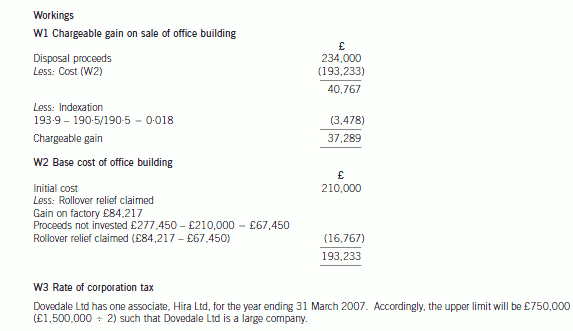
(c) Calculate the expected corporation tax liability of Dovedale Ltd for the year ending 31 March 2007 on the
assumption that all available reliefs are claimed by Dovedale Ltd but that Hira Ltd will not claim any capital
allowances in that year. (4 marks)
正确答案:
-
第8题:
(ii) Analyse the effect of delaying the sale of the business of the Stiletto Partnership to Razor Ltd until
30 April 2007 on Clint’s income tax and national insurance position.
You are not required to prepare detailed calculations of his income tax or national insurance liabilities.
(4 marks)
正确答案:(ii) The implications of delaying the sale of the business
The implications of delaying the sale of the business until 30 April would have been as follows:
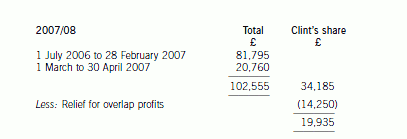
– Clint would have received an additional two months of profits amounting to £6,920 (£20,760 x 1/3).
– Clint’s trading income in 2006/07 would have been reduced by £13,015 (£43,723 – £30,708), much of which
would have been subject to income tax at 40%. His additional trading income in 2007/08 of £19,935 would all
have been taxed at 10% and 22%.
– Clint is entitled to the personal age allowance of £7,280 in both years. However, it is abated by £1 for every £2
by which his total income exceeds £20,100. Once Clint’s total income exceeds £24,590 (£20,100 + ((£7,280
– £5,035) x 2)), his personal allowance will be reduced to the standard amount of £5,035. Accordingly, the
increased personal allowance would not be available in 2006/07 regardless of the year in which the business was
sold. It is available in 2007/08 (although part of it is wasted) but would not have been if the sale of the business
had been delayed.
– Clint’s class 4 national insurance contributions in 2006/07 would have been reduced due to the fall in the level
of his trading income. However, much of the saving would be at 1% only. Clint is not liable to class 4 national
insurance contributions in 2007/08 as he is 65 at the start of the year.
– Changing the date on which the business was sold would have had no effect on Clint’s class 2 liability as he is
not required to make class 2 contributions once he is 65 years old.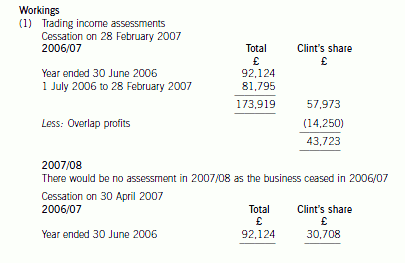
-
第9题:
5 (a) Carver Ltd was incorporated and began trading in August 2002. It is a close company with no associated
companies. It has always prepared accounts to 31 December and will continue to do so in the future.
It has been decided that Carver Ltd will sell its business as a going concern to Blade Ltd, an unconnected
company, on 31 July 2007. Its premises and goodwill will be sold for £2,135,000 and £290,000 respectively
and its machinery and equipment for £187,000. The premises, which do not constitute an industrial building,
were acquired on 1 August 2002 for £1,808,000 and the goodwill has been generated internally by the
company. The machinery and equipment cost £294,000; no one item will be sold for more than its original cost.
The tax adjusted trading profit of Carver Ltd in 2007, before taking account of both capital allowances and the
sale of the business assets, is expected to be £81,000. The balance on the plant and machinery pool for the
purposes of capital allowances as at 31 December 2006 was £231,500. Machinery costing £38,000 was
purchased on 1 March 2007. Carver Ltd is classified as a small company for the purposes of capital allowances.
On 1 August 2007, the proceeds from the sale of the business will be invested in either an office building or a
portfolio of UK quoted company shares, as follows:
Office building
The office building would be acquired for £3,100,000; the vendor is not registered for value added tax (VAT).
Carver Ltd would borrow the additional funds required from a UK bank. The building is let to a number of
commercial tenants who are not connected with Carver Ltd and will pay rent, in total, of £54,000 per calendar
quarter, in advance, commencing on 1 August 2007. The company’s expenditure for the period from 1 August
2007 to 31 December 2007 is expected to be:
£
Loan interest payable to UK bank 16,000
Building maintenance costs 7,500
Share portfolio
Shares would be purchased for the amount of the proceeds from the sale of the business with no need for further
loan finance. It is estimated that the share portfolio would generate dividends of £36,000 and capital gains, after
indexation allowance, of £10,000 in the period from 1 August 2007 to 31 December 2007.
All figures are stated exclusive of value added tax (VAT).
Required:
(i) Taking account of the proposed sale of the business on 31 July 2007, state with reasons the date(s) on
which Carver Ltd must submit its corporation tax return(s) for the year ending 31 December 2007.
(2 marks)
正确答案:
(a) (i) Due date for submission of corporation tax return
Carver Ltd intends to cease trading on 31 July 2007. This will bring to an end the accounting period that began on
1 January 2007. A new accounting period will commence on 1 August 2007 and end on the company’s accounting
reference date on 31 December 2007.
Carver Ltd is required to submit its corporation tax return by the later of:
– one year after the end of its accounting period; and
– one year after the end of the period of account in which the last day of the accounting period falls.
Accordingly, the company must submit its corporation tax returns for both accounting periods by 31 December 2008. -
第10题:
(iv) The stamp duty and/or stamp duty land tax payable by the Saturn Ltd group; (2 marks)
Additional marks will be awarded for the appropriateness of the format and presentation of the memorandum
and the effectiveness with which the information is communicated. (2 marks)
正确答案:
(iv) Stamp duty and stamp duty land tax
– The purchase of Tethys Ltd will give rise to a liability to ad valorem stamp duty of £1,175 (£235,000 x 0·5%).
The stamp duty must be paid by Saturn Ltd within 30 days of the share transfer in order to avoid interest being
charged. It is not an allowable expense for the purposes of corporation tax. -
第11题:
5 Gagarin wishes to persuade a number of wealthy individuals who are business contacts to invest in his company,
Vostok Ltd. He also requires advice on the recoverability of input tax relating to the purchase of new premises.
The following information has been obtained from a meeting with Gagarin.
Vostok Ltd:
– An unquoted UK resident company.
– Gagarin owns 100% of the company’s ordinary share capital.
– Has 18 employees.
– Provides computer based services to commercial companies.
– Requires additional funds to finance its expansion.
Funds required by Vostok Ltd:
– Vostok Ltd needs to raise £420,000.
– Vostok Ltd will issue 20,000 shares at £21 per share on 31 August 2008.
– The new shareholder(s) will own 40% of the company.
– Part of the money raised will contribute towards the purchase of new premises for use by Vostok Ltd.
Gagarin’s initial thoughts:
– The minimum investment will be 5,000 shares and payment will be made in full on subscription.
– Gagarin has a number of wealthy business contacts who may be interested in investing.
– Gagarin has heard that it may be possible to obtain tax relief for up to 60% of the investment via the enterprise
investment scheme.
Wealthy business contacts:
– Are all UK resident higher rate taxpayers.
– May wish to borrow the funds to invest in Vostok Ltd if there is a tax incentive to do so.
New premises:
– Will cost £446,500 including value added tax (VAT).
– Will be used in connection with all aspects of Vostok Ltd’s business.
– Will be sold for £600,000 plus VAT in six years time.
– Vostok Ltd will waive the VAT exemption on the sale of the building.
The VAT position of Vostok Ltd:
– In the year ending 31 March 2009, 28% of Vostok Ltd’s supplies will be exempt for the purposes of VAT.
– This percentage is expected to reduce over the next few years.
– Irrecoverable input tax due to the company’s partially exempt status exceeds the de minimis limits.
Required:
(a) Prepare notes for Gagarin to use when speaking to potential investors. The notes should include:
(i) The tax incentives immediately available in respect of the amount invested in shares issued in
accordance with the enterprise investment scheme; (5 marks)
正确答案:
(a) (i) The tax incentives immediately available
Income tax
– The investor’s income tax liability for 2008/09 will be reduced by 20% of the amount subscribed for the shares.
– Up to half of the amount invested can be treated as if paid in 2007/08 rather than 2008/09. This is subject to a
maximum carryback of £50,000.
This ability to carryback relief to the previous year is useful where the investor’s income in 2008/09 is insufficient
to absorb all of the relief available.
Tutorial note
There would be no change to the income tax liability of 2007/08 where an amount is treated as if paid in that year.
This ensures that such a claim does not affect payments on account under the self assessment system. Instead, the
tax refund due is calculated by reference to 2007/08 but is deducted from the next payment of tax due from the
taxpayer or is repaid to the taxpayer.
Capital gains tax deferral
– For every £1 invested in Vostok Ltd, an investor can defer £1 of capital gain and thus, potentially, 40 pence of
capital gains tax.
– The gain deferred can be in respect of the disposal of any asset.
– The shares must be subscribed for within the four year period starting one year prior to the date on which the
disposal giving rise to the gain took place. -
第12题:
(b) Calculate the amount of input tax that will be recovered by Vostok Ltd in respect of the new premises in the
year ending 31 March 2009 and explain, using illustrative calculations, how any additional recoverable input
tax will be calculated in future years. (5 marks)
正确答案:
(b) Recoverable input tax in respect of new premises
Vostok Ltd will recover £47,880 (£446,500 x 7/47 x 72%) in the year ending 31 March 2009.
The capital goods scheme will apply to the purchase of the building because it is to cost more than £250,000. Under the
scheme, the total amount of input tax recovered reflects the use of the building over the period of ownership, up to a maximum
of ten years, rather than merely the year of purchase.
Further input tax will be recovered in future years as the percentage of exempt supplies falls. (If the percentage of exempt
supplies were to rise, Vostok Ltd would have to repay input tax to HMRC.)
The additional recoverable input tax will be computed by reference to the percentage of taxable supplies in each year including
the year of sale. For example, if the percentage of taxable supplies in a particular subsequent year were to be 80%, the
additional recoverable input tax would be computed as follows.
£446,500 x 7/47 x 1/10 x (80% – 72%) = £532.
Further input tax will be recovered in the year of sale as if Vostok Ltd’s supplies in the remaining years of the ten-year period
are fully vatable. For example, if the building is sold in year seven, the additional recoverable amount for the remaining three
years will be calculated as follows.
£446,500 x 7/47 x 1/10 x (100% – 72%) x 3 = £5,586. -
第13题:
Required:
(iii) A firm of consultants has offered to undertake a study on behalf of Envico Ltd which will provide perfect
information regarding seminar attendance during the forthcoming year.
Advise the management of Envico Ltd with regard to the maximum amount that they should pay to
consultants for perfect information regarding seminar attendance and comment briefly on the use of
perfect information in such decisions. (5 marks)
正确答案:
(iii) If attendance = 100 then management would opt for room size A which would produce a contribution of £832,000 x
0·2 = £166,400.
If attendance = 200 then management would opt for room size B which would produce a contribution of £2,163,200
x 0·5 = £1,081,600.
If attendance = 400 then management would opt for room size D which would produce a contribution of £6,656,000
x 0·3 = £1,996,800.
Therefore the expected value of perfect information would be the sum of the expected values of the three possible
outcomes which amounts to £3,244,800. Thus, if the information is correct then management should be willing to pay
up to £3,244,800 – £1,497,600 = £1,747,200 for the information. In practice, it is unlikely that perfect information
is obtainable. The management of Envico Ltd are really buying an information system that will provide them with a signal
which may prove to be correct or incorrect! For example, the consultants may predict that demand will be for 300
seminar places, however there still remains the fact that there is a likelihood of actual demand being for either 100,
200 or 400 seminar places. One should be mindful that imperfect information which may be, say only 75% reliable,
might still be worth obtaining. Other than when the value of imperfect and perfect information are equal to zero, the
value of perfect information will always be greater than the value of imperfect information. -
第14题:
(b) Comment (with relevant calculations) on the performance of the business of Quicklink Ltd and Celer
Transport during the year ended 31 May 2005 and, insofar as the information permits, its projected
performance for the year ending 31 May 2006. Your answer should specifically consider:
(i) Revenue generation per vehicle
(ii) Vehicle utilisation and delivery mix
(iii) Service quality. (14 marks)
正确答案: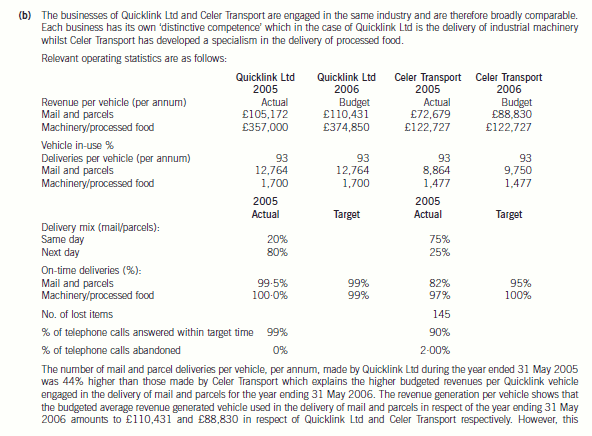
difference will reduce in the year ending 31 May 2006 due to the projected growth in sales volumes of the Celer Transport
business. The average mail/parcels delivery of mail/parcels per vehicle of the Quicklink Ltd part of the business is budgeted
at 12,764 which is still 30·91% higher than that of the Celer Transport business.
As far as specialist activities are concerned, Quicklink Ltd is budgeted to generate average revenues per vehicle amounting to
£374,850 whilst Celer Transport is budgeted to earn an average of £122,727 from each of the vehicles engaged in delivery
of processed food. It is noticeable that all contracts with major food producers were renewed on 1 June 2005 and it would
appear that there were no increases in the annual value of the contracts with major food producers. This might have been
the result of a strategic decision by the management of the combined entity in order to secure the future of this part of the
business which had been built up previously by the management of Celer Transport.
Each vehicle owned by Quicklink Ltd and Celer Transport is in use for 340 days during each year, which based on a
365 day year would give an in use % of 93%. This appears acceptable given the need for routine maintenance and repairs
due to wear and tear.
During the year ended 31 May 2005 the number of on-time deliveries of mail and parcel and industrial machinery deliveries
were 99·5% and 100% respectively. This compares with ratios of 82% and 97% in respect of mail and parcel and processed
food deliveries made by Celer Transport. In this critical area it is worth noting that Quicklink Ltd achieved their higher on-time
delivery target of 99% in respect of each activity whereas Celer Transport were unable to do so. Moreover, it is worth noting
that Celer Transport missed their target time for delivery of food products on 975 occasions throughout the year 31 May 2005
and this might well cause a high level of customer dissatisfaction and even result in lost business.
It is interesting to note that whilst the businesses operate in the same industry they have a rather different delivery mix in
terms of same day/next day demands by clients. Same day deliveries only comprise 20% of the business of Quicklink Ltd
whereas they comprise 75% of the business of Celer Transport. This may explain why the delivery performance of Celer
Transport with regard to mail and parcel deliveries was not as good as that of Quicklink Ltd.
The fact that 120 items of mail and 25 parcels were lost by the Celer Transport business is most disturbing and could prove
damaging as the safe delivery of such items is the very substance of the business and would almost certainly have resulted
in a loss of customer goodwill. This is an issue which must be addressed as a matter of urgency.
The introduction of the call management system by Quicklink Ltd on 1 June 2004 is now proving its worth with 99% of calls
answered within the target time of 20 seconds. This compares favourably with the Celer Transport business in which only
90% of a much smaller volume of calls were answered within a longer target time of 30 seconds. Future performance in this
area will improve if the call management system is applied to the Celer Transport business. In particular, it is likely that the
number of abandoned calls will be reduced and enhance the ‘image’ of the Celer Transport business.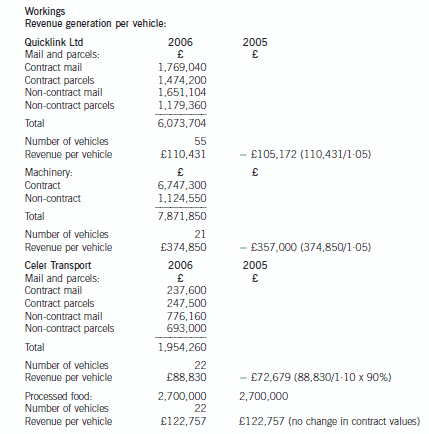

-
第15题:
(ii) Comment briefly on the use of its own tree plantations as a source of raw materials by Our Timbers Ltd.
(3 marks)
正确答案:
(ii) The use of its own tree plantations as a source of raw materials not only ensures available supplies of timber but may
also demonstrate that the directors of Our Timbers Ltd are mindful of the need for careful planning in the consumption
of natural resources. This concern with the need to protect the environment will enhance the reputation of Our Timbers
Ltd as an environmentally-conscious organisation which in turn may translate into a source of competitive advantage
since contemporary thought is very much focused on the environmental responsibilities of organisations with particular
regard to the use of natural resources such as timber.
-
第16题:
(iii) whether you agree or not with the statement of the production director. (3 marks)
正确答案:
(iii) ‘If we implement a reward scheme then it is bound to be beneficial for BGL’.
The statement of the manufacturing director is not necessarily correct. Indeed there is much evidence to support the
proposition that the existence of performance-related reward schemes can encourage dysfunctional behaviour. This often
manifests itself in the form. of ‘budgetary slack’ which is incorporated into budgets in anticipation of subsequent cuts by
higher levels of management or to make subsequent performance look better. -
第17题:
(b) Calculate the corporation tax (CT) liabilities for Alantech Ltd, Boron Ltd and Bubble Ltd for the year ending
31 December 2004 on the assumption that loss reliefs are taken as early as possible. (9 marks)
正确答案:(b) Schedule D Case I calculation
The three companies form. a group for both group relief and capital gains purposes as all shareholdings pass the 75%
ownership test. The calculation of the corporation tax liabilities is as follows:
-
第18题:
(ii) Briefly outline the tax consequences for Henry if the types of protection identified in (i) were to be
provided for him by Happy Home Ltd compared to providing them for himself. You are not required to
discuss the corporation tax (CT) consequences for Happy Home Ltd. (4 marks)
正确答案:
(ii) Provision of protection: company or individual
If any of the policies are taken out and paid for by Henry personally, then there will be no tax relief on the premiums,
but neither will there normally be any tax payable on the proceeds or benefits received.
If Happy Home Ltd were to pay the premiums on a policy taken out by Henry, and of which he was the direct beneficiary,
then this will constitute a benefit, on the grounds that the company will have satisfied a personal liability of Henry’s.
Accordingly, income tax and Class 1A national insurance contributions will be payable on the benefit.
If, however, Happy Home Ltd were to decide to offer protection benefits to their employees on a group basis (and not
just to Henry), then it would be possible to avoid a charge under the benefits rules and/or obtain a lower rate of premium
under a collective policy. For example:
– A death in service benefit of up to four times remuneration can be provided as part of an approved pension scheme.
No benefit charge arises on Henry and any lump sum will be paid tax free. This could be considered a substitute
for a term assurance policy.
– If a group permanent health insurance policy were taken out, no benefit charge would arise on Henry, but any
benefits payable under the policy would be paid to Happy Home Ltd in the first instance. When subsequently paid
on to Henry, such payments would be treated as arising from his employment and subject to PAYE and national
insurance as for normal salary payments.
– If a group critical illness policy were taken out, again no benefit charge would arise on Henry, but in this case also,
any benefits received by Henry directly from Happy Home Ltd as a result of the payments under the policy would
be considered as derived from his employment and subject to income tax and national insurance. Such a charge
to tax and national insurance would however be avoided if these payments were made in terms of a trust. -
第19题:
(iii) State how your answer in (ii) would differ if the sale were to be delayed until August 2006. (3 marks)
正确答案:
-
第20题:
(iii) The extent to which Amy will be subject to income tax in the UK on her earnings in respect of duties
performed for Cutlass Inc and the travel costs paid for by that company. (5 marks)
Appropriateness of format and presentation of the report and the effectiveness with which its advice is
communicated. (2 marks)
Note:
You should assume that the income tax rates and allowances for the tax year 2006/07 and the corporation tax
rates and allowances for the financial year 2006 apply throughout this questio
正确答案:
(iii) Amy’s UK income tax position
Amy will remain UK resident and ordinarily resident as she is not leaving the UK permanently or for a complete tax year
under a full time contract of employment. Accordingly, she will continue to be subject to UK tax on her worldwide income
including her earnings in respect of the duties she performs for Cutlass Inc. The earnings from these duties will also be
taxable in Sharpenia as the income arises in that country.
The double tax treaty between the UK and Sharpenia will either exempt the employment income in one of the two
countries or give double tax relief for the tax paid in Sharpenia. The double tax relief will be the lower of the UK tax and
the Sharpenian tax on the income from Cutlass Inc.
Amy will not be subject to UK income tax on the expenses borne by Cutlass Inc in respect of her flights to and from
Sharpenia provided her journeys are wholly and exclusively for the purposes of performing her duties in Sharpenia.
The amounts paid by Cutlass Inc in respect of Amy’s family travelling to Sharpenia will be subject to UK income tax as
Amy will not be absent from the UK for a continuous period of at least 60 days. -
第21题:
(ii) The use of the trading loss of Tethys Ltd for the year ending 31 December 2008; (6 marks)
正确答案:
(ii) Tethys Ltd – Use of trading loss
– The two companies will not be in a group relief group as Saturn Ltd will not own 75% of Tethys Ltd.
– For a consortium to exist, 75% of the ordinary share capital of Tethys Ltd must be held by companies which each
hold at least 5%. Accordingly, Tethys Ltd will be a consortium company if the balance of its share capital is owned
by Clangers Ltd but not if it is owned by Edith Clanger.
– If Tethys Ltd qualifies as a consortium company: 65% of its trading losses in the period from 1 August 2008 to
31 December 2008 can be surrendered to Saturn Ltd, i.e. £21,667 (£80,000 x 5/12 x 65%).
– If Tethys Ltd does not qualify as a consortium company: none of its loss can be surrendered to Saturn Ltd.
– The acquisition of 65% of Tethys Ltd is a change in ownership of the company. If there is a major change in the
nature or conduct of the trade of Tethys Ltd within three years of 1 August 2008, the loss arising prior to that date
cannot be carried forward for relief in the future.
Further information required:
– Ownership of the balance of the share capital of Tethys Ltd. -
第22题:
(b) Prepare a reasoned explanation of how any capital gains tax arising in the UK on the sale of the paintings
can be minimised. (2 marks)
正确答案:
(b) Minimising capital gains tax on the sale of the paintings
Galileo will become resident and ordinarily resident from the date he arrives in the UK as he intends to stay for more than
three years. Prior to that date he will be neither resident nor ordinarily resident such that he will not be subject to UK capital
gains tax.
Galileo should sell the paintings before he leaves Astronomeria; this will avoid UK capital gains tax completely.
Tutorial note
The gains would be taxable on the remittance basis if the paintings were sold after Galileo’s arrival in the UK. However, this
would not help Galileo to minimise the capital gains tax due as he needs to bring the sales proceeds into the UK in order
to purchase a house. -
第23题:
(ii) The answers to any questions that the potential investors may raise in connection with the maximum
possible investment, borrowing to finance the subscription and the implications of selling the shares.
(7 marks)
Note: you should assume that Vostok Ltd and its trade qualify for the purposes of the enterprise investment
scheme and you are not required to list the conditions that need to be satisfied by the company, its
shares or its business activities.
正确答案:
(ii) Answers to questions from potential investors
Maximum investment
– For the relief to be available, a shareholder (together with spouse and children) cannot own more than 30% of the
company. Accordingly, the maximum investment by a single subscriber will be £315,000 (15,000 x £21).
Borrowing to finance the purchase
– There would normally be tax relief for the interest paid on a loan taken out to acquire shares in a close company
such as Vostok Ltd. However, this relief is not available when the shares qualify for relief under the enterprise
investment scheme.
Implications of a subscriber selling the shares in Vostok Ltd
– The income tax relief will be withdrawn if the shares in Vostok Ltd are sold within three years of subscription.
– Any profit arising on the sale of the shares in Vostok Ltd on which income tax relief has been given will be exempt
from capital gains tax provided the shares have been held for three years.
– Any capital loss arising on the sale of the shares will be allowable regardless of how long the shares have been
held. However, the loss will be reduced by the amount of income tax relief obtained in respect of the investment.
The loss may be used to reduce the investor’s taxable income, and hence his income tax liability, for the tax year
of loss and/or the preceding tax year.
– Any gain deferred at the time of subscription will become chargeable in the year in which the shares in Vostok Ltd
are sold.