
(ii) Briefly discuss THREE disadvantages of using EVA? in the measurement of financial performance.(3 marks)
题目
(ii) Briefly discuss THREE disadvantages of using EVA? in the measurement of financial performance.
(3 marks)
相似考题
更多“(ii) Briefly discuss THREE disadvantages of using EVA? in the measurement of financial performance.(3 marks)”相关问题
-
第1题:
6 Communication is important for all organisations and requires an understanding of communication flows and channels.
Required:
(a) Briefly explain the main purposes of the three main formal communication channels in an organisation:
(i) Downwards; (3 marks)
正确答案:
6 There are many forms of communication within an organisation, both formal and informal. Formally communicated information often flows in one of three main directions: downwards, upwards and lateral. However, all organisations also have informal communication channels and management must understand their importance.
(a) Formal communicated information flows in three main directions.
(i) Downwards. This form. of communication is often the one most easily recognised and understood. The purpose of downward communication is to give specific directives, to provide information about procedures and practices and to provide information about work practices. It also serves to tell employees about their performance and provides information on organisational and departmental objectives.
-
第2题:
5 Ambush, a public limited company, is assessing the impact of implementing the revised IAS39 ‘Financial Instruments:
Recognition and Measurement’. The directors realise that significant changes may occur in their accounting treatment
of financial instruments and they understand that on initial recognition any financial asset or liability can be
designated as one to be measured at fair value through profit or loss (the fair value option). However, there are certain
issues that they wish to have explained and these are set out below.
Required:
(a) Outline in a report to the directors of Ambush the following information:
(i) how financial assets and liabilities are measured and classified, briefly setting out the accounting
method used for each category. (Hedging relationships can be ignored.) (10 marks)
正确答案:5 Report to the Directors of Ambush, a public limited company
(a) The following report sets out the principal aspects of IAS 39 in the designated areas.
(i) Classification of financial instruments and their measurement
Financial assets and liabilities are initially measured at fair value which will normally be the fair value of the
consideration given or received. Transaction costs are included in the initial carrying value of the instrument unless it
is carried at ‘fair value through profit or loss’ when these costs are recognised in the income statement.
Financial assets should be classified into four categories:
(i) financial assets at fair value through profit or loss
(ii) loans and receivables
(iii) held-to-maturity investments (HTM)
(iv) available-for-sale financial assets (AFS).
The first category above has two sub categories which are ‘held for trading’ and those designated to this category at
inception/initial recognition. This latter designation is irrevocable.
Financial liabilities have two categories: those at fair value through profit or loss, and ‘other’ liabilities. As with financial
assets those liabilities designated as at fair value through profit or loss have two sub categories which are the same as
those for financial assets.
Reclassifications between categories are uncommon and restricted under IAS 39 and are prohibited into and out of the
fair value through profit or loss category. Reclassifications between AFS and HTM are possible but it is not possible from
loans and receivables to AFS. The held to maturity category is limited in its application as if the company sells or
reclassifies more than an immaterial amount of the portfolio, it is barred from using the category for at least two years.
Also all remaining HTM investments would be reclassified to AFS.
Subsequent measurement of financial assets and liabilities depends on the classification. The following tablesummarises the position: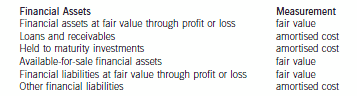
Amortised cost is the cost of an asset or liability adjusted to achieve a constant effective interest rate over the life of the
asset or liability.
It is not possible to compute amortised cost for instruments that do not have fixed or determinable payments, such as
for equity instruments, and such instruments therefore cannot be classified into these categories.
A company must apply the effective interest rate method in the measurement of amortised cost. The effective interest
rate method determines how much interest income or interest expense should be reported in profit and loss.
For financial assets at fair value through profit or loss and financial liabilities at fair value through profit or loss, all
changes in fair value are recognised in profit or loss when they occur. This includes unrealised holding gains and losses.
For available-for-sale financial assets, unrealised holding gains and losses are deferred in reserves until they are realised
or impairment occurs. Only interest income and dividend income, impairment losses, and certain foreign currency gains
and losses are recognised in profit or loss.
Investments in unquoted equity instruments that cannot be reliably measured at fair value are subsequently measureat cost. Unrealised holding gains/losses are not normally recognised in profit/loss. -
第3题:
5 Financial statements have seen an increasing move towards the use of fair values in accounting. Advocates of ‘fair
value accounting’ believe that fair value is the most relevant measure for financial reporting whilst others believe that
historical cost provides a more useful measure.
Issues have been raised over the reliability and measurement of fair values, and over the nature of the current level
of disclosure in financial statements in this area.
Required:
(a) Discuss the problems associated with the reliability and measurement of fair values and the nature of any
additional disclosures which may be required if fair value accounting is to be used exclusively in corporate
reporting. (13 marks)
正确答案:
(a) Reliability and Measurement
Fair value can be defined as the price that would be received to sell an asset or paid to transfer a liability. The fair value can
be thought of as an ‘exit price’. A fair value measurement assumes that the transaction to sell the asset or transfer the liability
occurs in the principal market for the asset or liability or, in the absence of a principal market, the most advantageous market
for the asset or liability which is the market in which the reporting entity would sell the asset or transfer the liability with the
price that maximises the amount that would be received or minimises the amount that would be paid. IAS39 ‘Financial
Instruments: Recognition and Measurement’ requires an entity to use the most advantageous active market in measuring the
fair value of a financial asset or liability when multiple markets exist whereas IAS41 ‘Agriculture’ requires an entity to use the
most relevant market. Thus there can be different approaches for estimating exit prices. Additionally valuation techniques and
current replacement cost could be used.
A hierarchy of fair value measurements would have to be developed in order to convey information about the nature of the
information used in creating the fair values. For example quoted prices (unadjusted) in active markets would provide better
quality information than quoted prices for similar assets and liabilities in active markets which would provide better quality
information than prices which reflect the reporting entity’s own thinking about the assumptions that market participants would
use in pricing the asset or liability. Enron made extensive use of what it called ‘mark-to-market’ accounting which was based
on valuation techniques and estimates. IFRSs currently do not have a single hierarchy that applies to all fair value measures.
Instead individual standards indicate preferences for certain inputs and measures of fair value over others, but this guidance
is not consistent among all IFRSs.
Some companies, in order to effectively manage their businesses, have already developed models for determining fair values.
Businesses manage their operations by managing risks. A risk management process often requires measurement of fair values
of contracts, financial instruments, and risk positions.
If markets were liquid and transparent for all assets and liabilities, fair value accounting clearly would give reliable information
which is useful in the decision making process. However, because many assets and liabilities do not have an active market,
the inputs and methods for estimating their fair value are more subjective and, therefore, the valuations are less reliable. Fair
value estimates can vary greatly, depending on the valuation inputs and methodology used. Where management uses
significant judgment in selecting market inputs when market prices are not available, reliability will continue to be an issue.
Management can use significant judgment in the valuation process. Management bias, whether intentional or unintentional,
may result in inappropriate fair value measurements and consequently misstatements of earnings and equity capital. Without
reliable fair value estimates, the potential for misstatements in financial statements prepared using fair value measurements
will be even greater.
Consideration must be given to revenue recognition issues in a fair value system. It must be ensured that unearned revenue
is not recognised early as it recently was by certain high-tech companies.
As the variety and complexity of financial instruments increases, so does the need for independent verification of fair value
estimates. However, verification of valuations that are not based on observable market prices is very challenging. Users of
financial statements will need to place greater emphasis on understanding how assets and liabilities are measured and how
reliable these valuations are when making decisions based on them.
Disclosure
Fair values reflect point estimates and do not result in transparent financial statements. Additional disclosures are necessary
to bring meaning to these fair value estimates. These disclosures might include key drivers affecting valuations, fair-valuerange
estimates, and confidence levels. Another important disclosure consideration relates to changes in fair value amounts.
For example, changes in fair values on securities can arise from movements in interest rates, foreign-currency rates, and credit
quality, as well as purchases and sales from the portfolio. For users to understand fair value estimates, they must be given
adequate disclosures about what factors caused the changes in fair value. It could be argued that the costs involved in
determining fair values may exceed the benefits derived therefrom. When considering how fair value information should be
presented in the financial statements, it is important to consider what type of financial information investors want. There are
indications that some investors desire both fair value information and historical cost information. One of the issues affecting
the credibility of fair value disclosures currently is that a number of companies include ‘health warnings’ with their disclosures
indicating that the information is not used by management. This language may contribute to users believing that the fair value
disclosures lack credibility.
-
第4题:
Required:
Discuss the principles and practices which should be used in the financial year to 30 November 2008 to account
for:(b) the costs incurred in extending the network; (7 marks)
正确答案:
Costs incurred in extending network
The cost of an item of property, plant and equipment should be recognised when
(i) it is probable that future economic benefits associated with the item will flow to the entity, and
(ii) the cost of the item can be measured reliably (IAS16, ‘Property, plant and equipment’ (PPE))
It is necessary to assess the degree of certainty attaching to the flow of economic benefits and the basis of the evidence available
at the time of initial recognition. The cost incurred during the initial feasibility study ($250,000) should be expensed as incurred,
as the flow of economic benefits to Johan as a result of the study would have been uncertain.
IAS16 states that the cost of an item of PPE comprises amongst other costs, directly attributable costs of bringing the asset to the
location and condition necessary for it to be capable of operating in a manner intended by management (IAS16, para 16).
Examples of costs given in IAS16 are site preparation costs, and installation and assembly costs. The selection of the base station
site is critical for the optimal operation of the network and is part of the process of bringing the network assets to a working
condition. Thus the costs incurred by engaging a consultant ($50,000) to find an optimal site can be capitalised as it is part of
the cost of constructing the network and depreciated accordingly as planning permission has been obtained.
Under IAS17, ‘Leases’, a lease is defined as an agreement whereby the lessor conveys to the lessee, in return for a payment or
series of payments, the right to use an asset for an agreed period of time. A finance lease is a lease that transfers substantially all
the risks and rewards incidental to ownership of the leased asset to the lessee. An operating lease is a lease other than a finance
lease. In the case of the contract regarding the land, there is no ownership transfer and the term is not for the major part of the
asset’s life as it is land which has an indefinite economic life. Thus substantially all of the risks and rewards incidental to ownership
have not been transferred. The contract should be treated, therefore, as an operating lease. The payment of $300,000 should be
treated as a prepayment in the statement of financial position and charged to the income statement over the life of the contract on
the straight line basis. The monthly payments will be expensed and no value placed on the lease contract in the statement of
financial position -
第5题:
(b) Discuss the relevance of each of the following actions as steps in trying to remedy performance measurement
problems relating to the ‘365 Sports Complex’ and suggest examples of specific problem classifications that
may be reduced or eliminated by each action:
(i) Focusing on and improving the measurement of customer satisfaction
(ii) Involving staff at all levels in the development and implementation of performance measures
(iii) Being flexible in the extent to which formal performance measures are relied on
(iv) Giving consideration to the auditing of the performance measurement system. (8 marks)
正确答案:
(b) Trying to focus on and improve the measurement of customer satisfaction.
This is a vital goal. Without monitoring and improvement of levels of customer satisfaction, an organisation will tend to
underachieve and is likely to have problems with its future effectiveness. Positive signals from performance measures made
earlier in the value chain are only relevant if they contribute to the ultimate requirement of customer satisfaction. Tunnel vision
and sub-optimisation are examples of measurement problems that may be reduced through recognition of the need for a
management focus on customer satisfaction. For example undue focus on the importance of maximising opening hours may
lead to lack of focus on other quality issues seen as important by customers.
Involving staff at all levels in the development and implementation of performance measures.
People are involved in the achievement of performance measures at all levels and in all aspects of an organisation. It is
important that all staff are willing to accept and work towards any performance measures that are developed to monitor their
part in the operation of the organisation and in the achievement of its objectives. This should help, for example, to reduce
gaming. At the sports complex an example of gaming might be, a deliberate attempt to understate the potential benefits of
maintaining the buildings in order to ensure that funds would be used for other purposes such as an increased advertising
budget. The directors of Astrodome Sports Ltd must recognise that leisure facilities that appear dated and in a poor state of
repair will cause customers to look for more aesthetically appealing alternatives.
Being flexible in the extent to which formal performance measures are relied on.
It is best to acknowledge that measures should not be relied on exclusively for control. A performance measure may give a
short-term signal that does not relate directly to actions that are taking place to improve the level of performance in the longer
term. To some extent, improved performance may be achieved through the informal interaction between individuals and
groups. This flexibility should help to reduce measure fixation and misrepresentation. For example the percentage increase in
the quantity of bowling equipment purchased is seen as necessarily implying increased demand for use of the bowling greens.
Giving consideration to the audit of the performance measurement system.
Actions that may be taken may include:
– Seeking expert interpretation of the performance measures in place. It is important that any audit is ‘free from bias’ and
conducted independently on an ‘arm’s length’ basis. Thus it is essential that such audits should be ‘free from the
influence’ of those personnel involved in the operation of the system.
– Maintaining a careful audit of the data used. Any assessment scheme is only as good as the data on which it is founded
and how this data is analysed and interpreted.
The above actions should help, in particular, to reduce the incidence and impact of measure fixation, misinterpretation and
gaming.
For example, an audit may show that the directors of Astrodome Sports Ltd are fixated on equipment availability and
misinterpret this as being the key to customer volume and high profitability. The audit may also provide evidence of gaming
such as a deliberate attempt to underplay the benefits of one course of action in order to release funds for use on some
alternative.
-
第6题:
(ii) Briefly discuss FOUR non-financial factors which might influence the above decision. (4 marks)
正确答案:
(ii) Four factors that could be considered are as follows:
(i) The quality of the service provided by NSC as evidenced by, for example, the comfort of the ferries, on-board
facilities, friendliness and responsiveness of staff.
(ii) The health and safety track record of NSC – passenger safety is a ‘must’ in such operations.
(iii) The reliability, timeliness and dependability of NSC as a service provider.
(iv) The potential loss of image due to redundancies within Wonderland plc. -
第7题:
(ii) Comment briefly on the use of its own tree plantations as a source of raw materials by Our Timbers Ltd.
(3 marks)
正确答案:
(ii) The use of its own tree plantations as a source of raw materials not only ensures available supplies of timber but may
also demonstrate that the directors of Our Timbers Ltd are mindful of the need for careful planning in the consumption
of natural resources. This concern with the need to protect the environment will enhance the reputation of Our Timbers
Ltd as an environmentally-conscious organisation which in turn may translate into a source of competitive advantage
since contemporary thought is very much focused on the environmental responsibilities of organisations with particular
regard to the use of natural resources such as timber.
-
第8题:
(c) Explain the term ‘target costing’ and how it may be applied by GWCC. Briefly discuss any potential
limitations in its application. (8 marks)
正确答案:
(c) Target costing should be viewed as an integral part of a strategic profit management system. The initial consideration in target
costing is the determination of an estimate of the selling price for a new product which will enable a firm to capture its required
share of the market. In this particular example, Superstores plc, which on the face of it looks a powerful commercial
organisation, wishes to apply a 35% mark-up on the purchase price of each cake from GWCC. Since Superstores plc has
already decided on a launch price of £20·25 then it follows that the maximum selling price that can be charged by GWCC
is (100/135) x £20·25 which is £15·00.
This is clearly a situation which lends itself to the application of target costing/pricing techniques as in essence GWCC can
see the extent to which they fall short of the required level of return with regard to a contract with Superstores plc which ends
after twelve months. Thus it is necessary to reduce the total costs by £556,029 to this figure in order to achieve the desired
level of profit, having regard to the rate of return required on new capital investment. The deduction of required profit from
the proposed selling price will produce a target price that must be met in order to ensure that the desired rate of return is
obtained. Thus the main theme that underpins target costing can be seen to be ‘what should a product cost in order to achieve
the desired level of return’.
Target costing will necessitate comparison of current estimated cost levels against the target level which must be achieved if
the desired levels of profitability, and hence return on investment, are to be achieved. Thus where a gap exists between the
current estimated cost levels and the target cost, it is essential that this gap be closed.
The Directors of GWCC plc should be aware of the fact that it is far easier to ‘design out’ cost during the pre-production phase
than to ‘control out’ cost during the production phase. Thus cost reduction at this stage of a product’s life cycle is of critical
significance to business success.
A number of techniques may be employed in order to help in the achievement and maintenance of the desired level of target
cost. Attention should be focussed upon the identification of value added and non-value added activities with the aim of the
elimination of the latter. The product should be developed in an atmosphere of ‘continuous improvement’. In this regard, total
quality techniques such as the use of Quality circles may be used in attempting to find ways of achieving reductions in product
cost.
Value engineering techniques can be used to evaluate necessary product features such as the quality of materials used. It is
essential that a collaborative approach is taken by the management of GWCC and that all interested parties such as suppliers
and customers are closely involved in order to engineer product enhancements at reduced cost.
The degree of success that will be achieved by GWCC via the application of target costing principles will be very much
dependent on the extent of ‘flexibility’ in variable costs. Also the accuracy of information gathered by GWCC will assume
critical importance because the use of inaccurate information will produce calculated ‘cost gaps’ which are meaningless and
render the application of target costing principles of little value. -
第9题:
(b) Briefly discuss how stakeholder groups (other than management and employees) may be rewarded for ‘good’
performance. (4 marks)
正确答案:
(b) Good performance should result in improved profitability and therefore other stakeholder groups may be rewarded for ‘good
performance’ as follows:
– Shareholders may receive increased returns on equity in the form. of increased dividends and /or capital growth.
– Customers may benefit from improved quality of products and services, and possibly lower prices.
– Suppliers may benefit from increased volumes of purchases.
– Government will benefit from increased amounts of taxation. -
第10题:
(c) Briefly discuss why the directors of HFL might choose contract D irrespective of whether or not contract D
would have been selected using expected values as per part (a). (2 marks)
正确答案:
(c) The directors might select Contract D under which 360,000 kilograms of organic mushrooms would be supplied to HFL for
each outlet. This is the entire capacity of HFL which would ensure that competitors would not be able to supply the same
product and hence the competitive advantage held by HFL might be preserved. -
第11题:
3 (a) Financial statements often contain material balances recognised at fair value. For auditors, this leads to additional
audit risk.
Required:
Discuss this statement. (7 marks)
正确答案:
3 Poppy Co
(a) Balances held at fair value are frequently recognised as material items in the statement of financial position. Sometimes it is
required by the financial reporting framework that the measurement of an asset or liability is at fair value, e.g. certain
categories of financial instruments, whereas it is sometimes the entity’s choice to measure an item using a fair value model
rather than a cost model, e.g. properties. It is certainly the case that many of these balances will be material, meaning that
the auditor must obtain sufficient appropriate evidence that the fair value measurement is in accordance with the
requirements of financial reporting standards. ISA 540 (Revised and Redrafted) Auditing Accounting Estimates Including Fair
Value Accounting Estimates and Related Disclosures and ISA 545 Auditing Fair Value Measurements and Disclosures
contain guidance in this area.
As part of the understanding of the entity and its environment, the auditor should gain an insight into balances that are stated
at fair value, and then assess the impact of this on the audit strategy. This will include an evaluation of the risk associated
with the balance(s) recognised at fair value.
Audit risk comprises three elements; each is discussed below in the context of whether material balances shown at fair value
will lead to increased risk for the auditor.
Inherent risk
Many measurements based on estimates, including fair value measurements, are inherently imprecise and subjective in
nature. The fair value assessment is likely to involve significant judgments, e.g. regarding market conditions, the timing of
cash flows, or the future intentions of the entity. In addition, there may be a deliberate attempt by management to manipulate
the fair value to achieve a desired aim within the financial statements, in other words to attempt some kind of window
dressing.
Many fair value estimation models are complicated, e.g. discounted cash flow techniques, or the actuarial calculations used
to determine the value of a pension fund. Any complicated calculations are relatively high risk, as difficult valuation techniques
are simply more likely to contain errors than simple valuation techniques. However, there will be some items shown at fair
value which have a low inherent risk, because the measurement of fair value may be relatively straightforward, e.g. assets
that are regularly bought and sold on open markets that provide readily available and reliable information on the market prices
at which actual exchanges occur.
In addition to the complexities discussed above, some fair value measurement techniques will contain significant
assumptions, e.g. the most appropriate discount factor to use, or judgments over the future use of an asset. Management
may not always have sufficient experience and knowledge in making these judgments.
Thus the auditor should approach some balances recognised at fair value as having a relatively high inherent risk, as their
subjective and complex nature means that the balance is prone to contain an error. However, the auditor should not just
assume that all fair value items contain high inherent risk – each balance recognised at fair value should be assessed for its
individual level of risk.
Control risk
The risk that the entity’s internal monitoring system fails to prevent and detect valuation errors needs to be assessed as part
of overall audit risk assessment. One problem is that the fair value assessment is likely to be performed once a year, outside
the normal accounting and management systems, especially where the valuation is performed by an external specialist.
Therefore, as a non-routine event, the assessment of fair value is likely not to have the same level of monitoring or controls
as a day-to-day business transaction.
However, due to the material impact of fair values on the statement of financial position, and in some circumstances on profit,
management may have made great effort to ensure that the assessment is highly monitored and controlled. It therefore could
be the case that there is extremely low control risk associated with the recognition of fair values.
Detection risk
The auditor should minimise detection risk via thorough planning and execution of audit procedures. The audit team may
lack experience in dealing with the fair value in question, and so would be unlikely to detect errors in the valuation techniques
used. Over-reliance on an external specialist could also lead to errors not being found.
Conclusion
It is true that the increasing recognition of items measured at fair value will in many cases cause the auditor to assess the
audit risk associated with the balance as high. However, it should not be assumed that every fair value item will be likely to
contain a material misstatement. The auditor must be careful to identify and respond to the level of risk for fair value items
on an individual basis to ensure that sufficient and appropriate evidence is gathered, thus reducing the audit risk to an
acceptable level. -
第12题:
JJG Co is planning to raise $15 million of new finance for a major expansion of existing business and is considering a rights issue, a placing or an issue of bonds. The corporate objectives of JJG Co, as stated in its Annual Report, are to maximise the wealth of its shareholders and to achieve continuous growth in earnings per share. Recent financial information on JJG Co is as follows:
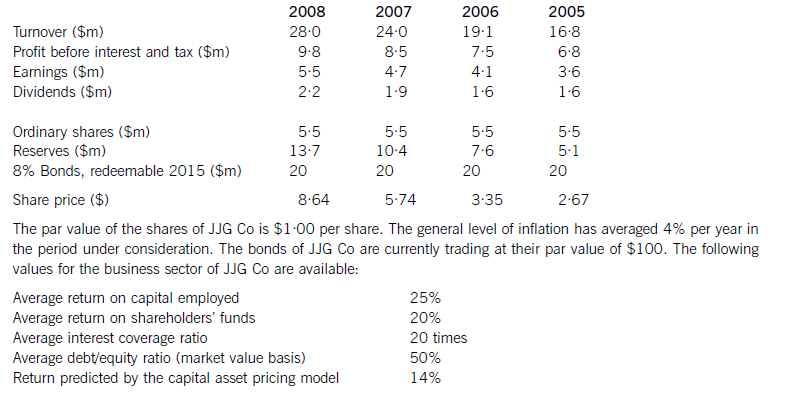
Required:
(a) Evaluate the financial performance of JJG Co, and analyse and discuss the extent to which the company has achieved its stated corporate objectives of:
(i) maximising the wealth of its shareholders;
(ii) achieving continuous growth in earnings per share.
Note: up to 7 marks are available for financial analysis.(12 marks)
(b) If the new finance is raised via a rights issue at $7·50 per share and the major expansion of business has
not yet begun, calculate and comment on the effect of the rights issue on:
(i) the share price of JJG Co;
(ii) the earnings per share of the company; and
(iii) the debt/equity ratio. (6 marks)
(c) Analyse and discuss the relative merits of a rights issue, a placing and an issue of bonds as ways of raising the finance for the expansion. (7 marks)
正确答案:
AchievementofcorporateobjectivesJJGCohasshareholderwealthmaximisationasanobjective.Thewealthofshareholdersisincreasedbydividendsreceivedandcapitalgainsonsharesowned.Totalshareholderreturncomparesthesumofthedividendreceivedandthecapitalgainwiththeopeningshareprice.TheshareholdersofJJGCohadareturnof58%in2008,comparedwithareturnpredictedbythecapitalassetpricingmodelof14%.Thelowestreturnshareholdershavereceivedwas21%andthehighestreturnwas82%.Onthisbasis,theshareholdersofthecompanyhaveexperiencedasignificantincreaseinwealth.Itisdebatablewhetherthishasbeenasaresultoftheactionsofthecompany,however.Sharepricesmayincreaseirrespectiveoftheactionsanddecisionsofmanagers,orevendespitethem.Infact,lookingatthedividendpersharehistoryofthecompany,therewasoneyear(2006)wheredividendswereconstant,eventhoughearningspershareincreased.Itisalsodifficulttoknowwhenwealthhasbeenmaximised.Anotherobjectiveofthecompanywastoachieveacontinuousincreaseinearningspershare.Analysisshowsthatearningspershareincreasedeveryyear,withanaverageincreaseof14·9%.Thisobjectiveappearstohavebeenachieved.CommentonfinancialperformanceReturnoncapitalemployed(ROCE)hasbeengrowingtowardsthesectoraverageof25%onayear-by-yearbasisfrom22%in2005.Thissteadygrowthintheprimaryaccountingratiocanbecontrastedwithirregulargrowthinturnover,thereasonsforwhichareunknown.Returnonshareholders’fundshasbeenconsistentlyhigherthantheaverageforthesector.ThismaybeduemoretothecapitalstructureofJJGCothantogoodperformancebythecompany,however,inthesensethatshareholders’fundsaresmalleronabookvaluebasisthanthelong-termdebtcapital.Ineverypreviousyearbut2008thegearingofthecompanywashigherthanthesectoraverage.(b)CalculationoftheoreticalexrightspershareCurrentshareprice=$8·64pershareCurrentnumberofshares=5·5millionsharesFinancetoberaised=$15mRightsissueprice=$7·50pershareNumberofsharesissued=15m/7·50=2millionsharesTheoreticalexrightspricepershare=((5·5mx8·64)+(2mx7·50))/7·5m=$8·34pershareThesharepricewouldfallfrom$8·64to$8·34pershareHowever,therewouldbenoeffectonshareholderwealthEffectofrightsissueonearningspershareCurrentEPS=100centspershareRevisedEPS=100x5·5m/7·5m=73centspershareTheEPSwouldfallfrom100centspershareto73centspershareHowever,asmentionedearlier,therewouldbenoeffectonshareholderwealthEffectofrightsissueonthedebt/equityratioCurrentdebt/equityratio=100x20/47·5=42%Revisedmarketvalueofequity=7·5mx8·34=$62·55millionReviseddebt/equityratio=100x20/62·55=32%Thedebt/equityratiowouldfallfrom42%to32%,whichiswellbelowthesectoraveragevalueandwouldsignalareductioninfinancialrisk(c)Thecurrentdebt/equityratioofJJGCois42%(20/47·5).Althoughthisislessthanthesectoraveragevalueof50%,itismoreusefulfromafinancialriskperspectivetolookattheextenttowhichinterestpaymentsarecoveredbyprofits.Theinterestonthebondissueis$1·6million(8%of$20m),givinganinterestcoverageratioof6·1times.IfJJGCohasoverdraftfinance,theinterestcoverageratiowillbelowerthanthis,butthereisinsufficientinformationtodetermineifanoverdraftexists.Theinterestcoverageratioisnotonlybelowthesectoraverage,itisalsolowenoughtobeacauseforconcern.Whiletheratioshowsanupwardtrendovertheperiodunderconsideration,itstillindicatesthatanissueoffurtherdebtwouldbeunwise.Aplacing,oranyissueofnewsharessuchasarightsissueorapublicoffer,woulddecreasegearing.Iftheexpansionofbusinessresultsinanincreaseinprofitbeforeinterestandtax,theinterestcoverageratiowillincreaseandfinancialriskwillfall.GiventhecurrentfinancialpositionofJJGCo,adecreaseinfinancialriskiscertainlypreferabletoanincrease.Aplacingwilldiluteownershipandcontrol,providingthenewequityissueistakenupbynewinstitutionalshareholders,whilearightsissuewillnotdiluteownershipandcontrol,providingexistingshareholderstakeuptheirrights.Abondissuedoesnothaveownershipandcontrolimplications,althoughrestrictiveornegativecovenantsinbondissuedocumentscanlimittheactionsofacompanyanditsmanagers.Allthreefinancingchoicesarelong-termsourcesoffinanceandsoareappropriateforalong-terminvestmentsuchastheproposedexpansionofexistingbusiness.Equityissuessuchasaplacingandarightsissuedonotrequiresecurity.Noinformationisprovidedonthenon-currentassetsofJJGCo,butitislikelythattheexistingbondissueissecured.Ifanewbondissuewasbeingconsidered,JJGCowouldneedtoconsiderwhetherithadsufficientnon-currentassetstoofferassecurity,althoughitislikelythatnewnon-currentassetswouldbeboughtaspartofthebusinessexpansion. -
第13题:
(b) What are the advantages and disadvantages of using franchising to develop La Familia Amable budget hotel
chain? (8 marks)
正确答案:
(b) Franchising is typically seen as a quick and cost effective way of growing the business but Ramon should be aware of both
the advantages and disadvantages of using it as the preferred method of growth. Franchised chains are argued to benefit from
the sort of brand recognition and economies of scale not enjoyed by independent owner/managers. When combined with the
high levels of motivation normally associated with owner/managed businesses, franchises can be argued to get the best of
both worlds.
Franchising is defined as ‘a contractual agreement between two legally independent companies whereby the franchisor grants
the right to the franchisee to sell the franchisor’s product or do business under its trademarks in a given location for a specified
period of time. In return, the franchisee agrees to pay the franchisor a combination of fees, usually including an up-front
franchise fee, royalties calculated as a percentage of unit revenues, and an advertising conbribution that is also usually a
percentage of unit sales.’
Ramon is considering a type of franchising called ‘business-format franchising’, where the franchisor sells a way of doing
business to its franchisees. Business-format franchising is a model frequently found in the fast food and restaurant industry,
hotels and motels, construction and maintenance, and non-food retailing. Often these franchises are labour intensive and
relatively small-scale operations.
Franchising is seen as a safer alternative to growing the business organically, so while this may be true of well established
global franchises, failure rates among franchised small businesses were greater than those of independent businesses (in one
US study a 34·7% failure rate for franchises as opposed to 28·0% for independents over a six or seven year period). Often
it is the failure of the franchisor that brings down its franchisees. Failure stems from the franchisee not only having to rely on
their own skills and enthusiasm but also the capacity of the franchisor and other franchisees to make the overall operation
work.
The advantages to the franchisee are through gaining access to a well-regarded brand name that will generate a higher level
of demand and use of a tried and tested business model that should reduce the franchisee’s operating costs. Both of these
benefits stem from being a member of a well-established franchised system. Yet La Familia Amable along with many other
franchises will be new and small. These smaller franchises tend to be regional in scope, and fairly unknown outside their
regional market. This has a significant effect on what the franchisees can expect to gain from their franchisors and their
prospects of success. Both parties need to carefully assess the strengths and weaknesses of the system. Companies growing
via franchises need to take the time to understand their business model thoroughly and determine how franchising fits with
their long-term strategy. Care must be taken with the franchise agreement that creates a genuine partnership with the rightbalance between freedom and control over the franchisees. -
第14题:
(b) (i) Discuss the main factors that should be taken into account when determining how to treat gains and
losses arising on tangible non-current assets in a single statement of financial performance. (8 marks)
正确答案:
(b) (i) Currently there are many rules on how gains and losses on tangible non current assets should be reported and these
have traditionally varied from country to country. The main issues revolve around the reporting of depreciation,
disposal/revaluation gains and losses, and impairment losses. The reporting of such elements should take into account
whether the tangible non current assets have been revalued or held at historical cost. The problem facing standard
setters is where to report such gains and losses.The question is whether they should be reported as part of operating
activities or as ‘other gains and losses’.
Holding gains arising on the sale of tangible non current assets could be reported separately from operating results so
that the latter is not obscured by an asset realisation that reflects more a change in market prices than any increase in
the operating activity of the entity. Other changes in the carrying amounts of tangible non current assets will be reported
as part of the operating results. For example, the depreciation charge tries to reflect the consumption of the asset by the
entity and as such is not a holding loss. There may be cases where the depreciation charge does not reflect the
consumption of economic benefits. For example, the pattern and rate of depreciation could have been misjudged
because the asset’s useful life has been assessed incorrectly. In this case, when an asset is sold any excess or shortfall
of depreciation may need to be dealt with in the operating result.
Impairment is another factor to consider in reporting gains and losses on tangible non current assets. Impairment is
effectively accelerated depreciation. Impairment arises when the carrying amount of the asset is above its recoverable
amount. It follows therefore that any impairment loss should be reported as part of the operating result. Any losses on
disposal, to the extent that they represent impairment, could therefore be reported as part of the operating results. Any
losses which represent holding losses could be reported in ‘other gains and losses’. The difficulty will be differentiating
between holding losses and impairment losses. There will have to be clear and concise definitions of these terms or it
could lead to abuse by companies in their quest to maximise operating profits.
A distinction should be made between gains and losses arising on tangible non current assets as a result of revaluations
and those arising on disposal. The nature of the gain or loss is essentially the same although the timing and certainty
of the gain/loss is different. Therefore revaluation gains/losses may be reported in the ‘other gains and losses’ section.
Where an asset has been revalued, any loss on disposal that represents an impairment would be charged to operating
results and any remaining loss reported in ‘other gains and losses’.
Essentially, gains and losses should be reported on the basis of the characteristics of the gains and losses themselves.
Gains and losses with similar characteristics should be reported together thus helping the comparability of financial
performance nationally and internationally. -
第15题:
(b) Discuss how management’s judgement and the financial reporting infrastructure of a country can have a
significant impact on financial statements prepared under IFRS. (6 marks)
Appropriateness and quality of discussion. (2 marks)
正确答案:
(b) Management judgement may have a greater impact under IFRS than generally was the case under national GAAP. IFRS
utilises fair values extensively. Management have to use their judgement in selecting valuation methods and formulating
assumptions when dealing with such areas as onerous contracts, share-based payments, pensions, intangible assets acquired
in business combinations and impairment of assets. Differences in methods or assumptions can have a major impact on
amounts recognised in financial statements. IAS1 expects companies to disclose the sensitivity of carrying amounts to the
methods, assumptions and estimates underpinning their calculation where there is a significant risk of material adjustment
to their carrying amounts within the next financial year. Often management’s judgement is that there is no ‘significant risk’
and they often fail to disclose the degree of estimation or uncertainty and thus comparability is affected.
In addition to the IFRSs themselves, a sound financial reporting infrastructure is required. This implies effective corporate
governance practices, high quality auditing standards and practices, and an effective enforcement or oversight mechanism.
Therefore, consistency and comparability of IFRS financial statements will also depend on the robust nature of the other
elements of the financial reporting infrastructure.
Many preparers of financial statements will have been trained in national GAAP and may not have been trained in the
principles underlying IFRS and this can lead to unintended inconsistencies when implementing IFRS especially where the
accounting profession does not have a CPD requirement. Additionally where the regulatory system of a country is not well
developed, there may not be sufficient market information to utilise fair value measurements and thus this could lead to
hypothetical markets being created or the use of mathematical modelling which again can lead to inconsistencies because of
lack of experience in those countries of utilising these techniques. This problem applies to other assessments or estimates
relating to such things as actuarial valuations, investment property valuations, impairment testing, etc.
The transition to IFRS can bring significant improvement to the quality of financial performance and improve comparability
worldwide. However, there are issues still remaining which can lead to inconsistency and lack of comparability with those
financial statements. -
第16题:
(b) Discuss the relative costs to the preparer and benefits to the users of financial statements of increased
disclosure of information in financial statements. (14 marks)
Quality of discussion and reasoning. (2 marks)
正确答案:
(b) Increased information disclosure benefits users by reducing the likelihood that they will misallocate their capital. This is
obviously a direct benefit to individual users of corporate reports. The disclosure reduces the risk of misallocation of capital
by enabling users to improve their assessments of a company’s prospects. This creates three important results.
(i) Users use information disclosed to increase their investment returns and by definition support the most profitable
companies which are likely to be those that contribute most to economic growth. Thus, an important benefit of
information disclosure is that it improves the effectiveness of the investment process.
(ii) The second result lies in the effect on the liquidity of the capital markets. A more liquid market assists the effective
allocation of capital by allowing users to reallocate their capital quickly. The degree of information asymmetry between
the buyer and seller and the degree of uncertainty of the buyer and the seller will affect the liquidity of the market as
lower asymmetry and less uncertainty will increase the number of transactions and make the market more liquid.
Disclosure will affect uncertainty and information asymmetry.
(iii) Information disclosure helps users understand the risk of a prospective investment. Without any information, the user
has no way of assessing a company’s prospects. Information disclosure helps investors predict a company’s prospects.
Getting a better understanding of the true risk could lower the price of capital for the company. It is difficult to prove
however that the average cost of capital is lowered by information disclosure, even though it is logically and practically
impossible to assess a company’s risk without relevant information. Lower capital costs promote investment, which can
stimulate productivity and economic growth.
However although increased information can benefit users, there are problems of understandability and information overload.
Information disclosure provides a degree of protection to users. The benefit is fairness to users and is part of corporate
accountability to society as a whole.
The main costs to the preparer of financial statements are as follows:
(i) the cost of developing and disseminating information,
(ii) the cost of possible litigation attributable to information disclosure,
(iii) the cost of competitive disadvantage attributable to disclosure.
The costs of developing and disseminating the information include those of gathering, creating and auditing the information.
Additional costs to the preparers include training costs, changes to systems (for example on moving to IFRS), and the more
complex and the greater the information provided, the more it will cost the company.
Although litigation costs are known to arise from information disclosure, it does not follow that all information disclosure leads
to litigation costs. Cases can arise from insufficient disclosure and misleading disclosure. Only the latter is normally prompted
by the presentation of information disclosure. Fuller disclosure could lead to lower costs of litigation as the stock market would
have more realistic expectations of the company’s prospects and the discrepancy between the valuation implicit in the market
price and the valuation based on a company’s financial statements would be lower. However, litigation costs do not
necessarily increase with the extent of the disclosure. Increased disclosure could reduce litigation costs.
Disclosure could weaken a company’s ability to generate future cash flows by aiding its competitors. The effect of disclosure
on competitiveness involves benefits as well as costs. Competitive disadvantage could be created if disclosure is made relating
to strategies, plans, (for example, planned product development, new market targeting) or information about operations (for
example, production-cost figures). There is a significant difference between the purpose of disclosure to users and
competitors. The purpose of disclosure to users is to help them to estimate the amount, timing, and certainty of future cash
flows. Competitors are not trying to predict a company’s future cash flows, and information of use in that context is not
necessarily of use in obtaining competitive advantage. Overlap between information designed to meet users’ needs and
information designed to further the purposes of a competitor is often coincidental. Every company that could suffer competitive
disadvantage from disclosure could gain competitive advantage from comparable disclosure by competitors. Published figures
are often aggregated with little use to competitors.
Companies bargain with suppliers and with customers, and information disclosure could give those parties an advantage in
negotiations. In such cases, the advantage would be a cost for the disclosing entity. However, the cost would be offset
whenever information disclosure was presented by both parties, each would receive an advantage and a disadvantage.
There are other criteria to consider such as whether the information to be disclosed is about the company. This is both a
benefit and a cost criterion. Users of corporate reports need company-specific data, and it is typically more costly to obtain
and present information about matters external to the company. Additionally, consideration must be given as to whether the
company is the best source for the information. It could be inefficient for a company to obtain or develop data that other, more
expert parties could develop and present or do develop at present.
There are many benefits to information disclosure and users have unmet information needs. It cannot be known with any
certainty what the optimal disclosure level is for companies. Some companies through voluntary disclosure may have
achieved their optimal level. There are no quantitative measures of how levels of disclosure stand with respect to optimal
levels. Standard setters have to make such estimates as best they can, guided by prudence, and by what evidence of benefits
and costs they can obtain. -
第17题:
(c) Excluding the number of complaints by patients, identify and briefly explain THREE quantitative
non-financial performance measures that could be used to assess the ‘quality of service’ provided by the
Dental Health Partnership. (3 marks)
正确答案:
(c) In order to assess the quality of patient care provided by the Dental Health Partnership the following performance measures
might be used:
– The percentage of ‘on time’ treatment of those patients who arrived prior to their appointment time would provide an
indication regarding the effectiveness of the scheduling of appointments by the Dental Health Partnership.
– the percentage of patient appointments which were re-arranged at the request of the Dental Health Partnership.
Rearranged appointments represent the provision of a lower level of service provision to clients who may, as a result,
switch to an alternative dental practice.
– the percentage of patients who return for treatment after their first appointment would provide an indication that they
were satisfied with the service they received.
– the percentage of patients who were able to gain an appointment at their preferred date and time is an indication of the
availability of the service to clients.
Note: Candidates were only required to discuss three measures. -
第18题:
(e) Briefly discuss FOUR initiatives that management might consider in order to further enhance profitability.
(4 marks)
正确答案:
(e) In order to enhance profitability management might take the following actions:
(i) Increase the maximum capacity of the circus.
(ii) Undertake a detailed review of operating costs which are budgeted at £239,200,000. Such a review might identify nonvalue
added costs which may be eliminated thereby increasing profitability.
(iii) Enter into a strategic arrangement with large hotels and travel agencies to offer travel and accommodation inclusive
arrangements for visitors to Cinola Island. This might help to increase the number of visitors to the zoo thereby increasing
profits.
(iv) Change the price structure and entitlement of tickets so that purchasers might visit Cinola Island on two separate days
in order to attend the zoo and circus. Additional revenues would arise as a consequence of the increased number of
visitors to the zoo, thereby increasing profitability.
(v) Hold prize draws for free tickets to the zoo for families on an ‘all-inclusive basis’, including restaurants, photographs,
souvenirs etc.
N.B. Only four initiatives were required to be discussed. -
第19题:
(ii) Briefly discuss TWO factors which could reduce the rate of return earned by the investment as per the
results in part (a). (4 marks)
正确答案:
(ii) Two factors which might reduce the return earned by the investment are as follows:
(i) Poor product quality
The very nature of the product requires that it is of the highest quality i.e. the cakes are made for human
consumption. Bad publicity via a ‘product recall’ could potentially have a catastrophic effect on the total sales to
Superstores plc over the eighteen month period.
(ii) The popularity of the Mighty Ben character
There is always the risk that the popularity of the character upon which the product is based will diminish with a
resultant impact on sales volumes achieved. In this regard it would be advisable to attempt to negotiate with
Superstores plc in order to minimise potential future losses. -
第20题:
(ii) Briefly explain the extent to which the application of sensitivity analysis might be useful in deciding
which refrigeration system to purchase and discuss the limitations inherent in its use. (3 marks)
正确答案:
(ii) Sensitivity analysis could be used to assess how responsive the NPV calculated in part (a) in respect of each decision
option change is to changes in the variables used to calculate it. The application of sensitivity analysis requires that the
net present values are calculated under alternative assumptions in order to determine how sensitive they are to changing
conditions. In this particular example then a relatively small change in the forecast cash flows might lead to a change
in the investment decision. The application of sensitivity analysis can indicate those variables to which the NPV is most
sensitive and the extent to which these variables may change before an investment results in a negative NPV. Thus the
application of sensitivity analysis may provide management with an indication of why a particular project might fail. The
directors of Stay Cool Ltd should give consideration to the potential variations in the independent variables which feature
in the decision-making process such as:
– estimated revenues
– estimated operating costs
– estimated working lives
– estimated repair costs
– the estimated discount rate i.e. cost of capital of each alternative investment.
Sensitivity analysis has some serious limitations. The use of the method requires changes in each variable under
consideration are isolated. However management may be focused on what happens if changes occur in two or more
critical variables. Another problem relating to the use of sensitivity analysis to forecast outcomes lies in the fact that it
provides no indication of the likelihood of the occurrence of changes in critical variables. -
第21题:
(b) Using the information contained in Appendix 1.1, discuss the financial performance of HLP and MAS,
incorporating details of the following in your discussion:
(i) Overall client fees (total and per consultation)
(ii) Advisory protection scheme consultation ‘utilisation levels’ for both property and commercial clients
(iii) Cost/expense levels. (10 marks)
正确答案:
(ii) As far as annual agreements relating to property work are concerned, HLP had a take up rate of 82·5% whereas MAS
had a take up rate of only 50%. Therefore, HLP has ‘lost out’ to competitor MAS in relative financial terms as regards
the ‘take-up’ of consultations relating to property work. This is because both HLP and MAS received an annual fee from
each property client irrespective of the number of consultations given. MAS should therefore have had a better profit
margin from this area of business than HLP. However, the extent to which HLP has ‘lost out’ cannot be quantified since
we would need to know the variable costs per consultation and this detail is not available. What we do know is that
HLP earned actual revenue per effective consultation amounting to £90·90 whereas the budgeted revenue per
consultation amounted to £100. MAS earned £120 per effective consultation.
The same picture emerges from annual agreements relating to commercial work. HLP had a budgeted take up rate of
50%, however the actual take up rate during the period was 90%. MAS had an actual take up rate of 50%. The actual
revenue per effective consultation earned by HLP amounted to £167 whereas the budgeted revenue per consultation
amounted to £300. MAS earned £250 per effective consultation.
There could possibly be an upside to this situation for HLP in that it might be the case that the uptake of 90% of
consultations without further charge by clients holding annual agreements in respect of commercial work might be
indicative of a high level of customer satisfaction. It could on the other hand be indicative of a mindset which says ‘I
have already paid for these consultations therefore I am going to request them’.
(iii) Budgeted and actual salaries in HLP were £50,000 per annum, per advisor. Two additional advisors were employed
during the year in order to provide consultations in respect of commercial work. MAS paid a salary of £60,000 to each
advisor which is 20% higher than the salary of £50,000 paid to each advisor by HLP. Perhaps this is indicative that
the advisors employed by MAS are more experienced and/or better qualified than those employed by HLP.
HLP paid indemnity insurance of £250,000 which is £150,000 (150%) more than the amount of £100,000 paid by
MAS. This excess cost may well have arisen as a consequence of successful claims against HLP for negligence in
undertaking commercial work. It would be interesting to know whether HLP had been the subject of any successful
claims for negligent work during recent years as premiums invariably reflect the claims history of a business. Rather
worrying is the fact that HLP was subject to three such claims during the year ended 31 May 2007.
Significant subcontract costs were incurred by HLP during the year probably in an attempt to satisfy demand and retain
the goodwill of its clients. HLP incurred subcontract costs in respect of commercial properties which totalled £144,000.
These consultations earned revenue amounting to (320 x £150) = £48,000, hence a loss of £96,000 was incurred
in this area of the business.
HLP also paid £300,000 for 600 subcontract consultations in respect of litigation work. These consultations earned
revenue amounting to (600 x £250) = £150,000, hence a loss of £150,000 was incurred in this area of the business.
In contrast, MAS paid £7,000 for 20 subcontract consultations in respect of commercial work and an identical amount
for 20 subcontract consultations in respect of litigation work. These consultations earned revenue amounting to
20 x (£150 + £200) =£7,000. Therefore, a loss of only £7,000 was incurred in respect of subcontract consultations
by MAS.
Other operating expenses were budgeted at 53·0% of sales revenue. The actual level incurred was 40·7% of sales
revenue. The fixed/variable split of such costs is not given but it may well be the case that the fall in this percentage is
due to good cost control by HLP. However, it might simply be the case that the original budget was flawed. Competitor
MAS would appear to have a slightly superior cost structure to that of HLP since its other operating expenses amounted
to 38·4% of sales revenue. Further information is required in order to draw firmer conclusions regarding cost control
within both businesses. -
第22题:
(ii) Briefly explain the implications of Parr & Co’s audit opinion for your audit opinion on the consolidated
financial statements of Cleeves Co for the year ended 30 September 2006. (3 marks)
正确答案:
(ii) Implications for audit opinion on consolidated financial statements of Cleeves
■ If the potential adjustments to non-current asset carrying amounts and loss are not material to the consolidated
financial statements there will be no implication. However, as Howard is material to Cleeves and the modification
appears to be ‘so material’ (giving rise to adverse opinion) this seems unlikely.
Tutorial note: The question clearly states that Howard is material to Cleeves, thus there is no call for speculation
on this.
■ As Howard is wholly-owned the management of Cleeves must be able to request that Howard’s financial statements
are adjusted to reflect the impairment of the assets. The auditor’s report on Cleeves will then be unmodified
(assuming that any impairment of the investment in Howard is properly accounted for in the separate financial
statements of Cleeves).
■ If the impairment losses are not recognised in Howard’s financial statements they can nevertheless be adjusted on
consolidation of Cleeves and its subsidiaries (by writing down assets to recoverable amounts). The audit opinion
on Cleeves should then be unmodified in this respect.
■ If there is no adjustment of Howard’s asset values (either in Howard’s financial statements or on consolidation) it
is most likely that the audit opinion on Cleeves’s consolidated financial statements would be ‘except for’. (It should
not be adverse as it is doubtful whether even the opinion on Howard’s financial statements should be adverse.)
Tutorial note: There is currently no requirement in ISA 600 to disclose that components have been audited by another
auditor unless the principal auditor is permitted to base their opinion solely upon the report of another auditor. -
第23题:
(b) (i) Discuss the relationship between the concepts of ‘business risk’ and ‘financial statement risk’; and
(4 marks)
正确答案:
(b) (i) Business risk is defined as a threat which could mean that a business fails to meet an ongoing business objective.
Business risks represent problems which are faced by the management of a business, and these problems should be
identified and assessed for their possible impact on the business.
Financial statement risk is the risk that components of the financial statements could be misstated, through inaccurate
or incomplete recording of transactions or disclosure. Financial statement risks therefore represent potential errors or
deliberate misstatements in the published accounts of a business.
There is usually a direct relationship between business risk and financial statement risk. Generally a business risk, if not
addressed by management, will have an impact on specific components of the financial statements. For example, for
Medix Co, declining demand for metal surgical equipment has been identified as a business risk. An associated financial
statement risk is the potential over-valuation of obsolete inventory.
Sometimes business risks have a more general effect on the financial statements. Weak internal systems and controls
are often identified as a business risk. Inadequacies in systems and controls could lead to errors or misstatements in
any area of the financial statements so auditors would perceive this as a general audit risk factor.
Business risks are often linked to going concern issues, because if a business is failing to meet objectives such as cash
generation, or revenue maximisation, then it may struggle to continue in operational existence. In terms of financial
statement risk, going concern is a very specific issue, and the risk is normally the inadequate disclosure of going concern
problems. In the extreme situation where a business is definitely not a going concern, then the risk is that the financial
statements have been prepared on the wrong basis, as in this case the ‘break up basis’ should be used.
Business risk and financial statement risk concepts can both be used by auditors in order to identify areas of the financial
statements likely to be misstated at the year end. The business risk approach places the auditor ‘in the shoes’ of
management, and therefore provides deeper insight into the operations of the business and generates extensive business
understanding.