
(b) The directors of Carver Ltd are aware that some of the company’s shareholders want to realise the value in theirshares immediately. Accordingly, instead of investing in the office building or the share portfolio they areconsidering two alternative str
题目
(b) The directors of Carver Ltd are aware that some of the company’s shareholders want to realise the value in their
shares immediately. Accordingly, instead of investing in the office building or the share portfolio they are
considering two alternative strategies whereby, following the sale of the company’s business, a payment will be
made to the company’s shareholders.
(i) Liquidate the company. The payment by the liquidator would be £126 per share.
(ii) The payment of a dividend of £125 per share following which a liquidator will be appointed. The payment
by the liquidator to the shareholders would then be £1 per share.
The company originally issued 20,000 £1 ordinary shares at par value to 19 members of the Cutler family.
Following a number of gifts and inheritances there are now 41 shareholders, all of whom are family members.
The directors have asked you to attend a meeting to set out the tax implications of these two alternative strategies
for each of the two main groups of shareholders: adults with shareholdings of more than 500 shares and children
with shareholdings of 200 shares or less.
Required:
Prepare notes explaining:
– the amount chargeable to tax; and
– the rates of tax that will apply
in respect of each of the two strategies for each of the two groups of shareholders ready for your meeting
with the directors of Carver Ltd. You should assume that none of the shareholders will have any capital
losses either in the tax year 2007/08 or brought forward as at 5 April 2007. (10 marks)
Note:
You should assume that the rates and allowances for the tax year 2006/07 will continue to apply for the
foreseeable future.
相似考题
更多“(b) The directors of Carver Ltd are aware that some of the company’s shareholders want to realise the value in theirshares immediately. Accordingly, instead of investing in the office building or the share portfolio they areconsidering two alternative str”相关问题
-
第1题:
3 (a) Leigh, a public limited company, purchased the whole of the share capital of Hash, a limited company, on 1 June
2006. The whole of the share capital of Hash was formerly owned by the five directors of Hash and under the
terms of the purchase agreement, the five directors were to receive a total of three million ordinary shares of $1
of Leigh on 1 June 2006 (market value $6 million) and a further 5,000 shares per director on 31 May 2007,
if they were still employed by Leigh on that date. All of the directors were still employed by Leigh at 31 May
2007.
Leigh granted and issued fully paid shares to its own employees on 31 May 2007. Normally share options issued
to employees would vest over a three year period, but these shares were given as a bonus because of the
company’s exceptional performance over the period. The shares in Leigh had a market value of $3 million
(one million ordinary shares of $1 at $3 per share) on 31 May 2007 and an average fair value of
$2·5 million (one million ordinary shares of $1 at $2·50 per share) for the year ended 31 May 2007. It is
expected that Leigh’s share price will rise to $6 per share over the next three years. (10 marks)
Required:
Discuss with suitable computations how the above share based transactions should be accounted for in the
financial statements of Leigh for the year ended 31 May 2007.
正确答案:
(a) The shares issued to the management of Hash by Leigh (three million ordinary shares of $1) for the purchase of the company
would not be accounted for under IFRS2 ‘Share-based payment’ but would be dealt with under IFRS3 ‘Business
Combinations’.
The cost of the business combination will be the total of the fair values of the consideration given by the acquirer plus any
attributable cost. In this case the shares of Leigh will be fair valued at $6 million with $3 million being shown as share capital
and $3million as share premium. However, the shares issued as contingent consideration may be accounted for under IFRS2.
The terms of the issuance of shares will need to be examined. Where part of the consideration may be reliant on uncertain
future events, and it is probable that the additional consideration is payable and can be measured reliably, then it is included
in the cost of the business consideration at the acquisition date. However, the question to be answered in the case of the
additional 5,000 shares per director is whether the shares are compensation or part of the purchase price. There is a need
to understand why the acquisition agreement includes a provision for a contingent payment. It is possible that the price paid
initially by Leigh was quite low and, therefore, this then represents a further purchase consideration. However, in this instance
the additional payment is linked to continuing employment and, therefore, it would be argued that because of the link between
the contingent consideration and continuing employment that it represents a compensation arrangement which should be
included within the scope of IFRS2.
Thus as there is a performance condition, (the performance condition will apply as it is not a market condition) the substance
of the agreement is that the shares are compensation, then they will be fair valued at the grant date and not when the shares
vest. Therefore, the share price of $2 per share will be used to give compensation of $50,000 (5 x 5,000 x $2). (Under
IFRS3, fair value is measured at the date the consideration is provided and discounted to presented value. No guidance is
provided on what the appropriate discount rate might be. Thus the fair value used would have been $3 per share at 31 May
2007.) The compensation will be charged to the income statement and included in equity.
The shares issued to the employees of Leigh will be accounted for under IFRS2. The issuance of fully paid shares will be
presumed to relate to past service. The normal vesting period for share options is irrelevant, as is the average fair value of the
shares during the period. The shares would be expensed at a value of $3 million with a corresponding increase in equity.
Goods or services acquired in a share based payment transaction should be recognised when they are received. In the case
of goods then this will be when this occurs. However, it is somewhat more difficult sometimes to determine when services
are received. In a case of goods the vesting date is not really relevant, however, it is highly relevant for employee services. If
shares are issued that vest immediately then there is a presumption that these are a consideration for past employee services. -
第2题:
5 The directors of Quapaw, a limited liability company, are reviewing the company’s draft financial statements for the
year ended 31 December 2004.
The following material matters are under discussion:
(a) During the year the company has begun selling a product with a one-year warranty under which manufacturing
defects are remedied without charge. Some claims have already arisen under the warranty. (2 marks)
Required:
Advise the directors on the correct treatment of these matters, stating the relevant accounting standard which
justifies your answer in each case.
NOTE: The mark allocation is shown against each of the three matters
正确答案:
(a) The correct treatment is to provide for the best estimate of the costs likely to be incurred under the warranty, as required by
IAS37 Provisions, contingent liabilities and contingent assets. -
第3题:
3 Moffat Ltd, which commenced trading on 1 December 2002, supplies and fits tyres and exhaust pipes and services
motor vehicles at thirty locations. The directors and middle management are based at the Head Office of Moffat Ltd.
Each location has a manager who is responsible for day-to-day operations and is supported by an administrative
assistant. All other staff at each location are involved in fitting and servicing operations.
The directors of Moffat Ltd are currently preparing a financial evaluation of an investment of £2 million in a new IT
system for submission to its bank. They are concerned that sub-optimal decisions are being made because the current
system does not provide appropriate information throughout the organisation. They are also aware that not all of the
benefits from the proposed investment will be quantitative in nature.
Required:
(a) Explain the characteristics of THREE types of information required to assist in decision-making at different
levels of management and on differing timescales within Moffat Ltd, providing TWO examples of information
that would be appropriate to each level. (10 marks)
正确答案:
(a) The management of an organisation need to exercise control at different levels within an organisation. These levels are often
categorised as being strategic, tactical and operational. The information required by management at these levels varies in
nature and content.
Strategic information
Strategic information is required by the management of an organisation in order to enable management to take a longer term
view of the business and assess how the business may perform. during that period. The length of this longer term view will
vary from one organisation to another, being very much dependent upon the nature of the business and the ability of those
responsible for strategic direction to be able to scan the planning horizon. Strategic information tends to be holistic and
summary in nature and would be used by management when, for example, undertaking SWOT analysis. In Moffat Ltd
strategic information might relate to the development of new services such as the provision of a home-based vehicle recovery
service or the provision of twenty-four hour servicing. Other examples would relate to the threats posed by Moffat Ltd’s
competitors or assessing the potential acquisition of a tyre manufacturer in order to enhance customer value via improved
efficiency and lower costs.
Tactical information
Tactical information is required in order to facilitate management planning and control for shorter time periods than strategic
information. Such information relates to the tactics that management adopt in order to achieve a specific course of action. In
Moffat Ltd this might involve the consideration of whether to open an additional outlet in another part of the country or
whether to employ additional supervisors at each outlet in order to improve the quality of service provision to its customers.
Operational information
Operational information relates to a very short time scale and is often used to determine immediate actions by those
responsible for day-to-day management. In Moffat Ltd, the manager at each location within Moffat Ltd would require
information relating to the level of customer sales, the number of vehicles serviced and the number of complaints received
during a week. Operational information might be used within Moffat Ltd in order to determine whether staff are required to
work overtime due to an unanticipated increase in demand, or whether operatives require further training due to excessive
time being spent on servicing certain types of vehicle. -
第4题:
3 On 1 January 2007 Dovedale Ltd, a company with no subsidiaries, intends to purchase 65% of the ordinary share
capital of Hira Ltd from Belgrove Ltd. Belgrove Ltd currently owns 100% of the share capital of Hira Ltd and has no
other subsidiaries. All three companies have their head offices in the UK and are UK resident.
Hira Ltd had trading losses brought forward, as at 1 April 2006, of £18,600 and no income or gains against which
to offset losses in the year ended 31 March 2006. In the year ending 31 March 2007 the company expects to make
further tax adjusted trading losses of £55,000 before deduction of capital allowances, and to have no other income
or gains. The tax written down value of Hira Ltd’s plant and machinery as at 31 March 2006 was £96,000 and
there will be no fixed asset additions or disposals in the year ending 31 March 2007. In the year ending 31 March
2008 a small tax adjusted trading loss is anticipated. Hira Ltd will surrender the maximum possible trading losses
to Belgrove Ltd and Dovedale Ltd.
The tax adjusted trading profit of Dovedale Ltd for the year ending 31 March 2007 is expected to be £875,000 and
to continue at this level in the future. The profits chargeable to corporation tax of Belgrove Ltd are expected to be
£38,000 for the year ending 31 March 2007 and to increase in the future.
On 1 February 2007 Dovedale Ltd will sell a small office building to Hira Ltd for its market value of £234,000.
Dovedale Ltd purchased the building in March 2005 for £210,000. In October 2004 Dovedale Ltd sold a factory
for £277,450 making a capital gain of £84,217. A claim was made to roll over the gain on the sale of the factory
against the acquisition cost of the office building.
On 1 April 2007 Dovedale Ltd intends to acquire the whole of the ordinary share capital of Atapo Inc, an unquoted
company resident in the country of Morovia. Atapo Inc sells components to Dovedale Ltd as well as to other
companies in Morovia and around the world.
It is estimated that Atapo Inc will make a profit before tax of £160,000 in the year ending 31 March 2008 and will
pay a dividend to Dovedale Ltd of £105,000. It can be assumed that Atapo Inc’s taxable profits are equal to its profit
before tax. The rate of corporation tax in Morovia is 9%. There is a withholding tax of 3% on dividends paid to
non-Morovian resident shareholders. There is no double tax agreement between the UK and Morovia.
Required:
(a) Advise Belgrove Ltd of any capital gains that may arise as a result of the sale of the shares in Hira Ltd. You
are not required to calculate any capital gains in this part of the question. (4 marks)
正确答案:
(a) Capital gains that may arise on the sale by Belgrove Ltd of shares in Hira Ltd
Belgrove Ltd will realise a capital gain on the sale of the shares unless the substantial shareholding exemption applies. The
exemption will be given automatically provided all of the following conditions are satisfied.
– Belgrove Ltd has owned at least 10% of Hira Ltd for a minimum of 12 months during the two years prior to the sale.
– Belgrove Ltd is a trading company or a member of a trading group during that 12-month period and immediately after
the sale.
– Hira Ltd is a trading company or the holding company of a trading group during that 12-month period and immediately
after the sale.
Hira Ltd will no longer be in a capital gains group with Belgrove Ltd after the sale. Accordingly, a capital gain, known as a
degrouping charge, may arise in Hira Ltd. A degrouping charge will arise if, at the time it leaves the Belgrove Ltd group, Hira
Ltd owns any capital assets which were transferred to it at no gain, no loss within the previous six years by a member of the
Belgrove Ltd capital gains group. -
第5题:
(ii) Explain whether or not Carver Ltd will become a close investment-holding company as a result of
acquiring either the office building or the share portfolio and state the relevance of becoming such a
company. (2 marks)
正确答案:
(ii) Close investment holding company status
Carver Ltd will not become a close investment-holding company if it purchases the office building as, although it will no
longer be a trading company, it intends to rent out the building to a number of tenants none of whom is connected to
the company.
Carver Ltd will become a close investment holding company if it purchases a portfolio of quoted shares as it will no
longer be a trading company. As a result it will pay corporation tax at the full rate of 30% regardless of the level of its
profits. -
第6题:
3 Spica, one of the director shareholders of Acrux Ltd, has been in dispute with the other shareholders over plans to
expand the company’s activities overseas. In order to resolve the position it has been agreed that Spica will sell her
shares back to the company. Once the purchase of her shares has taken place, the company intends to establish a
number of branches overseas and acquire a shareholding in a number of companies that are resident and trade in
overseas countries.
The following information has been obtained from client files and meetings with the parties involved.
Acrux Ltd:
– An unquoted UK resident company.
– Share capital consists of 50,000 ordinary shares issued at £1·90 per share in July 2000.
– None of the other shareholders has any connection with Spica.
The purchase of own shares:
– The company will purchase all of Spica’s shares for £8 per share.
– The transaction will take place by the end of 2008.
Spica:
– Purchased 8,000 shares in Acrux Ltd for £2 per share on 30 September 2003.
– Has no income in the tax year 2008/09.
– Has chargeable capital gains in the tax year 2008/09 of £3,800.
– Has houses in the UK and the country of Solaris and divides her time between them.
Investment in non-UK resident companies:
– Acrux Ltd will acquire between 15% and 20% of each of the non-UK resident companies.
– The companies will not be controlled foreign companies as the rates of tax in the overseas countries will be
between 23% and 42%.
– There may or may not be a double tax treaty between the UK and the overseas countries in which the companies
are resident. Where there is a treaty, it will be based on the OECD model treaty.
– None of the countries concerned levy withholding tax on dividends paid to UK companies.
– The directors of Acrux Ltd are concerned that the rate of tax suffered on the profits of the overseas companies
will be very high as they will be taxed in both the overseas country and in the UK.
Required:
(a) (i) Prepare detailed calculations to determine the most beneficial tax treatment of the payment Spica will
receive for her shares; (7 marks)
正确答案:
-
第7题:
TQ Company, a listed company, recently went into administration (it had become insolvent and was being managed by a firm of insolvency practitioners). A group of shareholders expressed the belief that it was the chairman, Miss Heike Hoiku, who was primarily to blame. Although the company’s management had made a number of strategic errors that brought about the company failure, the shareholders blamed the chairman for failing to hold senior management to account. In particular, they were angry that Miss Hoiku had not challenged chief executive Rupert Smith who was regarded by some as arrogant and domineering. Some said that Miss Hoiku was scared of Mr Smith.
Some shareholders wrote a letter to Miss Hoiku last year demanding that she hold Mr Smith to account for a number of previous strategic errors. They also asked her to explain why she had not warned of the strategic problems in her chairman’s statement in the annual report earlier in the year. In particular, they asked if she could remove Mr Smith from office for incompetence. Miss Hoiku replied saying that whilst she understood their concerns, it was difficult to remove a serving chief executive from office.
Some of the shareholders believed that Mr Smith may have performed better in his role had his reward package been better designed in the first place. There was previously a remuneration committee at TQ but when two of its four non-executive members left the company, they were not replaced and so the committee effectively collapsed.
Mr Smith was then able to propose his own remuneration package and Miss Hoiku did not feel able to refuse him.
He massively increased the proportion of the package that was basic salary and also awarded himself a new and much more expensive company car. Some shareholders regarded the car as ‘excessively’ expensive. In addition, suspecting that the company’s performance might deteriorate this year, he exercised all of his share options last year and immediately sold all of his shares in TQ Company.
It was noted that Mr Smith spent long periods of time travelling away on company business whilst less experienced directors struggled with implementing strategy at the company headquarters. This meant that operational procedures were often uncoordinated and this was one of the causes of the eventual strategic failure.
(a) Miss Hoiku stated that it was difficult to remove a serving chief executive from office.
Required:
(i) Explain the ways in which a company director can leave the service of a board. (4 marks)
(ii) Discuss Miss Hoiku’s statement that it is difficult to remove a serving chief executive from a board.
(4 marks)
(b) Assess, in the context of the case, the importance of the chairman’s statement to shareholders in TQ
Company’s annual report. (5 marks)
(c) Criticise the structure of the reward package that Mr Smith awarded himself. (4 marks)
(d) Criticise Miss Hoiku’s performance as chairman of TQ Company. (8 marks)
正确答案:(a) (i) Leaving the service of a board
Resignation with or without notice. Any director is free to withdraw his or her labour at any time but there is normally
a notice period required to facilitate an orderly transition from the outgoing chief executive to the incoming one.
Not offering himself/herself for re-election. Terms of office, which are typically three years, are renewable if the director
offers him or herself for re-election and the shareholders support the renewal. Retirement usually takes place at the end
of a three-year term when the director decides not to seek re-election.
Death in service when, obviously, the director is unable to either provide notice or seek retirement.
Failure of the company. When a company fails, all directors’ contracts are cancelled although this need not signal the
end of the directors’ involvement with company affairs as there may be ongoing legal issues to be resolved.
Being removed e.g. by being dismissed for disciplinary offences. It is relatively easy to ‘prove’ a disciplinary offence but
much more difficult to ‘prove’ incompetence. The nature of disciplinary offences are usually made clear in the terms and
conditions of employment and company policy.
Prolonged absence. Directors unable to perform. their duties owing to protracted absence, for any reason, may be
removed. The length of qualifying absence period varies by jurisdiction.
Being disqualified from being a company director by a court. Directors can be banned from holding directorships by a
court for a number of reasons including personal bankruptcy and other legal issues.
Failing to be re-elected if, having offered him or herself for re-election, shareholders elect not to re-appoint.
An ‘agreed departure’ such as by providing compensation to a director to leave.(ii) Discuss Miss Hoiku’s statement
The way that directors’ contracts and company law are written (in most countries) makes it difficult to remove a director
such as Mr Smith from office during an elected term of office so in that respect, Miss Hoiku is correct. Unless his contract
has highly specific performance targets built in to it, it is difficult to remove Mr Smith for incompetence in the
short-term as it is sometimes difficult to assess the success of strategies until some time has passed. If the alleged
incompetence is within Mr Smith’s term of office (typically three years) then it will usually be necessary to wait until the
director offers himself for re-election. The shareholders can then simply not re-elect the incompetent director (in this
case, Mr Smith). The most likely way to achieve the departure of Mr Smith within his term of office will be to ‘encourage’
him to resign by other directors failing to support him or by shareholders issuing a vote of no confidence at an AGM or
EGM. This would probably involve offering him a suitable financial package to depart at a time chosen by the other
members of the board or company shareholders.
(b) Importance of the chairman’s statement
The chairman’s statement (or president’s letter in some countries) is an important and usually voluntary item, typically carried
at the very beginning of an annual report. In general terms, it is intended to convey important messages to shareholders in
general, strategic terms. As a separate section from other narrative reporting sections of an annual report, it offers the
chairman the opportunity to inform. shareholders about issues that he or she feels it would be beneficial for them to be aware
of. This independent communication is an important part of the separation of the roles of CEO and chairman.
In the case of TQ Company, the role of the chairman is of particular importance because of the dominance of Mr Smith.
Miss Hoiku had a particular responsibility to use her most recent statement to inform. shareholders about going concern issues
notwithstanding the difficulties that might cause in her relationship with Mr Smith. Miss Hoiku has an ethical as well as an
agency responsibility to express her independence in the chairman’s statement and convey issues relevant to company value
to the company’s shareholders. She can use her chairman’s statement for this purpose.(c) Criticise the structure of the reward package that Mr Smith awarded himself
The balance between basic to performance related pay was very poor. Mr Smith, perhaps being aware that the prospect of
gaining much performance related income was low, took the opportunity to increase the fixed element of his income to
compensate. This was not only unprofessional and unethical on Mr Smith’s part, but it also represented very bad value for
shareholders. Having exercised his share options and sold the resulting shares, there was now no element of alignment of
his package with shareholder interests at all. His award to himself of an ‘excessively’ expensive company car was also not
in the shareholders’ interests. The fact that he exercised and sold all of his share options means that he will now have no
personal financial motivation to take strategic decisions intended to increase TQ Company’s share value. This represents a
poor degree of alignment between Mr Smith’s package and the interests of TQ’s shareholders.
(d) Criticise Miss Hoiku’s performance as chairman of TQ Company
The case describes a particularly poor performance by a company chairman. It is a key function of the chairman to represent
the shareholders’ interests in the company and Miss Hoiku has clearly failed in this duty.
A key reason for her poor performance was her reported inability or unwillingness to face up to Mr Smith who was clearly a
domineering personality. A key quality of a company chairman is his or her ability and willingness to personally challenge the
chief executive if necessary.
She failed to ensure that a committee structure was in place, allowing as she did, the remunerations committee to atrophy
when two members left the company.
Linked to this, it appears from the case that the two non-executive directors that left were not replaced and again, it is a part
of the chairman’s responsibility to ensure that an adequate number of non-executives are in place on the board.
She inexplicably allowed Mr Smith to design his own rewards package and presided over him reducing the performance
related element of his package which was clearly misaligned with the shareholders’ interests.
When Mr Smith failed to co-ordinate the other directors because of his unspecified business travel, she failed to hold him to
account thereby allowing the company’s strategy to fail.
There seems to have been some under-reporting of potential strategic problems in the most recent annual report. A ‘future
prospects’ or ‘continuing business’ statement is often a required disclosure in an annual report (in many countries) and there is evidence that this statement may have been missing or misleading in the most recent annual report. -
第8题:
6 Charles and Jane Miro, aged 31 and 34 years respectively, have been married for ten years and have two children
aged six and eight years. Charles is a teacher but for the last five years he has stayed at home to look after their
children. Jane works as a translator for Speak Write Ltd.
Speak Write Ltd was formed and began trading on 6 April 2006. It provides translation services to universities. Jane,
who ceased employment with Barnham University to found the company, owns 100% of its ordinary share capital
and is its only employee.
Speak Write Ltd has translated documents for four different universities since it began trading. Its biggest client is
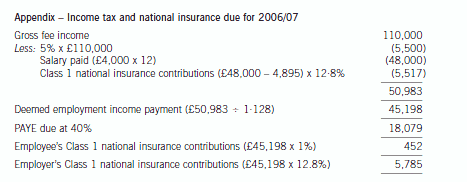
Barnham University which represents 70% of the company’s gross income. It is estimated that the company’s gross
fee income for its first 12 months of trading will be £110,000. Speak Write Ltd usually agrees fixed fees in advance
with its clients although it charges for some projects by reference to the number of days taken to do the work. None
of the universities makes any payment to Speak Write Ltd in respect of Jane being on holiday or sick.
All of the universities insist that Jane does the work herself. Jane carries out the work for three of the universities in
her office at home using a computer and specialised software owned by Speak Write Ltd. The work she does for
Barnham University is done in the university’s library on one of its computers as the documents concerned are too
delicate to move.
The first set of accounts for Speak Write Ltd will be drawn up for the year ending 5 April 2007. It is estimated that
the company’s tax adjusted trading profit for this period will be £52,500. This figure is after deducting Jane’s salary
of £4,000 per month and the related national insurance contributions but before any adjustments required by the
application of the personal service companies (IR 35) legislation. The company has no other sources of income or
capital gains.
Jane has not entered into any communication with HM Revenue and Customs (HMRC) with respect to the company
and wants to know:
– When the corporation tax computation should be submitted and when the tax is due.
– When the corporation tax computation can be regarded as having been agreed by HMRC.
Charles and Jane have requested a meeting to discuss the family’s finances. In particular, they wish to consider the
shortfall in the family’s annual income and any other related issues if Jane were to die. Their mortgage is covered
by a term assurance policy but neither of them have made any pension contributions or carried out any other long
term financial planning.
Jane has estimated that her annual after tax income from Speak Write Ltd, on the assumption that she extracts all of
the company’s profits, will be £58,000. Charles owns two investment properties that together generate after tax
income of £8,500. He estimates that he could earn £28,000 after tax if he were to return to work.
The couple’s annual surplus income, after payment of all household expenditure including mortgage payments of
£900 per month, is £21,000. Charles and Jane have no other sources of income.
Required:
(a) Write a letter to Jane setting out:
(i) the arguments that HMRC could put forward, based only on the facts set out above, in support of
applying the IR 35 legislation to Speak Write Ltd; and
(ii) the additional income tax and national insurance contributions that would be payable, together with
their due date of payment, if HMRC applied the IR 35 legislation to all of the company’s income in
2006/07. (11 marks)
正确答案: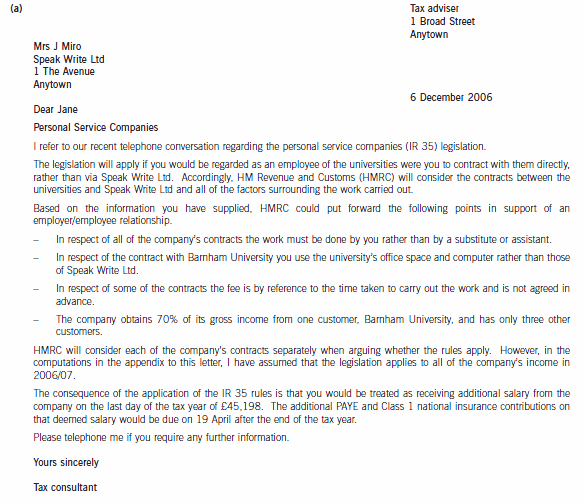
-
第9题:
We believe that_________ recent changes in state laws, the majority vote standard is now
in the best interests of the company and its shareholders.A. due to
B. whereas
C. otherwise
D. instead of答案:A解析:我们认为由于最近国家法律的改变,多数票决标准现在是对公司和股东最有利的。横线处应填人介词。recent changes in state laws是majority vote standard is的原因,故选A。 -
第10题:
Investment Tips
By Scott Russell
Investing in stocks that are less than $5 per share is a good way to boost your stock portfolio. Many big investors ignore these stocks because of the potential risks involved, however, these stocks often grow significantly over the course of time. Investing in inexpensive stocks is a wise move, provided that you hold on to them for at least one year to allow enough time for them to develop.
Four stocks that I suggest for less than $5 per share are High Standard Pharmaceuticals Company, Nova Oil, Inc., Direct Access Publishing Group, and Peak Media Holdings. If you are new to the market, you might want to try investing in them through an online brokerage firm that does not charge a high commission for their services, and remember: only invest up to five percent of your entire stock portfolio in any stock, including these.
------------------------------------------------------------------------------------------------------------------------------
Quick Stock Quotes -- Thursday April 22 -- 2:40 P.M.
(Quotes delayed by 20 minutes)
Nova Oil, Inc. (NOI)
3.93 +0.08 +2.08%
Previous Close 3.85
Open 3.87
High 3.94
Low 3.79
Volume 864,300
Bid 3.91
Bid Size 600
Ask 3.97
Ask Size 3,300
52 Week range 1.64-8.90
What company's stock is profiled?A. Nova Oil, Inc.
B. Peak Media Holdings
C. Direct Access Publishing Group
D. High Standard Pharmaceuticals Company答案:A解析: -
第11题:
问答题Practice 3 Equity securities are known as shares (or stock) in a corporation. Stockholders are considered owners of the corporation. The Articles of Incorporation must state the number of shares and the characteristics of the stock. To issue stock is actually to offer shares of stock for sale. The corporation’s Board of Directors controls when and to whom the corporation’s shares are offered and sold. Outstanding shares—Outstanding shares are shares already issued and purchased by the shareholder or stockholder. Par value—Par value is an arbitrary value assigned to each share in the Articles of Incorporation but does not necessarily reflect the true market value of the stock. Shares may not be issued and sold by the corporation for less than their par value therefore it is sometimes advisable not to state any par value at all or state a par value lower than the estimated market price. No par value allows the Board of Directors to decide each time shares are issued what the price per share will be. In a very large corporation where the stock is publicly traded at a public exchange, such as the New York Stock Exchange, the public demand for the stock of the corporation rather than the Board of Directors determines the selling price of the stock. Capital account—The capital account of a corporation is an entry in the books of the corporation and is determined by multiplying the par or stated value of the corporation’s stock by the number of shares outstanding. For example, if the corporation had sold 1,000 shares of stock which had $10 par value, the capital account would be $10,000.正确答案:
【参考译文】
股票是指公司发行的股份。股东是公司的所有者。公司条例必须说明公司股份的数量及其特征。发行股票实际上是出售公司的股份。公司董事会决定何时以及向何种人发售股票。
流动股——指已发行的,股东已购买的股票。
票面价值——指根据公司条例而赋予每股股票的价值。但它并不一定反映股票真正的市场价值。股票不能以低于票面价值发行和出售,因此有时不规定票面价值或所规定的票面价值低于估计的市场价值是非常明智的。在没有规定票面价值时,公司董事会得以在每次发行股票时决定每股的价格。某大公司的股票在大型公共交易所(如纽约证券交易所)进行公开交易时,公众对公司股票的需求而不是公司董事会决定该公司股票的交易价格。
资本性账户——指公司登记在册的资本,它等于流动股的数量与票面价值或是规定价值的乘积。比如说,某公司发行了1000股,每股票面价值为10美元,它的资本账户则是1万美元。解析: 暂无解析 -
第12题:
单选题A complete copy of this year’s annual company report will be provided ______ the marketing directors.Aof
Bon
Cby
Dalong
正确答案: C解析:
句意:市场营销主管将提供一份今年公司年度报告的完整副本。句中为被动语态,在被动句中,动作发出者通常由介词by引出。annual report年度报告。 -
第13题:
(b) On 31 May 2007, Leigh purchased property, plant and equipment for $4 million. The supplier has agreed to
accept payment for the property, plant and equipment either in cash or in shares. The supplier can either choose
1·5 million shares of the company to be issued in six months time or to receive a cash payment in three months
time equivalent to the market value of 1·3 million shares. It is estimated that the share price will be $3·50 in
three months time and $4 in six months time.
Additionally, at 31 May 2007, one of the directors recently appointed to the board has been granted the right to
choose either 50,000 shares of Leigh or receive a cash payment equal to the current value of 40,000 shares at
the settlement date. This right has been granted because of the performance of the director during the year and
is unconditional at 31 May 2007. The settlement date is 1 July 2008 and the company estimates the fair value
of the share alternative is $2·50 per share at 31 May 2007. The share price of Leigh at 31 May 2007 is $3 per
share, and if the director chooses the share alternative, they must be kept for a period of four years. (9 marks)
Required:
Discuss with suitable computations how the above share based transactions should be accounted for in the
financial statements of Leigh for the year ended 31 May 2007.
正确答案:(b) Transactions that allow choice of settlement are accounted for as cash-settled to the extent that the entity has incurred a
liability (IFRS2 para 34). The share based transaction is treated as the issuance of a compound financial instrument. IFRS2
applies similar measurement principles to determine the value of the constituent parts of a compound instrument as that
required by IAS32 ‘Financial Instruments: Disclosure and Presentation’. The purchase of the property, plant and equipment
(PPE) and the grant to the director, both fall under this section of IFRS2 as the supplier and the director have a choice of
settlement. The fair value of the goods can be measured directly as regards the purchase of the PPE and therefore this fact
determines that the transaction is treated in a certain way. In the case of the director, the fair value of the service rendered
will be determined by the fair value of the equity instruments given and IFRS2 says that this type of share based transaction
should be dealt with in a certain way. Under IFRS2, if the fair value of the goods or services received can be measured directly
and easily then the equity element is determined by taking the fair value of the goods or services less the fair value of the
debt element of this instrument. The debt element is essentially the cash payment that will occur. If the fair value of the goods
or services is measured by reference to the fair value of the equity instruments given then the whole of the compound
instrument should be fair valued. The equity element becomes the difference between the fair value of the equity instruments
granted less the fair value of the debt component. It should take into account the fact that the counterparty must forfeit its
right to receive cash in order to receive the equity instrument.
When Leigh received the property, plant and equipment it should have recorded a liability of $4 million and an increase in
equity of $0·55 million being the difference between the value of the property, plant and equipment and the fair value of theliability. The fair value of the liability is the cash payment of $3·50 x 1·3 million shares, i.e. $4·55 million.
The accounting entry would be:
-
第14题:
(c) At a recent meeting of the board of directors, the managing director of Envico Ltd said that he considered it
essential to be able to assess the ‘value for money’ of each seminar. He suggested that the quality of the speakers
and the comfort of the seminar rooms were two assessment criteria that should be used in order to assess the
‘value for money’ of each seminar.
Required:
Discuss SIX separate and distinct assessment criteria (including those suggested by the managing director),
that would enable the management of Envico Ltd to assess the ‘value for money’ of each seminar.
(6 marks)
正确答案:
(c) The following are six separate and distinct assessment criteria (including those suggested by the managing director), that
would enable the management of Envico Ltd to assess the ‘value for money’ of each seminar. The assessment criteria are
presented as questions that would comprise the contents of a questionnaire but other presentations would have been equally
acceptable.
(1) Did the course meet your objectives?
‘Value for money’ may, in part, be assessed by reference to the ‘effectiveness’ of the service provision. Effectiveness may
be viewed in this context as meeting the objectives of attendees. All attendees have similar but varying objectives and
hence it is vital that Envico Ltd meets the objectives of all attendees if seminars are to constitute ‘value for money’.
(2) How would you rate the quality of the speakers?
A primary resource of Envico Ltd is its speakers and thus it is important to gauge how they were perceived to perform
by the attendees.
(3) How would you rate comfort, cleanliness and facilities of the seminar rooms?
Again, a principal resource, which is consumed when providing the service, is the seminar room and the facilities
contained within it. Attendees will find a clean and ergonomically designed room more conducive for education and
training activities.
(4) How would you assess the quality of the course materials?
Since Envico Ltd undertakes the provision of educational and training seminars then the quality of course materials
provided assumes critical significance as they represent the ‘raison d’être’ of Envico Ltd. If they are perceived to be of
high quality they may act as a good advertisement for the company. Conversely, poor quality course materials will cause
Envico Ltd to be perceived poorly.
(5) How strongly would you recommend Envico courses to friends and colleagues?
This is a very important consideration since ‘word of mouth’ may represent the best means of advertising the services
provided by Envico Ltd and is indicative of whether attendees consider that they have received ‘value for money’ from
Envico Ltd.
(6) Do you consider that you could have achieved your objectives in attending the course in a more expedient manner? If
so, please detail below.
This question acknowledges that the time of attendees is a scarce resource and hence there may well be an opportunity
cost in attending seminars in addition to the explicit costs such as course fees, travel and subsistence costs etc. It is
essential that Envico Ltd is flexible in its approach to meeting the needs of clients where attendance at seminars is either
impracticable or undesirable. Perhaps a series of interactive CDs and/or video tuition may be more appropriate in certain
instances. -
第15题:
6 Assume today’s date is 16 April 2005.
Henry, aged 48, is the managing director of Happy Home Ltd, an unquoted UK company specialising in interior
design. He is wealthy in his own right and is married to Helen, who is 45 years old. They have two children – Stephen,
who is 19, and Sally who is 17.
As part of his salary, Henry was given 3,000 shares in Happy Home Ltd with an option to acquire a further 10,000
shares. The options were granted on 15 July 2003, shortly after the company started trading, and were not part of
an approved share option scheme. The free shares were given to Henry on the same day.
The exercise price of the share options was set at the then market value of £1·00 per share. The options are not
capable of being exercised after 10 years from the date of grant. The company has been successful, and the current
value of the shares is now £14·00 per share. Another shareholder has offered to buy the shares at their market value,
so Henry exercised his share options on 14 April 2005 and will sell the shares next week, on 20 April 2005.
With the company growing in size, Henry wishes to recruit high quality staff, but the company lacks the funds to pay
them in cash. Henry believes that giving new employees the chance to buy shares in the company would help recruit
staff, as they could share in the growth in value of Happy Home Ltd. Henry has heard that there is a particular share
scheme that is suitable for small, fast growing companies. He would like to obtain further information on how such
a scheme would work.
Henry has accumulated substantial assets over the years. The family house is owned jointly with Helen, and is worth
£650,000. Henry has a £250,000 mortgage on the house. In addition, Henry has liquid assets worth £340,000
and Helen has shares in quoted companies currently worth £125,000. Henry has no forms of insurance, and believes
he should make sure that his wealth and family are protected. He is keen to find out what options he should be
considering.
Required:
(a) (i) State how the gift of the 3,000 shares in Happy Home Ltd was taxed. (1 mark)
正确答案:
(a) (i) Gift of shares
Shares, which are given free or sold at less than market value, are charged to income tax on the difference between the
market value and the amount paid (if any) for the shares. Henry was given 3,000 shares with a market value of £1 at
the time of gift, so he was assessed to income tax on £3,000, in the tax year 2003/04. -
第16题:
5 (a) Carver Ltd was incorporated and began trading in August 2002. It is a close company with no associated
companies. It has always prepared accounts to 31 December and will continue to do so in the future.
It has been decided that Carver Ltd will sell its business as a going concern to Blade Ltd, an unconnected
company, on 31 July 2007. Its premises and goodwill will be sold for £2,135,000 and £290,000 respectively
and its machinery and equipment for £187,000. The premises, which do not constitute an industrial building,
were acquired on 1 August 2002 for £1,808,000 and the goodwill has been generated internally by the
company. The machinery and equipment cost £294,000; no one item will be sold for more than its original cost.
The tax adjusted trading profit of Carver Ltd in 2007, before taking account of both capital allowances and the
sale of the business assets, is expected to be £81,000. The balance on the plant and machinery pool for the
purposes of capital allowances as at 31 December 2006 was £231,500. Machinery costing £38,000 was
purchased on 1 March 2007. Carver Ltd is classified as a small company for the purposes of capital allowances.
On 1 August 2007, the proceeds from the sale of the business will be invested in either an office building or a
portfolio of UK quoted company shares, as follows:
Office building
The office building would be acquired for £3,100,000; the vendor is not registered for value added tax (VAT).
Carver Ltd would borrow the additional funds required from a UK bank. The building is let to a number of
commercial tenants who are not connected with Carver Ltd and will pay rent, in total, of £54,000 per calendar
quarter, in advance, commencing on 1 August 2007. The company’s expenditure for the period from 1 August
2007 to 31 December 2007 is expected to be:
£
Loan interest payable to UK bank 16,000
Building maintenance costs 7,500
Share portfolio
Shares would be purchased for the amount of the proceeds from the sale of the business with no need for further
loan finance. It is estimated that the share portfolio would generate dividends of £36,000 and capital gains, after
indexation allowance, of £10,000 in the period from 1 August 2007 to 31 December 2007.
All figures are stated exclusive of value added tax (VAT).
Required:
(i) Taking account of the proposed sale of the business on 31 July 2007, state with reasons the date(s) on
which Carver Ltd must submit its corporation tax return(s) for the year ending 31 December 2007.
(2 marks)
正确答案:
(a) (i) Due date for submission of corporation tax return
Carver Ltd intends to cease trading on 31 July 2007. This will bring to an end the accounting period that began on
1 January 2007. A new accounting period will commence on 1 August 2007 and end on the company’s accounting
reference date on 31 December 2007.
Carver Ltd is required to submit its corporation tax return by the later of:
– one year after the end of its accounting period; and
– one year after the end of the period of account in which the last day of the accounting period falls.
Accordingly, the company must submit its corporation tax returns for both accounting periods by 31 December 2008. -
第17题:
3 Palm plc recently acquired 100% of the ordinary share capital of Nikau Ltd from Facet Ltd. Palm plc intends to use
Nikau Ltd to develop a new product range, under the name ‘Project Sabal’. Nikau Ltd owns shares in a non-UK
resident company, Date Inc.
The following information has been extracted from client files and from a meeting with the Finance Director of Palm
plc.
Palm plc:
– Has more than 40 wholly owned subsidiaries such that all group companies pay corporation tax at 30%.
– All group companies prepare accounts to 31 March.
– Acquired Nikau Ltd on 1 November 2007 from Facet Ltd, an unrelated company.
Nikau Ltd:
– UK resident company that manufactures domestic electronic appliances for sale in the European Union (EU).
– Large enterprise for the purposes of the enhanced relief available for research and development expenditure.
– Trading losses brought forward as at 1 April 2007 of £195,700.
– Budgeted taxable trading profit of £360,000 for the year ending 31 March 2008 before taking account of ‘Project
Sabal’.
– Dividend income of £38,200 will be received in the year ending 31 March 2008 in respect of the shares in Date
Inc.
‘Project Sabal’:
– Development of a range of electronic appliances, for sale in North America.
– Project Sabal will represent a significant advance in the technology of domestic appliances.
– Nikau Ltd will spend £70,000 on staffing costs and consumables researching and developing the necessary
technology between now and 31 March 2008. Further costs will be incurred in the following year.
– Sales to North America will commence in 2009 and are expected to generate significant profits from that year.
Shares in Date Inc:
– Nikau Ltd owns 35% of the ordinary share capital of Date Inc.
– The shares were purchased from Facet Ltd on 1 June 2003 for their market value of £338,000.
– The sale was a no gain, no loss transfer for the purposes of corporation tax.
– Facet Ltd purchased the shares in Date Inc on 1 March 1994 for £137,000.
Date Inc:
– A controlled foreign company resident in the country of Palladia.
– Annual chargeable profits arising out of property investment activities are approximately £120,000, of which
approximately £115,000 is distributed to its shareholders each year.
The tax system in Palladia:
– No taxes on income or capital profits.
– 4% withholding tax on dividends paid to shareholders resident outside Palladia.
Required:
(a) Prepare detailed explanatory notes, including relevant supporting calculations, on the effect of the following
issues on the amount of corporation tax payable by Nikau Ltd for the year ending 31 March 2008.
(i) The costs of developing ‘Project Sabal’ and the significant commercial changes to the company’s
activities arising out of its implementation. (8 marks)
正确答案:
(a) Nikau Ltd – Effect on corporation tax payable for the year ending 31 March 2008
(i) Project Sabal
Research and development expenditure
The expenditure incurred in respect of research and development will give rise to an enhanced deduction for the
purposes of computing the taxable trading profits of Nikau Ltd. The enhanced deduction is 125% of the qualifying
expenditure as Nikau Ltd is a large enterprise for this purpose.
The expenditure will reduce the profits chargeable to corporation tax of Nikau Ltd by £87,500 (£70,000 x 1·25) and
its corporation tax liability by £26,250 (£87,500 x 30%).
The budgeted expenditure will qualify for the enhanced deduction because it appears to satisfy the following conditions.
– It is likely to qualify as research and development expenditure within generally accepted accounting principles as
it will result in new technical knowledge and the production of a substantially improved device for use in the
industry.
– It exceeds £10,000 in Nikau Ltd’s accounting period.
– It relates to staff costs, consumable items or other qualifying expenditure as opposed to capital items.
– It will result in further trading activities for Nikau Ltd.
Use of brought forward trading losses
The development of products for the North American market is likely to represent a major change in the nature and
conduct of the trade of Nikau Ltd. This is because the company is developing new products and intends to sell them in
a new market. It is a major change as sales to North America are expected to generate significant additional profits.
Because this change will occur within three years of the change in the ownership of Nikau Ltd on 1 November 2007,
any trading losses arising prior to that date cannot be carried forward beyond that date.
Accordingly, the trading losses brought forward may only be offset against £158,958 ((£360,000 – £87,500) x 7/12)
of the company’s trading profits for the year. The remainder of the trading losses £36,742 (£195,700 – £158,958) will
be lost resulting in lost tax relief of £11,023 (£36,742 x 30%).
Tutorial note
The profits for the year ending 31 March 2008 will be apportioned to the periods pre and post 1 November 2007 on
either a time basis or some other basis that is just and reasonable. -
第18题:
5 Gagarin wishes to persuade a number of wealthy individuals who are business contacts to invest in his company,
Vostok Ltd. He also requires advice on the recoverability of input tax relating to the purchase of new premises.
The following information has been obtained from a meeting with Gagarin.
Vostok Ltd:
– An unquoted UK resident company.
– Gagarin owns 100% of the company’s ordinary share capital.
– Has 18 employees.
– Provides computer based services to commercial companies.
– Requires additional funds to finance its expansion.
Funds required by Vostok Ltd:
– Vostok Ltd needs to raise £420,000.
– Vostok Ltd will issue 20,000 shares at £21 per share on 31 August 2008.
– The new shareholder(s) will own 40% of the company.
– Part of the money raised will contribute towards the purchase of new premises for use by Vostok Ltd.
Gagarin’s initial thoughts:
– The minimum investment will be 5,000 shares and payment will be made in full on subscription.
– Gagarin has a number of wealthy business contacts who may be interested in investing.
– Gagarin has heard that it may be possible to obtain tax relief for up to 60% of the investment via the enterprise
investment scheme.
Wealthy business contacts:
– Are all UK resident higher rate taxpayers.
– May wish to borrow the funds to invest in Vostok Ltd if there is a tax incentive to do so.
New premises:
– Will cost £446,500 including value added tax (VAT).
– Will be used in connection with all aspects of Vostok Ltd’s business.
– Will be sold for £600,000 plus VAT in six years time.
– Vostok Ltd will waive the VAT exemption on the sale of the building.
The VAT position of Vostok Ltd:
– In the year ending 31 March 2009, 28% of Vostok Ltd’s supplies will be exempt for the purposes of VAT.
– This percentage is expected to reduce over the next few years.
– Irrecoverable input tax due to the company’s partially exempt status exceeds the de minimis limits.
Required:
(a) Prepare notes for Gagarin to use when speaking to potential investors. The notes should include:
(i) The tax incentives immediately available in respect of the amount invested in shares issued in
accordance with the enterprise investment scheme; (5 marks)
正确答案:
(a) (i) The tax incentives immediately available
Income tax
– The investor’s income tax liability for 2008/09 will be reduced by 20% of the amount subscribed for the shares.
– Up to half of the amount invested can be treated as if paid in 2007/08 rather than 2008/09. This is subject to a
maximum carryback of £50,000.
This ability to carryback relief to the previous year is useful where the investor’s income in 2008/09 is insufficient
to absorb all of the relief available.
Tutorial note
There would be no change to the income tax liability of 2007/08 where an amount is treated as if paid in that year.
This ensures that such a claim does not affect payments on account under the self assessment system. Instead, the
tax refund due is calculated by reference to 2007/08 but is deducted from the next payment of tax due from the
taxpayer or is repaid to the taxpayer.
Capital gains tax deferral
– For every £1 invested in Vostok Ltd, an investor can defer £1 of capital gain and thus, potentially, 40 pence of
capital gains tax.
– The gain deferred can be in respect of the disposal of any asset.
– The shares must be subscribed for within the four year period starting one year prior to the date on which the
disposal giving rise to the gain took place. -
第19题:
According to the passage,in the late 1960's some residents of Boston were concerned with which aspect of skyscrapers?
A. The noise from their construction.
B. The removal of trees from building sites.
C. The harmful effects on the city's grass.
D. The high cost of rentable office space.
正确答案:C
[解析] 由倒数第二段第二句可知,“摩天楼产生的阴影对城市绿地有害”,答案为C。
-
第20题:
Investment Tips
By Scott Russell
Investing in stocks that are less than $5 per share is a good way to boost your stock portfolio. Many big investors ignore these stocks because of the potential risks involved, however, these stocks often grow significantly over the course of time. Investing in inexpensive stocks is a wise move, provided that you hold on to them for at least one year to allow enough time for them to develop.
Four stocks that I suggest for less than $5 per share are High Standard Pharmaceuticals Company, Nova Oil, Inc., Direct Access Publishing Group, and Peak Media Holdings. If you are new to the market, you might want to try investing in them through an online brokerage firm that does not charge a high commission for their services, and remember: only invest up to five percent of your entire stock portfolio in any stock, including these.
------------------------------------------------------------------------------------------------------------------------------
Quick Stock Quotes -- Thursday April 22 -- 2:40 P.M.
(Quotes delayed by 20 minutes)
Nova Oil, Inc. (NOI)
3.93 +0.08 +2.08%
Previous Close 3.85
Open 3.87
High 3.94
Low 3.79
Volume 864,300
Bid 3.91
Bid Size 600
Ask 3.97
Ask Size 3,300
52 Week range 1.64-8.90
What type of stocks is the article about?A. Oil company stocks
B. Inexpensive stocks
C. Pharmaceutical stocks
D. Stocks from new companies答案:B解析: -
第21题:
Investment Tips
By Scott Russell
Investing in stocks that are less than $5 per share is a good way to boost your stock portfolio. Many big investors ignore these stocks because of the potential risks involved, however, these stocks often grow significantly over the course of time. Investing in inexpensive stocks is a wise move, provided that you hold on to them for at least one year to allow enough time for them to develop.
Four stocks that I suggest for less than $5 per share are High Standard Pharmaceuticals Company, Nova Oil, Inc., Direct Access Publishing Group, and Peak Media Holdings. If you are new to the market, you might want to try investing in them through an online brokerage firm that does not charge a high commission for their services, and remember: only invest up to five percent of your entire stock portfolio in any stock, including these.
------------------------------------------------------------------------------------------------------------------------------
Quick Stock Quotes -- Thursday April 22 -- 2:40 P.M.
(Quotes delayed by 20 minutes)
Nova Oil, Inc. (NOI)
3.93 +0.08 +2.08%
Previous Close 3.85
Open 3.87
High 3.94
Low 3.79
Volume 864,300
Bid 3.91
Bid Size 600
Ask 3.97
Ask Size 3,300
52 Week range 1.64-8.90
At what price did the company's stock close on the previous day?A. $3.79 per share
B. $3.85 per share
C. $3.91 per share
D. $3.93 per share答案:B解析: -
第22题:
Investment Tips
By Scott Russell
Investing in stocks that are less than $5 per share is a good way to boost your stock portfolio. Many big investors ignore these stocks because of the potential risks involved, however, these stocks often grow significantly over the course of time. Investing in inexpensive stocks is a wise move, provided that you hold on to them for at least one year to allow enough time for them to develop.
Four stocks that I suggest for less than $5 per share are High Standard Pharmaceuticals Company, Nova Oil, Inc., Direct Access Publishing Group, and Peak Media Holdings. If you are new to the market, you might want to try investing in them through an online brokerage firm that does not charge a high commission for their services, and remember: only invest up to five percent of your entire stock portfolio in any stock, including these.
------------------------------------------------------------------------------------------------------------------------------
Quick Stock Quotes -- Thursday April 22 -- 2:40 P.M.
(Quotes delayed by 20 minutes)
Nova Oil, Inc. (NOI)
3.93 +0.08 +2.08%
Previous Close 3.85
Open 3.87
High 3.94
Low 3.79
Volume 864,300
Bid 3.91
Bid Size 600
Ask 3.97
Ask Size 3,300
52 Week range 1.64-8.90
What investment strategy does Mr. Russell NOT suggest in the article?A. Investing in more than one stock at once
B. Investing through an online brokerage firm
C. Investing in the stock for at least one year
D. Investing up to five percent of a stock portfolio.答案:A解析: -
第23题:
问答题Practice 9 ● You are the Purchasing Manager for a large company. Last month you decided to look for a new supplier for the stationery and office equipment that your company uses. You have found a new supplier, Compass Office Goods Ltd. ● Write a memo to your company’s department heads: ● explaining why you looked for a new supplier. ● saying who the new supplier is. ● asking for feedback about the goods that they supply. ● Write 40—50 words.正确答案: 【参考范文】
To: All Department Heads
From: Purchasing Manager
Date: July 20th
Subject: About the Goods of the New Supplier
As the former supplier couldn’t provide qualified stationery and office equipment to meet our satisfaction, we have decided to choose a new one—Compass Office Goods Ltd. We have distributed its sample products to each department. Any opinions about the goods it supplies will be welcome. Thank you.解析: 暂无解析