
4 The International Accounting Standards Board (IASB) has begun a joint project to revisit its conceptual framework forfinancial accounting and reporting. The goals of the project are to build on the existing frameworks and converge theminto a common fram
题目
4 The International Accounting Standards Board (IASB) has begun a joint project to revisit its conceptual framework for
financial accounting and reporting. The goals of the project are to build on the existing frameworks and converge them
into a common framework.
Required:
(a) Discuss why there is a need to develop an agreed international conceptual framework and the extent to which
an agreed international conceptual framework can be used to resolve practical accounting issues.
(13 marks)
相似考题
更多“4 The International Accounting Standards Board (IASB) has begun a joint project to revisit its conceptual framework forfinancial accounting and reporting. The goals of the project are to build on the existing frameworks and converge theminto a common fram”相关问题
-
第1题:
In the past, most project managers have come from _____ fields without proper _____ training or education in skills
A . Technical; accounting/finance
B . Technical; management
C . Technical; psychological
D . Marketing; technology-oriented
E . Business; manufacturing know-how
正确答案:B
-
第2题:
156 Expectancy theory as applied to project management implies that:
A. The team will work the hardest on those goals that are clearly explained by the project manager
B. The more rewards that the project manager provides, the better the performance of the team
C. Team members will work hardest for those project goals that also bring satisfaction to personal goals
D. Employees will work hardest for those project goals which are accompanied by high levels of authority for the individual team members E. None of the above
正确答案:C
-
第3题:
● Problems can occur in properly defining a project because:
A Project goals may not be agreeable to all parties
B The plan was "too loose," thus allowing priorities to change
C Low turnover of project personnel
D Too much communication between the client and project personnel
E The project objectives were quantified
正确答案:A
-
第4题:
3 The directors of Panel, a public limited company, are reviewing the procedures for the calculation of the deferred tax
provision for their company. They are quite surprised at the impact on the provision caused by changes in accounting
standards such as IFRS1 ‘First time adoption of International Financial Reporting Standards’ and IFRS2 ‘Share-based
Payment’. Panel is adopting International Financial Reporting Standards for the first time as at 31 October 2005 and
the directors are unsure how the deferred tax provision will be calculated in its financial statements ended on that
date including the opening provision at 1 November 2003.
Required:
(a) (i) Explain how changes in accounting standards are likely to have an impact on the provision for deferred
taxation under IAS12 ‘Income Taxes’. (5 marks)
正确答案:(a) (i) IAS12 ‘Income Taxes’ adopts a balance sheet approach to accounting for deferred taxation. The IAS adopts a full
provision approach to accounting for deferred taxation. It is assumed that the recovery of all assets and the settlement
of all liabilities have tax consequences and that these consequences can be estimated reliably and are unavoidable.
IFRS recognition criteria are generally different from those embodied in tax law, and thus ‘temporary’ differences will
arise which represent the difference between the carrying amount of an asset and liability and its basis for taxation
purposes (tax base). The principle is that a company will settle its liabilities and recover its assets over time and at that
point the tax consequences will crystallise.Thus a change in an accounting standard will often affect the carrying value of an asset or liability which in turn will
affect the amount of the temporary difference between the carrying value and the tax base. This in turn will affect the
amount of the deferred taxation provision which is the tax rate multiplied by the amount of the temporary differences(assuming a net liability for deferred tax.) -
第5题:
(b) Prepare the balance sheet of York at 31 October 2006, using International Financial Reporting Standards,
discussing the nature of the accounting treatments selected, the adjustments made and the values placed
on the items in the balance sheet. (20 marks)
正确答案: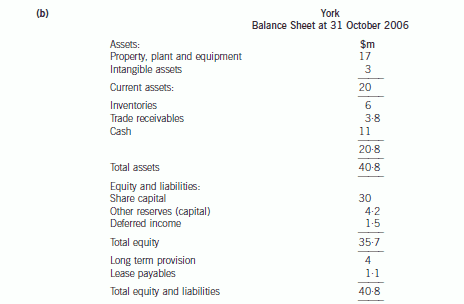
Gow’s net assets
IAS36 ‘Impairment of Assets’, sets out the events that might indicate that an asset is impaired. These circumstances include
external events such as the decline in the market value of an asset and internal events such as a reduction in the cash flows
to be generated from an asset or cash generating unit. The loss of the only customer of a cash generating unit (power station)
would be an indication of the possible impairment of the cash generating unit. Therefore, the power station will have to be
impairment tested.
The recoverable amount will have to be determined and compared to the value given to the asset on the setting up of the
joint venture. The recoverable amount is the higher of the cash generating unit’s fair value less costs to sell, and its value-inuse.
The fair value less costs to sell will be $15 million which is the offer for the purchase of the power station ($16 million)
less the costs to sell ($1 million). The value-in-use is the discounted value of the future cash flows expected to arise from the
cash generating unit. The future dismantling costs should be provided for as it has been agreed with the government that it
will be dismantled. The cost should be included in the future cash flows for the purpose of calculating value-in-use and
provided for in the financial statements and the cost added to the property, plant and equipment ($4 million ($5m/1·064)).
The value-in-use based on a discount rate of 6 per cent is $21 million (working). Therefore, the recoverable amount is
$21 million which is higher than the carrying value of the cash generating unit ($20 million) and, therefore, the value of the
cash generating unit is not impaired when compared to the present carrying value of $20 million (value before impairment
test).
Additionally IAS39, ‘Financial Instruments: recognition and measurement’, says that an entity must assess at each balance
sheet date whether a financial asset is impaired. In this case the receivable of $7 million is likely to be impaired as Race is
going into administration. The present value of the estimated future cash flows will be calculated. Normally cash receipts from
trade receivables will not be discounted but because the amounts are not likely to be received for a year then the anticipated
cash payment is 80% of ($5 million × 1/1·06), i.e. $3·8 million. Thus a provision for the impairment of the trade receivables
of $3·2 million should be made. The intangible asset of $3 million would be valueless as the contract has been terminated.
Glass’s Net Assets
The leased property continues to be accounted for as property, plant and equipment and the carrying amount will not be
adjusted. However, the remaining useful life of the property will be revised to reflect the shorter term. Thus the property will
be depreciated at $2 million per annum over the next two years. The change to the depreciation period is applied prospectively
not retrospectively. The lease liability must be assessed under IAS39 in order to determine whether it constitutes a
de-recognition of a financial liability. As the change is a modification of the lease and not an extinguishment, the lease liability
would not be derecognised. The lease liability will be adjusted for the one off payment of $1 million and re-measured to the
present value of the revised future cash flows. That is $0·6 million/1·07 + $0·6 million/(1·07 × 1·07) i.e. $1·1 million. The
adjustment to the lease liability would normally be recognised in profit or loss but in this case it will affect the net capital
contributed by Glass.
The termination cost of the contract cannot be treated as an intangible asset. It is similar to redundancy costs paid to terminate
a contract of employment. It represents compensation for the loss of future income for the agency. Therefore it must be
removed from the balance sheet of York. The recognition criteria for an intangible asset require that there should be probable
future economic benefits flowing to York and the cost can be measured reliably. The latter criterion is met but the first criterion
is not. The cost of gaining future customers is not linked to this compensation.
IAS18 ‘Revenue’ contains a concept of a ‘multiple element’ arrangement. This is a contract which contains two or more
elements which are in substance separate and are separately identifiable. In other words, the two elements can operate
independently from each other. In this case, the contract with the overseas company has two distinct elements. There is a
contract not to supply gas to any other customer in the country and there is a contract to sell gas at fair value to the overseas
company. The contract has not been fulfilled as yet and therefore the payment of $1·5 million should not be taken to profit
or loss in its entirety at the first opportunity. The non supply of gas to customers in that country occurs over the four year
period of the contract and therefore the payment should be recognised over that period. Therefore the amount should be
shown as deferred income and not as a deduction from intangible assets. The revenue on the sale of gas will be recognised
as normal according to IAS18.
There may be an issue over the value of the net assets being contributed. The net assets contributed by Glass amount to
$21·9 million whereas those contributed by Gow only total $13·8 million after taking into account any adjustments required
by IFRS. The joint venturers have equal shareholding in York but no formal written agreements, thus problems may arise ifGlass feels that the contributions to the joint venture are unequal.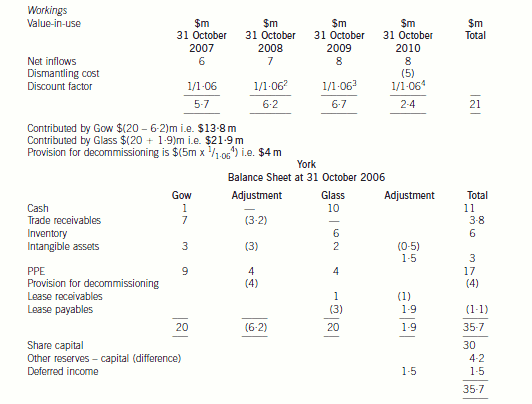
-
第6题:
4 Whilst acknowledging the importance of high quality corporate reporting, the recommendations to improve it are
sometimes questioned on the basis that the marketplace for capital can determine the nature and quality of corporate
reporting. It could be argued that additional accounting and disclosure standards would only distort a market
mechanism that already works well and would add costs to the reporting mechanism, with no apparent benefit. It
could be said that accounting standards create costly, inefficient, and unnecessary regulation. It could be argued that
increased disclosure reduces risks and offers a degree of protection to users. However, increased disclosure has several
costs to the preparer of financial statements.
Required:
(a) Explain why accounting standards are needed to help the market mechanism work effectively for the benefit
of preparers and users of corporate reports. (9 marks)
正确答案:
(a) It could be argued that the marketplace already offers powerful incentives for high-quality reporting as it rewards such by
easing or restricting access to capital or raising or lowering the cost of borrowing capital depending on the quality of the entity’s
reports. However, accounting standards play an important role in helping the market mechanism work effectively. Accounting
standards are needed because they:
– Promote a common understanding of the nature of corporate performance and this facilitates any negotiations between
users and companies about the content of financial statements. For example, many loan agreements specify that a
company provide the lender with financial statements prepared in accordance with generally accepted accounting
principles or International Financial Reporting Standards. Both the company and the lender understand the terms and
are comfortable that statements prepared according to those standards will meet certain information needs. Without
standards, the statements would be less useful to the lender, and the company and the lender would have to agree to
create some form. of acceptable standards which would be inefficient and less effective.
– Assist neutral and unbiased reporting. Companies may wish to portray their past performance and future prospects in
the most favourable light. Users are aware of this potential bias and are sceptical about the information they receive.
Standards build credibility and confidence in the capital marketplace to the benefit of both users and companies.
– Improve the comparability of information across companies and national boundaries. Without standards, there would be
little basis to compare one company with others across national boundaries which is a key feature of relevant
information.
– Create credibility in financial statements. Auditors verify that information is reported in accordance with standards and
this creates public confidence in financial statements
– Facilitate consistency of information by producing data in accordance with an agreed conceptual framework. A consistent
approach to the development and presentation of information assists users in accessing information in an efficient
manner and facilitates decision-making. -
第7题:
ACCOUNTING IS MORE THAN NUMBERS Accounting could date back to about 7,000 years ago. People of that time relied on old accounting methods to record the growth of crops and herds. Accounting has greatly developed with the growth of joint-stock companies. When you think of accounting, you may find pages of tables and numbers. That image doesn’t usually give you too much excitement. When you have your own business, though, those numbers come to mean the world to you because they give you the record of how much money you’ve earned or lost. Actually, accounting is not simply about strange dollar amounts or boring numbers; they’re your sales figures, your costs, and your profits. In other words, accounting is a language of business. Once you know how to work with those numbers, how to read those numbers and how to read the story they tell, you will be able to manage your business toward greater success.
1. Accounting could date back to about ()years ago.
A. 7,000
B. 6,000
C. 5,000
2. People in the old days relied on old accounting methods to record ().
A. how much money they had
B. management of their business
C. the growth of crops and herds
3. Accounting has greatly changed with the development of ().
A. crops and herds
B. joint-stock companies
C. internet companies
4. Accounting is very important in your business because it shows ().
A. how much money you’ve earned or lost
B. pages full of tables and numbers
C. strange dollar amounts or boring numbers
5. According to the writer, accounting is ().
A. a language of business
B. your sales figures, your costs, and your profits
C. Both A and B
参考答案:子问题 1:A; 子问题 2:C; 子问题 3:B; 子问题 4:A; 子问题 5:C
-
第8题:
听力原文:Although the said company is a sun-rising firm, its accounting management should be improved before the loan is extended to it.
(9)
A.The company is a sun-rising firm so it is worthwhile to extend the loan.
B.The company has some accounting problems, some improvement is needed.
C.The company is short of funds because it is sun-rising.
D.The company has some accounting problems because it is sun-rising.
正确答案:B
解析:单句意思为“尽管我们谈及的企业是成长性企业,但是在我们贷款给对方之前,它应该要完善它的财务会计管理。” -
第9题:
The two most common specialized fields of accounting in practice are().A.managerial accounting and financial accounting
B.managerial accounting and environmental accounting
C.forensic accounting and financial accounting
D.financial accounting and tax accounting systems
正确答案:A
-
第10题:
Faithful representation is a fundamental characteristic of useful information within the IASB’s Conceptual framework for financial reporting.
Which of the following accounting treatments correctly applies the principle of faithful representation?
A.Reporting a transaction based on its legal status rather than its economic substance
B.Excluding a subsidiary from consolidation because its activities are not compatible with those of the rest of the group
C.Recording the whole of the net proceeds from the issue of a loan note which is potentially convertible to equity shares as debt (liability)
D.Allocating part of the sales proceeds of a motor vehicle to interest received even though it was sold with 0% (interest free) finance
正确答案:DThe substance is that there is no ‘free’ finance; its cost, as such, is built into the selling price.
-
第11题:
()are?those?costs?that?cannot?be?directly?traced?to?a specific?project?and?therefore?will?be?accumulated?and allocated?equitably?over?multiple?projects?by?some?approved and?documented?accounting?procedure.A.Direct costs
B.Operation costs
C.Indirect costs
D.Implement costs答案:C解析:本题翻译:
()是指不能直接追溯到特定项目的成本,因此将通过一些批准和记录的会计程序在多个项目上平均累计和分配。
A.直接成本B.运营成本C.间接成本D.实施成本
本题考查成本的分类,不能直接的就可以理解为间接,间接成本:来自一般管理费用科目或几个项目共同负担的项目成本所分摊给本项目的费用。
而成本管理中不是涉及运营成本、实施成本。排除BD选项。所以此题选择C选项。 -
第12题:
单选题The medical board, concerned by the drop in insurance payments and the failure of the accounting department to obtain the anticipated funds, resolved to pursue legal action against the insurance company.Aconcerned by the drop in insurance payments and the failure of the accounting department to obtain
Bconcerning the drop in payments by insurance and the failure of the accounting department to obtain
Cbecause of its concern for the dropping insurance payments and the accounting department’s failure at obtaining
Din its concern that the drop in insurance payments and the failure of the accounting department to obtain
Ebeing concerned about the drop in insurance payments and the accounting department falling to obtain
正确答案: D解析:
B项表意不明;C项“failure at obtaining”不符合习惯表达;D项结构不完整;E项中“being concerned about the drop”不符合习惯表达,故本题应选A项。 -
第13题:
Expectancy theory as applied to project management implies that:
A The team will work the hardest on those goals that are clearly explained by the project manager
B The more rewards that the project manager provides, the better the performance of the team
C Team members will work hardest for those project goals that also bring satisfaction to personal goals
D Employees will work hardest for those project goals which are accompanied by high levels of authority for the individual team members
E None of the above
正确答案:C
-
第14题:
121 The quality objectives are approved in the conceptual stage of the project by the:
A. Project Engineer
B. Project Manager
C. Functional Manager
D. Quality Assurance Manager
E. Project Owner
正确答案:E
-
第15题:
● Including the customer in the process of project planning is:
A Slow and counterproductive.
B Essential in the definition and documentation of project goals.
C Necessary, but of limited value.
D Unnecessary because project goals are defined in the proposal stage.
E None of the above.
正确答案:B
-
第16题:
5 The International Accounting Standards Board (IASB) is currently in a joint project with the Accounting Standards
Board (ASB) in the UK and the Financial Accounting Standards Board (FASB) in the USA in the area of reporting
financial performance/comprehensive income. The main focus of the project is the development of a single statement
of comprehensive income to replace the income statement and statement of changes in equity. The objective is to
analyse all income and expenses and categorise them in a way that increases users’ understanding of the results of
an entity and assists in forming expectations of future income and expenditure. There seems to be some consensus
that the performance statement should be divided into three components being the results of operating activities,
financing and treasury activities, and other gains and losses.
Required:
(a) Describe the reasons why the three accounting standards boards have decided to cooperate and produce a
single statement of financial performance. (8 marks)
正确答案:
(a) The main reasons why the three accounting standards boards have decided to come together in a joint project regarding a
single performance statement are as follows:
(i) there are many different formats and classifications used for financial statements and different time periods used for
comparative data in different countries.
(ii) there are no common definitions as regards the key elements of financial performance and no agreement on the standard
definitions of the key ratios which would then determine the nature of the information that financial statements should
provide. There has been an increase in the reporting of alternative and often inconsistent financial performance
measures that has led to confusion and often has misled users.
(iii) there has been an increase in the use of pro-forma reporting which would tend to suggest that the existing totals and
sub totals in financial statements are not being used or relied upon as much as in the past.
(iv) there are benefits in separating transactions and events that are recorded at historical cost from those recorded at fair
value. Also, the differentiation between trading and holding gains gives useful information. This ‘mixed attribute’ model
is causing concern over the effects on reported performance.
(v) there is often insufficient disaggregation of data which prevents effective financial analysis of performance.
(vi) there has been an inconsistency in the use of ‘recycling ‘in financial statements of different jurisdictions which has led
to issues of reporting gains and losses twice.
(vii) the reporting of gains and losses on financial instruments required consideration. The gains and losses may currently be
reported under several headings dependent upon the nature of the instrument.
(viii) there are many relevant items excluded from the performance statements and inappropriate items included. For example
the reporting of foreign currency gains/losses on the retranslation of the net investment in foreign operations is normally
recognised in equity in many countries and dividends proposed shown on the face of the income statement when it does
not meet the definition of a liability and is a transaction with the owners of the business and not third parties.
(ix) Information is inconsistently classified within and outside totals and subtotals. -
第17题:
4 The transition to International Financial Reporting Standards (IFRSs) involves major change for companies as IFRSs
introduce significant changes in accounting practices that were often not required by national generally accepted
accounting practice. It is important that the interpretation and application of IFRSs is consistent from country to
country. IFRSs are partly based on rules, and partly on principles and management’s judgement. Judgement is more
likely to be better used when it is based on experience of IFRSs within a sound financial reporting infrastructure. It is
hoped that national differences in accounting will be eliminated and financial statements will be consistent and
comparable worldwide.
Required:
(a) Discuss how the changes in accounting practices on transition to IFRSs and choice in the application of
individual IFRSs could lead to inconsistency between the financial statements of companies. (17 marks)
正确答案:
(a) The transition to International Financial Reporting Standards (IFRS) involves major change for companies as IFRS introduces
significant changes in accounting practices that often were not required by national GAAPs. For example financial instruments
and share-based payment plans in many instances have appeared on the statements of financial position of companies for
the first time. As a result IFRS financial statements are often significantly more complex than financial statements based on
national GAAP. This complexity is caused by the more extensive recognition and measurement rules in IFRS and a greater
number of disclosure requirements. Because of this complexity, it can be difficult for users of financial statements which have
been produced using IFRS to understand and interpret them, and thus can lead to inconsistency of interpretation of those
financial statements.
The form. and presentation of financial statements is dealt with by IAS1 ‘Presentation of Financial Statements’. This standard
sets out alternative forms or presentations of financial statements. Additionally local legislation often requires supplementary
information to be disclosed in financial statements, and best practice as to the form. or presentation of financial statements
has yet to emerge internationally. As a result companies moving to IFRS have tended to adopt IFRS in a way which minimises
the change in the form. of financial reporting that was applied under national GAAP. For example UK companies have tended
to present a statement of recognised income and expense, and a separate statement of changes in equity whilst French
companies tend to present a single statement of changes in equity.
It is possible to interpret standards in different ways and in some standards there is insufficient guidance. For example there
are different acceptable methods of classifying financial assets under IAS39 ‘Financial Instruments: Recognition and
Measurement’ in the statement of financial position as at fair value through profit or loss (subject to certain conditions) or
available for sale.
IFRSs are not based on a consistent set of principles, and there are conceptual inconsistencies within and between standards.
Certain standards allow alternative accounting treatments, and this is a further source of inconsistency amongst financial
statements. IAS31 ‘Interests in Joint Ventures’ allows interests in jointly controlled entities to be accounted for using the equity
method or proportionate consolidation. Companies may tend to use the method which was used under national GAAP.
Another example of choice in accounting methods under IFRS is IAS16 ‘Property, Plant and equipment’ where the cost or
revaluation model can be used for a class of property, plant and equipment. Also there is very little industry related accounting
guidance in IFRS. As a result judgement plays an important role in the selection of accounting policies. In certain specific
areas this can lead to a degree of inconsistency and lack of comparability.
IFRS1, ‘First time Adoption of International Financial Reporting Standards’, allows companies to use a number of exemptions
from the requirements of IFRS. These exemptions can affect financial statements for several years. For example, companies
can elect to recognise all cumulative actuarial gains and losses relating to post-employment benefits at the date of transition
to IFRS but use the ‘corridor’ approach thereafter. Thus the effect of being able to use a ‘one off write off’ of any actuarial
losses could benefit future financial statements significantly, and affect comparability. Additionally after utilising the above
exemption, companies can elect to recognise subsequent gains and losses outside profit or loss in ‘other comprehensive
income’ in the period in which they occur and not use the ‘corridor’ approach thus affecting comparability further.
Additionally IAS18 ‘Revenue’ allows variations in the way revenue is recognised. There is no specific guidance in IFRS on
revenue arrangements with multiple deliverables. Transactions have to be analysed in accordance with their economic
substance but there is often no more guidance than this in IFRS. The identification of the functional currency under IAS21,
‘The effects of changes in foreign exchange rates’, can be subjective. For example the functional currency can be determined
by the currency in which the commodities that a company produces are commonly traded, or the currency which influences
its operating costs, and both can be different.
Another source of inconsistency is the adoption of new standards and interpretations earlier than the due date of application
of the standard. With the IASB currently preparing to issue standards with an adoption date of 1 January 2009, early adoption
or lack of it could affect comparability although IAS8 ‘Accounting Policies, Changes in Accounting Estimates and Errors’
requires a company to disclose the possible impact of a new standard on its initial application. Many companies make very
little reference to the future impact of new standards. -
第18题:
6 The explosive growth of investing and raising capital in the global markets has put new emphasis on the development
of international accounting, auditing and ethical standards. The International Federation of Accountants (IFAC) has
been at the forefront of the development of the worldwide accountancy profession through its activities in ethics,
auditing and education.
Required:
Explain the developments in each of the following areas and indicate how they affect Chartered Certified
Accountants:
(a) IFAC’s ‘Code of Ethics for Professional Accountants’; (5 marks)
正确答案:
6 DEVELOPMENTS AND CERTIFIED CHARTERED ACCOUNTANTS
Tutorial note: The answer which follows is indicative of the range of points which might be made. Other relevant material will
be given suitable credit.
(a) IFAC’s ‘Code of Ethics for Professional Accountants’
Since its issue in 1996, IFAC’s ‘Code of Ethics for Professional Accountants’ (‘The Code’) has undergone several revisions
(1996, 1998, 2001, 2004 and 2005). IFAC holds the view that due to national differences (of culture, language, legal and
social systems) the task of preparing detailed ethical requirements is primarily that of the member bodies in each country
concerned (and that they also have the responsibility to implement and enforce such requirements).
In recognizing the responsibilities of the accountancy profession, IFAC considers its own role to be in providing guidance and
promoting harmonization. IFAC has established ‘The Code’ to provide a basis on which the ethical requirements for
professional accountants in each country should be founded.
IFAC’s conceptual approach is principles-based. It provides a route to convergence that emphasises the profession’s integrity.
This approach may be summarised as:
■ identifying and evaluating circumstances and relationships that create threats (e.g. to independence); and
■ taking appropriate action to:
– eliminate these threats; or
– reduce them to an acceptable level by the application of safeguards.
If no safeguards are available to reduce a threat to an acceptable level an assurance engagement must be refused or
discontinued.
This approach was first introduced to Section 8 of The Code, on independence, and is applicable to assurance engagements
when the assurance report is dated on or after 31 December 2004.
Further to the cases of Enron, Worldcom and Parmalat, IFAC issued a revised Code in July 2005 that applies to all professional
accountants, whether in public practice, business, industry or government2.
A member body of IFAC may not apply less stringent standards than those stated in the Code. The Code is effective from
30 June 2006.
Practicing accountants and members in business must maintain the high standards of professional ethics that are expected
by their professional bodies (such as ACCA). These developments codify current best practice in the wake of the
aforementioned recent corporate scandals.
The developments in The Code have wider application in that it:
■ applies to all assurance services (not just audit);
■ considers the standpoints of the firm and of the assurance team.
Since ACCA is a member-body of IFAC the elevation of The Code to a standard will affect all Chartered Certified Accountants.
. -
第19题:
PURPOSE OF ACCOUNTING Every company has an accounting office or a finance department that looks ()its accounting details. An accounting department is the backbone(脊梁)of every business. It records all the business transactions(交易), and keeps a track(记录) of the incomes(收入) and expenses(支出)of the business. The accounting department also helps to determine the correct financial position and standing of the business. For a systematic(系统的)and ()recording of transactions, accounting is important. The purpose of accounting is recording all the transactions honestly and accurately in the “Books of Accounts(账本)”. The accounting process can be defined ()“the process that begins when the transaction takes place and ends ()the transaction is recorded in the books of accounts”. It includes a series of steps that ()to analyze(分析)and record the business transactions for a particular period.
1.A. forB. afterC. up
2.A. accurateB. simpleC. correct
3.A. toB. atC. as
4.A. whenB. whichC. what
5.A. useB. is usedC. uses
参考答案:子问题 1:B; 子问题 2:A; 子问题 3:B; 子问题 4:C; 子问题 5:A
-
第20题:
Accounting is More Than Numbers
Accounting could date back to about 7,000 years ago. People of that time relied on old accounting methods to record the growth of crops and herds. Accounting has greatly developed with the growth of joint-stock companies.
When you think of accounting, you may find pages of tables and numbers. That image doesn't usually give you too much excitement. When you have your own business, though, those numbers come to mean the world to you because they give you the record of how much money you've earned or lost.
Actually, accounting is not simply about strange dollar amounts or boring numbers; they're your sales figures, your costs, and your profits. In other words, accounting is a language of business. Once you know how to work with those numbers, how to read those numbers and how to read the story they tell, you will be able to manage your business toward greater success.
21. Accounting could date back to about()years ago.
A. 7,000
B. 6,000
C. 5,000
22. People in the old days relied on old accounting methods to record().
A. how much money they had
B. management of their business
C. the growth of crops and herds
23. Accounting has greatly changed with the development of().
A. crops and herds
B. joint-stock companies
C. internet companies
24. Accounting is very important in your business because it shows().
A. how much money you've earned or lost
B. pages full of tables and numbers
C. strange dollar amounts or boring numbers
25. According to the writer, accounting is().
A. a language of business
B. your sales figures, your costs, and your profits
C. Both A and B
参考答案:21-25:ACBAC
-
第21题:
(a) An assistant of yours has been criticised over a piece of assessed work that he produced for his study course for giving the definition of a non-current asset as ‘a physical asset of substantial cost, owned by the company, which will last longer than one year’.
Required:
Provide an explanation to your assistant of the weaknesses in his definition of non-current assets when
compared to the International Accounting Standards Board’s (IASB) view of assets. (4 marks)
(b) The same assistant has encountered the following matters during the preparation of the draft financial statements of Darby for the year ending 30 September 2009. He has given an explanation of his treatment of them.
(i) Darby spent $200,000 sending its staff on training courses during the year. This has already led to an
improvement in the company’s efficiency and resulted in cost savings. The organiser of the course has stated that the benefits from the training should last for a minimum of four years. The assistant has therefore treated the cost of the training as an intangible asset and charged six months’ amortisation based on the average date during the year on which the training courses were completed. (3 marks)
(ii) During the year the company started research work with a view to the eventual development of a new
processor chip. By 30 September 2009 it had spent $1·6 million on this project. Darby has a past history
of being particularly successful in bringing similar projects to a profitable conclusion. As a consequence the
assistant has treated the expenditure to date on this project as an asset in the statement of financial position.
Darby was also commissioned by a customer to research and, if feasible, produce a computer system to
install in motor vehicles that can automatically stop the vehicle if it is about to be involved in a collision. At
30 September 2009, Darby had spent $2·4 million on this project, but at this date it was uncertain as to
whether the project would be successful. As a consequence the assistant has treated the $2·4 million as an
expense in the income statement. (4 marks)
(iii) Darby signed a contract (for an initial three years) in August 2009 with a company called Media Today to
install a satellite dish and cabling system to a newly built group of residential apartments. Media Today will
provide telephone and television services to the residents of the apartments via the satellite system and pay
Darby $50,000 per annum commencing in December 2009. Work on the installation commenced on
1 September 2009 and the expenditure to 30 September 2009 was $58,000. The installation is expected
to be completed by 31 October 2009. Previous experience with similar contracts indicates that Darby will
make a total profit of $40,000 over the three years on this initial contract. The assistant correctly recorded
the costs to 30 September 2009 of $58,000 as a non-current asset, but then wrote this amount down to
$40,000 (the expected total profit) because he believed the asset to be impaired.
The contract is not a finance lease. Ignore discounting. (4 marks)
Required:
For each of the above items (i) to (iii) comment on the assistant’s treatment of them in the financial
statements for the year ended 30 September 2009 and advise him how they should be treated under
International Financial Reporting Standards.
Note: the mark allocation is shown against each of the three items above.
正确答案:
(a)Therearefourelementstotheassistant’sdefinitionofanon-currentassetandheissubstantiallyincorrectinrespectofallofthem.Thetermnon-currentassetswillnormallyincludeintangibleassetsandcertaininvestments;theuseoftheterm‘physicalasset’wouldbespecifictotangibleassetsonly.Whilstitisusuallythecasethatnon-currentassetsareofrelativelyhighvaluethisisnotadefiningaspect.Awastepaperbinmayexhibitthecharacteristicsofanon-currentasset,butonthegroundsofmaterialityitisunlikelytobetreatedassuch.Furthermorethepastcostofanassetmaybeirrelevant;nomatterhowmuchanassethascost,itistheexpectationoffutureeconomicbenefitsflowingfromaresource(normallyintheform.offuturecashinflows)thatdefinesanassetaccordingtotheIASB’sFrameworkforthepreparationandpresentationoffinancialstatements.Theconceptofownershipisnolongeracriticalaspectofthedefinitionofanasset.Itisprobablythecasethatmostnoncurrentassetsinanentity’sstatementoffinancialpositionareownedbytheentity;however,itistheabilityto‘control’assets(includingpreventingothersfromhavingaccesstothem)thatisnowadefiningfeature.Forexample:thisisanimportantcharacteristicintreatingafinanceleaseasanassetofthelesseeratherthanthelessor.Itisalsotruethatmostnon-currentassetswillbeusedbyanentityformorethanoneyearandapartofthedefinitionofproperty,plantandequipmentinIAS16Property,plantandequipmentreferstoanexpectationofuseinmorethanoneperiod,butthisisnotnecessarilyalwaysthecase.Itmaybethatanon-currentassetisacquiredwhichprovesunsuitablefortheentity’sintendeduseorisdamagedinanaccident.Inthesecircumstancesassetsmaynothavebeenusedforlongerthanayear,butneverthelesstheywerereportedasnon-currentsduringthetimetheywereinuse.Anon-currentassetmaybewithinayearoftheendofitsusefullifebut(unlessasaleagreementhasbeenreachedunderIFRS5Non-currentassetsheldforsaleanddiscontinuedoperations)wouldstillbereportedasanon-currentassetifitwasstillgivingeconomicbenefits.Anotherdefiningaspectofnon-currentassetsistheirintendedusei.e.heldforcontinuinguseintheproduction,supplyofgoodsorservices,forrentaltoothersorforadministrativepurposes.(b)(i)TheexpenditureonthetrainingcoursesmayexhibitthecharacteristicsofanassetinthattheyhaveandwillcontinuetobringfutureeconomicbenefitsbywayofincreasedefficiencyandcostsavingstoDarby.However,theexpenditurecannotberecognisedasanassetonthestatementoffinancialpositionandmustbechargedasanexpenseasthecostisincurred.Themainreasonforthislieswiththeissueof’control’;itisDarby’semployeesthathavethe‘skills’providedbythecourses,buttheemployeescanleavethecompanyandtaketheirskillswiththemor,throughaccidentorinjury,maybedeprivedofthoseskills.AlsothecapitalisationofstafftrainingcostsisspecificallyprohibitedunderInternationalFinancialReportingStandards(specificallyIAS38Intangibleassets).(ii)Thequestionspecificallystatesthatthecostsincurredtodateonthedevelopmentofthenewprocessorchipareresearchcosts.IAS38statesthatresearchcostsmustbeexpensed.Thisismainlybecauseresearchistherelativelyearlystageofanewprojectandanyfuturebenefitsaresofarinthefuturethattheycannotbeconsideredtomeetthedefinitionofanasset(probablefutureeconomicbenefits),despitethegoodrecordofsuccessinthepastwithsimilarprojects.Althoughtheworkontheautomaticvehiclebrakingsystemisstillattheresearchstage,thisisdifferentinnaturefromthepreviousexampleastheworkhasbeencommissionedbyacustomer,Assuch,fromtheperspectiveofDarby,itisworkinprogress(acurrentasset)andshouldnotbewrittenoffasanexpense.Anoteofcautionshouldbeaddedhereinthatthequestionsaysthatthesuccessoftheprojectisuncertainwhichpresumablymeansitmaynotbecompleted.ThisdoesnotmeanthatDarbywillnotreceivepaymentfortheworkithascarriedout,butitshouldbecheckedtothecontracttoensurethattheamountithasspenttodate($2·4million)willberecoverable.Intheeventthatsay,forexample,thecontractstatedthatonly$2millionwouldbeallowedforresearchcosts,thiswouldplacealimitonhowmuchDarbycouldtreatasworkinprogress.Ifthiswerethecasethen,forthisexample,Darbywouldhavetoexpense$400,000andtreatonly$2millionasworkinprogress.(iii)Thequestionsuggeststhecorrecttreatmentforthiskindofcontractistotreatthecostsoftheinstallationasanon-currentassetand(presumably)depreciateitoveritsexpectedlifeof(atleast)threeyearsfromwhenitbecomesavailableforuse.Inthiscasetheassetwillnotcomeintouseuntilthenextfinancialyear/reportingperiodandnodepreciationneedstobeprovidedat30September2009.Thecapitalisedcoststodateof$58,000shouldonlybewrittendownifthereisevidencethattheassethasbecomeimpaired.Impairmentoccurswheretherecoverableamountofanassetislessthanitscarryingamount.Theassistantappearstobelievethattherecoverableamountisthefutureprofit,whereas(inthiscase)itisthefuture(net)cashinflows.Thusanyimpairmenttestat30September2009shouldcomparethecarryingamountof$58,000withtheexpectednetcashflowfromthesystemof$98,000($50,000perannumforthreeyearslessfuturecashoutflowstocompletiontheinstallationof$52,000(seenotebelow)).Asthefuturenetcashflowsareinexcessofthecarryingamount,theassetisnotimpairedanditshouldnotbewrittendownbutshownasanon-currentasset(underconstruction)atcostof$58,000.Note:asthecontractisexpectedtomakeaprofitof$40,000onincomeof$150,000,thetotalcostsmustbe$110,000,withcoststodateat$58,000thisleavescompletioncostsof$52,000. -
第22题:
There has been significant divergence in practice over recognition of revenue mainly because International Financial Reporting Standards (IFRS) have contained limited guidance in certain areas. The International Accounting Standards Board (IASB) as a result of the joint project with the US Financial Accounting Standards Board (FASB) has issued IFRS 15 Revenue from Contracts with Customers. IFRS 15 sets out a five-step model, which applies to revenue earned from a contract with a customer with limited exceptions, regardless of the type of revenue transaction or the industry. Step one in the five-step model requires the identification of the contract with the customer and is critical for the purpose of applying the standard. The remaining four steps in the standard’s revenue recognition model are irrelevant if the contract does not fall within the scope of IFRS 15.
Required:
(a) (i) Discuss the criteria which must be met for a contract with a customer to fall within the scope of IFRS 15. (5 marks)
(ii) Discuss the four remaining steps which lead to revenue recognition after a contract has been identified as falling within the scope of IFRS 15. (8 marks)
(b) (i) Tang enters into a contract with a customer to sell an existing printing machine such that control of the printing machine vests with the customer in two years’ time. The contract has two payment options. The customer can pay $240,000 when the contract is signed or $300,000 in two years’ time when the customer gains control of the printing machine. The interest rate implicit in the contract is 11·8% in order to adjust for the risk involved in the delay in payment. However, Tang’s incremental borrowing rate is 5%. The customer paid $240,000 on 1 December 2014 when the contract was signed. (4 marks)
(ii) Tang enters into a contract on 1 December 2014 to construct a printing machine on a customer’s premises for a promised consideration of $1,500,000 with a bonus of $100,000 if the machine is completed within 24 months. At the inception of the contract, Tang correctly accounts for the promised bundle of goods and services as a single performance obligation in accordance with IFRS 15. At the inception of the contract, Tang expects the costs to be $800,000 and concludes that it is highly probable that a significant reversal in the amount of cumulative revenue recognised will occur. Completion of the printing machine is highly susceptible to factors outside of Tang’s influence, mainly issues with the supply of components.
At 30 November 2015, Tang has satisfied 65% of its performance obligation on the basis of costs incurred to date and concludes that the variable consideration is still constrained in accordance with IFRS 15. However, on 4 December 2015, the contract is modified with the result that the fixed consideration and expected costs increase by $110,000 and $60,000 respectively. The time allowable for achieving the bonus is extended by six months with the result that Tang concludes that it is highly probable that the bonus will be achieved and that the contract still remains a single performance obligation. Tang has an accounting year end of 30 November. (6 marks)
Required:
Discuss how the above two contracts should be accounted for under IFRS 15. (In the case of (b)(i), the discussion should include the accounting treatment up to 30 November 2016 and in the case of (b)(ii), the accounting treatment up to 4 December 2015.)
Note: The mark allocation is shown against each of the items above.
Professional marks will be awarded in question 4 for clarity and quality of presentation. (2 marks)
正确答案:(a) (i) The definition of what constitutes a contract for the purpose of applying the standard is critical. The definition of contract is based on the definition of a contract in the USA and is similar to that in IAS 32 Financial Instruments: Presentation. A contract exists when an agreement between two or more parties creates enforceable rights and obligations between those parties. The agreement does not need to be in writing to be a contract but the decision as to whether a contractual right or obligation is enforceable is considered within the context of the relevant legal framework of a jurisdiction. Thus, whether a contract is enforceable will vary across jurisdictions. The performance obligation could include promises which result in a valid expectation that the entity will transfer goods or services to the customer even though those promises are not legally enforceable.
The first criteria set out in IFRS 15 is that the parties should have approved the contract and are committed to perform. their respective obligations. It would be questionable whether that contract is enforceable if this were not the case. In the case of oral or implied contracts, this may be difficult but all relevant facts and circumstances should be considered in assessing the parties’ commitment. The parties need not always be committed to fulfilling all of the obligations under a contract. IFRS 15 gives the example where a customer is required to purchase a minimum quantity of goods but past experience shows that the customer does not always do this and the other party does not enforce their contract rights. However, there needs to be evidence that the parties are substantially committed to the contract.
It is essential that each party’s rights and the payment terms can be identified regarding the goods or services to be transferred. This latter requirement is the key to determining the transaction price.
The contract must have commercial substance before revenue can be recognised, as without this requirement, entities might artificially inflate their revenue and it would be questionable whether the transaction has economic consequences. Further, it should be probable that the entity will collect the consideration due under the contract. An assessment of a customer’s credit risk is an important element in deciding whether a contract has validity but customer credit risk does not affect the measurement or presentation of revenue. The consideration may be different to the contract price because of discounts and bonus offerings. The entity should assess the ability of the customer to pay and the customer’s intention to pay the consideration. If a contract with a customer does not meet these criteria, the entity can continually re-assess the contract to determine whether it subsequently meets the criteria.
Two or more contracts which are entered into around the same time with the same customer may be combined and accounted for as a single contract, if they meet the specified criteria. The standard provides detailed requirements for contract modifications. A modification may be accounted for as a separate contract or a modification of the original contract, depending upon the circumstances of the case.
(ii) Step one in the five-step model requires the identification of the contract with the customer. After a contract has been determined to fall under IFRS 15, the following steps are required before revenue can be recognised.
Step two requires the identification of the separate performance obligations in the contract. This is often referred to as ’unbundling’, and is done at the beginning of a contract. The key factor in identifying a separate performance obligation is the distinctiveness of the good or service, or a bundle of goods or services. A good or service is distinct if the customer can benefit from the good or service on its own or together with other readily available resources and is separately identifiable from other elements of the contract. IFRS 15 requires a series of distinct goods or services which are substantially the same with the same pattern of transfer, to be regarded as a single performance obligation. A good or service, which has been delivered, may not be distinct if it cannot be used without another good or service which has not yet been delivered. Similarly, goods or services which are not distinct should be combined with other goods or services until the entity identifies a bundle of goods or services which is distinct. IFRS 15 provides indicators rather than criteria to determine when a good or service is distinct within the context of the contract. This allows management to apply judgement to determine the separate performance obligations which best reflect the economic substance of a transaction.
Step three requires the entity to determine the transaction price, which is the amount of consideration which an entity expects to be entitled to in exchange for the promised goods or services. This amount excludes amounts collected on behalf of a third party, for example, government taxes. An entity must determine the amount of consideration to which it expects to be entitled in order to recognise revenue.
The transaction price might include variable or contingent consideration. Variable consideration should be estimated as either the expected value or the most likely amount. Management should use the approach which it expects will best predict the amount of consideration and should be applied consistently throughout the contract. An entity can only include variable consideration in the transaction price to the extent that it is highly probable that a subsequent change in the estimated variable consideration will not result in a significant revenue reversal. If it is not appropriate to include all of the variable consideration in the transaction price, the entity should assess whether it should include part of the variable consideration. However, this latter amount still has to pass the ’revenue reversal’ test.
Additionally, an entity should estimate the transaction price taking into account non-cash consideration, consideration payable to the customer and the time value of money if a significant financing component is present. The latter is not required if the time period between the transfer of goods or services and payment is less than one year. If an entity anticipates that it may ultimately accept an amount lower than that initially promised in the contract due to, for example, past experience of discounts given, then revenue would be estimated at the lower amount with the collectability of that lower amount being assessed. Subsequently, if revenue already recognised is not collectable, impairment losses should be taken to profit or loss.
Step four requires the allocation of the transaction price to the separate performance obligations. The allocation is based on the relative standalone selling prices of the goods or services promised and is made at inception of the contract. It is not adjusted to reflect subsequent changes in the standalone selling prices of those goods or services. The best evidence of standalone selling price is the observable price of a good or service when the entity sells that good or service separately. If that is not available, an estimate is made by using an approach which maximises the use of observable inputs. For example, expected cost plus an appropriate margin or the assessment of market prices for similar goods or services adjusted for entity-specific costs and margins or in limited circumstances a residual approach. When a contract contains more than one distinct performance obligation, an entity allocates the transaction price to each distinct performance obligation on the basis of the standalone selling price.
Where the transaction price includes a variable amount and discounts, consideration needs to be given as to whether these amounts relate to all or only some of the performance obligations in the contract. Discounts and variable consideration will typically be allocated proportionately to all of the performance obligations in the contract. However, if certain conditions are met, they can be allocated to one or more separate performance obligations.
Step five requires revenue to be recognised as each performance obligation is satisfied. An entity satisfies a performance obligation by transferring control of a promised good or service to the customer, which could occur over time or at a point in time. The definition of control includes the ability to prevent others from directing the use of and obtaining the benefits from the asset. A performance obligation is satisfied at a point in time unless it meets one of three criteria set out in IFRS 15. Revenue is recognised in line with the pattern of transfer.
If an entity does not satisfy its performance obligation over time, it satisfies it at a point in time and revenue will be recognised when control is passed at that point in time. Factors which may indicate the passing of control include the present right to payment for the asset or the customer has legal title to the asset or the entity has transferred physical possession of the asset.
(b) (i) The contract contains a significant financing component because of the length of time between when the customer pays for the asset and when Tang transfers the asset to the customer, as well as the prevailing interest rates in the market. A contract with a customer which has a significant financing component should be separated into a revenue component (for the notional cash sales price) and a loan component. Consequently, the accounting for a sale arising from a contract which has a significant financing component should be comparable to the accounting for a loan with the same features. An entity should use the discount rate which would be reflected in a separate financing transaction between the entity and its customer at contract inception. The interest rate implicit in the transaction may be different from the rate to be used to discount the cash flows, which should be the entity’s incremental borrowing rate. IFRS 15 would therefore dictate that the rate which should be used in adjusting the promised consideration is 5%, which is the entity’s incremental borrowing rate, and not 11·8%.
Tang would account for the significant financing component as follows:
Recognise a contract liability for the $240,000 payment received on 1 December 2014 at the contract inception:
Dr Cash $240,000
Cr Contract liability $240,000During the two years from contract inception (1 December 2014) until the transfer of the printing machine, Tang adjusts the amount of consideration and accretes the contract liability by recognising interest on $240,000 at 5% for two years.
Year to 30 November 2015
Dr Interest expense $12,000
Cr Contract liability $12,000Contract liability would stand at $252,000 at 30 November 2015.
Year to 30 November 2016
Dr Interest expense $12,600
Cr Contract liability $12,600Recognition of contract revenue on transfer of printing machine at 30 November 2016 of $264,600 by debiting contract liability and crediting revenue with this amount.
(ii) Tang accounts for the promised bundle of goods and services as a single performance obligation satisfied over time in accordance with IFRS 15. At the inception of the contract, Tang expects the following:
Transaction price $1,500,000
Expected costs $800,000
Expected profit (46·7%) $700,000At contract inception, Tang excludes the $100,000 bonus from the transaction price because it cannot conclude that it is highly probable that a significant reversal in the amount of cumulative revenue recognised will not occur. Completion of the printing machine is highly susceptible to factors outside the entity’s influence. By the end of the first year, the entity has satisfied 65% of its performance obligation on the basis of costs incurred to date. Costs incurred to date are therefore $520,000 and Tang reassesses the variable consideration and concludes that the amount is still constrained. Therefore at 30 November 2015, the following would be recognised:
Revenue $975,000
Costs $520,000
Gross profit $455,000However, on 4 December 2015, the contract is modified. As a result, the fixed consideration and expected costs increase by $110,000 and $60,000, respectively. The total potential consideration after the modification is $1,710,000 which is $1,610,000 fixed consideration + $100,000 completion bonus. In addition, the allowable time for achieving the bonus is extended by six months with the result that Tang concludes that it is highly probable that including the bonus in the transaction price will not result in a significant reversal in the amount of cumulative revenue recognised in accordance with IFRS 15. Therefore the bonus of $100,000 can be included in the transaction price. Tang also concludes that the contract remains a single performance obligation. Thus,Tang accounts for the contract modification as if it were part of the original contract. Therefore, Tang updates its estimates of costs and revenue as follows:
Tang has satisfied 60·5% of its performance obligation ($520,000 actual costs incurred compared to $860,000 total expected costs). The entity recognises additional revenue of $59,550 [(60·5% of $1,710,000) – $975,000 revenue recognised to date] at the date of the modification as a cumulative catch-up adjustment. As the contract amendment took place after the year end, the additional revenue would not be treated as an adjusting event.
-
第23题:
Accounting is More Than Numbers Accounting could date back to about 7,000 years ago. People of that time relied on old accounting methods to record the growth of crops and herds. Accounting has greatly developed with the growth of joints tock companies . When you think of accounting, you may find pages of tables and numbers. That image doesn’t usually give you too much excitement. When you have your ownbusiness, though, those numbers come to mean the world to you because they give you the record of how much money you’ve earned or lost. Actually, accounting is not simply about strange dollar amounts or boring numbers; they’re your sales figures, your costs, and your profits. In other words, accounting is alanguage of business. Once you know how to work with those numbers, how to read those numbers and how to read the story they tell, you will be able to manage your business toward greater success. Accounting has greatly changed with the development of().
- A、 crops and herds
- B、 joint stock companies
- C、 internet companies
正确答案:B