
(c) The inheritance tax payable by Adam in respect of the gift from his aunt. (4 marks)Additional marks will be awarded for the appropriateness of the format and presentation of the memorandum andthe effectiveness with which the information is communicate
题目
(c) The inheritance tax payable by Adam in respect of the gift from his aunt. (4 marks)
Additional marks will be awarded for the appropriateness of the format and presentation of the memorandum and
the effectiveness with which the information is communicated. (2 marks)
Note: you should assume that the tax rates and allowances for the tax year 2006/07 will continue to apply for the
foreseeable future.
相似考题
更多“(c) The inheritance tax payable by Adam in respect of the gift from his aunt. (4 marks)Additional marks will be awarded for the appropriateness of the format and presentation of the memorandum andthe effectiveness with which the information is communicate”相关问题
-
第1题:
(iii) Whether or not you agree with the statement of the marketing director in note (9) above. (5 marks)
Professional marks for appropriateness of format, style. and structure of the report. (4 marks)
正确答案:(iii) The marketing director is certainly correct in recognising that success is dependent on levels of service quality provided
by HFG to its clients. However, whilst the number of complaints is an important performance measure, it needs to be
used with caution. The nature of a complaint is, very often, far more indicative of the absence, or a lack, of service
quality. For example, the fact that 50 clients complained about having to wait for a longer time than they expected to
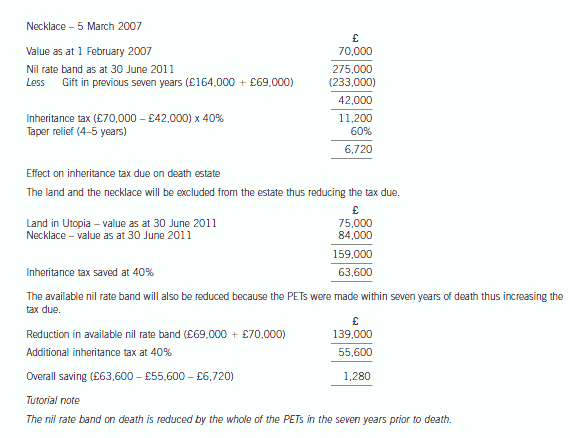
access gymnasium equipment is insignificant when compared to an accident arising from failure to maintain properly a
piece of gymnasium equipment. Moreover, the marketing director ought to be aware that the absolute number of
complaints may be misleading as much depends on the number of clients serviced during any given period. Thus, in
comparing the number of complaints received by the three centres then a relative measure of complaints received per
1,000 client days would be far more useful than the absolute number of complaints received.
The marketing director should also be advised that the number of complaints can give a misleading picture of the quality
of service provision since individuals have different levels of willingness to complain in similar situations.
The marketing director seems to accept the current level of complaints but is unwilling to accept any increase above this
level. This is not indicative of a quality-oriented organisation which would seek to reduce the number of complaints over
time via a programme of ‘continuous improvement’.
From the foregoing comments one can conclude that it would be myopic to focus on the number of client complaints
as being the only performance measure necessary to measure the quality of service provision. Other performance
measures which may indicate the level of service quality provided to clients by HFG are as follows:
– Staff responsiveness assumes critical significance in service industries. Hence the time taken to resolve client
queries by health centre staff is an important indicator of the level of service quality provided to clients.
– Staff appearance may be viewed as reflecting the image of the centres.
– The comfort of bedrooms and public rooms including facilities such as air-conditioning, tea/coffee-making and cold
drinks facilities, and office facilities such as e-mail, facsimile and photocopying.
– The availability of services such as the time taken to gain an appointment with a dietician or fitness consultant.
– The cleanliness of all areas within the centres will enhance the reputation of HFG. Conversely, unclean areas will
potentially deter clients from making repeat visits and/or recommendations to friends, colleagues etc.
– The presence of safety measures and the frequency of inspections made regarding gymnasium equipment within
the centres and compliance with legislation are of paramount importance in businesses like that of HFG.
– The achievement of target reductions in weight that have been agreed between centre consultants and clients.
(Other relevant measures would be acceptable.)
-
第2题:
(d) Advise on any lifetime inheritance tax (IHT) planning that could be undertaken in respect of both Stuart and
Rebecca to help reduce the potential inheritance tax (IHT) liability calculated in (c) above. (7 marks)
Relevant retail price index figures are:
May 1994 144·7
April 1998 162·6
正确答案:
(d) Stuart is not making use of his nil rate band, as all assets are transferred, exempt from inheritance tax (IHT), to Rebecca (as
spouse) on death. He should consider altering his will to transfer an amount equivalent to the nil rate band to his son, Sam.
If Stuart dies before altering his will, Rebecca can elect to make a Deed of Variation in favour of Sam instead. This will have
the same effect as the above.
Care should be taken in determining which assets are subject to this legacy. The Omega plc shares should not be transferred
to Sam as they currently attract 50% BPR. Instead, assets not subject to any reliefs (such as the insurance payout or cash
deposits) should be used instead. By doing this, IHT of £105,200 (£263,000 x 40%) could be saved on the ultimate death
of Rebecca.
It is too late for Stuart to make use of potentially exempt transfers (PETs) as no relief is obtained until three years have passed,
and full relief only occurs seven years after making the gifts. The same would also apply to Rebecca if she were to die on 1
March 2008. However, as she is currently in good health, she may decide to make lifetime gifts, although she should also
not gift the Omega plc shares for the reasons stated above as any gift other than of the entire holding will result in the loss
of BPR on the remainder.
Both individuals should make use of their annual exemptions (£3,000 per person per year). The annual exemptions not used
up in the previous year can be used in this current year. This would give a saving of £2,400 each (3,000 x 2 x 40%).
Exemptions for items such as small gifts (£250 per donee per year) are also available.
Gifts out of normal income should also be considered. After making such gifts, the individual should be left with sufficient
income to maintain their usual standard of living. To obtain the exemption, it is usually necessary to demonstrate general
evidence of a prior commitment to make the gifts, or a settled pattern of expenditure.
While there are no details of income, both Stuart and Rebecca are wealthy in their own right, and are likely to earn reasonable
sums from their investments. They should therefore be able to satisfy the conditions on that basis.
If Rebecca were to make substantial lifetime gifts, the donees would be advised to consider taking out insurance policies on
Rebecca’s life to cover the potential tax liabilities that may arise on any PETs in the event of her early death.
Tutorial note: the answer has assumed that the shares could be bought for £2·10, their value for IHT. -
第3题:
(c) Assuming that Joanne registers for value added tax (VAT) with effect from 1 April 2006:
(i) Calculate her income tax (IT) and capital gains tax (CGT) payable for the year of assessment 2005/06.
You are not required to calculate any national insurance liabilities in this sub-part. (6 marks)
正确答案:
-
第4题:
(ii) State, giving reasons, the tax reliefs in relation to inheritance tax (IHT) and capital gains tax (CGT) which
would be available to Alasdair if he acquires the warehouse and leases it to Gallus & Co, rather than to
an unconnected tenant. (4 marks)
正确答案:
(ii) Apart from the fact that Alasdair can keep an eye on his tenant, the main advantages are twofold:
IHT: If the firm are the tenants, the property will be land and buildings used in a business carried on by a partnership
in which the donor is a partner. Thus, Alasdair will be able to claim business property relief (BPR) at a rate of 50%
so long as he remains a partner in the firm. However, this relief would not be available until Alasdair has owned
the property for at least two years from his firm taking up the tenancy.
CGT: As Alasdair is a partner in the firm using the building, it will also be a qualifying asset for the purposes of rollover
relief on any gains arising from the disposal of the property. Assuming that Alasdair acquires a replacement asset
which will be used in the trade, the gain on sale can be deferred against the tax base cost of the replacement asset.
In the event that rollover relief cannot be used, any gains on disposal will be subject to business asset taper relief. -
第5题:
(ii) State when the inheritance tax (IHT) calculated in (i) would be payable and by whom. (2 marks)
正确答案:
(ii) Inheritance tax administration
The tax on Debbie’s estate (personalty and realty) would be paid by the personal representatives, usually an executor.
Inheritance tax is due six months from the end of the month in which death occurred (31 December 2005) or the date
on which probate is obtained (if earlier). However, an instalment option is available for certain assets, which includes
land and buildings i.e. the residence whereby the tax can be paid in 10 equal annual instalments. -
第6题:
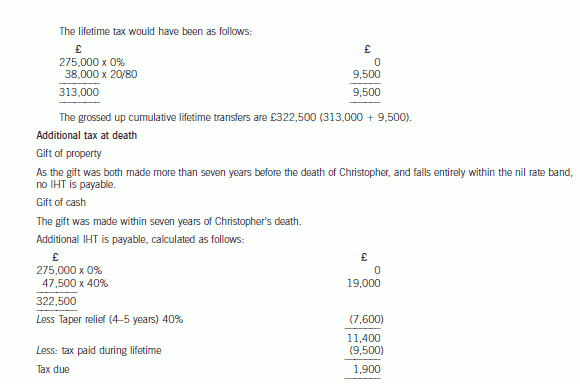
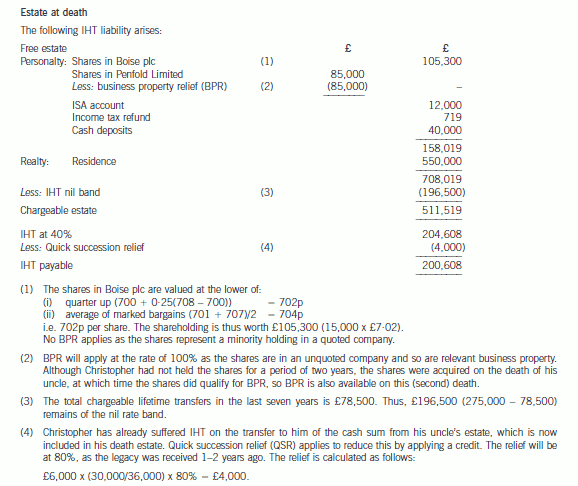
(b) Calculate the inheritance tax (IHT) liability arising as a result of Christopher’s death. (11 marks)
正确答案:
-
第7题:
(ii) Advise Andrew of the tax implications arising from the disposal of the 7% Government Stock, clearly
identifying the tax year in which any liability will arise and how it will be paid. (3 marks)
正确答案:
(ii) Government stock is an exempt asset for the purposes of capital gains tax, however, as Andrew’s holding has a nominal
value in excess of £5,000, a charge to income tax will arise under the accrued income scheme. This charge to income
tax will arise in 2005/06, being the tax year in which the next interest payment following disposal falls due (20 April
2005) and it will relate to the income accrued for the period 21 October 2004 to 14 March 2005 of £279 (145/182
x £350). As interest on Government Stock is paid gross (unless the holder applies to receive it net), the tax due of £112
(£279 x 40%) will be collected via the self-assessment system and as the interest was an ongoing source of income
will be included within Andrew’s half yearly payments on account payable on 31 January and 31 July 2006. -
第8题:
(iii) The extent to which Amy will be subject to income tax in the UK on her earnings in respect of duties
performed for Cutlass Inc and the travel costs paid for by that company. (5 marks)
Appropriateness of format and presentation of the report and the effectiveness with which its advice is
communicated. (2 marks)
Note:
You should assume that the income tax rates and allowances for the tax year 2006/07 and the corporation tax
rates and allowances for the financial year 2006 apply throughout this questio
正确答案:
(iii) Amy’s UK income tax position
Amy will remain UK resident and ordinarily resident as she is not leaving the UK permanently or for a complete tax year
under a full time contract of employment. Accordingly, she will continue to be subject to UK tax on her worldwide income
including her earnings in respect of the duties she performs for Cutlass Inc. The earnings from these duties will also be
taxable in Sharpenia as the income arises in that country.
The double tax treaty between the UK and Sharpenia will either exempt the employment income in one of the two
countries or give double tax relief for the tax paid in Sharpenia. The double tax relief will be the lower of the UK tax and
the Sharpenian tax on the income from Cutlass Inc.
Amy will not be subject to UK income tax on the expenses borne by Cutlass Inc in respect of her flights to and from
Sharpenia provided her journeys are wholly and exclusively for the purposes of performing her duties in Sharpenia.
The amounts paid by Cutlass Inc in respect of Amy’s family travelling to Sharpenia will be subject to UK income tax as
Amy will not be absent from the UK for a continuous period of at least 60 days. -
第9题:
(c) Explanatory notes, together with relevant supporting calculations, in connection with the loan. (8 marks)
Additional marks will be awarded for the appropriateness of the format and presentation of the schedules, the
effectiveness with which the information is communicated and the extent to which the schedules are structured in
a logical manner. (3 marks)
Notes: – you should assume that the tax rates and allowances for the tax year 2006/07 and for the financial year
to 31 March 2007 apply throughout the question.
– you should ignore value added tax (VAT).
正确答案:
(c) Tax implications of there being a loan from Flores Ltd to Banda
Flores Ltd should have paid tax to HMRC equal to 25% of the loan, i.e. £5,250. The tax should have been paid on the
company’s normal due date for corporation tax in respect of the accounting period in which the loan was made, i.e. 1 April
following the end of the accounting period.
The tax is due because Flores Ltd is a close company that has made a loan to a participator and that loan is not in the ordinary
course of the company’s business.
HMRC will repay the tax when the loan is either repaid or written off.
Flores Ltd should have included the loan on Banda’s Form. P11D in order to report it to HMRC.
Banda should have paid income tax on an annual benefit equal to 5% of the amount of loan outstanding during each tax
year. Accordingly, for each full year for which the loan was outstanding, Banda should have paid income tax of £231
(£21,000 x 5% x 22%).
Interest and penalties may be charged in respect of the tax underpaid by both Flores Ltd and Banda and in respect of the
incorrect returns made to HMRC
Willingness to act for Banda
We would not wish to be associated with a client who has engaged in deliberate tax evasion as this poses a threat to the
fundamental principles of integrity and professional behaviour. Accordingly, we should refuse to act for Banda unless she is
willing to disclose the details regarding the loan to HMRC and pay the ensuing tax liabilities. Even if full disclosure is made,
we should consider whether the loan was deliberately hidden from HMRC or Banda’s previous tax adviser.
In addition, companies are prohibited from making loans to directors under the Companies Act. We should advise Banda to
seek legal advice on her own position and that of Flores Ltd. -
第10题:
(iv) The stamp duty and/or stamp duty land tax payable by the Saturn Ltd group; (2 marks)
Additional marks will be awarded for the appropriateness of the format and presentation of the memorandum
and the effectiveness with which the information is communicated. (2 marks)
正确答案:
(iv) Stamp duty and stamp duty land tax
– The purchase of Tethys Ltd will give rise to a liability to ad valorem stamp duty of £1,175 (£235,000 x 0·5%).
The stamp duty must be paid by Saturn Ltd within 30 days of the share transfer in order to avoid interest being
charged. It is not an allowable expense for the purposes of corporation tax. -
第11题:
(b) Calculate the amount of input tax that will be recovered by Vostok Ltd in respect of the new premises in the
year ending 31 March 2009 and explain, using illustrative calculations, how any additional recoverable input
tax will be calculated in future years. (5 marks)
正确答案:
(b) Recoverable input tax in respect of new premises
Vostok Ltd will recover £47,880 (£446,500 x 7/47 x 72%) in the year ending 31 March 2009.
The capital goods scheme will apply to the purchase of the building because it is to cost more than £250,000. Under the
scheme, the total amount of input tax recovered reflects the use of the building over the period of ownership, up to a maximum
of ten years, rather than merely the year of purchase.
Further input tax will be recovered in future years as the percentage of exempt supplies falls. (If the percentage of exempt
supplies were to rise, Vostok Ltd would have to repay input tax to HMRC.)
The additional recoverable input tax will be computed by reference to the percentage of taxable supplies in each year including
the year of sale. For example, if the percentage of taxable supplies in a particular subsequent year were to be 80%, the
additional recoverable input tax would be computed as follows.
£446,500 x 7/47 x 1/10 x (80% – 72%) = £532.
Further input tax will be recovered in the year of sale as if Vostok Ltd’s supplies in the remaining years of the ten-year period
are fully vatable. For example, if the building is sold in year seven, the additional recoverable amount for the remaining three
years will be calculated as follows.
£446,500 x 7/47 x 1/10 x (100% – 72%) x 3 = £5,586. -
第12题:
问答题Inheritance tax is a tax which many countries levy on the total taxable value of the estate of a deceased person. Inheritance tax is paid by the inheritor of the estate or by the person in charge of its assets. In most cases, if the estate is left to a charitable organization or a surviving spouse, no inheritance tax is due. In China, inheritance tax does not exist. Should inheritance tax be introduced to China? The controversy that has raged over levying inheritance tax in China currently shows little sign of abating. The following are opinions from both sides. Read the excerpt carefully and write your response in about 300 words, in which you should: 1. summarize briefly the opinions from both sides, and then 2. give your comment. Marks will be awarded for content relevance, content sufficiency, organization and language quality. Failure to follow the above instructions may result in a loss of marks. Opponents of inheritance tax typically refer to it as “death tax.” They argue first that concern over burdening their children with this tax may lead elderly to make unwise investment decisions late in life, and that it may also discourage entrepreneurship earlier in life. Opponents also claim that morally it should be only the choice of the person who earned the money what should be done with it, not the government. They see taxing wealth at death as a kind of forced income redistribution that goes against the market economy. Proponents of inheritance tax say that it helps prevent consolidation of wealth in the hands of a few powerful families and is a basic building block of the nation’s system of taxation. They also feel that inheriting large sums without tax undermines people’s motives to work hard in the future and, thus, undercuts the principles of the market economy, encouraging people to become idle and unproductive, which hurts the country overall.正确答案:
【参考范文】
Should Inheritance Tax be Introduced to China? An inheritance tax is a tax paid by a person who inherits money or property or a levy on the estate of a person who has died. Many countries have inheritance tax, while China does not. Whether China should levy inheritance tax has become a hot topic of discussion. Supporters hold that it helps prevent the wealth from being always in the hands of a few powerful families. Inheriting large sums without tax weakens people’s enthusiasm for work, encouraging people to become lazy and unproductive, which is not conducive to the whole country. However, opponents argue that this tax may result in unwise investment decisions late in life, and discourage entrepreneurship earlier in life. It is a kind of forced income redistribution, ignoring the right of people earned the money.
From my points of view, inheritance tax should not be introduced to China. Firstly, it is a violation of human rights. In any country that has recognized the private property rights, a person’s private property can be handled without violating others all a person likes. The inheritance tax violates the rights of the people to dispose of their property. Secondly, inheritance tax will encourage abnormal consumption, conspicuous consumption of rich people, further intensifying contradictions and conflicts among social members. It may stimulate the rich to spend their money excessively before death and lead to hostility to the rich. Thirdly, inheritance tax will reduce the enthusiasm of entrepreneurs, exacerbate capital flight, economic migration and impede investment and capital inflows, inhibiting economic development. It may drive wealthy people to move assets out of the country or emigrate in order to avoid the tax, resulting in capital loss and brain drain.
To summarize, inheritance tax might not be an effective enough tool to narrow income disparity. Therefore, other measures are needed if the government wants to ensure a more equitable distribution of wealth in society.解析:
【审题构思】
本题要求考生围绕是否应该征收遗产税这一话题展开讨论。文章可以支持也可以反对,只要言之有理即可。考生首先要总结材料中的观点,然后明确陈述自己的观点。接下来论证自己的观点,注意要分点列举,这样才能做到内容充实,条理清晰。最后总结全文,重申观点;也可进一步补充观点,深化主题。 -
第13题:
(c) Assuming that Stuart:
(i) purchased 201,000 shares in Omega plc on 3 December 2005; and
(ii) dies on 20 December 2007,
calculate the potential inheritance tax (IHT) liability which would arise if Rebecca were to die on 1 March
2008, and no further tax planning measures were taken.
Assume that all asset values remain unchanged and that the current rates of inheritance tax continue to
apply. (6 marks)
正确答案:
-
第14题:
(b) Explain the capital gains tax (CGT) and inheritance tax (IHT) implications of Graeme gifting his remaining ‘T’
ordinary shares at their current value either:
(i) to his wife, Catherine; or
(ii) to his son, Barry.
Your answer should be supported by relevant calculations and clearly identify the availability and effect of
any reliefs (other than the CGT annual exemption) that might be used to reduce or defer any tax liabilities
arising. (9 marks)
正确答案: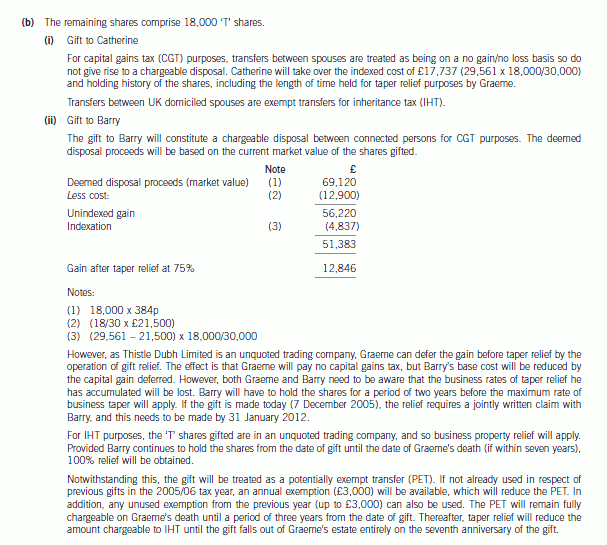
-
第15题:
(ii) Calculate her income tax (IT) and national insurance (NIC) payable for the year of assessment 2006/07.
(4 marks)
正确答案:
-
第16题:
(b) (i) Calculate the inheritance tax (IHT) that will be payable if Debbie were to die today (8 June 2005).
Assume that no tax planning measures are taken and that there has been no change in the value of any
of the assets since David’s death. (4 marks)
正确答案:
-
第17题:
(b) Mabel has two objectives when making the gifts to Bruce and Padma:
(1) To pay no tax on any gift in her lifetime; and
(2) To reduce the eventual liability to inheritance tax on her death.
Advise Mabel which item to gift to Bruce and to Padma in order to satisfy her objectives. Give reasons for
your advice.
Your advice should include a computation of the inheritance tax saved as a result of the two gifts, on the
assumption that Mabel dies on 30 June 2011. (10 marks)
正确答案: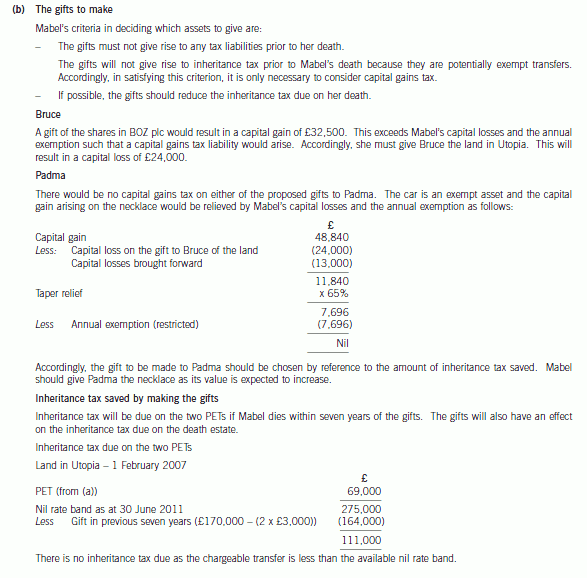
-
第18题:
(ii) Calculate the corporation tax (CT) payable by Tay Limited for the year ended 31 March 2006, taking
advantage of all available reliefs. (3 marks)
正确答案:
-
第19题:
(b) (i) Calculate Amanda’s income tax payable for the tax year 2006/07; (11 marks)
正确答案:

-
第20题:
(b) Advise Sergio on the appropriateness of investing in a domestic rental property in view of his personal
circumstances and recommend suitable alternative investments giving reasons for your advice. (4 marks)
正确答案:
(b) Sergio’s investments
Sergio aims to leave a substantial asset to his family on his death. Accordingly, in view of his age, he is right to be considering
investing in an asset whose value is unlikely to fall suddenly, such as a domestic rental property. However, it must be
recognised that although the value of land and buildings can usually be relied on to increase over a long period of time, its
value may fall over a shorter period. The only investments that cannot fall in value are cash deposits, although they do, of
course, fall in real terms due to the effects of inflation.
Sergio should consider whether or not he wishes to increase his annual income. The return on capital invested in a domestic
rental property is unlikely to be very high due to the recent increases in property values in the UK. Also, there are likely to be
periods when the house is unoccupied during which no income will be generated. If it is important to Sergio to generate
additional income he should consider other low-risk investments with a more reliable and higher rate of return, for example,
gilt edged stocks, unit trusts and cash deposits.
Sergio must also decide whether it is important to him to be able to access capital quickly, as it is usually not possible to
realise the capital invested in land and buildings at short notice. If this is important, Sergio should consider holding some of
his capital in cash deposits or other liquid investments, eg unit trusts.
Sergio could invest up to £7,000 each year in an individual savings account (ISA). A maximum of £3,000 can be held as a
cash deposit with the balance invested in quoted shares. The income and gains arising on the funds invested would be
exempt from both income tax and capital gains tax. This would be a relatively low-risk investment and would also be
accessible quickly if required. -
第21题:
5 Crusoe has contacted you following the death of his father, Noland. Crusoe has inherited the whole of his father’s
estate and is seeking advice on his father’s capital gains tax position and the payment of inheritance tax following his
death.
The following information has been extracted from client files and from telephone conversations with Crusoe.
Noland – personal information:
– Divorcee whose only other relatives are his sister, Avril, and two grandchildren.
– Died suddenly on 1 October 2007 without having made a will.
– Under the laws of intestacy, the whole of his estate passes to Crusoe.
Noland – income tax and capital gains tax:
– Has been a basic rate taxpayer since the tax year 2000/01.
– Sales of quoted shares resulted in:
– Chargeable gains of £7,100 and allowable losses of £17,800 in the tax year 2007/08.
– Chargeable gains of approximately £14,000 each tax year from 2000/01 to 2006/07.
– None of the shares were held for long enough to qualify for taper relief.
Noland – gifts made during lifetime:
– On 1 December 1999 Noland gave his house to Crusoe.
– Crusoe has allowed Noland to continue living in the house and has charged him rent of £120 per month
since 1 December 1999. The market rent for the house would be £740 per month.
– The house was worth £240,000 at the time of the gift and £310,000 on 1 October 2007.
– On 1 November 2004 Noland transferred quoted shares worth £232,000 to a discretionary trust for the benefit
of his grandchildren.
Noland – probate values of assets held at death: £
– Portfolio of quoted shares 370,000
Shares in Kurb Ltd 38,400
Chattels and cash 22,300
Domestic liabilities including income tax payable (1,900)
– It should be assumed that these values will not change for the foreseeable future.
Kurb Ltd:
– Unquoted trading company
– Noland purchased the shares on 1 December 2005.
Crusoe:
– Long-standing personal tax client of your firm.
– Married with two young children.
– Successful investment banker with very high net worth.
– Intends to gift the portfolio of quoted shares inherited from Noland to his aunt, Avril, who has very little personal
wealth.
Required:
(a) Prepare explanatory notes together with relevant supporting calculations in order to quantify the tax relief
potentially available in respect of Noland’s capital losses realised in 2007/08. (4 marks)
正确答案: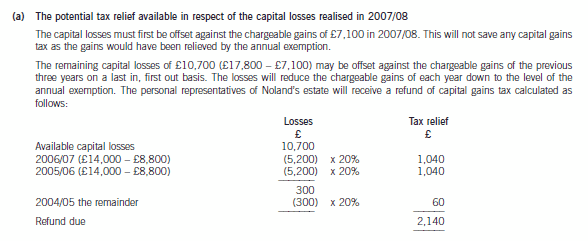
-
第22题:
(b) Advise Maureen on deregistration for the purposes of value added tax (VAT) and any possible alternative
strategy. (8 marks)
An additional mark will be awarded for the effectiveness with which the information is communicated.
(1 mark)
正确答案:
(b) Advice on Maureen’s VAT position
Deregistration
In order to voluntarily deregister for VAT you must satisfy HMRC that the value of your taxable supplies in the next twelve
months will not exceed £62,000. You will then be deregistered with effect from the date of your request or a later date as
agreed with HMRC.
On deregistering you are regarded as making a supply of all stocks and equipment in respect of which input tax has been
claimed. However, the VAT on this deemed supply need only be paid to HMRC if it exceeds £1,000.
Once you have deregistered, you must no longer charge VAT on your sales. You will also be unable to recover the input tax
on the costs incurred by your business. Instead, the VAT you pay on your costs will be allowable when computing your taxable
profits.
You should monitor your sales on a monthly basis; if your sales in a twelve-month period exceed £64,000 you must notify
HMRC within the 30 days following the end of the twelve-month period. You will be registered from the end of the month
following the end of the twelve-month period.
Flat rate scheme
Rather than deregistering you may wish to consider operating the flat rate scheme. This would reduce the amount of
administration as you would no longer need to record and claim input tax in respect of the costs incurred by your business.
Under the flat rate scheme you would continue to charge your customers VAT in the way that you do at the moment. You
would then pay HMRC a fixed percentage of your VAT inclusive turnover each quarter rather than calculating output tax less
input tax. This may be financially advantageous as compared with deregistering; I would be happy to prepare calculations for
you if you wish. -
第23题:
James died on 22 January 2015. He had made the following gifts during his lifetime:
(1) On 9 October 2007, a cash gift of £35,000 to a trust. No lifetime inheritance tax was payable in respect of this gift.
(2) On 14 May 2013, a cash gift of £420,000 to his daughter.
(3) On 2 August 2013, a gift of a property valued at £260,000 to a trust. No lifetime inheritance tax was payable in respect of this gift because it was covered by the nil rate band. By the time of James’ death on 22 January 2015, the property had increased in value to £310,000.
On 22 January 2015, James’ estate was valued at £870,000. Under the terms of his will, James left his entire estate to his children.
The nil rate band of James’ wife was fully utilised when she died ten years ago.
The nil rate band for the tax year 2007–08 is £300,000, and for the tax year 2013–14 it is £325,000.
Required:
(a) Calculate the inheritance tax which will be payable as a result of James’ death, and state who will be responsible for paying the tax. (6 marks)
(b) Explain why it might have been beneficial for inheritance tax purposes if James had left a portion of his estate to his grandchildren rather than to his children. (2 marks)
(c) Explain why it might be advantageous for inheritance tax purposes for a person to make lifetime gifts even when such gifts are made within seven years of death.
Notes:
1. Your answer should include a calculation of James’ inheritance tax saving from making the gift of property to the trust on 2 August 2013 rather than retaining the property until his death.
2. You are not expected to consider lifetime exemptions in this part of the question. (2 marks)
正确答案:(a) James – Inheritance tax arising on death
Lifetime transfers within seven years of death
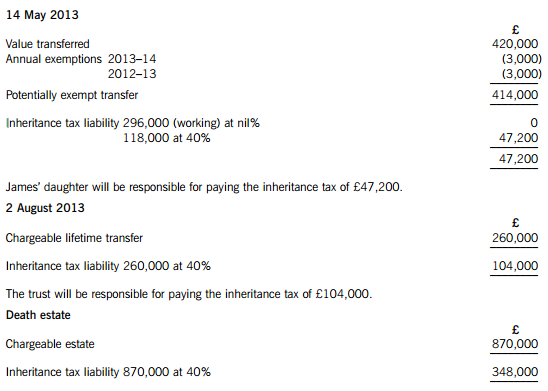
The personal representatives of James’ estate will be responsible for paying the inheritance tax of £348,000.
Working – Available nil rate band
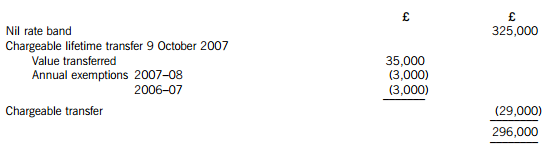
(b) Skipping a generation avoids a further charge to inheritance tax when the children die. Gifts will then only be taxed once before being inherited by the grandchildren, rather than twice.
(c) (1) Even if the donor does not survive for seven years, taper relief will reduce the amount of IHT payable after three years.
(2) The value of potentially exempt transfers and chargeable lifetime transfers are fixed at the time they are made.
(3) James therefore saved inheritance tax of £20,000 ((310,000 – 260,000) at 40%) by making the lifetime gift of property.