
(c) Explanatory notes, together with relevant supporting calculations, in connection with the loan. (8 marks)Additional marks will be awarded for the appropriateness of the format and presentation of the schedules, theeffectiveness with which the informat
题目
(c) Explanatory notes, together with relevant supporting calculations, in connection with the loan. (8 marks)
Additional marks will be awarded for the appropriateness of the format and presentation of the schedules, the
effectiveness with which the information is communicated and the extent to which the schedules are structured in
a logical manner. (3 marks)
Notes: – you should assume that the tax rates and allowances for the tax year 2006/07 and for the financial year
to 31 March 2007 apply throughout the question.
– you should ignore value added tax (VAT).
相似考题
更多“(c) Explanatory notes, together with relevant supporting calculations, in connection with the loan. (8 marks)Additional marks will be awarded for the appropriateness of the format and presentation of the schedules, theeffectiveness with which the informat”相关问题
-
第1题:
(d) Sirus raised a loan with a bank of $2 million on 1 May 2007. The market interest rate of 8% per annum is to
be paid annually in arrears and the principal is to be repaid in 10 years time. The terms of the loan allow Sirus
to redeem the loan after seven years by paying the full amount of the interest to be charged over the ten year
period, plus a penalty of $200,000 and the principal of $2 million. The effective interest rate of the repayment
option is 9·1%. The directors of Sirus are currently restructuring the funding of the company and are in initial
discussions with the bank about the possibility of repaying the loan within the next financial year. Sirus is
uncertain about the accounting treatment for the current loan agreement and whether the loan can be shown as
a current liability because of the discussions with the bank. (6 marks)
Appropriateness of the format and presentation of the report and quality of discussion (2 marks)
Required:
Draft a report to the directors of Sirus which discusses the principles and nature of the accounting treatment of
the above elements under International Financial Reporting Standards in the financial statements for the year
ended 30 April 2008.
正确答案:
(d) Repayment of the loan
If at the beginning of the loan agreement, it was expected that the repayment option would not be exercised, then the effective
interest rate would be 8% and at 30 April 2008, the loan would be stated at $2 million in the statement of financial position
with interest of $160,000 having been paid and accounted for. If, however, at 1 May 2007, the option was expected to be
exercised, then the effective interest rate would be 9·1% and at 30 April 2008, the cash interest paid would have been
$160,000 and the interest charged to the income statement would have been (9·1% x $2 million) $182,000, giving a
statement of financial position figure of $2,022,000 for the amount of the financial liability. However, IAS39 requires the
carrying amount of the financial instrument to be adjusted to reflect actual and revised estimated cash flows. Thus, even if
the option was not expected to be exercised at the outset but at a later date exercise became likely, then the carrying amount
would be revised so that it represented the expected future cash flows using the effective interest rate. As regards the
discussions with the bank over repayment in the next financial year, if the loan was shown as current, then the requirements
of IAS1 ‘Presentation of Financial Statements’ would not be met. Sirus has an unconditional right to defer settlement for longer
than twelve months and the liability is not due to be legally settled in 12 months. Sirus’s discussions should not be considered
when determining the loan’s classification.
It is hoped that the above report clarifies matters. -
第2题:
Discuss the principles and practices which should be used in the financial year to 30 November 2008 to account
for:(c) the purchase of handsets and the recognition of revenue from customers and dealers. (8 marks)
Appropriateness and quality of discussion. (2 marks)
正确答案:Handsets and revenue recognition
The inventory of handsets should be measured at the lower of cost and net realisable value (IAS2, ‘Inventories’, para 9). Johan
should recognise a provision at the point of purchase for the handsets to be sold at a loss. The inventory should be written down
to its net realisable value (NRV) of $149 per handset as they are sold both to prepaid customers and dealers. The NRV is $51
less than cost. Net realisable value is the estimated selling price in the normal course of business less the estimated selling costs.
IAS18, ‘Revenue’, requires the recognition of revenue by reference to the stage of completion of the transaction at the reporting
date. Revenue associated with the provision of services should be recognised as service as rendered. Johan should record the
receipt of $21 per call card as deferred revenue at the point of sale. Revenue of $18 should be recognised over the six month
period from the date of sale. The unused call credit of $3 would be recognised when the card expires as that is the point at which
the obligation of Johan ceases. Revenue is earned from the provision of services and not from the physical sale of the card.
IAS18 does not deal in detail with agency arrangements but says the gross inflows of economic benefits include amounts collected
on behalf of the principal and which do not result in increases in equity for the entity. The amounts collected on behalf of the
principal are not revenue. Revenue is the amount of the ‘commission’. Additionally where there are two or more transactions, they
should be taken together if the commercial effect cannot be understood without reference to the series of transactions as a whole.
As a result of the above, Johan should not recognise revenue when the handset is sold to the dealer, as the dealer is acting as an
agent for the sale of the handset and the service contract. Johan has retained the risk of the loss in value of the handset as they
can be returned by the dealer and the price set for the handset is under the control of Johan. The handset sale and the provision
of the service would have to be assessed as to their separability. However, the handset cannot be sold separately and is
commercially linked to the provision of the service. Johan would, therefore, recognise the net payment of $130 as a customer
acquisition cost which may qualify as an intangible asset under IAS38, and the revenue from the service contract will be recognised
as the service is rendered. The intangible asset would be amortised over the 12 month contract. The cost of the handset from the
manufacturer will be charged as cost of goods sold ($200). -
第3题:
(ii) Recommend which of the refrigeration systems should be purchased. You should state your reasons
which must be supported by relevant calculations. (3 marks)
正确答案:
-
第4题:
(iii) Whether or not you agree with the statement of the marketing director in note (9) above. (5 marks)
Professional marks for appropriateness of format, style. and structure of the report. (4 marks)
正确答案:(iii) The marketing director is certainly correct in recognising that success is dependent on levels of service quality provided
by HFG to its clients. However, whilst the number of complaints is an important performance measure, it needs to be
used with caution. The nature of a complaint is, very often, far more indicative of the absence, or a lack, of service
quality. For example, the fact that 50 clients complained about having to wait for a longer time than they expected to
access gymnasium equipment is insignificant when compared to an accident arising from failure to maintain properly a
piece of gymnasium equipment. Moreover, the marketing director ought to be aware that the absolute number of
complaints may be misleading as much depends on the number of clients serviced during any given period. Thus, in
comparing the number of complaints received by the three centres then a relative measure of complaints received per
1,000 client days would be far more useful than the absolute number of complaints received.
The marketing director should also be advised that the number of complaints can give a misleading picture of the quality
of service provision since individuals have different levels of willingness to complain in similar situations.
The marketing director seems to accept the current level of complaints but is unwilling to accept any increase above this
level. This is not indicative of a quality-oriented organisation which would seek to reduce the number of complaints over
time via a programme of ‘continuous improvement’.
From the foregoing comments one can conclude that it would be myopic to focus on the number of client complaints
as being the only performance measure necessary to measure the quality of service provision. Other performance
measures which may indicate the level of service quality provided to clients by HFG are as follows:
– Staff responsiveness assumes critical significance in service industries. Hence the time taken to resolve client
queries by health centre staff is an important indicator of the level of service quality provided to clients.
– Staff appearance may be viewed as reflecting the image of the centres.
– The comfort of bedrooms and public rooms including facilities such as air-conditioning, tea/coffee-making and cold
drinks facilities, and office facilities such as e-mail, facsimile and photocopying.
– The availability of services such as the time taken to gain an appointment with a dietician or fitness consultant.
– The cleanliness of all areas within the centres will enhance the reputation of HFG. Conversely, unclean areas will
potentially deter clients from making repeat visits and/or recommendations to friends, colleagues etc.
– The presence of safety measures and the frequency of inspections made regarding gymnasium equipment within
the centres and compliance with legislation are of paramount importance in businesses like that of HFG.
– The achievement of target reductions in weight that have been agreed between centre consultants and clients.
(Other relevant measures would be acceptable.)
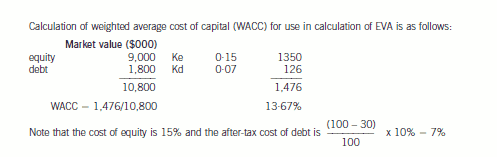
-
第5题:
(b) Explain the advantages from a tax point of view of operating the new business as a partnership rather than
as a company whilst it is making losses. You should calculate the tax adjusted trading loss for the year
ending 31 March 2008 for both situations and indicate the years in which the loss relief will be obtained.
You are not required to prepare any other supporting calculations. (10 marks)
正确答案:(b) The new business
There are two tax advantages to operating the business as a partnership.
(i) Reduction in taxable income
If the new business is operated as a company, Cindy and Arthur would both be taxed at 40% on their salaries. In
addition, employer and employee national insurance contributions would be due on £105 (£5,000 – £4,895) in respect
of each of them.
If the new business is operated as a partnership, the partners would have no taxable trading income because the
partnership has made a loss; any salaries paid to the partners would be appropriations of the profit or loss of the
business and not employment income. They would, however, each have to pay Class 2 national insurance contributions
of £2·10 each per week.
(ii) Earlier relief for trading losses
If the new business is operated as a company, its tax adjusted trading loss in the year ending 31 March 2008 would
be as follows: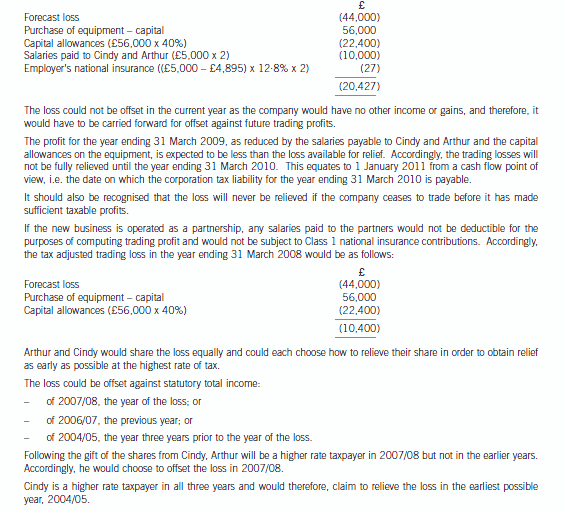
-
第6题:
(iii) The extent to which Amy will be subject to income tax in the UK on her earnings in respect of duties
performed for Cutlass Inc and the travel costs paid for by that company. (5 marks)
Appropriateness of format and presentation of the report and the effectiveness with which its advice is
communicated. (2 marks)
Note:
You should assume that the income tax rates and allowances for the tax year 2006/07 and the corporation tax
rates and allowances for the financial year 2006 apply throughout this questio
正确答案:
(iii) Amy’s UK income tax position
Amy will remain UK resident and ordinarily resident as she is not leaving the UK permanently or for a complete tax year
under a full time contract of employment. Accordingly, she will continue to be subject to UK tax on her worldwide income
including her earnings in respect of the duties she performs for Cutlass Inc. The earnings from these duties will also be
taxable in Sharpenia as the income arises in that country.
The double tax treaty between the UK and Sharpenia will either exempt the employment income in one of the two
countries or give double tax relief for the tax paid in Sharpenia. The double tax relief will be the lower of the UK tax and
the Sharpenian tax on the income from Cutlass Inc.
Amy will not be subject to UK income tax on the expenses borne by Cutlass Inc in respect of her flights to and from
Sharpenia provided her journeys are wholly and exclusively for the purposes of performing her duties in Sharpenia.
The amounts paid by Cutlass Inc in respect of Amy’s family travelling to Sharpenia will be subject to UK income tax as
Amy will not be absent from the UK for a continuous period of at least 60 days. -
第7题:
(d) Evaluate the effect on Gerard of the changes to be made by Fizz plc to its performance related bonus scheme.
You should ignore the effect of any pension contributions to be made by Gerard in the future, consider both
the value and timing of amounts received by Gerard and include relevant supporting calculations.
(5 marks)
Note: – You should assume that the income tax rates and allowances for the tax year 2006/07 apply throughout
this question.
正确答案:
(d) Implications for Gerard of the changes to Fizz plc’s bonus scheme
Value received
Under the existing scheme Gerard receives approximately £4,500 each year. This is subject to income tax at 40% and
national insurance contributions at 1% such that Gerard receives £2,655 (£4,500 x 59%) after all taxes.
Under the proposed share incentive plan (SIP), Gerard expects to receive free shares worth £3,500 (£2,100 + £1,400).
Provided the shares remain in the plan for at least five years there will be no income tax or national insurance contributions
in respect of the value received. Gerard’s base cost in the shares for the purposes of capital gains tax will be their value at
the time they are withdrawn from the scheme.
In addition, the amount he spends on partnership shares will be allowable for both income tax and national insurance such
that he will obtain shares with a value of £700 for a cost of only £413 (£700 x 59%).
Accordingly, Gerard will receive greater value under the SIP than he does under the existing bonus scheme. However, as noted
below, he will not be able to sell the free or matching shares until they have been in the scheme for at least three years by
which time they may have fallen in value.
Timing of receipt of benefit
Under the existing scheme Gerard receives a cash bonus each year.
The value of free and matching shares awarded under a SIP cannot be realised until the shares are withdrawn from the
scheme and sold. This withdrawal cannot take place until at least three years after the shares are awarded to Gerard.
Accordingly, Gerard will not have access to the value of the bonuses he receives under the SIP until the scheme has been in
operation for at least three years. In addition, if the shares are withdrawn within five years of being awarded, income tax and
national insurance contributions will become payable on the lower of their value at the time of the award and their value at
the time of withdrawal thus reducing the value of Gerard’s bonus. -
第8题:
(b) The tax relief available in respect of the anticipated trading losses, together with supporting calculations and
a recommended structure for the business. (16 marks)
正确答案:

Aral Ltd owned by Banda
The losses would have to be carried forward and deducted from the trading profits of the year ending 30 June 2010.
Aral Ltd cannot offset the loss in the current period or carry it back as it has no other income or gains.
Aral Ltd owned by Flores Ltd
The two companies will form. a group relief group if Flores Ltd owns at least 75% of the ordinary share capital of Aral
Ltd. The trading losses could be surrendered to Flores Ltd in the year ending 30 June 2008 and the year ending
30 June 2009. The total tax saved would be £11,079 ((£38,696 + £19,616) x 19%)
Recommended structure
The Aral business should be established in a company owned by Flores Ltd.
This will maximise the relief available in respect of the trading losses and enable relief to be obtained in the period in
which the losses are incurred.
Tutorial note
The whole of the loss for the period ending 30 June 2008 can be surrendered to Flores Ltd as it is less than that
company’s profit for the corresponding period, i.e. £60,000 (£120,000 x 6/12). -
第9题:
(b) Advise Maureen on deregistration for the purposes of value added tax (VAT) and any possible alternative
strategy. (8 marks)
An additional mark will be awarded for the effectiveness with which the information is communicated.
(1 mark)
正确答案:
(b) Advice on Maureen’s VAT position
Deregistration
In order to voluntarily deregister for VAT you must satisfy HMRC that the value of your taxable supplies in the next twelve
months will not exceed £62,000. You will then be deregistered with effect from the date of your request or a later date as
agreed with HMRC.
On deregistering you are regarded as making a supply of all stocks and equipment in respect of which input tax has been
claimed. However, the VAT on this deemed supply need only be paid to HMRC if it exceeds £1,000.
Once you have deregistered, you must no longer charge VAT on your sales. You will also be unable to recover the input tax
on the costs incurred by your business. Instead, the VAT you pay on your costs will be allowable when computing your taxable
profits.
You should monitor your sales on a monthly basis; if your sales in a twelve-month period exceed £64,000 you must notify
HMRC within the 30 days following the end of the twelve-month period. You will be registered from the end of the month
following the end of the twelve-month period.
Flat rate scheme
Rather than deregistering you may wish to consider operating the flat rate scheme. This would reduce the amount of
administration as you would no longer need to record and claim input tax in respect of the costs incurred by your business.
Under the flat rate scheme you would continue to charge your customers VAT in the way that you do at the moment. You
would then pay HMRC a fixed percentage of your VAT inclusive turnover each quarter rather than calculating output tax less
input tax. This may be financially advantageous as compared with deregistering; I would be happy to prepare calculations for
you if you wish. -
第10题:
(b) State, with reasons, the principal additional information that should be made available for your review of
Robson Construction Co. (8 marks)
正确答案:
(b) Principal additional information
■ Any service contracts with the directors or other members of the management team (e.g. the quantity surveyor). These
may contain ‘exit’ or other settlement terms in the event that their services are no longer required after a takeover/buyout.
■ Prior period financial statements (to 30 June 2005) disclosing significant accounting policies and the key assumptions
concerning the future (and other key sources of estimation uncertainty) that have a significant risk of causing a material
adjustment to the carrying amounts of assets and liabilities in the year to 30 June 2006.
For example, concerning:
– the outcome on the Sarwar dispute;
– estimates for guarantees/claims for rectification;
– assumptions made in estimating costs to completion (e.g. for increases in costs of materials or labour).
Tutorial note: Under IAS 1 ‘Presentation of Financial Statements’ the judgements made by management that have the
most significant effect on amounts recognised in financial statements (other than those involving estimations) should
also be disclosed.
■ The most recent management accounts and cash flow forecasts to assess the quality of management information being
used for decision-making and control. In particular, in providing Robson with the means of keeping its cash flows within
its overdraft limit.
Tutorial note: Note that Prescott has substantial cash resources. Therefore Robson’s lack of finance might be a reason
why its management are interested in selling the business.
■ A copy of the signed bank agreement for the overdraft facility (and any other agreements with finance providers). Any
breaches in debt covenants might result in penalties of contingent liabilities that Prescott would have to bear if it acquired
Robson.
■ The standard terms of contracts with customers for construction works. In particular, for:
– guarantees given (e.g. for rectification under warranty);
– penalty clauses (e.g. in the event of overruns or non-completion);
– disclaimers (including conditions for invoking force majeure).
Prescott will want to make some allowance for settlement of liabilities arising on contracts already completed/in-progress
when offering a price for Robson.
Tutorial note: A takeover might excuse Robson from fulfilling a contract.
■ Legal/correspondence files dealing with matters such as the claims of the residents of the housing development and
Robson’s claim against Sarwar Services Co. Also, fee notes rendered by Robson’s legal advisers showing the costs
incurred on matters referred to them.
■ Robson’s insurer’s ‘cover note’ to determine Robson’s exposure to claims for rectification work, damages, injuries to
employees, etc.
■ The quantity surveyor’s working papers for the last quarterly count (presumably at 31 March 2006) and the latest
available rolling budgets. Particular attention should be given to loss-making contracts and contracts that have not been
started. (Prescott might seek to settle rather than fulfil them.) The pattern of taking profits on contracts will be of
interest, for example, to determine the accuracy of the quantity surveyor’s estimates.
Tutorial note: A regular pattern of taking too much profit too soon might be due to underestimating costs to completion
or be evidence of cost overruns due to rectification.
■ Type and frequency of constructions undertaken. Prescott is interested in the building and refurbishment of hotels and
leisure facilities. Robson’s experience in this area may not be extensive.
■ Non-current asset register showing location of plant and equipment so that some test checking on physical existence
might be undertaken (if an agreed-upon-procedure). -
第11题:
问答题Advances in technology and science have solved many problems. However,they have also created new problems,among which pollution has attracted much attention of the public. Write a composition of about 400 words on the following topic,discussion the problems caused by pollution.ON POLLUTIONIn the first part of your writing you should present your thesis statement, and in the second part you should support the thesis statement with appropriate details. In the last part you should bring what you have written to a natural conclusion or a summary. Marks will be awarded for content, organization, grammar and appropriateness. Failure to follow the above instructions may result in a loss of marks.正确答案:
ON POLLUTION Nowadays we have many conveniences in our society, which have been brought through technology and science. However, these same advancements in technology and science have caused some very dangerous problems. These problems will not go away easily because people do not want to give up the conveniences of a modem lifestyle. The most critical problems that should be dealt with immediately are those of pollution.
Pollution caused by chemicals is a very serious problem because it causes the loss of the ozone layer. Without our ozone, not only we ourselves but also plant and animal life are exposed to dangerous rays from the sun. Aerosol cans emit chemicals that break down our ozone layer. Refrigeration and air-conditioning systems and ears also have dangerous emissions. A very serious threat to the planet—the warming of the earth's atmosphere—is primarily caused by carbon dioxide emissions. Many scientists think that the warming could be sufficient to melt the polar ice caps, thus raising the sea levels. This would mean that many parts of the world would be submerged below sea level.
There are other problems caused by pollution. Factories that make our modem conveniences emit poisonous gases onto the air we breathe. The chemicals we use for cleaning and wastes from factories go into our water systems and pollute the water we drink and the fish we eat. They also kill much of the wildlife we depend on for food. Some of the pesticides we have sprayed on our crops have been found to be dangerous. This kind of pollution may stay in the ground for a very long period of time.
Last but not the least, nuclear pollution will lead directly to nuclear damage. The explosions at Three Mile Island in the United States in 1979 and at Chernobyl in the Soviet Union in 1986 provided lessons to the global nuclear industry. The exposure to very high radiation levels released by nuclear plants within a short period of time may harm the environment many years, and usually will cause fatal injuries to human health.
In conclusion, the problems created by pollution are growing daily. Because people do not want to change their lifestyles, we must invent a way to neutralize the pollutants we are putting into our environment. People need to be educated so that will stop damaging the planet. Furthermore, government must take action to prevent individuals and companies from harming their environment.解析:
本文讨论了人们一直关心的话题——污染问题。作者首先指出:随着科技 的发展,出现了许多问题,而污染问题则是最严峻的问题。然后作者用三段就污染问题进行了论述:臭氧层被破坏使全球气候变暖、空气与水污染严重以及核污染。在最后一段作者指出,为了避免环境污染进一步恶化,个人与政府都应采取相应措施。 -
第12题:
问答题More and more students are renting flats to live away from campus, and some of them are student lovers. Some students think this is unacceptable, but others find it attractive. What is your opinion on student lovers living together? Write an article of about 400 words to express your opinion. You should supply a title for your article. In the first part of your writing you should present your thesis statement, and in the second part you should support the thesis statement with appropriate details. In the last part you should bring what you have written to a natural conclusion or a summary. Marks will be awarded for content, organization, grammar and appropriateness. Failure to follow the above instructions may result in a loss of marks.正确答案:
On Student Lovers' Living Together According to official statistics, the number of college student lovers living together off campus in Beijing has increased by four times between 1997 and 2001. This is undeniably true of many other places in China. Although many students do not strongly object to it, I don't think it is advisable for college student lovers to live together away from campus.
Some lovers say that living together can help them study better, for it can help them get rid of the interference of other students. This is actually not true. When living away from campus, the lovers will always think of each other rather than the teachers' assignment, and other unavoidable family chores such as looking and washing will also take much time away that might have been spent on study. Besides, many courses now require group work or cooperation. If they stay away from other classmates, how can they study these courses well?
Some lovers say that living together can relieve their loneliness and pressure, but it is not really the best choice. On the one hand, the real reason for their loneliness is that they are not focusing their mind on study. Study, the most important task for university students, can prove to be fascinating if you really focus on it. On the other hand, even if their loneliness is real, there are many better ways to deal with it. For instance, they can find friends to take part in sports or other entertaining activities. By staying away from other classmates, living together can be a source of rather than solution to loneliness.
Other lovers argue that they mean to get married after graduation, and this experience can help them test each other to see if they are suitable for married life. But this mentality does not hold water. The two lovers may really love each other, but living together can actually spoil a good relationship, because it enters into weakness rather than strength, doubt rather than conviction. A follow-up study shows that few couples living together really end in marriage.
In a word, those student lovers cannot find enough reasons to justify their choice. What they can offer all represent self-deception or misconception. Although universities are not allowed to forbid students to live off campus, they can still find more effective ways to convince this lost group of the disadvantages, and improve teaching and after-class activities to attract them back to campus.解析:
这道题要求回答的问题是Is it correct for student lovers to live together away from campus,属于观点态度题的范畴。例文作者在引言段中清楚地表达了自己的观点,并且从学习、心情和婚姻三个方面分析了校外同居的坏处。本文最突出的特点是采用了驳论形式,作者不是直接阐述校外同居的坏处,而是假设有人赞成这一做法并同其辩论。所以在正文段中,作者总是先引出反方观点,然后再说明自己观点并加以论证。由于采用这种方式,所有的主题句都出现在段落中间。本文其他成功之处还包括用文章的话题作标题,引言段采用数据开头以吸引读者注意以及用解决问题的建议作最终评论等。 -
第13题:
(b) Discuss how management’s judgement and the financial reporting infrastructure of a country can have a
significant impact on financial statements prepared under IFRS. (6 marks)
Appropriateness and quality of discussion. (2 marks)
正确答案:
(b) Management judgement may have a greater impact under IFRS than generally was the case under national GAAP. IFRS
utilises fair values extensively. Management have to use their judgement in selecting valuation methods and formulating
assumptions when dealing with such areas as onerous contracts, share-based payments, pensions, intangible assets acquired
in business combinations and impairment of assets. Differences in methods or assumptions can have a major impact on
amounts recognised in financial statements. IAS1 expects companies to disclose the sensitivity of carrying amounts to the
methods, assumptions and estimates underpinning their calculation where there is a significant risk of material adjustment
to their carrying amounts within the next financial year. Often management’s judgement is that there is no ‘significant risk’
and they often fail to disclose the degree of estimation or uncertainty and thus comparability is affected.
In addition to the IFRSs themselves, a sound financial reporting infrastructure is required. This implies effective corporate
governance practices, high quality auditing standards and practices, and an effective enforcement or oversight mechanism.
Therefore, consistency and comparability of IFRS financial statements will also depend on the robust nature of the other
elements of the financial reporting infrastructure.
Many preparers of financial statements will have been trained in national GAAP and may not have been trained in the
principles underlying IFRS and this can lead to unintended inconsistencies when implementing IFRS especially where the
accounting profession does not have a CPD requirement. Additionally where the regulatory system of a country is not well
developed, there may not be sufficient market information to utilise fair value measurements and thus this could lead to
hypothetical markets being created or the use of mathematical modelling which again can lead to inconsistencies because of
lack of experience in those countries of utilising these techniques. This problem applies to other assessments or estimates
relating to such things as actuarial valuations, investment property valuations, impairment testing, etc.
The transition to IFRS can bring significant improvement to the quality of financial performance and improve comparability
worldwide. However, there are issues still remaining which can lead to inconsistency and lack of comparability with those
financial statements. -
第14题:
(c) Mr Cobar, the chief executive of SHC, has decided to draft two alternative statements to explain both possible
outcomes of the secrecy/licensing decision to shareholders. Once the board has decided which one to pursue,
the relevant draft will be included in a voluntary section of the next corporate annual report.
Required:
(i) Draft a statement in the event that the board chooses the secrecy option. It should make a convincing
business case and put forward ethical arguments for the secrecy option. The ethical arguments should
be made from the stockholder (or pristine capitalist) perspective. (8 marks)
(ii) Draft a statement in the event that the board chooses the licensing option. It should make a convincing
business case and put forward ethical arguments for the licensing option. The ethical arguments should
be made from the wider stakeholder perspective. (8 marks)
(iii) Professional marks for the persuasiveness and logical flow of arguments: two marks per statement.
(4 marks)
正确答案:(c) (i) For the secrecy option
Important developments at SHC
This is an exciting time for the management and shareholders of Swan Hill Company. The research and development
staff at SHC have made a groundbreaking discovery (called the ‘sink method’) that will enable your company to produce
its major product at lower cost, in higher volumes and at a much higher quality than our competitors will be able to
using, as they do, the existing production technology. The sink process also produces at a lower rate of environmental
emissions which, as I’m sure shareholders will agree, is a very welcome development.
When considering the options following the discovery, your board decided that we should press ahead with the
investment needed to transform. the production facilities without offering the use of the technology to competitors under
a licensing arrangement. This means that once the new sink production comes on stream, SHC shareholders can, your
board believes, look forward to a significant strengthening of our competitive position.
The business case for this option is overwhelming. By pushing ahead with the investment needed to implement the sink
method, the possibility exists to gain a substantial competitive advantage over all of SHC’s competitors. It will place SHC
in a near monopolist position in the short term and in a dominant position long term. This will, in turn, give the company
pricing power in the industry and the likelihood of superior profits for many years to come. We would expect SHC to
experience substantial ‘overnight’ growth and the returns from this will reward shareholders’ loyalty and significantly
increase the value of the company. Existing shareholders can reasonably expect a significant increase in the value of
their holdings over the very short term and also over the longer term.
Ethical implications of the secrecy option
In addition to the overwhelming business case, however, there is a strong ethical case for the secrecy option. SHC
recognises that it is the moral purpose of SHC to make profits in order to reward those who have risked their own money
to support it over many years. Whilst some companies pursue costly programmes intended to serve multiple stakeholder
interests, SHC recognises that it is required to comply with the demands of its legal owners, its shareholders, and not
to dilute those demands with other concerns that will reduce shareholder returns. This is an important part of the agency
relationship: the SHC board will always serve the best economic interests of its shareholders: its legal owners. The SHC
board believes that any action taken that renders shareholder returns suboptimal is a threat to shareholder value and an
abuse of the agency position. Your board will always seek to maximise shareholder wealth; hence our decision to pursue
the secrecy option in this case. The secrecy option offers the possibility of optimal shareholder value and because
shareholders invest in SHC to maximise returns, that is the only ethical action for the board to pursue. Happily, this
option will also protect the employees’ welfare in SHC’s hometown of Swan Hill and demonstrate its commitment to the
locality. This, in turn, will help to manage two of the key value-adding resources in the company, its employees and its
reputation. This will help in local recruitment and staff retention in future years.
(ii) For the licensing option
Important developments at SHC
Your board was recently faced with a very difficult business and ethical decision. After the discovery by SHC scientists
of the groundbreaking sink production method, we had a choice of keeping the new production technology secret or
sharing the breakthrough under a licensing arrangement with our competitors. After a lengthy discussion, your board
decided that we should pursue the licensing option and I would like to explain our reasons for this on both business and
ethical grounds.
In terms of the business case for licensing, I would like shareholders to understand that although the secrecy option may
have offered SHC the possibility of an unassailable competitive advantage, in reality, it would have incurred a number
of risks. Because of the speed with which we would have needed to have acted, it would have necessitated a large
increase in our borrowing, bringing about a substantial change in our financial structure. This would, in turn, increase
liquidity pressures and make us more vulnerable to rising interest rates. A second risk with the secrecy option would
involve the security of the sink technology ‘secret’. If the sink process was leaked or discovered by competitors and
subsequently copied, our lack of a legally binding patent would mean we would have no legal way to stop them
proceeding with their own version of the sink process.
As well as avoiding the risks, however, the licensing option offers a number of specific business advantages. The royalties
from the licences granted to competitors are expected to be very large indeed. These will be used over the coming years
to extend our existing competitive advantage in the future. Finally, the ‘improvement sharing’ clause in the licensing
contract will ensure that the sink process will be improved and perfected with several manufacturers using the
technology at the same time. SHC’s sink production may, in consequence, improve at a faster rate than would have
been the case were we to have pursued the secrecy option.
Ethical implications of the licensing option
In addition to the business case, there is also a powerful ethical case for the decision we have taken. As a good,
responsible corporate citizen, Swan Hill Company acknowledges its many stakeholders and recognises the impacts that
a business decision has on others. Your board recognises that in addition to external stakeholders having influence over
our operations, our decisions can also affect others. In this case, we have carefully considered the likelihood that keeping
the new technology a secret from our competitors would radically reshape the industry. The superior environmental
performance of the sink process over existing methods will also mean that when fully adopted, the environmental
emissions of the entire industry will be reduced. SHC is very proud of this contribution to this reduction in overall
environmental impact.
There seems little doubt that the secrecy option would have had far-reaching and unfortunate effects upon our industry
and our competitors. The licensing option will allow competitors, and their employees and shareholders, to survive. It
is a compassionate act on our part and shows mercy to the other competitors in the industry. It recognises the number
of impacts that a business decision has and would be the fairest (and most just) option given the number of people
affected. -
第15题:
(b) Using the unit cost information available and your calculations in (a), prepare a financial analysis of the
decision strategy which TOC may implement with regard to the manufacture of each product. (6 marks)
正确答案: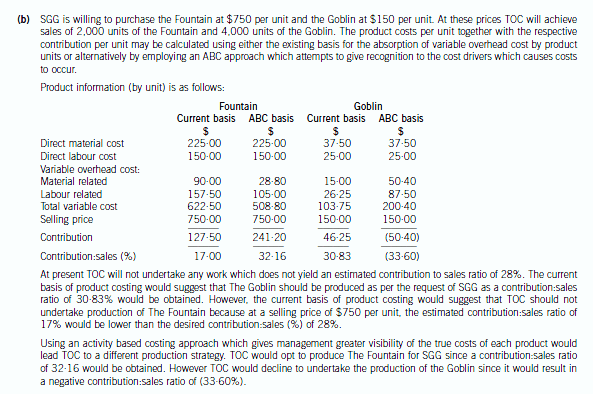
-
第16题:
(b) Explain by reference to Hira Ltd’s loss position why it may be beneficial for it not to claim any capital
allowances for the year ending 31 March 2007. Support your explanation with relevant calculations.
(6 marks)
正确答案:
(b) The advantage of Hira Ltd not claiming any capital allowances
In the year ending 31 March 2007 Hira Ltd expects to make a tax adjusted trading loss, before deduction of capital
allowances, of £55,000 and to surrender the maximum amount possible of trading losses to Belgrove Ltd and Dovedale Ltd.
For the first nine months of the year from 1 April 2006 to 31 December 2006 Hira Ltd is in a loss relief group with Belgrove
Ltd. The maximum surrender to Belgrove Ltd for this period is the lower of:
– the available loss of £41,250 (£55,000 x 9/12); and
– the profits chargeable to corporation tax of Belgrove of £28,500 (£38,000 x 9/12).
i.e. £28,500. This leaves losses of £12,750 (£41,250 – £28,500) unrelieved.
For the remaining three months from 1 January 2007 to 31 March 2007 Hira Ltd is a consortium company because at least
75% of its share capital is owned by companies, each of which own at least 5%. It can surrender £8,938 (£55,000 x 3/12
x 65%) to Dovedale Ltd and £4,812 (£55,000 x 3/12 x 35%) to Belgrove Ltd as both companies have sufficient taxable
profits to offset the losses. Accordingly, there are no losses remaining from the three-month period.
The unrelieved losses from the first nine months must be carried forward as Hira Ltd has no income or gains in that year or
the previous year. However, the losses cannot be carried forward beyond 1 January 2007 (the date of the change of
ownership of Hira Ltd) if there is a major change in the nature or conduct of the trade of Hira Ltd. Even if the losses can be
carried forward, the earliest year in which they can be relieved is the year ending 31 March 2009 as Hira Ltd is expected to
make a trading loss in the year ending 31 March 2008.
Any capital allowances claimed by Hira Ltd in the year ending 31 March 2007 would increase the tax adjusted trading loss
for that year and consequently the unrelieved losses arising in the first nine months.
If the capital allowances are not claimed, the whole of the tax written down value brought forward of £96,000 would be
carried forward to the year ending 31 March 2008 thus increasing the capital allowances and the tax adjusted trading loss,
for that year. By not claiming any capital allowances, Hira Ltd can effectively transfer a current period trading loss, which
would be created by capital allowances, of £24,000 (25% x £96,000) from the year ending 31 March 2007 to the following
year where it can be surrendered to the two consortium members. -
第17题:
(b) Advise on the capital gains implications should Trent Limited’s old building be sold as proposed. Support your
advice with relevant calculations. (4 marks)
正确答案:
This gives a higher post-entry loss of £50,000 (150,000 – 100,000) and so it is advisable for Trent Limited to make
this election.
The £100,000 of pre-entry losses are still available, but can only be set against gains on assets which:
(i) Trent Limited sold prior to being acquired (subject to the normal carry back restrictions), or
(ii) Trent Limited already owned when it was acquired, or
(iii) Trent Limited acquired from outside the group and used in its trade after being bought by Tay Limited. -
第18题:
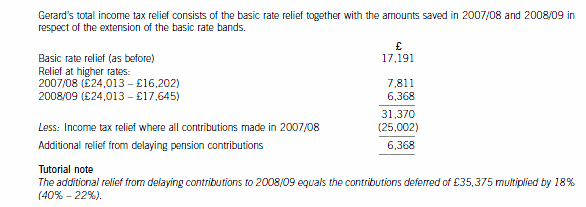
(c) Calculate and explain the amount of income tax relief that Gerard will obtain in respect of the pension
contributions he proposes to make in the tax year 2007/08 and contrast this with how his position could be
improved by delaying some of the contributions that he could have made in 2007/08 until 2008/09. You
should include relevant supporting calculations and quantify the additional tax savings arising as a result of
your advice.
You should ignore the proposed changes to the bonus scheme for this part of this question and assume that
Gerard’s income will not change in 2008/09. (12 marks)
正确答案:


-
第19题:
(c) The inheritance tax payable by Adam in respect of the gift from his aunt. (4 marks)
Additional marks will be awarded for the appropriateness of the format and presentation of the memorandum and
the effectiveness with which the information is communicated. (2 marks)
Note: you should assume that the tax rates and allowances for the tax year 2006/07 will continue to apply for the
foreseeable future.
正确答案:
(c) Inheritance tax payable by Adam
The gift by AS’s aunt was a potentially exempt transfer. No tax will be due if she lives until 1 June 2014 (seven years after
the date of the gift).
The maximum possible liability, on the assumption that there are no annual exemptions or nil band available, is £35,216
(£88,040 x 40%). This will only arise if AS’s aunt dies before 1 June 2010.
The maximum liability will be reduced by taper relief of 20% for every full year after 31 May 2010 for which AS’s aunt lives.
The liability will also be reduced if the chargeable transfers made by the aunt in the seven years prior to 1 June 2007 are
less than £285,000 or if the annual exemption for 2006/07 and/or 2007/08 is/are available. -
第20题:
(iv) The stamp duty and/or stamp duty land tax payable by the Saturn Ltd group; (2 marks)
Additional marks will be awarded for the appropriateness of the format and presentation of the memorandum
and the effectiveness with which the information is communicated. (2 marks)
正确答案:
(iv) Stamp duty and stamp duty land tax
– The purchase of Tethys Ltd will give rise to a liability to ad valorem stamp duty of £1,175 (£235,000 x 0·5%).
The stamp duty must be paid by Saturn Ltd within 30 days of the share transfer in order to avoid interest being
charged. It is not an allowable expense for the purposes of corporation tax. -
第21题:
(b) Calculate the amount of input tax that will be recovered by Vostok Ltd in respect of the new premises in the
year ending 31 March 2009 and explain, using illustrative calculations, how any additional recoverable input
tax will be calculated in future years. (5 marks)
正确答案:
(b) Recoverable input tax in respect of new premises
Vostok Ltd will recover £47,880 (£446,500 x 7/47 x 72%) in the year ending 31 March 2009.
The capital goods scheme will apply to the purchase of the building because it is to cost more than £250,000. Under the
scheme, the total amount of input tax recovered reflects the use of the building over the period of ownership, up to a maximum
of ten years, rather than merely the year of purchase.
Further input tax will be recovered in future years as the percentage of exempt supplies falls. (If the percentage of exempt
supplies were to rise, Vostok Ltd would have to repay input tax to HMRC.)
The additional recoverable input tax will be computed by reference to the percentage of taxable supplies in each year including
the year of sale. For example, if the percentage of taxable supplies in a particular subsequent year were to be 80%, the
additional recoverable input tax would be computed as follows.
£446,500 x 7/47 x 1/10 x (80% – 72%) = £532.
Further input tax will be recovered in the year of sale as if Vostok Ltd’s supplies in the remaining years of the ten-year period
are fully vatable. For example, if the building is sold in year seven, the additional recoverable amount for the remaining three
years will be calculated as follows.
£446,500 x 7/47 x 1/10 x (100% – 72%) x 3 = £5,586. -
第22题:
问答题In the past few decades,“generation gap” has become a quite popular phrase, signifying the barrier between parents and children. But what has caused the barrier, why do people living together disagree with each other? Write a composition of about 400 words on the following topic:Who Has Dug The Generation Gap? In the first part of your writing you should present your thesis statement, and in the second part you should support the thesis statement with appropriate details. In the last part you should bring what you have written to a natural conclusion or a summary. Marks will be awarded for content, organization, grammar and appropriateness. Failure to follow the above instructions may result in a loss of marks.正确答案:
Who Has Dug the Generation Gap? Since its invention, the phrase generation gap has spread all over the world in almost an instant. In the past few decades, although human beings are striving toward more common goals, the gap between parents and children seems to be widening. It is high time that we thought about the causes of this prevailing trouble.
The most important reason is that parents and children hold different values. With the constant development of technology, social values are also undergoing continuous changes. Because parents and children belong to quite different times, they naturally belong to different value groups, and this in turn leads to the barrier between different generations. For example, our parents living in the 1960s think that people should cherish their membership in their groups, and should adapt themselves to their groups, but we emphasize individual values and are ready to leave our groups at any moment in search of a better one. It is unlikely for people holding different values to agree on everything in life, and the barrier is, therefore, also unavoidable.
Another important reason for the generation barrier is lack of communication. A good talk can sometimes dissolve the disagreement between people with different values, but the trouble is that there is not enough communication. With the ever increasing pressure in work and life, parents are spending less effort and time with children; the children, faced with heavy study load or various distractions such as IV plays and computer games, are also spending less time with their parents. This results in a lack, or an inability, of communication when it is necessary.
Besides these two general reasons, there may be some special cases. According to a recent report, about 5 per cent of generation gap results from irresponsible parents. Some parents, especially those without good education, tend to evade the duty of raising and caring their children. The same report also reveals that about 3 percent of the problem results from problematic children who consistently refuse parents~ help. This type of cases represents only a small portion, but the problem is often more serious.
In a word, except for some special cases, barriers come into being either because the two parties involved embrace too different values or because they are not talking to each other often enough. After finding out the reasons, we may know that it is wrong to blame parents or children for the barriers, and we should mainly encourage communication, for if parents and children can talk to each other more, barriers will have less opportunity to stay.解析: 本文要求分析父母与子女之间产生隔阂的原因,属于因果关系的说明文。文章引言段采用了开门见山的方式,直接以代沟开始。Thesis statement用的是It is high time that we thought…,婉转但仍然达到了目的。正文段的衔接词很好地体现了各要点间的主次关系,用得非常恰当。结论段虽然提到三个要点,其实质是在强调前面两个,更强化了文章的衔接。因为是谈问题的原因,所以结尾处的最终评论就采用解决方法,非常自然协调。 -
第23题:
问答题Test 12 Friendship is forever a topic for human beings. How do you view “friendship”? Write on ANSWER SHEET TWO a composition of about 200 words on the following topic:FRIENDSHIP You are to write in three parts. In the first part, state specifically what your idea is. In the second part, provide one or two reasons to support your idea OR describe your idea. In the last part, bring what you have written to a natural conclusion or a summary. Marks will be awarded for content, organization, grammar and appropriateness. Failure to follow the instructions may result in a loss of marks.正确答案:
【参考范文】
Friends are indispensable in our daily life. When we feel happy, we can share the pleasure with them; when we feel gloomy, friends will comfort us; when we have some secrets, we just want to share them with friends; and when we have difficulties, friends are always ready to help us.
Life is a bouquet, friendship is flower. We cannot live without friendship just as we cannot survive without air or water. Friendship gives us a feeling of security and warmth; friendship encourages us to go ahead when we encounter difficulty.
Building friendship takes time. True friendship requires equality and loyalty. It is an in-depth relationship combining trust, support, understanding, empathy and intimacy. True friendship should be able to stand all kinds of tests. Just as an old saying goes, “A friend in need is a friend indeed.”
In conclusion, we must treasure our friends and friendship. A good friend can be a good companion in our lives. The more friends we have, the more help we can get from them and the more pleasure we can share with them. If we have true friends, we will feel happy in the world.解析: 暂无解析