
(iv) critiques the performance measurement system at TSC. (5 marks
题目
(iv) critiques the performance measurement system at TSC. (5 marks
相似考题
更多“(iv) critiques the performance measurement system at TSC. (5 marks”相关问题
-
第1题:
Susan is aware of benchmarking as a useful input into performance measurement and strategic change.
(b) Assess the contribution benchmarking could make to improving the position of the Marlow Fashion Group
and any limitations to its usefulness. (8 marks)
正确答案:(b) Benchmarking at Marlow Fashion will not be an easy exercise. Marlow Fashion has developed a distinctive way of reaching
its markets that means direct comparisons will be hard to make. Certainly, it can carry out historical benchmarking in
comparing how its own processes and activities have improved, or otherwise, over a relevant period of time. Unfortunately,
this is likely to simply confirm worsening performance. It can compare its own key operations against the ‘best in class’;
regardless of which industry the excellent performer comes from. It could and should have been carrying out competitive
benchmarking on the retail side of the business where information should be more easily available. There may be an
opportunity to benchmark itself against firms that have gone through a similar crisis and achieved a successful turnaround.In terms of the advantages and disadvantages, the willingness of managers responsible for a key area of performance to
compare themselves against relevant external performance measures should make them take responsibility for any changes
necessary. In Marlow Fashion, the acceptance that things have to be done differently will be the first stage in the turnaround.
Getting managers face-to-face with the problems, accepting responsibility for change and recognising that the necessary
changes are ‘doable’ is an important stage in creating a willingness to change. The disadvantages are that every organisation
and situation is different and there is no one best way. Marlow Fashion thought it had discovered the best way and this created
an unwillingness to change. There is also the danger that you are solving today’s problems with yesterday’s solutions. A good
competitor will be trying to maintain its competitive advantage through constantly improving its processes. It also has a vested
interest in trying to prevent its improvements from being revealed to its competitors. Also, many of the ‘softer’ processes –
typically involving people – are difficult if not impossible to replicate in another organisation. These advantages are to do with
culture and leadership and not easily transferable to another organisation and the context in which it is operating. -
第2题:
(c) Discuss the ethical and social responsibilities of the Beth Group and whether a change in the ethical and
social attitudes of the management could improve business performance. (7 marks)
Note: requirement (c) includes 2 professional marks for development of the discussion of the ethical and social
responsibilities of the Beth Group.
正确答案:
(c) Corporate social responsibility (CSR) is concerned with business ethics and the company’s accountability to its stakeholders,
and about the way it meets its wider obligations. CSR emphasises the need for companies to adopt a coherent approach to
a range of stakeholders including investors, employees, suppliers, and customers. Beth has paid little regard to the promotion
of socially and ethically responsible policies. For example, the decision to not pay the SME creditors on the grounds that they
could not afford to sue the company is ethically unacceptable. Additionally, Beth pays little regard to local customs and
cultures in its business dealings.
The stagnation being suffered by Beth could perhaps be reversed if it adopted more environmentally friendly policies. The
corporate image is suffering because of its attitude to the environment. Environmentally friendly policies could be cost effective
if they help to increase market share and reduce the amount of litigation costs it has to suffer. The communication of these
policies would be through the environmental report, and it is critical that stakeholders feel that the company is being
transparent in its disclosures.
Evidence of corporate misbehaviour (Enron, World.com) has stimulated interest in the behaviour of companies. There has
been pressure for companies to show more awareness and concern, not only for the environment but for the rights and
interests of the people they do business with. Governments have made it clear that directors must consider the short-term
and long-term consequences of their actions, and take into account their relationships with employees and the impact of the
business on the community and the environment. The behaviour of Beth will have had an adverse effect on their corporate
image.
CSR requires the directors to address strategic issues about the aims, purposes, and operational methods of the organisation,
and some redefinition of the business model that assumes that profit motive and shareholder interests define the core purpose
of the company. The profits of Beth will suffer if employees are not valued and there is poor customer support.
Arrangements should be put in place to ensure that the business is conducted in a responsible manner. The board should
look at broad social and environmental issues affecting the company and set policy and targets, monitoring performance and
improvements.
-
第3题:
5 A management accounting focus for performance management in an organisation may incorporate the following:
(1) the determination and quantification of objectives and strategies
(2) the measurement of the results of the strategies implemented and of the achievement of the results through a
number of determinants
(3) the application of business change techniques, in the improvement of those determinants.
Required:
(a) Discuss the meaning and inter-relationship of the terms (shown in bold type) in the above statement. Your
answer should incorporate examples that may be used to illustrate each term in BOTH profit-seeking
organisations and not-for-profit organisations in order to highlight any differences between the two types of
organisation. (14 marks)
正确答案:
5 (a) Objectives may be viewed as profit and market share in a profit-oriented organisation or the achievement of ‘value for money’
in a not-for-profit organisation (NFP). The overall objective of an organisation may be expressed in the wording of its mission
statement.
In order to achieve the objectives, long-term strategies will be required. In a profit-oriented organisation, this may incorporate
the evaluation of strategies that might include price reductions, product design changes, advertising campaign, product mix
change and methods changes, embracing change techniques such as BPR, JIT, TQM and ABM. In NFP situations, strategies
might address the need to achieve ‘economy’ through reduction in average cost per unit; ‘efficiency’ through maximisation of
the input:output ratio, whilst checking on ‘effectiveness’ through monitoring whether the objectives are achieved.
The annual budget will quantify the short-term results anticipated of the strategies. These results may be seen as the level of
financial performance and competitiveness achieved. This quantification may be compared with previous years and with
actual performance on an ongoing basis. Financial performance may be measured in terms of profit, liquidity, capital structure
and a range of ratios. Competitiveness may be measured by sales growth, market share and the number of new customers.
In a not-for-profit organisation, the results may be monitored by checking on the effectiveness of actions aimed at the
achievement of the objectives. For instance, the effectiveness of a University may be measured by the number of degrees
awarded and the grades achieved. The level of student ‘drop-outs’ each year may also be seen as a measure of ineffectiveness.
The determinants of results may consist of a number of measures. These may include the level of quality, customer
satisfaction, resource utilisation, innovation and flexibility that are achieved. Such determinants may focus on a range of nonfinancial
measures that may be monitored on an ongoing basis, as part of the feedback information in conjunction with
financial data.
A range of business change techniques may be used to enhance performance management.
Techniques may include:
Business process re-engineering (BPR) which involves the examination of business processes with a view to improving the
way in which each is implemented. A major focus may be on the production cycle, but it will also be applicable in areas such
as the accounting department.
Just-in-time (JIT) which requires commitment to the pursuit of ‘excellence’ in all aspects of an organisation.
Total quality management (TQM) which aims for continuous quality improvement in all aspects of the operation of an
organisation.
Activity based management systems (ABM) which focus on activities that are required in an organisation and the cost drivers
for such activities, with a view to identifying and improving activities that add value and eliminating those activities that do
not add value.
Long-term performance management is likely to embrace elements of BPR, JIT, TQM and ABM. All of these will be reflected
in the annual budget on an ongoing basis. -
第4题:
(b) Briefly discuss how stakeholder groups (other than management and employees) may be rewarded for ‘good’
performance. (4 marks)
正确答案:
(b) Good performance should result in improved profitability and therefore other stakeholder groups may be rewarded for ‘good
performance’ as follows:
– Shareholders may receive increased returns on equity in the form. of increased dividends and /or capital growth.
– Customers may benefit from improved quality of products and services, and possibly lower prices.
– Suppliers may benefit from increased volumes of purchases.
– Government will benefit from increased amounts of taxation. -
第5题:
5 GE Railways plc (GER) operates a passenger train service in Holtland. The directors have always focused solely on
the use of traditional financial measures in order to assess the performance of GER since it commenced operations
in 1992. The Managing Director of GER has asked you, as a management accountant, for assistance with regard to
the adoption of a balanced scorecard approach to performance measurement within GER.
Required:
(a) Prepare a memorandum explaining the potential benefits and limitations that may arise from the adoption of
a balanced scorecard approach to performance measurement within GER. (8 marks)
正确答案:
(a) To: Board of directors
From: Management Accountant
Date: 8 June 2007
The potential benefits of the adoption of a balanced scorecard approach to performance measurement within GER are as
follows:
A broader business perspective
Financial measures invariably have an inward-looking perspective. The balanced scorecard is wider in its scope and
application. It has an external focus and looks at comparisons with competitors in order to establish what constitutes best
practice and ensures that required changes are made in order to achieve it. The use of the balanced scorecard requires a
balance of both financial and non-financial measures and goals.
A greater strategic focus
The use of the balanced scorecard focuses to a much greater extent on the longer term. There is a far greater emphasis on
strategic considerations. It attempts to identify the needs and wants of customers and the new products and markets. Hence
it requires a balance between short term and long term performance measures.
A greater focus on qualitative aspects
The use of the balanced scorecard attempts to overcome the over-emphasis of traditional measures on the quantifiable aspects
of the internal operations of an organisation expressed in purely financial terms. Its use requires a balance between
quantitative and qualitative performance measures. For example, customer satisfaction is a qualitative performance measure
which is given prominence under the balanced scorecard approach.
A greater focus on longer term performance
The use of traditional financial measures is often dominated by financial accounting requirements, for example, the need to
show fixed assets at their historic cost. Also, they are primarily focused on short-term profitability and return on capital
employed in order to gain stakeholder approval of short term financial reports, the longer term or whole life cycle often being
ignored.
The limitations of a balanced scorecard approach to performance measurement may be viewed as follows:
The balanced scorecard attempts to identify the chain of cause and effect relationships which will provide the stimulus for
the future success of an organisation.
Advocates of a balanced scorecard approach to performance measurement suggest that it can constitute a vital component
of the strategic management process.
However, Robert Kaplan and David Norton, the authors of the balanced scorecard concept concede that it may not be suitable
for all firms. Norton suggests that it is most suitable for firms which have a long lead time between management action and
financial benefit and that it will be less suitable for firms with a short-term focus. However, other flaws can be detected in
the balanced scorecard.
The balanced scorecard promises to outline the theory of the firm by clearly linking the driver/outcome measures in a cause
and effect chain, but this will be difficult if not impossible to achieve.
The precise cause and effect relationships between measures for each of the perspectives on the balanced scorecard will be
complex because the driver and outcome measures for the various perspectives are interlinked. For example, customer
satisfaction may be seen to be a function of several drivers, such as employee satisfaction, manufacturing cycle time and
quality. However, employee satisfaction may in turn be partially driven by customer satisfaction and employee satisfaction
may partially drive manufacturing cycle time. A consequence of this non-linearity of the cause and effect chain (i.e., there is
non-linear relationship between an individual driver and a single outcome measure), is that there must be a question mark
as to the accuracy of any calculated correlations between driver and outcome measures. Allied to this point, any calculated
correlations will be historic. This implies that it will only be possible to determine the accuracy of cause and effect linkages
after the event, which could make the use of the balanced scorecard in dynamic industries questionable. If the market is
undergoing rapid evolution, for example, how meaningful are current measures of customer satisfaction or market share?
These criticisms do not necessarily undermine the usefulness of the balanced scorecard in presenting a more comprehensive
picture of organisational performance but they do raise doubts concerning claims that a balanced scorecard can be
constructed which will outline a clear cause and effect chain between driver and outcome measures and the firm’s financial
objectives. -
第6题:
(ii) Briefly discuss THREE disadvantages of using EVA? in the measurement of financial performance.
(3 marks)
正确答案:
(ii) Disadvantages of an EVA approach to the measurement of financial performance include:
(i) The calculation of EVA may be complicated due to the number of adjustments required.
(ii) It is difficult to use EVA for inter-firm and inter-divisional comparisons because it is not a ratio measure.
(iii) Economic depreciation is difficult to estimate and conflicts with generally accepted accounting principles.
Note: Other relevant discussion would be acceptable. -
第7题:
(ii) evaluates the relative performance of the four depots as indicated by the analysis in the summary table
prepared in (i); (5 marks)
正确答案:
(ii) The summary analysis in (a)(i) shows that using overall points gained, Michaelangelotown has achieved the best
performance with 12 points. Donatellotown and Leonardotown have achieved a reasonable level of performance with
eight points each. Raphaeltown has under performed, however, gaining only four out of the available 12 points.
Michaelangelotown is the only depot to have achieved both an increase in revenue over budget and an increased
profit:revenue percentage.
In the customer care and service delivery statistics, Michaelangelotown has achieved all six of the target standards,
Donatellotown four; Leonardotown three. The Raphaeltown statistic of achieving only one out of six targets indicates the
need for investigation.
With regard to the credit control and administrative efficiency statistics, Leonardotown and Michaelangelotown achieved
all four standards and Donatellotown achieved three of the four standards. Once again, Raphaeltown is the ‘poor
performer’ achieving only two of the four standards. -
第8题:
(b) The management of Division C has identified the need to achieve cost savings in order to become more
competitive. They have decided that an analysis and investigation of quality costs into four sub-categories will
provide a focus for performance measurement and improvement.
Required:
Identify the FOUR sub-categories into which quality costs can be analysed and provide examples (which
must relate to Division C) of each of the four sub-categories of quality cost that can be investigated in order
that overall cost savings might be achieved and hence the performance improved. (8 marks)
正确答案:
(b) Quality costs may be monitored by measuring costs of non-conformance and costs of conformance.
Costs of non-conformance occur when the product fails to reach the design quality standards. Such costs may be subdivided
into internal failure costs and external failure costs.
Internal failure costs occur when the failure is detected before the transfer of the product to the customer.
External failure costs occur when the failure to reach the required standards is not detected until after the product has been
transferred to the customer.
Costs of conformance are those incurred in reducing or eliminating the costs of non-conformance. Such costs may be
subdivided into appraisal costs and prevention costs.
Appraisal costs are those associated with the evaluation of items such as purchased material and services in order to ensure
that they conform. to the agreed specification.
Prevention costs are those associated with the implementation of a quality improvement programme. Such costs are planned
in advance and their implementation should lead to continuous improvement.
Examples of quality costs relevant to Division C may include:
Internal failure costs: cost of materials scrapped due to poor receipt and storage procedures or losses of CC output due to poor
processing routines.
External failure costs: cost of quality problems with batch of CC not detected until it has reached Division B. This may require
free replacement of the batch and compensation for loss of output by Division B.
Appraisal costs: evaluation of purchased material and services in relation to the manufacture of CC to ensure that it conforms
to the agreed specification; e.g. inspection and testing before use.
Prevention costs: the cost of implementation of staff training and the costs of equipment testing to ensure that it conforms to
the specification standards required for the production of CC.
(Alternative relevant examples would be accepted) -
第9题:
(b) Describe the principal audit procedures to be carried out in respect of the following:
(i) The measurement of the share-based payment expense; (6 marks)
正确答案:
(b) (i) Principal audit procedures – measurement of share-based payment expense
– Obtain management calculation of the expense and agree the following from the calculation to the contractual
terms of the scheme:
– Number of employees and executives granted options
– Number of options granted per employee
– The official grant date of the share options
– Vesting period for the scheme
– Required performance conditions attached to the options.
– Recalculate the expense and check that the fair value has been correctly spread over the stated vesting period.
– Agree fair value of share options to specialist’s report and calculation, and evaluate whether the specialist report is
a reliable source of evidence.
– Agree that the fair value calculated is at the grant date.
Tutorial note: A specialist such as a chartered financial analyst would commonly be used to calculate the fair value
of non-traded share options at the grant date, using models such as the Black-Scholes Model.
– Obtain and review a forecast of staffing levels or employee turnover rates for the duration of the vesting period, and
scrutinise the assumptions used to predict level of staff turnover.
– Discuss previous levels of staff turnover with a representative of the human resources department and query why
0% staff turnover has been predicted for the next three years.
– Check the sensitivity of the calculations to a change in the assumptions used in the valuation, focusing on the
assumption of 0% staff turnover.
– Obtain written representation from management confirming that the assumptions used in measuring the expense
are reasonable.
Tutorial note: A high degree of scepticism must be used by the auditor when conducting the final three procedures
due to the management assumption of 0% staff turnover during the vesting period. -
第10题:
Which of the following sequences of steps can be used to increase the amount of virtual memory (page memory) available to Windows?()
- A、Start > Control Panel > System > Advanced tab > Startup and Recovery > Advanced tab > Settings > Advanced tab
- B、Start > Control Panel > System > General tab > Under Performance > Settings > Advanced tab
- C、Start > Control Panel > System > Advanced tab > Under Performance > Settings > Advanced tab
- D、Start > Control Panel > System > Performance tab > Under Performance > Settings > Advanced tab
正确答案:C -
第11题:
A network administrator wants to analyze the historical performance of the servers in the organization and forecast the system performance needs into the future. Which add-on component of IBM Director would be used to assist with this task?()
- A、Capacity Manager
- B、Resource Monitors
- C、System Availability
- D、System Performance Monitor
正确答案:A -
第12题:
单选题The International Association of Lighthouse authorities (IALA) buoyage system “A” uses some types of marks to distinguish safe navigation? Which type(s) does(do) not belong to the system?()Alateral marks and cardinal marks
Bsafe water marks
Cisolated danger marks and special marks
Ddangerous water marks
正确答案: B解析: 暂无解析 -
第13题:
(b) Using the information provided in the case scenario, strategically evaluate the performance of the company
up to 2004, indicating any areas of particular concern. (20 marks)
正确答案:
(b) Essentially, Universal is a one product or service company selling its services into two main customer segments in the housing
market. From the performance information provided in Table 1, the company has achieved impressive rates of growth over
the 2001–4 period and this growth has come almost exclusively from private house owners. Universal is in the replacement
market. Its customers are looking to replace existing roofing systems with low maintenance/high attractiveness Universal
systems. To date growth has been exclusively within one region and been achieved by growing the area served through
investment in showrooms and depots.
Universal has chosen to grow its business through a differentiation focus strategy. It has identified a niche not served by the
major PVC doors and windows installers and poorly served by small independent installers. The value chain analysis
discussed above has shown the ways in which Universal has successfully distinguished itself from its competitors. Growth
has been through increasing its market penetration of one particular region. Such is the size of the private house owner market
and the lack of effective competition that the company has achieved a significant share of the market in its particular region.
However, in national terms, with 1% of the available market, Universal is a small operator. What is clear from the sales figures
is that as the firm grows bigger the relative rate of growth inevitably slows down, so that by 2004 it has an annual growth of
27% – still impressive by most companies standards. The move into supplying the commercial housing market has been
successful, but the share of total sales seems to have stabilised at around 5%. Universal clearly is finding it difficult to commit
sufficient new resources to this sector while coping with the growth from the domestic housing sector. Direct labour and other
direct costs seem to be a reasonable proportion of sales and predictably grow with the number of installation teams. Overall,
the gross margin, which sustains sales, marketing and overhead expenses, is moving in the right direction with a gross margin
of 52·6% achieved in 2004.
Labour, not surprisingly in a service business, consumes a considerable amount of costs. If one combines the direct labour
with the commission costs of sales canvassers and representatives together with salaries to staff in head office, one is in a
business where well over 50% of costs are attributable to people. Equally important is the fact that over 80% of the staff
employed by Universal is paid by results. This has significant consequences for the structure of reward systems and the
training and development of staff looking to maximise their incomes through either their individual or team performance.
Clearly, Universal sees no incompatibility between a reward system dominated by payments by results and the delivery of a
quality service differentiating it from its competitors.
Marketing has grown considerably over the period and reflects the recruitment of Mick Hendry as Sales and Marketing Director
in 2002. The marketing and sales model is very much one influenced by the one used by large PVC installers of doors and
windows. Here there is a heavy emphasis on direct selling techniques supported by increasing levels of advertising. Universal
sells to its customers directly and therefore avoids the costs and channel complications of using third parties to provide its
services. In many ways the direct selling techniques used are a very well established way of reaching the customer. Elements
of the marketing mix may be influenced by changes in communication technology, but the nature of the service requires
effective face-to-face contact with the customer. Sales to private house owners using credit generates significant finance
commission and is an important source of extra margin to Universal. Often in businesses depending on significant amounts
of credit sales the sales representative receives significant reward for selling a finance arrangement to the customer.
In terms of net profit achieved, 2001 and 2002 represents a significant change and, as argued in the scenario, this reflects
the recruitment of the Sales and Marketing Director. The achievement of this ‘step change’ in sales required commensurate
increases in most costs, but it is the significant increase in sales costs that explains the losses experienced in 2002. Sales
costs as a proportion of total sales rose from 14% in 2001 to almost 34% in 2002.
Particularly significant is the increase in sales commissions paid. The detailed changes in the way commission is paid is not
given in the case scenario, but it seems likely to reflect the previous experience of the Sales and Marketing Director in a closely
related industry. Similar levels of sales costs are incurred in 2003 and 2004 but the increase in sales, improvement in gross
margin and slower rate of growth in commissions paid explain the improved return on sales from –6·7% in 2002 to 4·2%
in 2003 and 5·8% in 2004.
Equally significant is the growth in showrooms and depots to support the growth in sales. Each additional facility costs in the
order of £30K with significant additions to costs in terms of staff and stock. Overall the performance of Universal over the
2001–2004 period is of a company achieving high rates of growth, incurring significant costs in so doing and moving into
modest levels of profit over the period. Its cost structure reflects the service it provides and the staff and reward systemsenabling the service to be provided. -
第14题:
(b) Discuss the relevance of each of the following actions as steps in trying to remedy performance measurement
problems relating to the ‘365 Sports Complex’ and suggest examples of specific problem classifications that
may be reduced or eliminated by each action:
(i) Focusing on and improving the measurement of customer satisfaction
(ii) Involving staff at all levels in the development and implementation of performance measures
(iii) Being flexible in the extent to which formal performance measures are relied on
(iv) Giving consideration to the auditing of the performance measurement system. (8 marks)
正确答案:
(b) Trying to focus on and improve the measurement of customer satisfaction.
This is a vital goal. Without monitoring and improvement of levels of customer satisfaction, an organisation will tend to
underachieve and is likely to have problems with its future effectiveness. Positive signals from performance measures made
earlier in the value chain are only relevant if they contribute to the ultimate requirement of customer satisfaction. Tunnel vision
and sub-optimisation are examples of measurement problems that may be reduced through recognition of the need for a
management focus on customer satisfaction. For example undue focus on the importance of maximising opening hours may
lead to lack of focus on other quality issues seen as important by customers.
Involving staff at all levels in the development and implementation of performance measures.
People are involved in the achievement of performance measures at all levels and in all aspects of an organisation. It is
important that all staff are willing to accept and work towards any performance measures that are developed to monitor their
part in the operation of the organisation and in the achievement of its objectives. This should help, for example, to reduce
gaming. At the sports complex an example of gaming might be, a deliberate attempt to understate the potential benefits of
maintaining the buildings in order to ensure that funds would be used for other purposes such as an increased advertising
budget. The directors of Astrodome Sports Ltd must recognise that leisure facilities that appear dated and in a poor state of
repair will cause customers to look for more aesthetically appealing alternatives.
Being flexible in the extent to which formal performance measures are relied on.
It is best to acknowledge that measures should not be relied on exclusively for control. A performance measure may give a
short-term signal that does not relate directly to actions that are taking place to improve the level of performance in the longer
term. To some extent, improved performance may be achieved through the informal interaction between individuals and
groups. This flexibility should help to reduce measure fixation and misrepresentation. For example the percentage increase in
the quantity of bowling equipment purchased is seen as necessarily implying increased demand for use of the bowling greens.
Giving consideration to the audit of the performance measurement system.
Actions that may be taken may include:
– Seeking expert interpretation of the performance measures in place. It is important that any audit is ‘free from bias’ and
conducted independently on an ‘arm’s length’ basis. Thus it is essential that such audits should be ‘free from the
influence’ of those personnel involved in the operation of the system.
– Maintaining a careful audit of the data used. Any assessment scheme is only as good as the data on which it is founded
and how this data is analysed and interpreted.
The above actions should help, in particular, to reduce the incidence and impact of measure fixation, misinterpretation and
gaming.
For example, an audit may show that the directors of Astrodome Sports Ltd are fixated on equipment availability and
misinterpret this as being the key to customer volume and high profitability. The audit may also provide evidence of gaming
such as a deliberate attempt to underplay the benefits of one course of action in order to release funds for use on some
alternative.
-
第15题:
(b) Advise the management of SCC Ltd of THREE strategies that should be considered in order to improve the
future performance of SCC Ltd. (6 marks)
正确答案:
(b) The four quadrants of the Boston-growth share matrix summarise expected profits and resultant cash flows and recommends
an outline strategy to follow which rather simplistically may be summarised as invest in stars, scrutinise the problem children,
milk the cows and divest the dogs.
Value Chain Analysis
It is vital that the management of SCC Ltd undertake a value chain analysis of each of its divisions in order to identify and
eliminate all non-value added activities, thereby improving profitability and cash flow without necessarily increasing turnover
or market share.
Divestment of the Footwear division
Serious consideration should be given to the divestment of the Footwear division. This will enable resources to be redirected
to divisions categorised as problem children i.e. the Industrial and Children’s divisions.
Support the Stars
As far as the Fashion division is concerned, it is obviously in a growth market and currently performing well. It is vital, given
the forecast performance of the other subsidiaries that the management of SCC Ltd do not concentrate on the poor performers
to the detriment of its only star. -
第16题:
(c) Using the information contained in Appendix 1.2, compare the performance of HLP and MAS incorporating
relevant percentage and ratio statistics under the following headings:
(i) Competitiveness; (5 marks)
正确答案: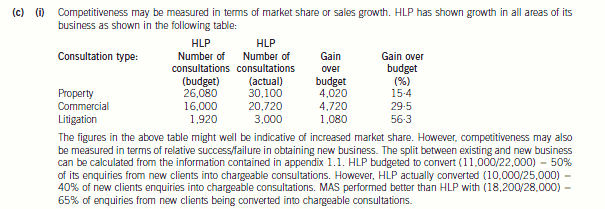
-
第17题:
(ii) Suggest THREE other performance measures (not applied in (i)) which might be used to assess the
customer perspective of the balanced scorecard of GER. (3 marks)
正确答案:
(ii) Performance measures that may be used to assess the customer perspective of the balanced scorecard of GER include
the following:
Lost or damaged luggage per 1,000 passengers
Train cancellation rate
Denied boarding rate
Number of passenger complaints.
Note: Only three measures were required.
-
第18题:
(b) Explain FIVE critical success factors to the performance of HSC on which the directors must focus if HSC is
to achieve success in its marketplace. (10 marks)
正确答案:
(b) Critical success factors are as follows:
Product quality
The fact that the production staff have no previous experience in a food production environment is likely to prove problematic.
It is vital that a comprehensive training programme is put in place at the earliest opportunity. HSC need to reach and maintain
the highest level of product quality as soon as possible.
Supply quality
The quality of delivery into SFG supermarkets assumes critical significance. Time literally will be of the essence since 90%
of all sandwiches are sold in SFG’s supermarkets before 2 pm each day. Hence supply chain management must be extremely
robust as there is very little scope for error.
Technical quality
Compliance with existing regulations regarding food production including all relevant factory health and safety requirements
is vital in order to establish and maintain the reputation of HSC as a supplier of quality products. The ability to store products
at the correct temperature is critical because sandwiches are produced for human consumption and in extreme circumstance
could cause fatalities.
External credibility
Accreditation by relevant trade associations/regulators will be essential if nationwide acceptance of HSC as a major producer
of sandwiches is to be established.
New product development
Whilst HSC have developed a range of healthy eating sandwiches it must be recognised that consumer tastes change and
that in the face of competition there will always be a need for a continuous focus on new product development.
Margin
Whilst HSC need to recognise all other critical success factors they should always be mindful that the need to obtain the
desired levels of gross and net margin remain of the utmost importance.
Notes: (i) Only five critical success factors were required.
(ii) Alternative relevant discussion and examples would be acceptable. -
第19题:
Note: requirement (a) includes 4 professional marks.
A central feature of the performance measurement system at TSC is the widespread use of league tables that display
each depot’s performance relative to one another.
Required:
(b) Evaluate the potential benefits and problems associated with the use of ‘league tables’ as a means of
measuring performance. (6 marks)
正确答案:
(b) A central feature of many performance measurement systems is the widespread use of league tables that display each
business unit’s performance relative to one another. In the case of service organisations such as TSC the use of league tables
emphasises the company’s critical success factors of profitability and quality of service by reporting results on a weekly basis
at the depot level. The fact that such league tables are used by management will actively encourage competition, in terms of
performance, among depots. The individual position of a business unit in the league table is keenly observed both by the
manager of that unit and his/her peers.
In theory, performance is transparent. In practice although each depot performs essentially the same function and is subject
to the same modes of measurement, circumstances pertaining to different business units may vary significantly. Some depots
may be situated near to the hub (main distribution centre), some may be located far away and some may be in urban zones
with well developed road networks whilst others may be in remote rural areas. Measuring performance via a league table
makes no allowance whatsoever for these relative differences, hence, inequality is built into the performance measurement
system.
Moreover, depot managers might be held responsible for areas over which they have no formal control. The network nature
of the business suggests that there will be a high degree of interdependence of depots; the depot responsible for collection
will very often not be the depot responsible for delivery. Therefore, it is frequently the case that business may be gained for
which the collecting depot receives the revenue, but for which the delivering depot bears the cost. Obviously this impacts
upon the profit statements of both depots. The formal system might not recognise such difficulties, the corporate view being
that ‘the business needs to be managed’; the depots should therefore see any such anomalies as mild constraints to work
around rather than barriers to break down. In such circumstances delivering depots and collecting depots should discuss such
problems on an informal basis. Such informal discussions are aided by close communications between depots recognising
the interdependencies of the business. -
第20题:
(iv) The stamp duty and/or stamp duty land tax payable by the Saturn Ltd group; (2 marks)
Additional marks will be awarded for the appropriateness of the format and presentation of the memorandum
and the effectiveness with which the information is communicated. (2 marks)
正确答案:
(iv) Stamp duty and stamp duty land tax
– The purchase of Tethys Ltd will give rise to a liability to ad valorem stamp duty of £1,175 (£235,000 x 0·5%).
The stamp duty must be paid by Saturn Ltd within 30 days of the share transfer in order to avoid interest being
charged. It is not an allowable expense for the purposes of corporation tax. -
第21题:
Using the following information: Performance data from an existing system that a new system will replace; Performance estimates that anticipate future workloads; Micro-partitioning and logical partitioning implementations. Which of the following allows a technical sales representative to create a system design which can be imported into an HMC?()
- A、IBMeConfig
- B、IBM Performance Monitor
- C、IBM Workload Estimator (WLE)
- D、IBM System Planning Tool (SPT)
正确答案:D -
第22题:
A customer has 5 older POWER5 systems and they want to consolidate them onto a POWER6 system. What information is important to analyze when deciding how to design the new machine using the System Planning Tool?()
- A、 vmstat and iostat data from the older machines
- B、 The number of CPUs that were installed in the original machines
- C、 Data from Workload Estimator (WLE) and IBM Performance Management (PM)
- D、 Performance data that is collected from the new system after it has been put into production
正确答案:C -
第23题:
单选题A customer has 5 older POWER5 systems and they want to consolidate them onto a POWER6 system. What information is important to analyze when deciding how to design the new machine using the System Planning Tool?()Avmstat and iostat data from the older machines
BThe number of CPUs that were installed in the original machines
CData from Workload Estimator (WLE) and IBM Performance Management (PM)
DPerformance data that is collected from the new system after it has been put into production
正确答案: A解析: 暂无解析