
3 Assume that today’s date is 10 May 2005.You have recently been approached by Fred Flop. Fred is the managing director and 100% shareholder of FlopLimited, a UK trading company with one wholly owned subsidiary. Both companies have a 31 March year-end.Fre
题目
3 Assume that today’s date is 10 May 2005.
You have recently been approached by Fred Flop. Fred is the managing director and 100% shareholder of Flop
Limited, a UK trading company with one wholly owned subsidiary. Both companies have a 31 March year-end.
Fred informs you that he is experiencing problems in dealing with aspects of his company tax returns. The company
accountant has been unable to keep up to date with matters, and Fred also believes that mistakes have been made
in the past. Fred needs assistance and tells you the following:
Year ended 31 March 2003
The corporation tax return for this period was not submitted until 2 November 2004, and corporation tax of £123,500
was paid at the same time. Profits chargeable to corporation tax were stated as £704,300.
A formal notice (CT203) requiring the company to file a self-assessment corporation tax return (dated 1 February
2004) had been received by the company on 4 February 2004.
A detailed examination of the accounts and tax computation has revealed the following.
– Computer equipment totalling £50,000 had been expensed in the accounts. No adjustment has been made in
the tax computation.
– A provision of £10,000 was made for repairs, but there is no evidence of supporting information.
– Legal and professional fees totalling £46,500 were allowed in full without any explanation. Fred has
subsequently produced the following analysis:
Analysis of legal & professional fees
£
Legal fees on a failed attempt to secure a trading loan 15,000
Debt collection agency fees 12,800
Obtaining planning consent for building extension 15,700
Accountant’s fees for preparing accounts 14,000
Legal fees relating to a trade dispute 19,000
– No enquiry has yet been raised by the Inland Revenue.
– Flop Ltd was a large company in terms of the Companies Act definition for the year in question.
– Flop Ltd had taxable profits of £595,000 in the previous year.
Year ended 31 March 2004
The corporation tax return has not yet been submitted for this year. The accounts are late and nearing completion,
with only one change still to be made. A notice requiring the company to file a self-assessment corporation tax return
(CT203) dated 27 July 2004 was received on 1 August 2004. No corporation tax has yet been paid.
1 – The computation currently shows profits chargeable to corporation tax of £815,000 before accounting
adjustments, and any adjustments for prior years.
– A company owing Flop Ltd £50,000 (excluding VAT) has gone into liquidation, and it is unlikely that any of this
money will be paid. The money has been outstanding since 3 September 2003, and the bad debt will need to
be included in the accounts.
1 Fred also believes there are problems in relation to the company’s VAT administration. The VAT return for the quarter
ended 31 March 2005 was submitted on 5 May 2005, and VAT of £24,000 was paid at the same time. The previous
return to 31 December 2004 was also submitted late. In addition, no account has been made for the VAT on the bad
debt. The VAT return for 30 June 2005 may also be late. Fred estimates the VAT liability for that quarter to be £8,250.
Required:
(a) (i) Calculate the revised corporation tax (CT) payable for the accounting periods ending 31 March 2003
and 2004 respectively. Your answer should include an explanation of the adjustments made as a result
of the information which has now come to light. (7 marks)
(ii) State, giving reasons, the due payment date of the corporation tax (CT) and the filing date of the
corporation tax return for each period, and identify any interest and penalties which may have arisen to
date. (8 marks)
相似考题
参考答案和解析
(a) Calculation of corporation tax
Year ended 31 March 2003
Corporation tax payable
There are three adjusting items:.
(i) The computers are capital items, as they have an enduring benefit. These need to be added back in the Schedule D
Case I calculation, and capital allowances claimed instead. The company is not small or medium by Companies Act
definitions and therefore no first year allowances are available. Allowances of £12,500 (50,000 x 25%) can be claimed,
leaving a TWDV of £37,500.
(ii) The provision appears to be general in nature. In addition there is insufficient information to justify the provision and it
should be disallowed until such times as it is released or utilised.
(iii) Costs relating to trading loan relationships are allowable, as are costs relating to the trade (debt collection, trade disputes
and accounting work). Costs relating to capital items (£5,700) are not allowable so will have to be added back.
Total profit chargeable to corporation tax is therefore £704,300 + 50,000 – 12,500 + 10,000 + 5,700 = 757,500. There are two associates, and therefore the 30% tax rate starts at £1,500,000/2 = £750,000. Corporation tax payable is 30% x£757,500 = £227,250.
Payment date
Although the rate of tax is 30% and the company ‘large’, quarterly payments will not apply, as the company was not large in the previous year. The due date for payment of tax is therefore nine months and one day after the end of the tax accounting period (31 March 2003) i.e. 1 January 2004.
Filing date
This is the later of:
– 12 months after the end of the period of account: 31 March 2004
– 3 months after the date of the notice requiring the return 1 May 2004
i.e. 1 May 2004.

更多“3 Assume that today’s date is 10 May 2005.You have recently been approached by Fred Flop. Fred is the managing director and 100% shareholder of FlopLimited, a UK trading company with one wholly owned subsidiary. Both companies have a 31 March year-end.Fre”相关问题
-
第1题:
For this part, assume today’s date is 15 August 2005.
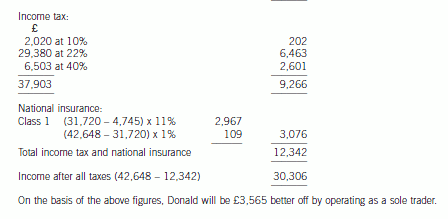
5 (a) Donald is aged 22, single, and about to finish his university education. He has plans to start up a business selling
computer games, and intends to start trading on 1 April 2006, making up accounts to 31 March annually.
He believes that his business will generate cash (equal to taxable profits) of £47,500 in the first year. He
originally intended to operate as a sole trader, but he has recently discovered that as an alternative, he could
operate through a company. He has been advised that if this is the case, he can take a maximum gross salary
of £42,648 out of the company.
Required:
(i) Advise Donald on the income tax (IT), national insurance (NIC) and corporation tax (CT) liabilities he
will incur for the year ended 31 March 2007 trading under each of the two alternative business
structures (sole trade/company). Your advice should be supported by calculations of disposable income
for both alternatives assuming that in the company case, he draws the maximum salary stated.
(7 marks)
正确答案: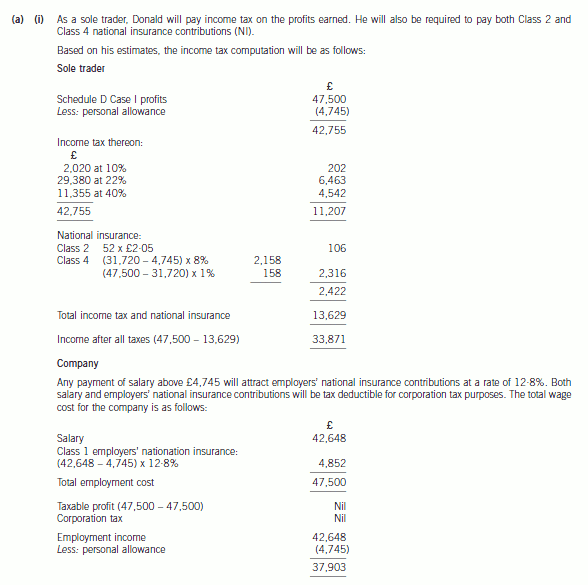
-
第2题:
3 On 1 January 2007 Dovedale Ltd, a company with no subsidiaries, intends to purchase 65% of the ordinary share
capital of Hira Ltd from Belgrove Ltd. Belgrove Ltd currently owns 100% of the share capital of Hira Ltd and has no
other subsidiaries. All three companies have their head offices in the UK and are UK resident.
Hira Ltd had trading losses brought forward, as at 1 April 2006, of £18,600 and no income or gains against which
to offset losses in the year ended 31 March 2006. In the year ending 31 March 2007 the company expects to make
further tax adjusted trading losses of £55,000 before deduction of capital allowances, and to have no other income
or gains. The tax written down value of Hira Ltd’s plant and machinery as at 31 March 2006 was £96,000 and
there will be no fixed asset additions or disposals in the year ending 31 March 2007. In the year ending 31 March
2008 a small tax adjusted trading loss is anticipated. Hira Ltd will surrender the maximum possible trading losses
to Belgrove Ltd and Dovedale Ltd.
The tax adjusted trading profit of Dovedale Ltd for the year ending 31 March 2007 is expected to be £875,000 and
to continue at this level in the future. The profits chargeable to corporation tax of Belgrove Ltd are expected to be
£38,000 for the year ending 31 March 2007 and to increase in the future.
On 1 February 2007 Dovedale Ltd will sell a small office building to Hira Ltd for its market value of £234,000.
Dovedale Ltd purchased the building in March 2005 for £210,000. In October 2004 Dovedale Ltd sold a factory
for £277,450 making a capital gain of £84,217. A claim was made to roll over the gain on the sale of the factory
against the acquisition cost of the office building.
On 1 April 2007 Dovedale Ltd intends to acquire the whole of the ordinary share capital of Atapo Inc, an unquoted
company resident in the country of Morovia. Atapo Inc sells components to Dovedale Ltd as well as to other
companies in Morovia and around the world.
It is estimated that Atapo Inc will make a profit before tax of £160,000 in the year ending 31 March 2008 and will
pay a dividend to Dovedale Ltd of £105,000. It can be assumed that Atapo Inc’s taxable profits are equal to its profit
before tax. The rate of corporation tax in Morovia is 9%. There is a withholding tax of 3% on dividends paid to
non-Morovian resident shareholders. There is no double tax agreement between the UK and Morovia.
Required:
(a) Advise Belgrove Ltd of any capital gains that may arise as a result of the sale of the shares in Hira Ltd. You
are not required to calculate any capital gains in this part of the question. (4 marks)
正确答案:
(a) Capital gains that may arise on the sale by Belgrove Ltd of shares in Hira Ltd
Belgrove Ltd will realise a capital gain on the sale of the shares unless the substantial shareholding exemption applies. The
exemption will be given automatically provided all of the following conditions are satisfied.
– Belgrove Ltd has owned at least 10% of Hira Ltd for a minimum of 12 months during the two years prior to the sale.
– Belgrove Ltd is a trading company or a member of a trading group during that 12-month period and immediately after
the sale.
– Hira Ltd is a trading company or the holding company of a trading group during that 12-month period and immediately
after the sale.
Hira Ltd will no longer be in a capital gains group with Belgrove Ltd after the sale. Accordingly, a capital gain, known as a
degrouping charge, may arise in Hira Ltd. A degrouping charge will arise if, at the time it leaves the Belgrove Ltd group, Hira
Ltd owns any capital assets which were transferred to it at no gain, no loss within the previous six years by a member of the
Belgrove Ltd capital gains group. -
第3题:
4 (a) For this part, assume today’s date is 1 March 2006.
Bill and Ben each own 50% of the ordinary share capital in Flower Limited, an unquoted UK trading company
that makes electronic toys. Flower Limited was incorporated on 1 August 2005 with 1,000 £1 ordinary shares,
and commenced trading on the same day. The business has been successful, and the company has accumulated
a large cash balance of £180,000, which is to be used to purchase a new factory. However, Bill and Ben have
received an offer from a rival company, which they are considering. The offer provides Bill and Ben with two
alternative methods of payment for the purchase of their shares:
(i) £480,000 for the company, inclusive of the £180,000 cash balance.
(ii) £300,000 for the company assuming the cash available for the factory purchase is extracted prior to sale.
Bill and Ben each currently receive a gross salary of £3,750 per month from Flower Limited. Part of the offer
terms is that Bill and Ben would be retained as employees of the company on the same salary.
Neither Bill nor Ben has used any of their capital gains tax annual exemption for the tax year 2005/06.
Required:
(i) Calculate which of the following means of extracting the £180,000 from Flower Limited on 31 March
2006 will result in the highest after tax cash amount for Bill and Ben:
(1) payment of a dividend, or
(2) payment of a salary bonus.
You are not required to consider the corporation tax (CT) implications for Flower Limited in your
answer. (5 marks)
正确答案: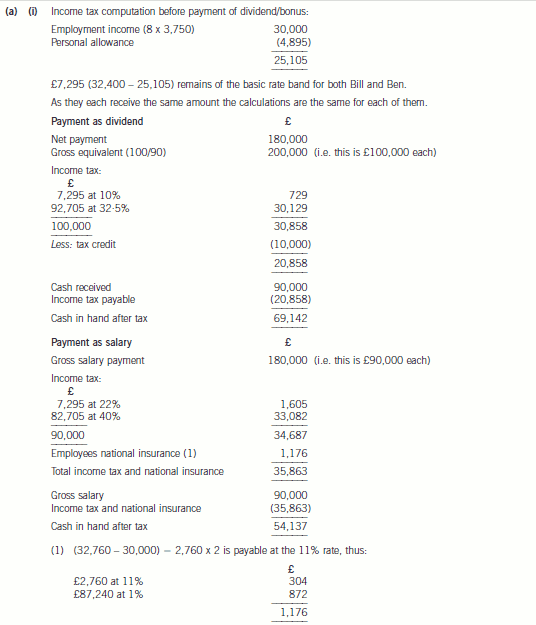
As a result, Bill and Ben would each be better off by £15,005 (69,142 – 54,137). If the cash were extracted by way
of dividend.
Tutorial note: In this answer the employers’ national insurance liability on the salary has been ignored. Credit would be
given to a candidate who recognised this issue. -
第4题:
3 Palm plc recently acquired 100% of the ordinary share capital of Nikau Ltd from Facet Ltd. Palm plc intends to use
Nikau Ltd to develop a new product range, under the name ‘Project Sabal’. Nikau Ltd owns shares in a non-UK
resident company, Date Inc.
The following information has been extracted from client files and from a meeting with the Finance Director of Palm
plc.
Palm plc:
– Has more than 40 wholly owned subsidiaries such that all group companies pay corporation tax at 30%.
– All group companies prepare accounts to 31 March.
– Acquired Nikau Ltd on 1 November 2007 from Facet Ltd, an unrelated company.
Nikau Ltd:
– UK resident company that manufactures domestic electronic appliances for sale in the European Union (EU).
– Large enterprise for the purposes of the enhanced relief available for research and development expenditure.
– Trading losses brought forward as at 1 April 2007 of £195,700.
– Budgeted taxable trading profit of £360,000 for the year ending 31 March 2008 before taking account of ‘Project
Sabal’.
– Dividend income of £38,200 will be received in the year ending 31 March 2008 in respect of the shares in Date
Inc.
‘Project Sabal’:
– Development of a range of electronic appliances, for sale in North America.
– Project Sabal will represent a significant advance in the technology of domestic appliances.
– Nikau Ltd will spend £70,000 on staffing costs and consumables researching and developing the necessary
technology between now and 31 March 2008. Further costs will be incurred in the following year.
– Sales to North America will commence in 2009 and are expected to generate significant profits from that year.
Shares in Date Inc:
– Nikau Ltd owns 35% of the ordinary share capital of Date Inc.
– The shares were purchased from Facet Ltd on 1 June 2003 for their market value of £338,000.
– The sale was a no gain, no loss transfer for the purposes of corporation tax.
– Facet Ltd purchased the shares in Date Inc on 1 March 1994 for £137,000.
Date Inc:
– A controlled foreign company resident in the country of Palladia.
– Annual chargeable profits arising out of property investment activities are approximately £120,000, of which
approximately £115,000 is distributed to its shareholders each year.
The tax system in Palladia:
– No taxes on income or capital profits.
– 4% withholding tax on dividends paid to shareholders resident outside Palladia.
Required:
(a) Prepare detailed explanatory notes, including relevant supporting calculations, on the effect of the following
issues on the amount of corporation tax payable by Nikau Ltd for the year ending 31 March 2008.
(i) The costs of developing ‘Project Sabal’ and the significant commercial changes to the company’s
activities arising out of its implementation. (8 marks)
正确答案:
(a) Nikau Ltd – Effect on corporation tax payable for the year ending 31 March 2008
(i) Project Sabal
Research and development expenditure
The expenditure incurred in respect of research and development will give rise to an enhanced deduction for the
purposes of computing the taxable trading profits of Nikau Ltd. The enhanced deduction is 125% of the qualifying
expenditure as Nikau Ltd is a large enterprise for this purpose.
The expenditure will reduce the profits chargeable to corporation tax of Nikau Ltd by £87,500 (£70,000 x 1·25) and
its corporation tax liability by £26,250 (£87,500 x 30%).
The budgeted expenditure will qualify for the enhanced deduction because it appears to satisfy the following conditions.
– It is likely to qualify as research and development expenditure within generally accepted accounting principles as
it will result in new technical knowledge and the production of a substantially improved device for use in the
industry.
– It exceeds £10,000 in Nikau Ltd’s accounting period.
– It relates to staff costs, consumable items or other qualifying expenditure as opposed to capital items.
– It will result in further trading activities for Nikau Ltd.
Use of brought forward trading losses
The development of products for the North American market is likely to represent a major change in the nature and
conduct of the trade of Nikau Ltd. This is because the company is developing new products and intends to sell them in
a new market. It is a major change as sales to North America are expected to generate significant additional profits.
Because this change will occur within three years of the change in the ownership of Nikau Ltd on 1 November 2007,
any trading losses arising prior to that date cannot be carried forward beyond that date.
Accordingly, the trading losses brought forward may only be offset against £158,958 ((£360,000 – £87,500) x 7/12)
of the company’s trading profits for the year. The remainder of the trading losses £36,742 (£195,700 – £158,958) will
be lost resulting in lost tax relief of £11,023 (£36,742 x 30%).
Tutorial note
The profits for the year ending 31 March 2008 will be apportioned to the periods pre and post 1 November 2007 on
either a time basis or some other basis that is just and reasonable. -
第5题:
(ii) Audit work on after-date bank transactions identified a transfer of cash from Batik Co. The audit senior has
documented that the finance director explained that Batik commenced trading on 7 October 2005, after
being set up as a wholly-owned foreign subsidiary of Jinack. No other evidence has been obtained.
(4 marks)
Required:
Identify and comment on the implications of the above matters for the auditor’s report on the financial
statements of Jinack Co for the year ended 30 September 2005 and, where appropriate, the year ending
30 September 2006.
NOTE: The mark allocation is shown against each of the matters.
正确答案:
(ii) Wholly-owned foreign subsidiary
■ The cash transfer is a non-adjusting post balance sheet event. It indicates that Batik was trading after the balance
sheet date. However, that does not preclude Batik having commenced trading before the year end.
■ The finance director’s oral representation is wholly insufficient evidence with regard to the existence (or otherwise)
of Batik at 30 September 2005. If it existed at the balance sheet date its financial statements should have been
consolidated (unless immaterial).
■ The lack of evidence that might reasonably be expected to be available (e.g. legal papers, registration payments,
etc) suggests a limitation on the scope of the audit.
■ If such evidence has been sought but not obtained then the limitation is imposed by the entity (rather than by
circumstances).
■ Whilst the transaction itself may not be material, the information concerning the existence of Batik may be material
to users and should therefore be disclosed (as a non-adjusting event). The absence of such disclosure, if the
auditor considered necessary, would result in a qualified ‘except for’, opinion.
Tutorial note: Any matter that is considered sufficiently material to be worthy of disclosure as a non-adjusting
event must result in such a qualified opinion if the disclosure is not made.
■ If Batik existed at the balance sheet date and had material assets and liabilities then its non-consolidation would
have a pervasive effect. This would warrant an adverse opinion.
■ Also, the nature of the limitation (being imposed by the entity) could have a pervasive effect if the auditor is
suspicious that other audit evidence has been withheld. In this case the auditor should disclaim an opinion. -
第6题:
3 The Stiletto Partnership consisted of three partners, Clint, Ben and Amy, who shared the profits of the business
equally. On 28 February 2007 the partners sold the business to Razor Ltd, in exchange for shares in Razor Ltd, with
each former partner owning one third of the new company.
The recent, tax adjusted, trading profits of the Stiletto Partnership have been as follows:
£
Year ended 30 June 2006 92,124
1 July 2006 to 28 February 2007 81,795
Clint, who was 65 on 5 October 2006, retired when the business was sold to Razor Ltd. He is now suggesting that
if the sale of the partnership, and his retirement, had been delayed until 30 April 2007, his total tax liability would
have been reduced. Clint’s only other income is gross pension income of £6,100 per year, which he began receiving
in the tax year 2005/06. Clint did not receive any salary or dividends from Razor Ltd. It is estimated that the
partnership’s tax adjusted trading profits for the period from 1 March 2007 to 30 April 2007 would have been
£20,760. Clint has overlap profits of £14,250 brought forward from when the partnership began trading.
Razor Ltd manufactures industrial cutting tools. On 1 July 2007, Razor Ltd will subscribe for the whole of the ordinary
share capital of Cutlass Inc, a company newly incorporated in the country of Sharpenia. It is intended that Cutlass
Inc will purchase partly finished tools from Razor Ltd and customise them in Sharpenia. It is anticipated that Cutlass
Inc’s annual profits chargeable to corporation tax will be approximately £120,000.
Ben and Amy will be the directors of Cutlass Inc, although Ben will not be involved in the company’s business on a
day-to-day basis. Amy intends to spend one or two weeks each month in the country of Sharpenia looking after the
company’s affairs. The remainder of her time will be spent in the UK. Amy has employment contracts with both Razor
Ltd and Cutlass Inc and her duties for Cutlass Inc will be carried out wholly in Sharpenia. Cutlass Inc will pay for
Amy’s flights to and from Sharpenia and for her husband and baby to visit her there twice a year. Amy is currently
UK resident and ordinarily resident.
The system of income tax and corporation tax in the country of Sharpenia is broadly similar to that in the UK although
the rate of corporation tax is 38% regardless of the level of profits. There is a double tax treaty between the UK and
Sharpenia based on the OECD model treaty. The clause in the treaty dealing with company residency states that a
company resident in both countries under domestic law will be regarded under the treaty as being resident only in the
country where it is effectively managed and controlled. Sharpenia is not a member of the European Union.
Required:
(a) (i) Calculate Clint’s taxable trading profits for the tax years 2006/07 and 2007/08 for both of the
alternative retirement dates (28 February 2007 and 30 April 2007). (3 marks)
正确答案: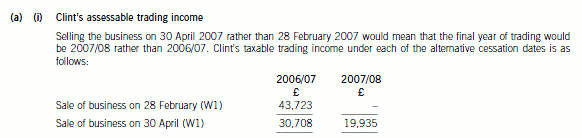
-
第7题:
China’s markets have been strengthened by Strong domestic consumption and it also stimulated both multinationals and domestic companies to shift the emphasis of their operations from 'Made in China' to 'Made for China'.()
此题为判断题(对,错)。
参考答案:对
-
第8题:
共用题干
New Product Will Save lives
Drinking water that looks clean may still contain bugs(虫子),which can cause illness.
A small company called Genera Technologies has produced a testing method in three
stages,which shows whether water is safe.The new test shows if water needs chemicals
added to it,to destroy anything harmful.It was invented by scientist Dr. Adrian Parton,
who started Genera five years ago.He and his employees have developed the test together
with a British water company.
Andy Headland,Genera's marketing director,recently presented the test at a
conference in the USA and forecast good American sales for it.Genera has already sold 11
of its tests at$42,500 a time in the UK and has a further four on order. It expects to sell
another 25 tests before the end of March.The company says it is the only test in the UK to
be approved by the government.
Genera was formed five years ago and until October last year had only five employees;
it now employs 14.Mr Headland believes that the company should make around$19 million
by the end of the year in the UK alone.The new product has been a commercial success in the USA.
A:Right
B:Wrong
C:Not mentioned答案:B解析: -
第9题:
问答题Practice 6 ● You are the head of the Administrative Department of a company. The Managing Director has asked you to write a proposal for office health and safety provisions. ● Write a proposal for the Managing Director: ● giving reasons for writing the proposed proposal ● summarizing the problems that have been raised concerning office health and safety ● giving the main causes of the possible accidents ● suggesting new provisions of office health and safety. ● Write 200~250 words on the separate answer paper provided.正确答案: 【参考范文】
To: Mr. Gates, Managing Director
From: John Smith, Head of the Administrative Department
Date: March 18, 2006
Subject: Office Health and Safety Provisions
On the request of the Managing Director, I have investigated into the problems raised with regard to office health and safety. Particularly, I have talked to office managers concerning any accidents or job-related illnesses, which have occurred, and I was supposed to recommend ways to improve the situation.
A study was made about all accidents that were reported in the last year. It shows three main causes: failure to follow safety regulations; faulty equipment; inadequate knowledge of health and safety procedures of new staff.
Records of all job-related illness were also studied during the past year. Meetings will be held to discuss measures to be taken.
Proposals:
It is suggested that a list of safety regulations be clearly displayed in the company’s dining room and main offices.
Make sure the new staff are well informed of the company’s safety regulations and policy.
The Personnel Manager should take the responsibility of instructing all new staff on the procedures regarding the use of office equipment and machinery.
It is indispensable for all staff to exercise fire drill procedures at least twice a year.
It is decided by office managers that old office equipment be replaced with newer models, especially chairs without right back support.解析: 暂无解析 -
第10题:
单选题Although a teenager, Fred could resist _____ what to do and what not to do.Ato be told
Bhaving been told
Cbeing told
Dto have been told
正确答案: D解析:
句意:尽管Fred只有十几岁,他却拒绝接受别人指使他该做什么和不该做什么。resist后面只能跟动名词,所以A项和D项可以排除。having been told表示已经被告知,而being told泛指一般的被告知。 -
第11题:
单选题Which statement is true?()ACompilation fails because the hashCode method is not overridden.
BA HashSet could contain multiple Person objects with the same name.
CAll Person objects will have the same hash code because the hashCode method is not overridden.
DIf a HashSet contains more than one Person object with name="Fred", then removing another Person, also with name="Fred", will remove them all.
正确答案: A解析: 暂无解析 -
第12题:
问答题Write a memo in about 50 words. You are the Personnel Manager of a company, and have been approached by your IT Department to recruit three new members of staff. Write a memo to Miss Kate Bush, the Manager of the IT Department, ·informing her you have received over 100 applications and have selected 10 candidates for interview, ·telling her you will write to the candidates inviting them for interview, and ·asking her to tell you the time and the place of the interview.正确答案: To: Miss Kate Bush
From: your name, Personnel Manager
Subject: IT Department job interview
Date: April 18, 2013
I have received over 100 applications for the three new positions in the IT Department and have put together a short list of 10 candidates. I will shortly write to the candidates inviting them for interview. Please let me know when and where you would like the interview to take place so that I can inform the candidates when I write to them.解析: 暂无解析 -
第13题:
6 Assume today’s date is 16 April 2005.
Henry, aged 48, is the managing director of Happy Home Ltd, an unquoted UK company specialising in interior
design. He is wealthy in his own right and is married to Helen, who is 45 years old. They have two children – Stephen,
who is 19, and Sally who is 17.
As part of his salary, Henry was given 3,000 shares in Happy Home Ltd with an option to acquire a further 10,000
shares. The options were granted on 15 July 2003, shortly after the company started trading, and were not part of
an approved share option scheme. The free shares were given to Henry on the same day.
The exercise price of the share options was set at the then market value of £1·00 per share. The options are not
capable of being exercised after 10 years from the date of grant. The company has been successful, and the current
value of the shares is now £14·00 per share. Another shareholder has offered to buy the shares at their market value,
so Henry exercised his share options on 14 April 2005 and will sell the shares next week, on 20 April 2005.
With the company growing in size, Henry wishes to recruit high quality staff, but the company lacks the funds to pay
them in cash. Henry believes that giving new employees the chance to buy shares in the company would help recruit
staff, as they could share in the growth in value of Happy Home Ltd. Henry has heard that there is a particular share
scheme that is suitable for small, fast growing companies. He would like to obtain further information on how such
a scheme would work.
Henry has accumulated substantial assets over the years. The family house is owned jointly with Helen, and is worth
£650,000. Henry has a £250,000 mortgage on the house. In addition, Henry has liquid assets worth £340,000
and Helen has shares in quoted companies currently worth £125,000. Henry has no forms of insurance, and believes
he should make sure that his wealth and family are protected. He is keen to find out what options he should be
considering.
Required:
(a) (i) State how the gift of the 3,000 shares in Happy Home Ltd was taxed. (1 mark)
正确答案:
(a) (i) Gift of shares
Shares, which are given free or sold at less than market value, are charged to income tax on the difference between the
market value and the amount paid (if any) for the shares. Henry was given 3,000 shares with a market value of £1 at
the time of gift, so he was assessed to income tax on £3,000, in the tax year 2003/04. -
第14题:
(b) Peter, one of Linden Limited’s non-executive directors, having lived and worked in the UK for most of his adult
life, sold his home near London on 22 March 2006 and, together with his wife (a French citizen), moved to live
in a villa which she owns in the south of France. Peter is now demanding that the tax deducted from his director’s
fees, for the board meetings held on 18 April and 16 May 2006, be refunded, on the grounds that, as he is no
longer resident in the UK, he is no longer liable to UK income tax. All of the company’s board meetings are held
at its offices in Cambridge.
Despite Peter’s assurance that none of the other companies of which he is a director has disputed his change of
tax status, Damian is uncertain whether he should make the refunds requested. However, as Peter is a friend of
the company’s founder, Linden Limited’s managing director is urging him to do so, stating that if the tax does
have to be paid, then Linden Limited could always bear the cost.
Required:
Advise Damian whether Peter is correct in his assertion regarding his tax position and in the case that there
is a UK tax liability the implications of the managing director’s suggestion. You are not required to consider
national insurance (NIC) issues. (4 marks)
正确答案:
(b) Peter will have been resident and ordinarily resident in the UK. When such individuals leave the UK for a purpose other than
to take up full time employment abroad, they normally continue to still be so regarded unless their absence spans a complete
tax year. But, where someone intends to live permanently abroad or to do so for a period of at least three tax years, they may
be treated as non-resident and non-ordinarily resident from the day after the date of their departure, if they can provide
evidence to HMRC of that intention. Selling a residence in the UK and setting up home abroad will normally constitute such
evidence. However to retain non-resident status the intention must actually be fulfilled, and visits to the UK must not exceed
182 days in any tax year or average more than 90 days per year over a period of four tax years. Given that Peter would appear
to have several company directorships in the UK, it is possible that he might fail to satisfy the 90 day average ‘substantial
visits’ rule.
Even if Peter is classed as non-resident, any remuneration earned in the UK will still be liable to UK income tax, and subject
to PAYE, unless it is for duties incidental to an overseas employment, which is unlikely to be the case for fees paid to a nonexecutive
director for attending board meetings. Thus, income tax should still be deducted from the fees under PAYE. Where
PAYE should have been deducted from a director’s emoluments and it has not been, but the tax is nevertheless accounted
for by the company to HMRC, then to the extent that the tax is not reimbursed by the director, he will be treated as receiving
a benefit equivalent to the amount of tax. -
第15题:
(b) For this part, assume today’s date is 1 May 2010.
Bill and Ben decided not to sell their company, and instead expanded the business themselves. Ben, however,
is now pursuing other interests, and is no longer involved with the day to day activities of Flower Limited. Bill
believes that the company would be better off without Ben as a voting shareholder, and wishes to buy Ben’s
shares. However, Bill does not have sufficient funds to buy the shares himself, and so is wondering if the
company could acquire the shares instead.
The proposed price for Ben’s shares would be £500,000. Both Bill and Ben pay income tax at the higher rate.
Required:
Write a letter to Ben:
(1) stating the income tax (IT) and/or capital gains tax (CGT) implications for Ben if Flower Limited were to
repurchase his 50% holding of ordinary shares, immediately in May 2010; and
(2) advising him of any available planning options that might improve this tax position. Clearly explain any
conditions which must be satisfied and quantify the tax savings which may result.
(13 marks)
Assume that the corporation tax rates for the financial year 2005 and the income tax rates and allowances
for the tax year 2005/06 apply throughout this question.
正确答案:(b) [Ben’s address] [Firm’s address]
Dear Ben [Date]
A company purchase of own shares can be subject to capital gains treatment if certain conditions are satisfied. However, one
of these conditions is that the shares in question must have been held for a minimum period of five years. As at 1 May 2010,
your shares in Flower Limited have only been held for four years and ten months. As a result, the capital gains treatment will
not apply.
In the absence of capital gains treatment, the position on a company repurchase of its own shares is that the payment will
be treated as an income distribution (i.e. a dividend) in the hands of the recipient. The distribution element is calculated as
the proceeds received for the shares less the price paid for them. On the basis that the purchase price is £500,000, then the
element of distribution will be £499,500 (500,000 – 500). This would be taxed as follows: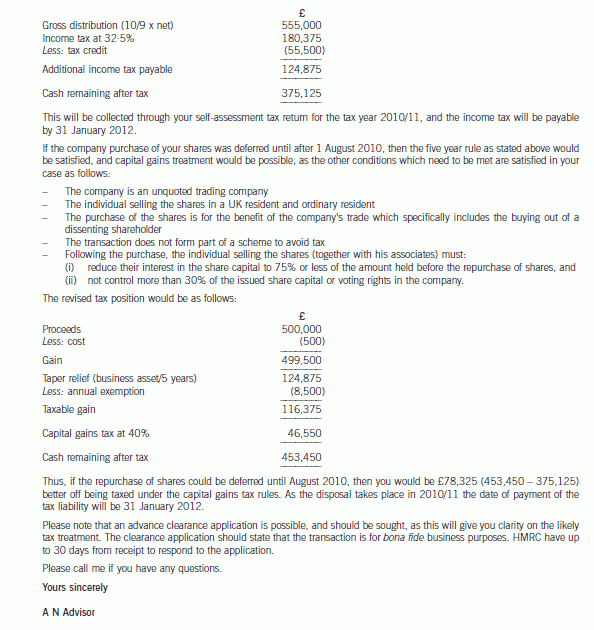
-
第16题:
3 Spica, one of the director shareholders of Acrux Ltd, has been in dispute with the other shareholders over plans to
expand the company’s activities overseas. In order to resolve the position it has been agreed that Spica will sell her
shares back to the company. Once the purchase of her shares has taken place, the company intends to establish a
number of branches overseas and acquire a shareholding in a number of companies that are resident and trade in
overseas countries.
The following information has been obtained from client files and meetings with the parties involved.
Acrux Ltd:
– An unquoted UK resident company.
– Share capital consists of 50,000 ordinary shares issued at £1·90 per share in July 2000.
– None of the other shareholders has any connection with Spica.
The purchase of own shares:
– The company will purchase all of Spica’s shares for £8 per share.
– The transaction will take place by the end of 2008.
Spica:
– Purchased 8,000 shares in Acrux Ltd for £2 per share on 30 September 2003.
– Has no income in the tax year 2008/09.
– Has chargeable capital gains in the tax year 2008/09 of £3,800.
– Has houses in the UK and the country of Solaris and divides her time between them.
Investment in non-UK resident companies:
– Acrux Ltd will acquire between 15% and 20% of each of the non-UK resident companies.
– The companies will not be controlled foreign companies as the rates of tax in the overseas countries will be
between 23% and 42%.
– There may or may not be a double tax treaty between the UK and the overseas countries in which the companies
are resident. Where there is a treaty, it will be based on the OECD model treaty.
– None of the countries concerned levy withholding tax on dividends paid to UK companies.
– The directors of Acrux Ltd are concerned that the rate of tax suffered on the profits of the overseas companies
will be very high as they will be taxed in both the overseas country and in the UK.
Required:
(a) (i) Prepare detailed calculations to determine the most beneficial tax treatment of the payment Spica will
receive for her shares; (7 marks)
正确答案:
-
第17题:
(b) You are the audit manager of Petrie Co, a private company, that retails kitchen utensils. The draft financial
statements for the year ended 31 March 2007 show revenue $42·2 million (2006 – $41·8 million), profit before
taxation of $1·8 million (2006 – $2·2 million) and total assets of $30·7 million (2006 – $23·4 million).
You are currently reviewing two matters that have been left for your attention on Petrie’s audit working paper file
for the year ended 31 March 2007:
(i) Petrie’s management board decided to revalue properties for the year ended 31 March 2007 that had
previously all been measured at depreciated cost. At the balance sheet date three properties had been
revalued by a total of $1·7 million. Another nine properties have since been revalued by $5·4 million. The
remaining three properties are expected to be revalued later in 2007. (5 marks)
Required:
Identify and comment on the implications of these two matters for your auditor’s report on the financial
statements of Petrie Co for the year ended 31 March 2007.
NOTE: The mark allocation is shown against each of the matters above.
正确答案:
(b) Implications for auditor’s report
(i) Selective revaluation of premises
The revaluations are clearly material to the balance sheet as $1·7 million and $5·4 million represent 5·5% and 17·6%
of total assets, respectively (and 23·1% in total). As the effects of the revaluation on line items in the financial statements
are clearly identified (e.g. revalued amount, depreciation, surplus in statement of changes in equity) the matter is not
pervasive.
The valuations of the nine properties after the year end provide additional evidence of conditions existing at the year end
and are therefore adjusting events per IAS 10 Events After the Balance Sheet Date.
Tutorial note: It is ‘now’ still less than three months after the year end so these valuations can reasonably be expected
to reflect year end values.
However, IAS 16 Property, Plant and Equipment does not permit the selective revaluation of assets thus the whole class
of premises would need to have been revalued for the year to 31 March 2007 to change the measurement basis for this
reporting period.
The revaluation exercise is incomplete. Unless the remaining three properties are revalued before the auditor’s report on
the financial statements for the year ended 31 March 2007 is signed off:
(1) the $7·1 revaluation made so far must be reversed to show all premises at depreciated cost as in previous years;
OR
(2) the auditor’s report would be qualified ‘except for’ disagreement regarding non-compliance with IAS 16.
When it is appropriate to adopt the revaluation model (e.g. next year) the change in accounting policy (from a cost model
to a revaluation model) should be accounted for in accordance with IAS 16 (i.e. as a revaluation).
Tutorial note: IAS 8 Accounting Policies, Changes in Accounting Estimates and Errors does not apply to the initial
application of a policy to revalue assets in accordance with IAS 16.
Assuming the revaluation is written back, before giving an unmodified opinion, the auditor should consider why the three
properties were not revalued. In particular if there are any indicators of impairment (e.g. physical dilapidation) there
should be sufficient evidence on the working paper file to show that the carrying amount of these properties is not
materially greater than their recoverable amount (i.e. the higher of value in use and fair value less costs to sell).
If there is insufficient evidence to confirm that the three properties are not impaired (e.g. if the auditor was prevented
from inspecting the properties) the auditor’s report would be qualified ‘except for’ on grounds of limitation on scope.
If there is evidence of material impairment but management fail to write down the carrying amount to recoverable
amount the auditor’s report would be qualified ‘except for’ disagreement regarding non-compliance with IAS 36
Impairment of Assets.
-
第18题:
-Okay, what is the decision? -As you know, we have been a privately held, family-owned company for over 120 years,_____________.A and I think it definitely has a bright future ;
B but it may be time to consider some major changes ;
C but the company faces tough competition
参考答案:B
-
第19题:
共用题干
New Product Will Save lives
Drinking water that looks clean may still contain bugs(虫子),which can cause illness.
A small company called Genera Technologies has produced a testing method in three
stages,which shows whether water is safe.The new test shows if water needs chemicals
added to it,to destroy anything harmful.It was invented by scientist Dr. Adrian Parton,
who started Genera five years ago.He and his employees have developed the test together
with a British water company.
Andy Headland,Genera's marketing director,recently presented the test at a
conference in the USA and forecast good American sales for it.Genera has already sold 11
of its tests at$42,500 a time in the UK and has a further four on order. It expects to sell
another 25 tests before the end of March.The company says it is the only test in the UK to
be approved by the government.
Genera was formed five years ago and until October last year had only five employees;
it now employs 14.Mr Headland believes that the company should make around$19 million
by the end of the year in the UK alone.Genera has increased the number of its employees recently.
A:Right
B:Wrong
C:Not mentioned答案:A解析: -
第20题:
Write a memo in about 50 words. You are the Personnel Manager of a company, and have been approached by your IT Department to recruit three new members of staff. Write a memo to Miss Kate Bush, the Manager of the IT Department, ·informing her you have received over 100 applications and have selected 10 candidates for interview, ·telling her you will write to the candidates inviting them for interview, and ·asking her to tell you the time and the place of the interview.
To: Miss Kate Bush
From: your name, Personnel Manager
Subject: IT Department job interview
Date: April 18, 2013
I have received over 100 applications for the three new positions in the IT Department and have put together a short list of 10 candidates. I will shortly write to the candidates inviting them for interview. Please let me know when and where you would like the interview to take place so that I can inform the candidates when I write to them.
略 -
第21题:
单选题Although a teenager, Fred could resist ______ what to do and what not to do.Ato be told
Bhaving been told
Cbeing told
Dto have been told
正确答案: C解析:
尽管Fred只有十几岁,他却拒绝接受别人指使他该做什么和不该做什么。resist后面只能跟动名词,所以A项和D项可以排除。having been told表示已经被告知,而being told泛指一般的被告知。 -
第22题:
问答题Practice 8 ● You are the Managing Director of a company whose profits have recently increased and you would like to reward staff for this. ● Write an email to all staff: ● thanking them for their contribution ● explaining why profits increased ● telling them what their reward will be. ● Write 40-50 words.正确答案: 【参考范文】
To: All Staff
From: Bill Bush
Date: 7th December 2002
Subject: Staff Reward
Because of your hard work and long working hours, the profits of our company this month increased by 10% compared with the same period last year. I would like to thank you for your long devoted work. A party hold at the Grand hotel has been arranged tomorrow as a prize.
Enjoy!解析: 暂无解析 -
第23题:
单选题Shadow chancellor George Osborne holds that ______.ALondon is not capable of hosting the summit
BLord Myners should not have signed off Sir Fred Goodwin’s pension
Cthere was no “common ground” on the G20
Dthe UK government’s entire economic strategy has fallen apart
正确答案: C解析:
题目问的是:影子大臣乔治·奥斯本持有什么观点?文章第14段提到“He said the UK government would have ‘more credibility’... if the prime minister had sacked Lord Myners accused of signing off RBS bank boss Sir Fred Goodwin’s £703,000 pension.”,表述了如果首相解雇麦纳斯勋爵,指控他签收苏格兰皇家银行老大弗雷德·古德温703,000英镑的津贴,英国政府就应该在银行家的奖金和离岸避税上更具公信力。由此可得乔治·奥斯本认为麦纳斯不应该签署弗雷德·古德温的退休金。故选B。