
21 Which of the following statements about contingent assets and contingent liabilities are correct?1 A contingent asset should be disclosed by note if an inflow of economic benefits is probable.2 A contingent liability should be disclosed by note if it i
题目
21 Which of the following statements about contingent assets and contingent liabilities are correct?
1 A contingent asset should be disclosed by note if an inflow of economic benefits is probable.
2 A contingent liability should be disclosed by note if it is probable that a transfer of economic benefits to settle it
will be required, with no provision being made.
3 No disclosure is required for a contingent liability if it is not probable that a transfer of economic benefits to settle
it will be required.
4 No disclosure is required for either a contingent liability or a contingent asset if the likelihood of a payment or
receipt is remote.
A 1 and 4 only
B 2 and 3 only
C 2, 3 and 4
D 1, 2 and 4
相似考题
参考答案和解析
更多“21 Which of the following statements about contingent assets and contingent liabilities are correct?1 A contingent asset should be disclosed by note if an inflow of economic benefits is probable.2 A contingent liability should be disclosed by note if it i”相关问题
-
第1题:
15 Which of the following statements about intangible assets are correct?
1 If certain criteria are met, research expenditure must be recognised as an intangible asset.
2 Goodwill may not be revalued upwards.
3 Internally generated goodwill should not be capitalised.
A 2 and 3 only
B 1 and 3 only
C 1 and 2 only
D All three statements are correct
正确答案:A
-
第2题:
20 IAS 2 Inventories defines the extent to which overheads are included in the cost of inventories of finished goods.
Which of the following statements about the IAS 2 requirements in this area are correct?
1 Finished goods inventories may be valued on the basis of labour and materials cost only, without including overheads.
2 Carriage inwards, but not carriage outwards, should be included in overheads when valuing inventories of finished goods.
3 Factory management costs should be included in fixed overheads allocated to inventories of finished goods.
A All three statements are correct
B 1 and 2 only
C 1 and 3 only
D 2 and 3 only
正确答案:D
-
第3题:
9 Which of the following items must be disclosed in a company’s published financial statements (including notes)
if material, according to IAS1 Presentation of financial statements?
1 Finance costs.
2 Staff costs.
3 Depreciation and amortisation expense.
4 Movements on share capital.
A 1 and 3 only
B 1, 2 and 4 only
C 2, 3 and 4 only
D All four items
正确答案:D
-
第4题:
19 Which of the following statements about intangible assets in company financial statements are correct according
to international accounting standards?
1 Internally generated goodwill should not be capitalised.
2 Purchased goodwill should normally be amortised through the income statement.
3 Development expenditure must be capitalised if certain conditions are met.
A 1 and 3 only
B 1 and 2 only
C 2 and 3 only
D All three statements are correct
正确答案:A
-
第5题:
8 Which of the following statements about accounting concepts and conventions are correct?
(1) The money measurement concept requires all assets and liabilities to be accounted for at historical cost.
(2) The substance over form. convention means that the economic substance of a transaction should be reflected in
the financial statements, not necessarily its legal form.
(3) The realisation concept means that profits or gains cannot normally be recognised in the income statement until
realised.
(4) The application of the prudence concept means that assets must be understated and liabilities must be overstated
in preparing financial statements.
A 1 and 3
B 2 and 3
C 2 and 4
D 1 and 4.
正确答案:B
-
第6题:
17 Which of the following statements are correct?
(1) All non-current assets must be depreciated.
(2) If goodwill is revalued, the revaluation surplus appears in the statement of changes in equity.
(3) If a tangible non-current asset is revalued, all tangible assets of the same class should be revalued.
(4) In a company’s published balance sheet, tangible assets and intangible assets must be shown separately.
A 1 and 2
B 2 and 3
C 3 and 4
D 1 and 4
正确答案:C
-
第7题:
(c) During the year Albreda paid $0·1 million (2004 – $0·3 million) in fines and penalties relating to breaches of
health and safety regulations. These amounts have not been separately disclosed but included in cost of sales.
(5 marks)
Required:
For each of the above issues:
(i) comment on the matters that you should consider; and
(ii) state the audit evidence that you should expect to find,
in undertaking your review of the audit working papers and financial statements of Albreda Co for the year ended
30 September 2005.
NOTE: The mark allocation is shown against each of the three issues.
正确答案:
(c) Fines and penalties
(i) Matters
■ $0·1 million represents 5·6% of profit before tax and is therefore material. However, profit has fallen, and
compared with prior year profit it is less than 5%. So ‘borderline’ material in quantitative terms.
■ Prior year amount was three times as much and represented 13·6% of profit before tax.
■ Even though the payments may be regarded as material ‘by nature’ separate disclosure may not be necessary if,
for example, there are no external shareholders.
■ Treatment (inclusion in cost of sales) should be consistent with prior year (‘The Framework’/IAS 1 ‘Presentation of
Financial Statements’).
■ The reason for the fall in expense. For example, whether due to an improvement in meeting health and safety
regulations and/or incomplete recording of liabilities (understatement).
■ The reason(s) for the breaches. For example, Albreda may have had difficulty implementing new guidelines in
response to stricter regulations.
■ Whether expenditure has been adjusted for in the income tax computation (as disallowed for tax purposes).
■ Management’s attitude to health and safety issues (e.g. if it regards breaches as an acceptable operational practice
or cheaper than compliance).
■ Any references to health and safety issues in other information in documents containing audited financial
statements that might conflict with Albreda incurring these costs.
■ Any cost savings resulting from breaches of health and safety regulations would result in Albreda possessing
proceeds of its own crime which may be a money laundering offence.
(ii) Audit evidence
■ A schedule of amounts paid totalling $0·1 million with larger amounts being agreed to the cash book/bank
statements.
■ Review/comparison of current year schedule against prior year for any apparent omissions.
■ Review of after-date cash book payments and correspondence with relevant health and safety regulators (e.g. local
authorities) for liabilities incurred before 30 September 2005.
■ Notes in the prior year financial statements confirming consistency, or otherwise, of the lack of separate disclosure.
■ A ‘signed off’ review of ‘other information’ (i.e. directors’ report, chairman’s statement, etc).
■ Written management representation that there are no fines/penalties other than those which have been reflected in
the financial statements. -
第8题:
(c) In November 2006 Seymour announced the recall and discontinuation of a range of petcare products. The
product recall was prompted by the high level of customer returns due to claims of poor quality. For the year to
30 September 2006, the product range represented $8·9 million of consolidated revenue (2005 – $9·6 million)
and $1·3 million loss before tax (2005 – $0·4 million profit before tax). The results of the ‘petcare’ operations
are disclosed separately on the face of the income statement. (6 marks)
Required:
For each of the above issues:
(i) comment on the matters that you should consider; and
(ii) state the audit evidence that you should expect to find,
in undertaking your review of the audit working papers and financial statements of Seymour Co for the year ended
30 September 2006.
NOTE: The mark allocation is shown against each of the three issues.
正确答案:
■ The discontinuation of the product line after the balance sheet date provides additional evidence that, as at the
balance sheet date, it was of poor quality. Therefore, as at the balance sheet date:
– an allowance (‘provision’) may be required for credit notes for returns of products after the year end that were
sold before the year end;
– goods returned to inventory should be written down to net realisable value (may be nil);
– any plant and equipment used exclusively in the production of the petcare range of products should be tested
for impairment;
– any material contingent liabilities arising from legal claims should be disclosed.
(ii) Audit evidence
■ A copy of Seymour’s announcement (external ‘press release’ and any internal memorandum).
■ Credit notes raised/refunds paid after the year end for faulty products returned.
■ Condition of products returned as inspected during physical attendance of inventory count.
■ Correspondence from customers claiming reimbursement/compensation for poor quality.
■ Direct confirmation from legal adviser (solicitor) regarding any claims for customers including estimates of possible
payouts. -
第9题:
Which of the following does not belong to current assets?
A.cash
B.account payable
C.account receivable
D.note receivable
正确答案:B
解析:录音原文提到Cash, accounts receivable and notes receivable due within a year or less are current assets.现金、期限在一年以内(含一年)的应收账款和应收票据都属于流动资产。B项中应付账款是流动负债。 -
第10题:
You are an audit manager at Rockwell & Co, a firm of Chartered Certified Accountants. You are responsible for the audit of the Hopper Group, a listed audit client which supplies ingredients to the food and beverage industry worldwide.
The audit work for the year ended 30 June 2015 is nearly complete, and you are reviewing the draft audit report which has been prepared by the audit senior. During the year the Hopper Group purchased a new subsidiary company, Seurat Sweeteners Co, which has expertise in the research and design of sugar alternatives. The draft financial statements of the Hopper Group for the year ended 30 June 2015 recognise profit before tax of $495 million (2014 – $462 million) and total assets of $4,617 million (2014: $4,751 million). An extract from the draft audit report is shown below:
Basis of modified opinion (extract)
In their calculation of goodwill on the acquisition of the new subsidiary, the directors have failed to recognise consideration which is contingent upon meeting certain development targets. The directors believe that it is unlikely that these targets will be met by the subsidiary company and, therefore, have not recorded the contingent consideration in the cost of the acquisition. They have disclosed this contingent liability fully in the notes to the financial statements. We do not feel that the directors’ treatment of the contingent consideration is correct and, therefore, do not believe that the criteria of the relevant standard have been met. If this is the case, it would be appropriate to adjust the goodwill balance in the statement of financial position.
We believe that any required adjustment may materially affect the goodwill balance in the statement of financial position. Therefore, in our opinion, the financial statements do not give a true and fair view of the financial position of the Hopper Group and of the Hopper Group’s financial performance and cash flows for the year then ended in accordance with International Financial Reporting Standards.
Emphasis of Matter Paragraph
We draw attention to the note to the financial statements which describes the uncertainty relating to the contingent consideration described above. The note provides further information necessary to understand the potential implications of the contingency.
Required:
(a) Critically appraise the draft audit report of the Hopper Group for the year ended 30 June 2015, prepared by the audit senior.
Note: You are NOT required to re-draft the extracts from the audit report. (10 marks)
(b) The audit of the new subsidiary, Seurat Sweeteners Co, was performed by a different firm of auditors, Fish Associates. During your review of the communication from Fish Associates, you note that they were unable to obtain sufficient appropriate evidence with regard to the breakdown of research expenses. The total of research costs expensed by Seurat Sweeteners Co during the year was $1·2 million. Fish Associates has issued a qualified audit opinion on the financial statements of Seurat Sweeteners Co due to this inability to obtain sufficient appropriate evidence.
Required:
Comment on the actions which Rockwell & Co should take as the auditor of the Hopper Group, and the implications for the auditor’s report on the Hopper Group financial statements. (6 marks)
(c) Discuss the quality control procedures which should be carried out by Rockwell & Co prior to the audit report on the Hopper Group being issued. (4 marks)
正确答案:(a) Critical appraisal of the draft audit report
Type of opinion
When an auditor issues an opinion expressing that the financial statements ‘do not give a true and fair view’, this represents an adverse opinion. The paragraph explaining the modification should, therefore, be titled ‘Basis of Adverse Opinion’ rather than simply ‘Basis of Modified Opinion’.
An adverse opinion means that the auditor considers the misstatement to be material and pervasive to the financial statements of the Hopper Group. According to ISA 705 Modifications to Opinions in the Independent Auditor’s Report, pervasive matters are those which affect a substantial proportion of the financial statements or fundamentally affect the users’ understanding of the financial statements. It is unlikely that the failure to recognise contingent consideration is pervasive; the main effect would be to understate goodwill and liabilities. This would not be considered a substantial proportion of the financial statements, neither would it be fundamental to understanding the Hopper Group’s performance and position.
However, there is also some uncertainty as to whether the matter is even material. If the matter is determined to be material but not pervasive, then a qualified opinion would be appropriate on the basis of a material misstatement. If the matter is not material, then no modification would be necessary to the audit opinion.
Wording of opinion/report
The auditor’s reference to ‘the acquisition of the new subsidiary’ is too vague; the Hopper Group may have purchased a number of subsidiaries which this phrase could relate to. It is important that the auditor provides adequate description of the event and in these circumstances it would be appropriate to name the subsidiary referred to.
The auditor has not quantified the amount of the contingent element of the consideration. For the users to understand the potential implications of any necessary adjustments, they need to know how much the contingent consideration will be if it becomes payable. It is a requirement of ISA 705 that the auditor quantifies the financial effects of any misstatements, unless it is impracticable to do so.
In addition to the above point, the auditor should provide more description of the financial effects of the misstatement, including full quantification of the effect of the required adjustment to the assets, liabilities, incomes, revenues and equity of the Hopper Group.
The auditor should identify the note to the financial statements relevant to the contingent liability disclosure rather than just stating ‘in the note’. This will improve the understandability and usefulness of the contents of the audit report.
The use of the term ‘we do not feel that the treatment is correct’ is too vague and not professional. While there may be some interpretation necessary when trying to apply financial reporting standards to unique circumstances, the expression used is ambiguous and may be interpreted as some form. of disclaimer by the auditor with regard to the correct accounting treatment. The auditor should clearly explain how the treatment applied in the financial statements has departed from the requirements of the relevant standard.
Tutorial note: As an illustration to the above point, an appropriate wording would be: ‘Management has not recognised the acquisition-date fair value of contingent consideration as part of the consideration transferred in exchange for the acquiree, which constitutes a departure from International Financial Reporting Standards.’
The ambiguity is compounded by the use of the phrase ‘if this is the case, it would be appropriate to adjust the goodwill’. This once again suggests that the correct treatment is uncertain and perhaps open to interpretation.
If the auditor wishes to refer to a specific accounting standard they should refer to its full title. Therefore instead of referring to ‘the relevant standard’ they should refer to International Financial Reporting Standard 3 Business Combinations.
The opinion paragraph requires an appropriate heading. In this case the auditors have issued an adverse opinion and the paragraph should be headed ‘Adverse Opinion’.
As with the basis paragraph, the opinion paragraph lacks authority; suggesting that the required adjustments ‘may’ materially affect the financial statements implies that there is a degree of uncertainty. This is not the case; the amount of the contingent consideration will be disclosed in the relevant purchase agreement, so the auditor should be able to determine whether the required adjustments are material or not. Regardless, the sentence discussing whether the balance is material or not is not required in the audit report as to warrant inclusion in the report the matter must be considered material. The disclosure of the nature and financial effect of the misstatement in the basis paragraph is sufficient.
Finally, the emphasis of matter paragraph should not be included in the audit report. An emphasis of matter paragraph is only used to draw attention to an uncertainty/matter of fundamental importance which is correctly accounted for and disclosed in the financial statements. An emphasis of matter is not required in this case for the following reasons:
– Emphasis of matter is only required to highlight matters which the auditor believes are fundamental to the users’ understanding of the business. An example may be where a contingent liability exists which is so significant it could lead to the closure of the reporting entity. That is not the case with the Hopper Group; the contingent liability does not appear to be fundamental.
– Emphasis of matter is only used for matters where the auditor has obtained sufficient appropriate evidence that the matter is not materially misstated in the financial statements. If the financial statements are materially misstated, in this regard the matter would be fully disclosed by the auditor in the basis of qualified/adverse opinion paragraph and no emphasis of matter is necessary.
(b) Communication from the component auditor
The qualified opinion due to insufficient evidence may be a significant matter for the Hopper Group audit. While the possible adjustments relating to the current year may not be material to the Hopper Group, the inability to obtain sufficient appropriate evidence with regard to a material matter in Seurat Sweeteners Co’s financial statements may indicate a control deficiency which the auditor was not aware of at the planning stage and it could indicate potential problems with regard to the integrity of management, which could also indicate a potential fraud. It could also indicate an unwillingness of management to provide information, which could create problems for future audits, particularly if research and development costs increase in future years. If the group auditor suspects that any of these possibilities are true, they may need to reconsider their risk assessment and whether the audit procedures performed are still appropriate.
If the detail provided in the communication from the component auditor is insufficient, the group auditor should first discuss the matter with the component auditor to see whether any further information can be provided. The group auditor can request further working papers from the component auditor if this is necessary. However, if Seurat Sweeteners has not been able to provide sufficient appropriate evidence, it is unlikely that this will be effective.
If the discussions with the component auditor do not provide satisfactory responses to evaluate the potential impact on the Hopper Group, the group auditor may need to communicate with either the management of Seurat Sweeteners or the Hopper Group to obtain necessary clarification with regard to the matter.
Following these procedures, the group auditor needs to determine whether they have sufficient appropriate evidence to draw reasonable conclusions on the Hopper Group’s financial statements. If they believe the lack of information presents a risk of material misstatement in the group financial statements, they can request that further audit procedures be performed, either by the component auditor or by themselves.
Ultimately the group engagement partner has to evaluate the effect of the inability to obtain sufficient appropriate evidence on the audit opinion of the Hopper Group. The matter relates to research expenses totalling $1·2 million, which represents 0·2% of the profit for the year and 0·03% of the total assets of the Hopper Group. It is therefore not material to the Hopper Group’s financial statements. For this reason no modification to the audit report of the Hopper Group would be required as this does not represent a lack of sufficient appropriate evidence with regard to a matter which is material to the Group financial statements.
Although this may not have an impact on the Hopper Group audit opinion, this may be something the group auditor wishes to bring to the attention of those charged with governance. This would be particularly likely if the group auditor believed that this could indicate some form. of fraud in Seurat Sweeteners Co, a serious deficiency in financial reporting controls or if this could create problems for accepting future audits due to management’s unwillingness to provide access to accounting records.
(c) Quality control procedures prior to issuing the audit report
ISA 220 Quality Control for an Audit of Financial Statements and ISQC 1 Quality Control for Firms that Perform. Audits and Reviews of Historical Financial Information, and Other Assurance and Related Services Agreements require that an engagement quality control reviewer shall be appointed for audits of financial statements of listed entities. The audit engagement partner then discusses significant matters arising during the audit engagement with the engagement quality control reviewer.
The engagement quality control reviewer and the engagement partner should discuss the failure to recognise the contingent consideration and its impact on the auditor’s report. The engagement quality control reviewer must review the financial statements and the proposed auditor’s report, in particular focusing on the conclusions reached in formulating the auditor’s report and consideration of whether the proposed auditor’s opinion is appropriate. The audit documentation relating to the acquisition of Seurat Sweeteners Co will be carefully reviewed, and the reviewer is likely to consider whether procedures performed in relation to these balances were appropriate.
Given the listed status of the Hopper Group, any modification to the auditor’s report will be scrutinised, and the firm must be sure of any decision to modify the report, and the type of modification made. Once the engagement quality control reviewer has considered the necessity of a modification, they should consider whether a qualified or an adverse opinion is appropriate in the circumstances. This is an important issue, given that it requires judgement as to whether the matters would be material or pervasive to the financial statements.
The engagement quality control reviewer should ensure that there is adequate documentation regarding the judgements used in forming the final audit opinion, and that all necessary matters have been brought to the attention of those charged with governance.
The auditor’s report must not be signed and dated until the completion of the engagement quality control review.
Tutorial note: In the case of the Hopper Group’s audit, the lack of evidence in respect of research costs is unlikely to be discussed unless the audit engagement partner believes that the matter could be significant, for example, if they suspected the lack of evidence is being used to cover up a financial statements fraud.
-
第11题:
问答题Practice 1 You should spend about 40 minutes on this task. Write about the following topic: Multi-cultural societies, in which there is a mixture of different ethnic peoples, bring more benefits than drawbacks to a country. To what extent do you agree or disagree? You should write at least 250 words.正确答案: 【参考范文】
As a popular slogan goes, The whole globe is just a meter away. With the development of technology, the entire world shrinks into a village in a few decades, which brings about more clashes among people from different races. Someone pushes the so-called solution forward that it is better to divide people into groups according to races. However, this can never solve the problem but only aggravate it.
Admittedly, living in a multi-cultural community with full freedom and without any restriction is a nightmare for everyone indeed. The racial conflicts and residential differentiation would be a huge barrier for all the residents living together. However, if they can do everything cautiously by taking the cultural differences into account, living in this kind of surroundings will offer a great opportunity to enjoy much more communication worldwide in one's short lifetime, which will attract countless people to look forward to the multi-cultural life experience.
Obviously, among all the benefits of multi-cultural society, the following two reasons should, at least, be specially mentioned: First, The colorful and diverse community can deepen the understanding between one people and another. In other words, if people plan to imitate others' custom or behaviour, it is better to understand it before their copying it. Second, it is a shame and inhumane for all modem citizens to discriminate anyone living in any circumstance. In fact, all the people are nothing but simply and most importantly, all creatures have the equal right to live on the earth, so it is not necessary to hold some stereotypes against others. Multi-cultural society is a remarkable stage in history, and more likely it is warfare against the Racism, which will finally succeed without any doubt.
As is mentioned above, racism and multi-culture are contradictory with each other, which should be sensibly solved. As capable human beings, we may regard others’ lifestyles improper, but we should respect them no matter whether we like them or not.解析: 暂无解析 -
第12题:
单选题()is not a proper office at which a note of sea protest should be filed.AConsul
BNotary Public
CMarine Protest Office
DDiplomatic Representative
正确答案: B解析: 暂无解析 -
第13题:
18 Which of the following statements about accounting ratios and their interpretation are correct?
1 A low-geared company is more able to survive a downturn in profit than a highly-geared company.
2 If a company has a high price earnings ratio, this will often indicate that the market expects its profits to rise.
3 All companies should try to achieve a current ratio (current assets/current liabilities) of 2:1.
A 2 and 3 only
B 1 and 3 only
C 1 and 2 only
D All three statements are correct
正确答案:C
-
第14题:
(b) (i) Discusses the principles involved in accounting for claims made under the above warranty provision.
(6 marks)
(ii) Shows the accounting treatment for the above warranty provision under IAS37 ‘Provisions, Contingent
Liabilities and Contingent Assets’ for the year ended 31 October 2007. (3 marks)
Appropriateness of the format and presentation of the report and communication of advice. (2 marks)
正确答案:(b) Provisions – IAS37
An entity must recognise a provision under IAS37 if, and only if:
(a) a present obligation (legal or constructive) has arisen as a result of a past event (the obligating event)
(b) it is probable (‘more likely than not’), that an outflow of resources embodying economic benefits will be required to settle
the obligation
(c) the amount can be estimated reliably
An obligating event is an event that creates a legal or constructive obligation and, therefore, results in an enterprise having
no realistic alternative but to settle the obligation. A constructive obligation arises if past practice creates a valid expectation
on the part of a third party. If it is more likely than not that no present obligation exists, the enterprise should disclose a
contingent liability, unless the possibility of an outflow of resources is remote.
The amount recognised as a provision should be the best estimate of the expenditure required to settle the present obligation
at the balance sheet date, that is, the amount that an enterprise would rationally pay to settle the obligation at the balance
sheet date or to transfer it to a third party. This means provisions for large populations of events such as warranties, are
measured at a probability weighted expected value. In reaching its best estimate, the entity should take into account the risks
and uncertainties that surround the underlying events.
Expected cash outflows should be discounted to their present values, where the effect of the time value of money is material
using a risk adjusted rate (it should not reflect risks for which future cash flows have been adjusted). If some or all of the
expenditure required to settle a provision is expected to be reimbursed by another party, the reimbursement should be
recognised as a separate asset when, and only when, it is virtually certain that reimbursement will be received if the entity
settles the obligation. The amount recognised should not exceed the amount of the provision. In measuring a provision future
events should be considered. The provision for the warranty claim will be determined by using the expected value method.
The past event which causes the obligation is the initial sale of the product with the warranty given at that time. It would be
appropriate for the company to make a provision for the Year 1 warranty of $280,000 and Year 2 warranty of $350,000,
which represents the best estimate of the obligation (see Appendix 2). Only if the insurance company have validated the
counter claim will Macaljoy be able to recognise the asset and income. Recovery has to be virtually certain. If it is virtually
certain, then Macaljoy may be able to recognise the asset. Generally contingent assets are never recognised, but disclosed
where an inflow of economic benefits is probable.
The company could discount the provision if it was considered that the time value of money was material. The majority of
provisions will reverse in the short term (within two years) and, therefore, the effects of discounting are likely to be immaterial.
In this case, using the risk adjusted rate (IAS37), the provision would be reduced to $269,000 in Year 1 and $323,000 in
Year 2. The company will have to determine whether this is material.
Appendix 1
The accounting for the defined benefit plan is as follows:
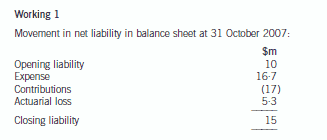

-
第15题:
16 Which of the following statements about accounting concepts and conventions are correct?
(1) The entity concept requires that a business is treated as being separate from its owners.
(2) The use of historical cost accounting tends to understate assets and profit when prices are rising.
(3) The prudence concept means that the lowest possible values should be applied to income and assets and the
highest possible values to expenses and liabilities.
(4) The money measurement concept means that only assets capable of being reliably measured in monetary terms
can be included in the balance sheet of a business.
A 1 and 2
B 2 and 3
C 3 and 4
D 1 and 4
正确答案:D
-
第16题:
22 Which of the following statements about limited liability companies’ accounting is/are correct?
1 A revaluation reserve arises when a non-current asset is sold at a profit.
2 The authorised share capital of a company is the maximum nominal value of shares and loan notes the company
may issue.
3 The notes to the financial statements must contain details of all adjusting events as defined in IAS10 Events after
the balance sheet date.
A All three statements
B 1 and 2 only
C 2 and 3 only
D None of the statements
正确答案:D
-
第17题:
12 Which of the following statements are correct?
(1) Contingent assets are included as assets in financial statements if it is probable that they will arise.
(2) Contingent liabilities must be provided for in financial statements if it is probable that they will arise.
(3) Details of all adjusting events after the balance sheet date must be given in notes to the financial statements.
(4) Material non-adjusting events are disclosed by note in the financial statements.
A 1 and 2
B 2 and 4
C 3 and 4
D 1 and 3
正确答案:B
-
第18题:
21 Which of the following items must be disclosed in a company’s published financial statements?
1 Authorised share capital
2 Movements in reserves
3 Finance costs
4 Movements in non-current assets
A 1, 2 and 3 only
B 1, 2 and 4 only
C 2, 3 and 4 only
D All four items
正确答案:D
-
第19题:
(b) A sale of industrial equipment to Deakin Co in May 2005 resulted in a loss on disposal of $0·3 million that has
been separately disclosed on the face of the income statement. The equipment cost $1·2 million when it was
purchased in April 1996 and was being depreciated on a straight-line basis over 20 years. (6 marks)
Required:
For each of the above issues:
(i) comment on the matters that you should consider; and
(ii) state the audit evidence that you should expect to find,
in undertaking your review of the audit working papers and financial statements of Keffler Co for the year ended
31 March 2006.
NOTE: The mark allocation is shown against each of the three issues.
正确答案:
(b) Sale of industrial equipment
(i) Matters
■ The industrial equipment was in use for nine years (from April 1996) and would have had a carrying value of
$660,000 at 31 March 2005 (11/20 × $1·2m – assuming nil residual value and a full year’s depreciation charge
in the year of acquisition and none in the year of disposal). Disposal proceeds were therefore only $360,000.
■ The $0·3m loss represents 15% of PBT (for the year to 31 March 2006) and is therefore material. The equipment
was material to the balance sheet at 31 March 2005 representing 2·6% of total assets ($0·66/$25·7 × 100).
■ Separate disclosure, of a material loss on disposal, on the face of the income statement is in accordance with
IAS 16 ‘Property, Plant and Equipment’. However, in accordance with IAS 1 ‘Presentation of Financial Statements’,
it should not be captioned in any way that might suggest that it is not part of normal operating activities (i.e. not
‘extraordinary’, ‘exceptional’, etc).
Tutorial note: However, note that if there is a prior period error to be accounted for (see later), there would be
no impact on the current period income statement requiring consideration of any disclosure.
■ The reason for the sale. For example, whether the equipment was:
– surplus to operating requirements (i.e. not being replaced); or
– being replaced with newer equipment (thereby contributing to the $8·1m increase (33·8 – 25·7) in total
assets).
■ The reason for the loss on sale. For example, whether:
– the sale was at an under-value (e.g. to a related party);
– the equipment had a bad maintenance history (or was otherwise impaired);
– the useful life of the equipment is less than 20 years;
– there is any deferred consideration not yet recorded;
– any non-cash disposal proceeds have been overlooked (e.g. if another asset was acquired in a part-exchange).
■ If the useful life was less than 20 years, tangible non-current assets may be materially overstated in respect of other
items of equipment that are still in use and being depreciated on the same basis.
■ If the sale was to a related party then additional disclosure should be required in a note to the financial statements
for the year to 31 March 2006 (IAS 24 ‘Related Party Disclosures’).
Tutorial note: Since there are no specific pointers to a related party transaction (RPT), this point is not expanded
on.
■ Whether the sale was identified in the prior year audit’s post balance sheet event review. If so:
– the disclosure made in the prior year’s financial statements (IAS 10 ‘Events After the Balance Sheet Date’);
– whether an impairment loss was recognised at 31 March 2005.
■ If not, and the equipment was impaired at 31 March 2005, a prior period error should be accounted for (IAS 8
‘Accounting Policies, Changes in Accounting Estimates and Errors’). An impairment loss of $0·3m would have
been material to prior year profit (12·5%).
Tutorial note: Unless this was a RPT or the impairment arose after 31 March 2005 a prior period adjustment
should be made.
■ Failure to account for a prior period error (if any) would result in modification of the audit opinion ‘except for’ noncompliance
with IAS 8 (in the current year) and IAS 36 (in the prior period).
(ii) Audit evidence
■ Carrying amount ($0·66m as above) agreed to the non-current asset register balances at 31 March 2005 and
recalculation of the loss on disposal.
■ Cost and accumulated depreciation removed from the asset register in the year to 31 March 2006.
■ Receipt of proceeds per cash book agreed to bank statement.
■ Sales invoice transferring title to Deakin.
■ A review of maintenance expenses and records (e.g. to confirm reason for loss on sale).
■ Post balance sheet event review on prior year audit working papers file.
■ Management representation confirming that Deakin is not a related party (provided that there is no evidence to
suggest otherwise). -
第20题:
(d) Wader has decided to close one of its overseas branches. A board meeting was held on 30 April 2007 when a
detailed formal plan was presented to the board. The plan was formalised and accepted at that meeting. Letters
were sent out to customers, suppliers and workers on 15 May 2007 and meetings were held prior to the year
end to determine the issues involved in the closure. The plan is to be implemented in June 2007. The company
wish to provide $8 million for the restructuring but are unsure as to whether this is permissible. Additionally there
was an issue raised at one of the meetings. The operations of the branch are to be moved to another country
from June 2007 but the operating lease on the present buildings of the branch is non-cancellable and runs for
another two years, until 31 May 2009. The annual rent of the buildings is $150,000 payable in arrears on
31 May and the lessor has offered to take a single payment of $270,000 on 31 May 2008 to settle the
outstanding amount owing and terminate the lease on that date. Wader has additionally obtained permission to
sublet the building at a rental of $100,000 per year, payable in advance on 1 June. The company needs advice
on how to treat the above under IAS37 ‘Provisions, Contingent Liabilities and Contingent Assets’. (7 marks)
Required:
Discuss the accounting treatments of the above items in the financial statements for the year ended 31 May
2007.
Note: a discount rate of 5% should be used where necessary. Candidates should show suitable calculations where
necessary.
正确答案:(d) A provision under IAS37 ‘Provisions, Contingent Liabilities and Contingent assets’ can only be made in relation to the entity’s
restructuring plans where there is both a detailed formal plan in place and the plans have been announced to those affected.
The plan should identify areas of the business affected, the impact on employees and the likely cost of the restructuring and
the timescale for implementation. There should be a short timescale between communicating the plan and starting to
implement it. A provision should not be recognised until a plan is formalised.
A decision to restructure before the balance sheet date is not sufficient in itself for a provision to be recognised. A formal plan
should be announced prior to the balance sheet date. A constructive obligation should have arisen. It arises where there has
been a detailed formal plan and this has raised a valid expectation in the minds of those affected. The provision should only
include direct expenditure arising from the restructuring. Such amounts do not include costs associated with ongoing business
operations. Costs of retraining staff or relocating continuing staff or marketing or investment in new systems and distribution
networks, are excluded. It seems as though in this case a constructive obligation has arisen as there have been detailed formal
plans approved and communicated thus raising valid expectations. The provision can be allowed subject to the exclusion of
the costs outlined above.
Although executory contracts are outside IAS37, it is permissible to recognise a provision that is onerous. Onerous contracts
can result from restructuring plans or on a stand alone basis. A provision should be made for the best estimate of the excess
unavoidable costs under the onerous contract. This estimate should assess any likely level of future income from new sources.
Thus in this case, the rental income from sub-letting the building should be taken into account. The provision should be
-
第21题:
Banks in international lending face the risks common to all banks: liquidity risk, interest rate risk, credit (asset) risk, and contingent liabilities risk.
A.Right
B.Wrong
C.Doesn't say
正确答案:C
解析:文章通篇提及银行面临的三类风险,并加以举例,并没有提及Banks in international lending。 -
第22题:
以表现为条件的奖励(performance-contingent rewards)
正确答案:是指根据表现好坏所给予的奖励。 -
第23题:
名词解释题以任务为条件的奖励(task-contingent rewards)正确答案: 是指根据执行任务与否而非表现好坏所给予的奖励。解析: 暂无解析