
(b) How might the marketing mix vary between the three channels Helen is considering using? (8 marks)
题目
(b) How might the marketing mix vary between the three channels Helen is considering using? (8 marks)
相似考题
参考答案和解析
(b) The analysis of each of the market entry strategies has begun the process of identifying how the marketing mix of product,
price, place and promotion will vary significantly between the three outlets.
Product – here the nature of the product in terms of recipes and product range can be varied reasonably easily to meet the
demands of the outlet.
Price – again this will vary in significance between the three outlets with the greatest pressure coming from the supermarkets
and catering wholesalers. Margins may come under pressure with the supermarkets looking for a contribution to sales
promotions.
Promotion – here the issue of brand development is a crucial factor. Using her own brand, Helen can develop the product
range and extend the outlets she sells through.

更多“(b) How might the marketing mix vary between the three channels Helen is considering using? (8 marks)”相关问题
-
第1题:
(b) Explain how Perfect Shopper might re-structure its upstream supply chain to address the problems identified
in the scenario. (10 marks)
正确答案:
(b) Perfect Shopper currently has a relatively short upstream supply chain. They are bulk purchasers from established suppliers
of branded goods. Their main strength at the moment is to offer these branded goods at discounted prices to neighbourhood
shops that would normally have to pay premium prices for these goods.
In the upstream supply chain, the issue of branding is a significant one. At present, Perfect Shopper only provides branded
goods from established names to its customers. As far as the suppliers are concerned, Perfect Shopper is the customer and
the company’s regional warehouses are supplied as if they were the warehouses of conventional supermarkets. Perfect
Shopper might look at the following restructuring opportunities within this context:
– Examining the arrangements for the delivery of products from suppliers to the regional warehouses. At present this is in
the hands of the suppliers or contractors appointed by suppliers. It appears that when Perfect Shopper was established
it decided not to contract its own distribution. This must now be open to review. It is likely that competitors have
established contractual arrangements with logistics companies to collect products from suppliers. Perfect Shopper must
examine this, accompanied by an investigation into downstream distribution. A significant distribution contract would
probably include the branding of lorries and vans and this would provide an opportunity to increase brand visibility and
so tackle this issue at the same time.
– Contracting the supply and distribution of goods also offers other opportunities. Many integrated logistics contractors also
supply storage and warehousing solutions and it would be useful for Perfect Shopper to evaluate the costs of these.
Essentially, distribution, warehousing and packaging could be outsourced to an integrated logistics company and Perfect
Shopper could re-position itself as a primarily sales and marketing operation.
– Finally, Perfect Shopper must review how it communicates orders and ordering requirements with its suppliers. Their
reliance on supplier deliveries suggests that the relationship is a relatively straightforward one. There may be
opportunities for sharing information and allowing suppliers access to forecasted demand. There are many examples
where organisations have allowed suppliers access to their information to reduce costs and to improve the efficiency of
the supply chain as a whole.
The suggestions listed above assume that Perfect Shopper continues to only supply branded goods. Moving further upstream
in the supply chain potentially moves the company into the manufacture and supply of goods. This will raise a number of
significant issues about the franchise itself.
At present Perfect Shopper has, by necessity, concentrated on branded goods. It has not really had to understand how these
goods sell in specific locations because it has not been able to offer alternatives. The content of the standing order reflects
how the neighbourhood shop wishes to compete in its locality. However, if Perfect Shopper decides to commission its own
brand then the breadth of products is increased. Neighbourhood shops would be able to offer ‘own brand’ products to compete
with supermarkets who also focus on own brand products. It would also increase the visibility of the brand. However, Perfect
Shopper must be sure that this approach is appropriate as a whole. It could easily produce an own brand that reduces the
overall image of the company and hence devalues the franchise. Much more research is needed to assess the viability ofproducing ‘own brand’ goods. -
第2题:
(b) Using relevant evaluation criteria, assess how achievable and compatible these three strategic goals are over
the next five years. (20 marks)
正确答案:
(b) The three strategic goals are to become the leading premium ice cream brand in the UK; to increase sales to £25 million;
and to achieve a significant entry into the supermarket sector. On the basis of performance to date these goals will certainly
be stretching. All three strategies will involve significant growth in the company. Johnson and Scholes list three success criteria
against which the strategies can be assessed, namely suitability, acceptability and feasibility. Suitability is a test of whether a
strategy addresses the situation in which a company is operating. In Johnson and Scholes’ terms it is the firm’s ‘strategic
position’, an understanding of which comes from the analysis done in the answer to the question above. Acceptability is
concerned with the likely performance outcomes of the strategy and in particular whether the return and risk are in line with
the expectations of the stakeholders. Feasibility is the extent to which the strategy can be made to work and is determined
by the strategic capability of the company reflecting the resources available to implement the strategy. It is interesting to see
that the three growth related goals are compatible in that becoming the leading premium brand will involve increased market
penetration, product development and market development. If achieved it will increase sales and necessitate a successful
entry into the supermarket sector. Time will be an important influence on the success or otherwise of these growth goals –
five years seems to be a reasonable length of time to achieve these ambitious targets.
Suitability – Churchill is currently a small but significant player at the premium end of the market. This segment is becoming
more significant and is attractive because of the high prices and high margins attainable. This is leading to more intense
competition with global companies. One immediate question that springs to mind is what precisely does ‘leading brand’
mean? The most obvious test is that of market share and unless Churchill achieve the access to the supermarkets looked for
in the third strategic goal, seems difficult to achieve. If ‘leading brand’ implies brand recognition this again looks very
ambitious. On the positive side this segment of the ice cream market is showing significant growth and Churchill’s success
in gaining sponsorship rights to major sporting events is a step in the right direction. The combination of high price and high
quality should position the company where it wants to be. Achieving sales of £25 million represents a quantum shift in
performance in a company that has to date only achieved modest levels of sales growth.
Acceptability – as a family owned business the balance between risk and return is an important one. The family to date has
been ‘happy’ with a modest rate of growth and modest return in terms of profits. The other significant stakeholder group is
the professional managers headed up by Richard Smith. They seem much more growth orientated and may be happier with
the risks that the growth strategy entails. The family members seem more interested in the manufacturing side than the
retailing side of the business and their bad previous experiences with growing the business through international market
development may mean they are risk averse and less willing to invest the necessary resources.
Feasibility – again this is linked to how ‘leading brand’ is defined. If as seems likely the brand becomes more widely known
through increasing the number of company owned ice cream stores then a significant investment in retail outlets will be
necessary. Increasing the number of franchised outlets will reduce the financial resources required but may be at the expense
of the brand’s reputation. Certainly there would seem to be a need for increased levels of advertising and promotion –
particularly to gain access to the ice cream cabinets in the supermarket chains. This is likely to mean an increase in the
number of sales and marketing staff. Equally important will be the ability to develop and launch new products in a luxury
market shaped by impulse buying and customers looking to indulge themselves.
Overall, becoming the leading brand of premium ice cream may well be the key to achieving the desired presence in the
supermarket ice cream cabinets, which in turn is a pre-requisite for increasing company sales to £25 million. So the three
strategic goals may be regarded as consistent and compatible with one another. However each strategic goal will have to be
broken down into its key elements. For example in achieving sales of £25 million what proportion of sales will come from its
own ice cream stores and what proportion from other outlets including the supermarkets? Sales to date of Churchill ice cream
are dominated by impulse purchases but in achieving sales of £25 million penetrating the take home market will be essential.
Finally, what proportion of these take home sales will be under the supermarkets own label brands? Over reliance on own
label sales will seriously weaken Churchill’s desire to become the leading national brand of premium ice cream. It looks to
be an ambitious but attainable strategy but will require a significant planning effort to develop the necessary resources andcapabilities vital to successful implementation of the strategy. -
第3题:
(b) Explain how the process of developing scenarios might help John better understand the macro-environmental
factors influencing Airtite’s future strategy. (8 marks)
正确答案:(b) Carrying out a systematic PESTEL analysis is a key step in developing alternative scenarios about the future. Johnson and
Scholes define scenarios as ‘detailed and plausible views of how the business environment of an organisation might develop
in the future based on groupings of key environmental influences and drivers of change about which there is a high level of
uncertainty’. In developing scenarios it is necessary to isolate the key drivers of change, which have the potential to have a
significant impact on the company and are associated with high levels of uncertainty. Development of scenarios enables
managers to share assumptions about the future and the key variables shaping that future. This provides an opportunity for
real organisational learning. They are then in a position to monitor these key variables and amend strategies accordingly. It
is important to note that different stakeholder groups will have different expectations about the future and each may provide
a key input to the process of developing scenarios. By their very nature scenarios should not attempt to allocate probabilities
to the key factors and in so doing creating ‘spurious accuracy’ about those factors. A positive scenario is shown below and
should provide a shared insight into the external factors most likely to have a significant impact on Airtite‘s future strategy.
For most companies operating in global environments the ability to respond flexibly and quickly to macro-environmental
change would seem to be a key capability.
The scenario as illustrated below, clearly could have a major impact on the success or otherwise of Airtite’s strategy for the
future. The key drivers for change would seem to be the link between technology and global emissions, fuel prices and the
stability of the global political environment. Through creating a process which considers the drivers which will have most
impact on Airtite and which are subject to the greatest uncertainty, Airtite will have a greater chance of its strategy adaptingto changing circumstances.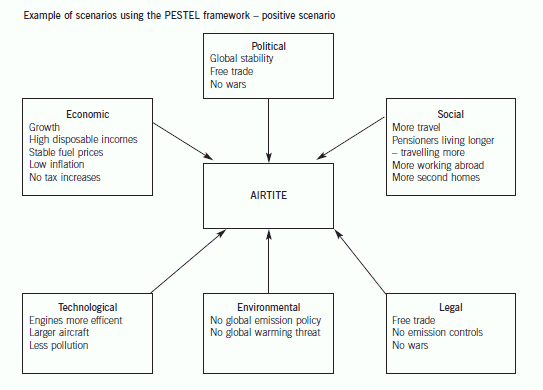
-
第4题:
(c) Critically evaluate Vincent Viola’s view that corporate governance provisions should vary by country.
(8 marks)
正确答案:
(c) Corporate governance provisions varying by country
There is a debate about the extent to which corporate governance provisions (in the form. of either written codes, laws or
general acceptances) should be global or whether they should vary to account for local differences. In this answer, Vincent
Viola’s view is critically evaluated.
In general terms, corporate governance provisions vary depending on such factors as local business culture, businesses’
capital structures, the extent of development of capital funding of businesses and the openness of stock markets. In Germany,
for example, companies have traditionally drawn much of their funding from banks thereby reducing their dependence on
shareholders’ equity. Stock markets in the Soviet Union are less open and less liquid than those in the West. In many
developing countries, business activity is concentrated among family-owned enterprises.
Against Vincent’s view
Although business cultures vary around the world, all business financed by private capital have private shareholders. Any
dilution of the robustness of provisions may ignore the needs of local investors to have their interests adequately represented.
This dilution, in turn, may allow bad practice, when present, to exist and proliferate.
Some countries suffer from a poor reputation in terms of endemic corruption and fraud and any reduction in the rigour with
which corporate governance provisions are implemented fail to address these shortcomings, notwithstanding the fact that they
might be culturally unexpected or difficult to implement.
In terms of the effects of macroeconomic systems, Vincent’s views ignore the need for sound governance systems to underpin
confidence in economic systems. This is especially important when inward investment needs are considered as the economic
wealth of affected countries are partly underpinned by the robustness, or not, of their corporate governance systems.
Supporting Vincent’s view
In favour of Vincent’s view are a number of arguments. Where local economies are driven more by small family businesses
and less by public companies, accountability relationships are quite different (perhaps the ‘family reasons’ referred to in the
case) and require a different type of accounting and governance.
There is a high compliance and monitoring cost to highly structured governance regimes that some developing countries may
deem unnecessary to incur.
There is, to some extent, a link between the stage of economic development and the adoption of formal governance codes.
It is generally accepted that developing countries need not necessarily observe the same levels of formality in governance as
more mature, developed economies.
Some countries’ governments may feel that they can use the laxity of their corporate governance regimes as a source of
international comparative advantage. In a ‘race to the bottom’, some international companies seeking to minimise the effects
of structured governance regimes on some parts of their operations may seek countries with less tight structures for some
operations.
-
第5题:
(c) Using information from the case, assess THREE risks to the Giant Dam Project. (9 marks)
正确答案:
(c) Assessment of three risks
Disruption and resistance by Stop-the-dam. Stop-the-dam seems very determined to delay and disrupt progress as much as
possible. The impact of its activity can be seen on two levels. It is likely that the tunnelling and other ‘human’ disruption will
cause a short-term delay but the more significant impact is that of exposing the lenders. In terms of probability, the case says
that it ‘would definitely be attempting to resist the Giant Dam Project when it started’ but the probability of exposing the
lenders is a much lower probability event if the syndicate membership is not disclosed.
Impact/hazard: low
Probability/likelihood: high
The risk to progress offered by First Nation can probably be considered to be low impact/hazard but high probability. The case
says that it ‘would be unlikely to disrupt the building of the dam’, meaning low impact/hazard, but that ‘it was highly likely
that they would protest’, meaning a high level of probability that the risk event would occur.
Impact: low
Probability: high
There are financing risks as banks seems to be hesitant when it comes to lending to R&M for the project. Such a risk event,
if realised, would have a high potential for disruption to progress as it may leave R&M with working capital financing
difficulties. The impact would be high because the bank may refuse to grant or extend loans if exposed (subject to existing
contractual terms). It is difficult to estimate the probability. Perhaps there will be a range of attitudes by the lending banks
with some more reticent than others (perhaps making it a ‘medium’ probability event).
Impact: medium to high (depending on the reaction of the bank)
Probability: low to medium (depending on how easy it would be to discover the lender) -
第6题:
(c) Identify TWO QUALITATIVE benefits that might arise as a consequence of the investment in a new IT system
and explain how you would attempt to assess them. (4 marks)
正确答案:
(c) One of the main qualitative benefits that may arise from an investment in a new IT system by Moffat Ltd is the improved level
of service to its customers in the form. of reduced waiting times which may arise as a consequence of better scheduling of
appointments, inventory management etc. This could be assessed via the introduction of a questionnaire requiring customers
to rate the service that they have received from their recent visit to a location within Moffat Ltd according to specific criteria
such as adherence to appointment times, time taken to service the vehicle, cleanliness of the vehicle, attitude of staff etc.
Alternatively a follow-up telephone call from a centralised customer services department may be made by Moffat Ltd
personnel in order to gather such information.
Another qualitative benefit of the proposed investment may arise in the form. of competitive advantage. Improvements in
customer specific information and service levels may give Moffat Ltd a competitive advantage. Likewise, improved inventory
management may enable costs to be reduced thereby enabling a ‘win-win’ relationship to be enjoyed with its customers. -
第7题:
(b) Explain how the adoption of residual income (RI) using the annuity method of depreciation might prove to
be a superior basis for the management incentive plan operated by NCL plc.
(N.B. No illustrative calculations should be incorporated into your explanation). (4 marks)
正确答案:
(b) The use of residual income as a basis for the management incentive plan operated by NCL plc would have the following
advantages:
Divisional management would be more willing to accept a project with a positive residual income and this would contribute
to the improved performance of NCL plc. Also, the disincentive to accept a project with a positive residual income but a return
on investment regarded by divisional management as not being in their best interests would be removed, because divisional
management would be rewarded.
The use of annuity depreciation may improve performance appraisal by removing the effect of straight-line depreciation which
tends to distort project returns especially in the early years of a project’s life when invested capital remains relatively high due
to the constant depreciation charge. The residual income approach using annuity depreciation will only match the NPV if the
annual cashflows of a project are constant. Hence the method when applied to the North or South projects would produce
an NPV which does not exactly match that previously calculated. By way of contrast it is forecast that the East project will
have constant cashflows and in this instance the NPV and residual income based approach when discounted, will produce
the same result. -
第8题:
(c) Briefly discuss why the directors of HFL might choose contract D irrespective of whether or not contract D
would have been selected using expected values as per part (a). (2 marks)
正确答案:
(c) The directors might select Contract D under which 360,000 kilograms of organic mushrooms would be supplied to HFL for
each outlet. This is the entire capacity of HFL which would ensure that competitors would not be able to supply the same
product and hence the competitive advantage held by HFL might be preserved. -
第9题:
(b) Illustrate how you might use analytical procedures to provide audit evidence and reduce the level of detailed
substantive procedures. (7 marks)
正确答案:
(b) Illustration of use of analytical procedures as audit evidence
Tutorial note: Note that ‘as audit evidence’ requires consideration of substantive analytical procedures rather that the
identification of risks (relevant to part (a)).
Revenue
Analytical procedures may be used in testing revenue for completeness of recording (‘understatement’). The average selling
price of a vehicle in 2005 was $68,830 ($526·0 million ÷ 7,642 vehicles). Applying this to the number of vehicles sold
in 2006, might be projected to generate $698·8 million ($68,830 × 10,153) revenue from the sale of vehicles. The draft
financial statements therefore show a potential shortfall of $110·8 million ($(698·8 – 588·0) million) that is, 15·6%.
This should be investigated and substantiated through more detailed analytical procedures. For example, the number of
vehicles sold should be analysed into models and multiplied by the list price of each for a more accurate estimate of potential
revenue. The impact of discounts and other incentives (e.g. 0% finance) on the list prices should then be allowed for. If
recorded revenue for 2006 (as per draft income statement adjusted for cutoff and consignment inventories) is materially lower
than that calculated, detailed substantive procedures may be required in order to show that there is no material error.
‘Proof in total’/reasonableness tests
The material correctness, or otherwise, of income statement items (in particular) may be assessed through appropriate ‘proof
in total’ calculations (or ‘reasonableness’ tests). For example:
■ Employee benefits costs: the average number of employees by category (waged/salaried/apprenticed) × the average pay
rate for each might prove that in total $91·0 million (as adjusted to actual at 31 December 2006) is not materially
misstated. The average number of employees needs to be checked substantively (e.g. recalculated based on the number
of employees on each payroll) and the average pay rates (e.g. to rates agreed with employee representatives).
Tutorial note: An alternative reasonableness might be to take last year’s actual adjusted for 2006 numbers of
employees grossed-up for any pay increases during the year (pro-rated as necessary).
■ Depreciation: the cost (or net book value) of each category of asset × by the relevant straight-line (or reducing balance)
depreciation rate. If a ‘ballpark’ calculation for the year is materially different to the annual charge a more detailed
calculation can be made using monthly depreciation calculations. The cost (or net book value) on which depreciation
is calculated should be substantively tested, for example by agreeing brought forward balances to prior year working
papers and additions to purchase invoices (costings in respect of assets under construction).
Tutorial note: Alternatively, last year’s depreciation charge may be reconciled to this year’s by considering depreciation
rates applied to brought forward balances with adjustments for additions/disposals.
■ Interest income: an average interest rate for the year can be applied to the monthly balance invested (e.g. in deposit
accounts) and compared with the amount recognised for the year to 31 December 2006 (as adjusted for any accrued
interest per the bank letter for audit purposes). The monthly balances (or averages) on which the calculation is
performed should be substantiated to bank deposit statements.
■ Interest expense: if the cash balances do not go into overdraft then this may be similar expenses (e.g. prompt payment
discounts to customers). If this is to particular dealers then a proof in total might be to apply the discount rate to the
amounts invoiced to the dealer during the period.
Immaterial items
For immaterial items analytical procedures alone may provide sufficient audit evidence that amounts in the financial
statements are not materially misstated so that detailed substantive procedures are not required. For example, a comparison
of administration and distribution, maintenance and insurance costs for 2006 compared with 2005 may be sufficient to show
that material error is highly unlikely. If necessary, further reasonableness tests could be performed. For example, considering
insurance costs to value of assets insured or maintenance costs to costs of assets maintained.
Ratio analysis
Ratio analysis can provide substantive evidence that income statement and balance sheet items are not materially misstated
by considering their inter-relationships. For example:
■ Asset turnover: Based on the draft financial statements property, plant and equipment has turned over 5·2 times
($645·5/124·5) compared with 5·9 times in 2005. This again highlights that income may be overstated, or assets
overstated (e.g. if depreciation is understated).
■ Inventory turnover: Using cost of materials adjusted for changes in inventories this has remained stable at 10·9 times.
Tutorial note: This is to be expected as in (a) the cost in the income statement has increased by 9% and the value of
inventories by 8·5%.
Inventories represent the smallest asset value on the balance sheet at 31 December 2006 (7·8% of total assets).
Therefore substantive procedures may be limited to agreeing physical count of material items (vehicles) and agreeing
cutoff.
■ Average collection period: This has increased to 41 days (73·1/645·5 × 365) from 30 days. Further substantive analysis
is required, for example, separating out non-current amounts (for sales on 0% finance terms). Substantive procedures
may be limited to confirmation of amounts due from dealers (and/or receipt of after-date cash) and agreeing cutoff of
goods on consignment.
■ Payment periods: This has remained constant at 37 days (2005 – 38 days). Detailed substantive procedures may be
restricted to reconciling only major suppliers’ statements and agreeing the cutoff on parts purchased from them. -
第10题:
How is NIC teaming configured when port channels are not in use in a Cisco Nexus 1000V?()
- A、active / active using spanning tree
- B、active / active
- C、active / passive using spanning tree
- D、active / passive
正确答案:D -
第11题:
Which three resources might be prioritized between competing pluggable databases when creating amultitenant container database plan (CDB plan) using Oracle Database Resource Manager?()
- A、Maximum Undo per consumer group
- B、Maximum Idle time
- C、Parallel server limit
- D、CPU
- E、Exadata I/O
- F、Local file system I/O
正确答案:C,D,F -
第12题:
单选题The author mentions “trousers” in paragraph 1 most likely in order to _____.Amake a comparison between the program target and the program audience
Bemphasize the similarities between the market segment and the program target
Cprovide an example of the way three groups of consumers are affected by a marketing program
Dclarify the distinction between the market segment and the program target
正确答案: D解析:
“Lots of people may need trousers,”指的是“market segment”;“a few qualify as likely buyers of very expensive designer trousers.”指的是“program target”。 -
第13题:
(c) Explain how Perfect Shopper might re-structure its downstream supply chain to address the problems
identified in the scenario. (10 marks)
正确答案:
(c) A number of opportunities appear to exist in the downstream supply chain.
As already mentioned above, Perfect Shopper can revisit its contract distribution arrangements. At present, distribution to
neighbourhood shops is in the hands of locally appointed contract distributors. As already suggested, it may be possible to
contract one integrated logistics company to carry out both inbound and outbound logistics, so gaining economies of scale
and opportunities for branding.
One of the problems identified in the independent report was the inflexibility of the ordering and delivering system. The
ordering system appears to be built around a fixed standard delivery made every two weeks, agreed in advance for a three
month period. Variations can be made to this standard order, but only increases – not decreases. Presumably, this
arrangement is required to allow Perfect Shopper to forecast demand over a three month period and to place bulk orders to
reflect these commitments. However, this may cause at least two problems. The first is that participating shops place a
relatively low standard order and rely on variations to fulfil demand. This causes problems for Perfect Shopper. Secondly, any
unpredictable fall in demand during the three month period leads to the shop having storage problems and unsold stock. This
potentially creates problems for the shop owner, who may also begin to question the value of the franchise. Hence Perfect
Shopper might wish to consider a much more flexible system where orders can be made to match demand and deliveries
can be made as required. This would also remove the requirement for a three monthly meeting between the franchisee andthe sales representative from Perfect Shopper. Investments in IT systems will be required to support this, with participating
shops placing orders over the Internet to reflect their requirements. This move towards a more flexible purchasing arrangement
may also make the outsourcing of warehousing and distribution even more appealing.
Perfect Shopper may also wish to investigate whether they can also provide value added services to customers, which not
only simplify the ordering system but also allow the shop managers to better understand their customers and fulfil their
requirements. The supply chain may legitimately include the customer’s customers, particularly for franchisers. This is already
acknowledged because Perfect Shopper produces tailored marketing material aimed at the end-consumer. Point of Sales (PoS)
devices feeding information back to Perfect Shopper would allow sales information to be analysed and fed back to the
shopkeeper as well as allowing automatic replenishment based on purchasing trends. However, this may be culturally difficult
for independent neighbourhood shopkeepers to accept. Furthermore, it would potentially include information outside the
products offered by Perfect Shopper and the implications of this would have to be considered. However, a whole shop sales
analysis might be a useful service to offer existing and potential franchisees.
Customers are increasingly willing to order products over the Internet. It seems unlikely that individual shopkeepers would be
able to establish and maintain their own Internet-based service. It would be useful for Perfect Shopper to explore the potential
of establishing a central website with customers placing orders from local shops. Again there are issues about scope, because
Perfect Shopper does not offer a whole-shop service. However, Michael de Kare-Silver has identified groceries as a product
area that has good potential for Internet purchase. In his electronic shopping potential test any product scoring over 20 hasgood potential. Groceries scored 27. -
第14题:
(c) What changes to Churchill’s existing marketing mix will be needed to achieve the three strategic goals?
(15 marks)
正确答案:
(c) Each of the strategic goals will have a profound impact on the marketing mix as it currently exists. As each goal affects the
market position of Churchill developing an appropriate marketing mix will be the key to successful implementation of the
overall growth strategy. The product, the brand and the reputation it creates are at the heart of the company’s marketing
strategy. Their focus on the premium segment of the market seems a sensible one and one which allows a small family-owned
business to survive and grow slowly. Evidence suggests this is a luxury indulgence market reflecting changing consumer tastes
and lifestyles. Managing the product range will be a major marketing activity. While the core products may develop an almost
timeless quality there will be a need to respond to the product innovations introduced by its much larger competitors. The
company’s emphasis on the quality of its products resulting from the quality of its ingredients is at the heart of its competitive
advantage. Growing the product range will also bring the danger of under performing products and a consequent need to
divest such products. Packaging is likely to be a key part of the products’ appeal and will be an area where constant innovation
is important.
Pricing raises a number of issues. Why is Churchill’s core product priced at £1 less than its immediate competition? What is
the basis on which Churchill prices this product? Each of the methods of pricing has its advantages and disadvantages. Using
cost plus may create an illusion of security in that all costs are covered, but at the same time raises issues as to whether
relevant costs have been included and allocated. Should the company price in anticipation of cost reductions as volume
increases? Should the basis for pricing be what your competitors are charging? As a luxury product one would assume that
its demand is relatively price inelastic: a significant increase in price e.g. £1 would lead to only a small reduction in quantity
demanded. Certainly, profit margins would be enhanced to help provide the financial resources the company needs if it is to
grow. One interesting issue on pricing is the extent to which it is pursuing a price skimming or price penetration policy –
evidence from the scenario suggests more of a price skimming policy in line with the luxury nature of the product.
Place is an equally important issue – the vertical integration strategy of the company has led to company-owned shops being
the main way customers can buy the product. At the same time, this distribution strategy has led to Churchill’s sales being
largely confined to one region in the UK – although it is the most populous. If Churchill has a desire to grow, does it do this
through expanding the number of company owned and franchised outlets or look for other channels of distribution in
particular the increasingly dominant supermarket chains? Each distribution strategy will have significant implications for other
elements in the marketing mix and for the resources and capabilities required in the company.
Finally, promotion is an interesting issue for the company. The relatively recent appointment of a sales and marketing director
perhaps reflects a need to balance the previous dominance of the manufacturing side of the business. Certainly there is
evidence to suggest that John Churchill is not convinced of the need to advertise. There are some real concerns about how
the brand is developed and promoted. Certainly sponsorship is now seen as a key part of the firm’s promotional strategy. The
company has a good reputation but customer access to the product is fairly limited. Overall there is scope for the company
to critically review its marketing mix and implement a very different mix if it wants to grow.
The four Ps above are very much the ‘hard’ elements in the marketing mix and Churchill in its desire to grow will need toensure that the ‘softer’ elements of people, physical evidence and processes are aligned to its ambitious strategy. -
第15题:
(b) What advantages and disadvantages might result from outsourcing Global Imaging’s HR function?
(8 marks)
正确答案:
(b) It is important to note that there is nothing in the nature of the activities carried out by HR staff and departments that prevents
outsourcing being looked at as a serious option. Indeed, amongst larger companies the outsourcing of some parts of the HR
function is already well under way, with one source estimating that HR outsourcing is growing by 27% each year. Paul,
therefore, needs to look at the HR activities identified above and assess the advantages and disadvantages of outsourcing a
particular HR activity. Outsourcing certain parts of the recruitment process has long been accepted, with professional
recruitment agencies and ‘head-hunters’ being heavily involved in the advertising and short listing of candidates for senior
management positions. Some HR specialists argue that outsourcing much of the routine personnel work, including
maintaining employees’ records, frees the HR specialist to make a real contribution to the strategic planning process. One
study argues that ‘HR should become a partner with senior and line managers in strategy execution’.
If Paul is able to outsource the routine HR activities this will free him to contribute to the development of the growth strategy
and the critical people needs that strategy will require. In many ways the HR specialist is in a unique position to assess current
skills and capabilities of existing staff and the extent to which these can be ‘leveraged’ to achieve the desired strategy. In
Hamel and Prahalad’s terms this strategy is likely to ‘stretch’ the people resources of the company and require the recruitment
of additional staff with the relevant capabilities. Paul needs to show how long it will take to develop the necessary staff
resources as this will significantly influence the time needed to achieve the growth strategy.
Outsourcing passes on to the provider the heavy investment needed if the company sets up its own internal HR services with
much of this investment now going into web-based systems. The benefits are reduced costs and improved service quality.
The downside is a perceived loss of control and a reduced ability to differentiate the HR function from that of competitors.
Issues of employee confidentiality are also relevant in the decision to outsource.
-
第16题:
(b) Using the TARA framework, construct four possible strategies for managing the risk presented by Product 2.
Your answer should describe each strategy and explain how each might be applied in the case.
(10 marks)
正确答案:
(b) Risk management strategies and Chen Products
Risk transference strategy
This would involve the company accepting a portion of the risk and seeking to transfer a part to a third party. Although an
unlikely possibility given the state of existing claims, insurance against future claims would serve to limit Chen’s potential
losses and place a limit on its losses. Outsourcing manufacture may be a way of transferring risk if the ourtsourcee can be
persuaded to accept some of the product liability.
Risk avoidance strategy
An avoidance strategy involves discontinuing the activity that is exposing the company to risk. In the case of Chen this would
involve ceasing production of Product 2. This would be pursued if the impact (hazard) and probability of incurring an
acceptable level of liability were both considered to be unacceptably high and there were no options for transference or
reduction.
Risk reduction strategy
A risk reduction strategy involves seeking to retain a component of the risk (in order to enjoy the return assumed to be
associated with that risk) but to reduce it and thereby limit its ability to create liability. Chen produces four products and it
could reconfigure its production capacity to produce proportionately more of Products 1, 3 and 4 and proportionately less of
Product 2. This would reduce Product 2 in the overall portfolio and therefore Chen’s exposure to its risks. This would need
to be associated with instructions to other departments (e.g. sales and marketing) to similarly reconfigure activities to sell
more of the other products and less of Product 2.
Risk acceptance strategy
A risk acceptance strategy involves taking limited or no action to reduce the exposure to risk and would be taken if the returns
expected from bearing the risk were expected to be greater than the potential liabilities. The case mentions that Product 2 is
highly profitable and it may be that the returns attainable by maintaining and even increasing Product 2’s sales are worth the
liabilities incurred by compensation claims. This is a risk acceptance strategy. -
第17题:
(b) Identify and explain THREE approaches that the directors of Moffat Ltd might apply in assessing the
QUALITATIVE benefits of the proposed investment in a new IT system. (6 marks)
正确答案:
(b) One approach that the directors of Moffat Ltd could adopt would be to ignore the qualitative benefits that may arise on the
basis that there is too much subjectivity involved in their assessment. The problem that this causes is that the investment will
probably look unattractive since all costs will be included in the evaluation whereas significant benefits and savings will have
been ignored. Hence such an approach is lacking in substance and is not recommended.
An alternative approach would involve attempting to attribute values to each of the identified benefits that are qualitative in
nature. Such an approach will necessitate the use of management estimates in order to derive the cash flows to be
incorporated in a cost benefit analysis. The problems inherent in this approach include gaining consensus among interested
parties regarding the footing of the assumptions from which estimated cash flows have been derived. Furthermore, if the
proposed investment does take place then it may well be impossible to prove that the claimed benefits of the new system
have actually been realised.
Perhaps the preferred approach is to acknowledge the existence of qualitative benefits and attempt to assess them in a
reasonable manner acceptable to all parties including the company’s bank. The financial evaluation would then not only
incorporate ‘hard’ facts relating to costs and benefits that are quantitative in nature, but also would include details of
qualitative benefits which management consider exist but have not attempted to assess in financial terms. Such benefits might
include, for example, the average time saved by location managers in analysing information during each operating period.
Alternatively the management of Moffat Ltd could attempt to express qualitative benefits in specific terms linked to a hierarchy
of organisational requirements. For example, qualitative benefits could be categorised as being:
(1) Essential to the business
(2) Very useful attributes
(3) Desirable, but not essential
(4) Possible, if funding is available
(5) Doubtful and difficult to justify. -
第18题:
(ii) Explain THREE strategies that might be adopted in order to improve the future prospects of Diverse
Holdings Plc. (6 marks)
正确答案:
(ii) The forecast situation of Diverse Holdings Plc is not without its problems. KAL and OPL require the immediate attention
of management. The position of KAL is precarious to say the least. There is a choice of strategies for it:
(i) Outsource the manufacture of appliances
(ii) Set up a manufacturing operation overseas
(ii) Withdraw from the market.
Each alternative must be assessed. Whatever decision is taken it is unlikely to affect the other four subsidiaries.
PSL is also independent of the other subsidiaries. A strategic decision to widen its range of products and outlets must
surely help. Hence management should endeavour to find new markets for its products, which are separate and distinct
from those markets served by its appointed distributors.
21
In order to improve the prospects of OPL management need to adopt appropriate strategies since at the present time the
company appears to be in a high growth market but is unable to capture a reasonable market share. Perhaps the answer
lies in increased or more effective advertising of the endorsement of the product range by health and safety experts.
Management should endeavour to develop a strategy to integrate further its subsidiaries so that they can benefit from
each other and also derive as much synergy as possible from the acquisition of HTL.
It is of paramount importance that management ensure that sufficient funds are channelled into growing OFL and HTL,
which are both showing a rising trend in profitability. The group has depleted cash reserves which must to some extent
be attributable to the purchase of HTL. It is possible that the divestment of KAL would provide some much needed
funding. -
第19题:
(ii) Comment briefly on how divisional managers might respond to the results achieved and ONE potential
problem that might be experienced by Our Timbers Ltd. (2 marks)
正确答案: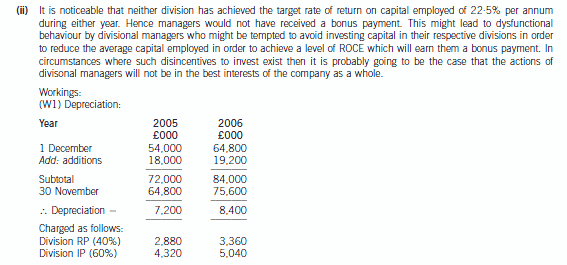
-
第20题:
(ii) Briefly discuss THREE disadvantages of using EVA? in the measurement of financial performance.
(3 marks)
正确答案:
(ii) Disadvantages of an EVA approach to the measurement of financial performance include:
(i) The calculation of EVA may be complicated due to the number of adjustments required.
(ii) It is difficult to use EVA for inter-firm and inter-divisional comparisons because it is not a ratio measure.
(iii) Economic depreciation is difficult to estimate and conflicts with generally accepted accounting principles.
Note: Other relevant discussion would be acceptable. -
第21题:
Which three resources might be prioritized between competing pluggable databases when creating amultitenant container database plan (CDB plan) using Oracle Database Resource Manager?()A. Maximum Undo per consumer group
B. Maximum Idle time
C. Parallel server limit
D. CPU
E. Exadata I/O
F. Local file system I/O
参考答案:C, D, F
-
第22题:
What feature comes into play to help ensure the completion of the backup should one of three backup devices fail during a backup that is using three different channels?()
- A、Channel failover
- B、Restartable backups
- C、Rescheduable backups
- D、Automatic backup recovery
- E、Channel recovery
正确答案:A -
第23题:
单选题What feature comes into play to help ensure the completion of the backup should one of three backup devices fail during a backup that is using three different channels?()AChannel failover
BRestartable backups
CRescheduable backups
DAutomatic backup recovery
EChannel recovery
正确答案: E解析: 暂无解析